10 Advanced Knowledge Management Strategies for 2025
Discover 10 powerful knowledge management strategies to streamline workflows. Learn to capture, share, and retain information with actionable tips.
In a world saturated with information, the real competitive advantage lies not in what you possess, but how effectively you use it. Traditional methods of sifting through dense reports, disorganized shared drives, and endless email chains are no longer sustainable. This friction creates significant knowledge gaps, duplicates effort, and slows innovation to a crawl. The solution is to adopt modern, intelligent knowledge management strategies that transform information overload into actionable intelligence.
This guide moves beyond theoretical concepts to provide a comprehensive roundup of 10 practical strategies designed for today's data-driven environment. We will explore how to systematically capture, organize, share, and retain your organization's institutional knowledge, with a special focus on how AI-powered tools like PDF Summarizer can accelerate each step. Whether you are a student tackling dense readings, a researcher conducting a literature review, or a professional analyzing complex reports, these methods will provide a clear roadmap.
You will learn specific, actionable techniques for everything from multi-document analysis and semantic search to multilingual processing and personalized knowledge curation. Forget simply storing information. The goal here is to build a dynamic, accessible, and intelligent knowledge ecosystem that empowers everyone, from academic researchers to compliance teams, to make faster, more informed decisions. Prepare to unlock your team’s collective genius and turn raw data into a strategic asset.
1. Document Summarization and Abstraction
One of the most immediate and impactful knowledge management strategies is adopting systematic document summarization. This approach involves condensing large volumes of text-based information, like reports, research papers, or legal contracts, into concise and accurate summaries. By leveraging advanced AI and Natural Language Processing (NLP), this strategy preserves critical data while discarding redundant information, allowing teams to grasp key insights in a fraction of the time.
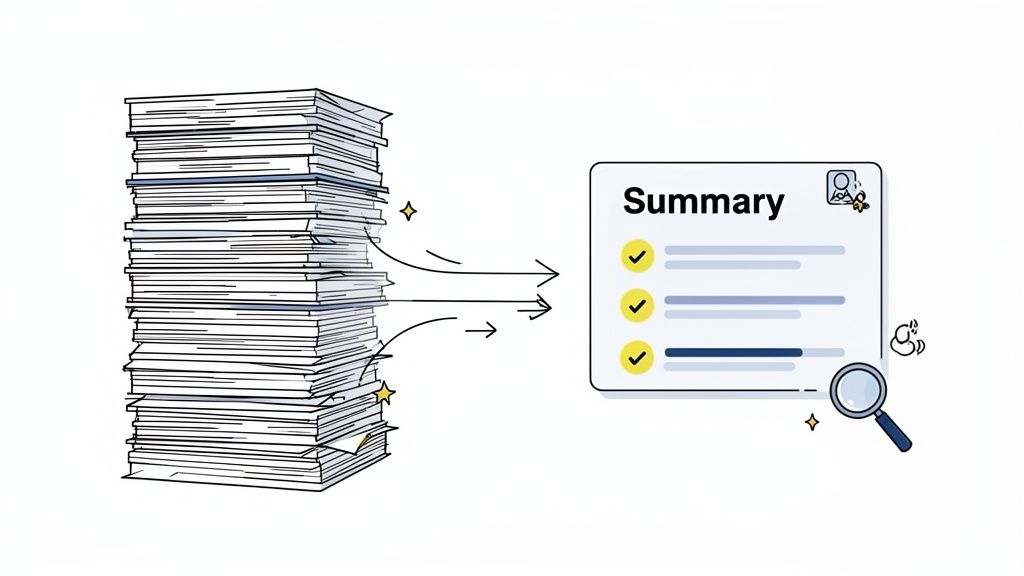
This method moves beyond simple highlighting by identifying core arguments, data points, and conclusions, presenting them in a structured abstract. It directly combats information overload, a common barrier to effective knowledge sharing and retention.
Practical Implementation and Use Cases
Implementing this strategy is straightforward with modern tools. For example, a legal team can upload dozens of contracts to an AI summarizer to quickly extract key obligations and risk factors, turning days of manual review into hours of strategic analysis. Similarly, academic researchers can process hundreds of papers for a literature review, rapidly identifying the most relevant studies without reading each one cover-to-cover.
Key use cases include:
- Business Analysts: Summarizing dense quarterly reports and market analyses to inform executive briefings.
- Students: Extracting main concepts from complex research papers to accelerate study and assignment completion.
- Project Managers: Condensing lengthy project proposals and status updates to keep stakeholders informed.
Actionable Tips for Success
To maximize the benefits of this knowledge management strategy, it's crucial to use summaries as a starting point, not the final word.
Key Insight: The goal of a summary is to accelerate comprehension and guide your focus. Always use it as a map to navigate the original document for critical details.
- Verify Crucial Data: Use summaries to identify important information, then click on citations to jump directly to the source passage for verification.
- Cross-Reference Insights: Generate summaries for multiple related documents to quickly compare findings and identify overarching themes or contradictions.
- Adjust Detail Level: Customize the summary length based on your need, from a high-level overview to a more detailed abstract.
To explore how AI-driven tools facilitate this process, you can learn more about how AI is used to summarize PDF documents. This strategy is essential for any organization aiming to make its internal knowledge more accessible and actionable.
2. Multi-Document Cross-Reference Analysis
A powerful evolution of single-document review, multi-document cross-reference analysis allows users to synthesize insights from a collection of sources simultaneously. This knowledge management strategy involves comparing, contrasting, and connecting information across multiple documents to uncover hidden patterns, validate data points, and identify contradictions. Instead of analyzing information in silos, this method creates a holistic view by treating a group of documents as a single, interconnected knowledge base.
By querying an entire document set at once, teams can move beyond simple information retrieval to sophisticated knowledge synthesis. This approach is fundamental for building comprehensive understanding and making well-rounded, evidence-based decisions.
Practical Implementation and Use Cases
Modern AI-powered tools make this once-daunting task highly accessible. For instance, an investment analyst can upload the annual reports of five competing companies and ask, "Which company had the highest R&D spending as a percentage of revenue over the last three years?" The system will scan all documents, extract the relevant data, and provide a synthesized answer with citations from each report.
Key use cases include:
- Compliance Teams: Reviewing new regulations against existing internal policies and historical legal precedents to identify conflicts.
- Academic Researchers: Comparing methodologies and findings across dozens of research papers to conduct a thorough literature review.
- Legal Professionals: Analyzing variations in clauses across multiple contracts to standardize agreements or identify risks.
Actionable Tips for Success
To effectively implement this strategy, a structured approach is essential. Start with a clear objective to guide your analysis and prevent aimless exploration.
Key Insight: Treat your document collection as a private expert. Ask it specific, comparative questions that you couldn't answer by reading just one source.
- Organize Thematically: Group documents by theme, project, or date before uploading to streamline your analysis and ensure relevant comparisons.
- Start with Broad Questions: Begin with high-level queries to map out key themes across the sources, then drill down with more specific questions.
- Verify with Side-by-Side Views: Use integrated viewers to check the original context of an AI-generated answer, ensuring accuracy and nuance.
This strategy transforms disparate files into a cohesive intelligence asset. By leveraging tools like a PDF Summarizer with multi-file chat capabilities, organizations can unlock deeper insights that are invisible when documents are reviewed one by one.
3. Semantic Search and Question-Answering Systems
One of the most powerful knowledge management strategies is to move beyond keyword-based retrieval and adopt semantic search. This intelligent approach uses AI to understand the meaning and context behind a query, not just the words themselves. It enables users to ask natural language questions and receive precise, sourced answers directly from within a vast repository of documents.
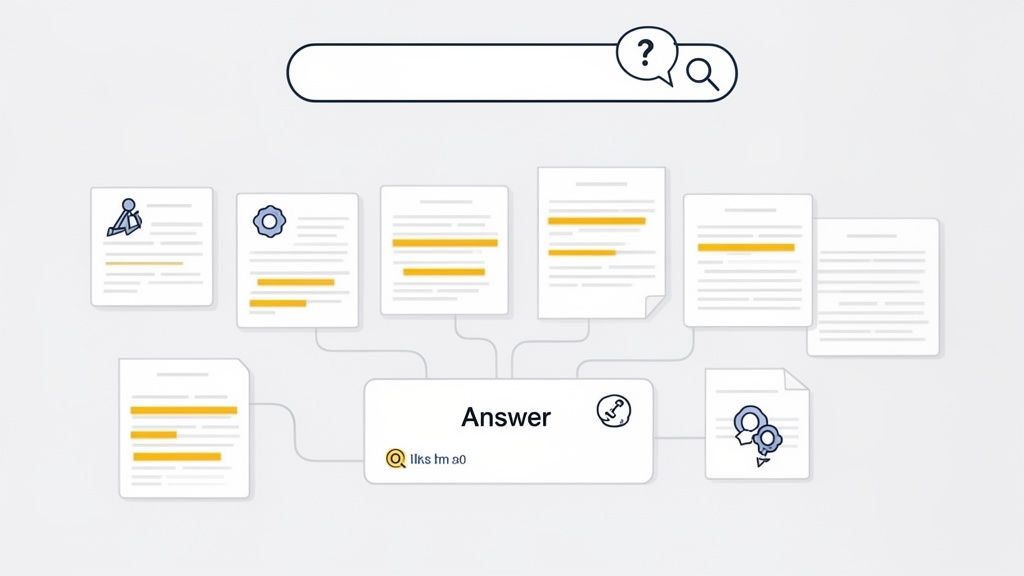
Instead of manually scanning documents for relevant phrases, this system synthesizes information to provide direct responses, complete with citations. This method transforms static knowledge bases into dynamic, conversational resources, drastically reducing the time spent finding critical information.
Practical Implementation and Use Cases
Implementing this strategy allows organizations to unlock granular insights buried deep within their documentation. For instance, a compliance officer can ask, "What are the specific GDPR data retention requirements for customer emails?" and get a direct answer sourced from multiple policy documents. Similarly, researchers can quickly identify contradictory findings by asking a system to compare methodologies across several studies. For building more accurate and fact-based systems, implementing Retrieval Augmented Generation (RAG) is a cutting-edge approach.
Key use cases include:
- Professionals: Querying compliance manuals for specific regulatory requirements without reading the entire document.
- Support Teams: Answering complex customer questions instantly by sourcing information from internal policy documents.
- Students: Asking specific questions about research methodology or historical context from dense academic papers.
Actionable Tips for Success
To effectively leverage question-answering systems, the quality of your query directly impacts the quality of the answer.
Key Insight: Treat the system as a research assistant. Ask specific, well-formed questions to guide its search and synthesis process for the most accurate and relevant answers.
- Be Specific: Instead of "project budget," ask "What was the approved marketing budget for the Q3 campaign?"
- Verify with Citations: Always use the provided source links to review the original context of the answer, ensuring accuracy and complete understanding.
- Use Follow-up Questions: Explore a topic more deeply by asking follow-up questions to refine your search and uncover related insights.
You can dive deeper into how you can ask questions to your documents to get the answers you need. This strategy is essential for making institutional knowledge immediately accessible and interactive.
4. Multilingual Knowledge Processing and Translation
In an increasingly globalized world, one of the most critical knowledge management strategies is to break down language barriers. Multilingual knowledge processing involves using advanced AI to translate, summarize, and analyze documents across different languages, ensuring that insights are accessible to everyone, regardless of the document's original language. This approach democratizes information and unlocks a vast repository of global knowledge that would otherwise remain siloed.
This strategy goes beyond simple word-for-word translation. It employs sophisticated AI models to understand context, technical jargon, and cultural nuances, enabling accurate cross-language Q&A and summarization. By doing so, organizations can seamlessly integrate international data into their centralized knowledge base, fostering a truly global perspective.
Practical Implementation and Use Cases
Implementing this strategy is now accessible through AI-powered platforms. For instance, a global compliance team can upload regulatory documents from several countries in their native languages and ask questions in English to quickly verify adherence to internal policies. Similarly, a multinational corporation can analyze customer feedback from different regions to identify global trends without needing a large team of translators.
Key use cases include:
- International Research Teams: Analyzing and synthesizing academic papers published in multiple languages to accelerate discovery.
- Multinational Companies: Reviewing foreign-language contracts and market reports to make informed global business decisions.
- Global Compliance Teams: Managing and auditing multilingual regulatory documents to ensure universal adherence.
Actionable Tips for Success
To effectively leverage multilingual processing, treat AI-powered translation as a powerful first-pass analysis tool, with human oversight for mission-critical applications.
Key Insight: The primary goal is to make foreign-language information discoverable and understandable. For legally binding or high-stakes decisions, always consult the original document or a professional translator.
- Verify Technical Accuracy: For documents with specialized terminology, use the translation to grasp the core concepts, but have a subject-matter expert review critical sections.
- Combine Original and Translated Views: Use a side-by-side comparison of the original text and its translation to ensure no nuance is lost, especially in legal or contractual contexts.
- Document Language Metadata: Always tag or record the original language of a document. This is crucial for auditing, referencing, and maintaining data integrity.
This strategy is fundamental for any organization operating on a global scale, transforming language from a barrier into a bridge for shared knowledge.
5. Citation Tracking and Source Attribution
A cornerstone of rigorous knowledge management strategies is establishing a system for citation tracking and source attribution. This approach involves meticulously documenting the origin of every piece of information, ensuring that all claims, data points, and insights can be traced back to their original source. By embedding verifiable citations directly within your knowledge base, you create a framework of trust and accountability.
This strategy transforms information from a simple assertion into a verifiable fact. It directly combats misinformation and strengthens the integrity of your organization's collective intelligence by ensuring every piece of knowledge is supported by concrete evidence.
Practical Implementation and Use Cases
Modern AI tools make this process seamless. Instead of manually copying and pasting references, these systems can automatically generate citations for information extracted from documents. For example, when a researcher uses an AI tool to ask a question across a hundred academic papers, the answer is delivered with precise, page-numbered citations from the source documents, allowing for instant verification.
Key use cases include:
- Legal Teams: Documenting regulatory compliance by linking internal policies directly to specific clauses in legal statutes.
- Academic Researchers: Building evidence-based arguments by generating a precise, traceable bibliography from dozens of research papers.
- Journalists and Reporters: Verifying facts and quotes for articles by instantly referencing the original interview transcripts or source reports.
Actionable Tips for Success
To fully leverage this knowledge management strategy, treat citations as more than just a formality; view them as pathways to deeper understanding.
Key Insight: Citations are not just for attribution; they are navigational tools that build confidence and enable deeper exploration of the source material.
- Verify Critical Data: Never take a generated insight at face value. Use the provided citation to jump directly to the source passage and confirm its context and accuracy.
- Build Comprehensive Bibliographies: As you extract information, use the automated citation feature to build a running list of references for reports or projects.
- Maintain an Audit Trail: For compliance or fact-checking purposes, keep a clear record of your Q&A sessions and their corresponding cited sources.
6. Adaptive Learning and Progressive Knowledge Building
A more dynamic approach to knowledge management strategies involves adaptive learning, where understanding is built iteratively rather than consumed passively. This method uses conversational interaction to progressively deepen comprehension of complex documents. Instead of just reading a summary, users engage in a dialogue, asking questions and receiving contextualized answers that build upon each other.
This strategy transforms static information into a guided learning experience. It allows individuals and teams to explore nuances, challenge assumptions, and uncover hidden connections within the content, fostering a more profound and lasting grasp of the subject matter. It is particularly effective for tackling dense, multifaceted information where a single pass is insufficient.
Practical Implementation and Use Cases
Implementing this strategy is intuitive with conversational AI tools that can interact with documents. For instance, a professional team onboarding to a new, complex project can start by asking an AI assistant for a high-level overview of the project charter. They can then ask follow-up questions about specific deliverables, timelines, and stakeholder responsibilities, drilling down layer by layer until they have a comprehensive understanding.
Key use cases include:
- Researchers: Progressively exploring methodologies and research gaps across multiple academic papers through guided questioning.
- Students: Building a foundational understanding of a difficult topic by asking broad questions and then moving to more specific, complex inquiries.
- Compliance Teams: Deconstructing intricate regulatory documents by asking targeted questions about clauses, obligations, and exceptions.
Actionable Tips for Success
To effectively use progressive knowledge building, structure your inquiry process from general to specific. This creates a logical path for comprehension.
Key Insight: Treat your document as an expert you can interview. Start with broad "get to know you" questions and drill down into the details as you build context.
- Start Broad, Then Go Deep: Begin with high-level questions like "What is the main purpose of this document?" before asking about specific data points or clauses.
- Use Follow-Up Questions: When an answer reveals something unexpected or interesting, use follow-up questions like "Can you elaborate on that point?" or "How does that relate to [another topic]?"
- Document Key Insights: At each stage of the conversation, summarize what you have learned to solidify your understanding and create a referenceable trail of insights.
This interactive approach makes knowledge acquisition an active, engaging process, ensuring that information is not just consumed but truly understood and retained.
7. Content Verification and Fact-Checking Through Source Review
A crucial, yet often overlooked, knowledge management strategy is the implementation of a systematic content verification process. This involves rigorously comparing extracted insights, summaries, and data points against their original source documents to ensure accuracy and integrity. By establishing a formal fact-checking workflow, organizations can actively combat misinformation, prevent the spread of outdated information, and build a trusted, reliable knowledge base.
This method ensures that the knowledge being shared and acted upon is not just a summary, but a faithful representation of the source material. It is the bedrock of data-driven decision-making and is essential for any high-stakes environment where accuracy is non-negotiable.
Practical Implementation and Use Cases
Implementing this strategy involves using tools that allow for side-by-side comparison of generated knowledge with source text. For example, a compliance officer can use an AI tool to extract all clauses related to data privacy from a new regulation and simultaneously view the original legal text to verify the interpretation is correct. This drastically reduces the risk of non-compliance due to misinterpretation.
Key use cases include:
- Auditors: Validating figures in financial statements by directly cross-referencing them with source records and transaction logs.
- Academic Reviewers: Checking a research paper’s claims by comparing them against the cited methodologies and data in appendices.
- Fact-Checkers: Verifying news claims by comparing journalistic summaries against primary source documents like court filings or official reports.
Actionable Tips for Success
To embed verification into your workflow, treat it as a standard step in the knowledge creation process, not an afterthought.
Key Insight: Trust is built on accuracy. A quick verification step prevents costly errors and builds long-term confidence in your organization's shared knowledge.
- Create a Verification Checklist: For critical information types, develop a simple checklist to ensure key data points, figures, and claims are always reviewed against the source.
- Cross-Verify with Multiple Sources: For high-impact decisions, check important facts against several independent documents to confirm consistency and identify potential contradictions.
- Document Your Sources: Always cite the origin of key findings, making it easy for others to perform their own verification if needed.
For practical applications, consider exploring AI-powered content verification tools that can enhance the accuracy and trustworthiness of your knowledge base. This strategy is indispensable for creating a knowledge management system that is both efficient and reliable.
8. Personalized Knowledge Curation and Filtering
A powerful knowledge management strategy is to move beyond one-size-fits-all information delivery and embrace personalized knowledge curation. This approach customizes information based on a user's role, expertise, and specific needs, ensuring they receive the most relevant insights without sifting through irrelevant data. By using AI to understand user context, this method delivers optimized and filtered information for maximum efficiency.
This strategy directly tackles the problem of noise in large knowledge bases. Instead of providing everyone with the same massive report, it extracts and presents only the sections or summaries that matter to each individual, transforming data overload into actionable intelligence.
Practical Implementation and Use Cases
Implementing this strategy involves setting up user profiles or using AI that adapts to query patterns. For instance, a compliance team can configure a system to automatically extract and summarize only the clauses related to specific regulatory requirements from hundreds of documents. Similarly, a research team can filter a collection of studies to focus solely on methodology sections, bypassing lengthy introductions.
Key use cases include:
- Students: Receiving academic-level summaries from textbooks, while a professor gets a high-level executive brief on the same content.
- Compliance Teams: Filtering thousands of internal policies to isolate information pertaining to a new regulation.
- Multilingual Organizations: Delivering summaries and Q&A responses in each team member's preferred language from a single source document.
Actionable Tips for Success
To effectively implement personalized curation, you must balance tailored content with the need for broader awareness. Start by defining clear roles and information needs.
Key Insight: Personalization shouldn't create information silos. The goal is to filter noise, not block discovery. Always provide an easy way for users to access the full, unfiltered source.
- Establish User Profiles: Set up preferences for users based on their role, department, or project to create a baseline for curation.
- Use Role-Based Templates: Create summary templates for different teams, such as a "financial summary" for the finance department or a "technical overview" for engineers.
- Balance with Exposure: Periodically review personalization settings to ensure users are not missing out on diverse perspectives or critical peripheral information.
By tailoring knowledge delivery, organizations can drastically improve the relevance and impact of their information assets, making this one of the most effective knowledge management strategies for modern teams.
9. Knowledge Organization Through Semantic Tagging and Classification
One of the most foundational knowledge management strategies is to systematically organize information through semantic tagging and classification. This approach involves assigning intelligent tags, categories, and metadata to knowledge assets like documents and reports. Instead of relying solely on folder structures, this method creates a searchable, interconnected web of information, allowing users to discover relevant knowledge based on context and meaning.
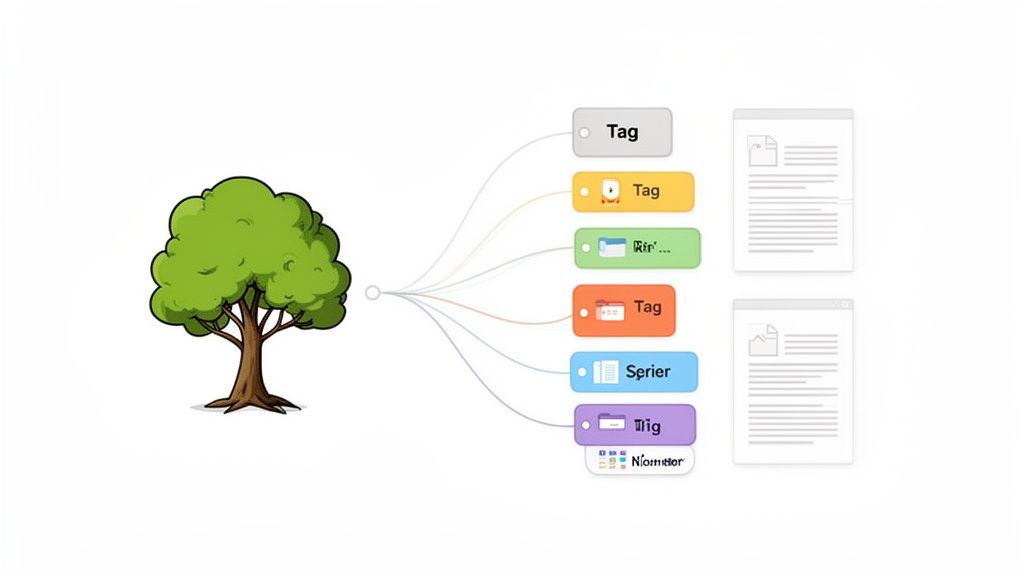
This strategy moves beyond simple keyword tagging by assigning metadata that describes what the information is about. It transforms a static archive into a dynamic, queryable knowledge base, making it easier to surface hidden connections and retrieve precise information instantly.
Practical Implementation and Use Cases
Implementing semantic tagging is achievable with modern document management systems and dedicated AI tools. For instance, a research team can automatically tag papers by methodology, findings, and limitations, enabling them to quickly filter for studies that used a specific research approach. A legal department can classify thousands of contracts by clause type, jurisdiction, and renewal date for proactive risk management.
Key use cases include:
- Business Analysts: Organizing competitor analysis by market segment, product line, and strategic initiatives.
- Students: Tagging research materials by theme, author, and relevance to a thesis statement.
- Legal Teams: Categorizing case files and contracts by governing law, risk level, and key dates.
Actionable Tips for Success
To build a robust and scalable system, it's vital to create a consistent framework for classification. A well-defined taxonomy is the backbone of this knowledge management strategy.
Key Insight: The value of tagging lies in its consistency. A clear, shared taxonomy ensures everyone organizes and retrieves information using the same logic.
- Establish a Tag Taxonomy: Before a large-scale rollout, create a clear guide that defines your tags and hierarchical categories.
- Leverage AI with Manual Review: Use AI-powered tools to suggest tags automatically, but have a human expert review and refine them for maximum accuracy.
- Regularly Refine Your Scheme: As your knowledge base grows and business needs evolve, periodically review and update your tagging system.
To see this strategy in action, you can learn more about how to organize research papers. This method is crucial for any team looking to create a truly intelligent and accessible knowledge repository.
10. Collaborative Knowledge Synthesis and Shared Learning
Beyond individual knowledge extraction, a truly mature knowledge management strategy fosters collaborative synthesis. This approach transforms information analysis from a solo activity into a dynamic team effort, enabling groups to build a shared understanding from complex documents. By creating a central hub for shared access, annotations, and insights, organizations turn isolated learning into powerful collective intelligence.
This method involves centralizing documents and providing tools for teams to review, comment on, and consolidate findings together. It ensures everyone is working from the same source material and can see each other's contributions in real time, preventing siloed interpretations and redundant work.
Practical Implementation and Use Cases
Implementing this strategy requires a platform that supports shared workspaces and collaborative features. For instance, a legal team can collectively review a set of contracts, with each member highlighting specific clauses and leaving comments for others. This creates a unified, annotated record of potential risks and obligations that is far more comprehensive than any single individual’s review.
Key use cases include:
- Research Teams: Collaboratively conducting literature reviews by sharing papers, highlighting key findings, and synthesizing a joint summary.
- Business Units: Analyzing competitor reports and market data together to align on strategic takeaways before a planning session.
- Academic Groups: Preparing for a group project by collectively summarizing source materials and building a shared outline.
Actionable Tips for Success
To ensure collaborative efforts are productive, it's vital to establish clear guidelines and leverage technology effectively.
Key Insight: True collaboration isn't just about sharing a document; it's about building a shared context and a single source of truth from it.
- Establish Clear Norms: Set guidelines for how to annotate, comment, and resolve conflicting interpretations to maintain clarity.
- Use Shared Summaries: Generate an initial AI-powered summary to give the entire team a common starting point for discussion and deeper analysis.
- Document Collaborative Findings: Maintain a clear record of the group’s final conclusions, with attributions if necessary, to create a reusable knowledge asset.
By shifting from individual analysis to collective synthesis, this knowledge management strategy accelerates comprehension and produces more robust, well-rounded insights.
10-Point Knowledge Management Strategies Comparison
| Item | Implementation complexity | Resource requirements | Expected outcomes | Ideal use cases | Key advantages |
|---|---|---|---|---|---|
| Document Summarization and Abstraction | Low–Moderate | Moderate (NLP models, quality source docs) | Concise summaries preserving key points; faster comprehension | Literature reviews, executive briefs, contract overviews | Saves time; variable detail levels; scalable |
| Multi-Document Cross-Reference Analysis | Moderate–High | Moderate–High (multiple documents, integration) | Syntheses highlighting patterns, contradictions, relationships | Meta-analyses, compliance reviews, competitive research | Reveals cross-source connections; finds gaps |
| Semantic Search and Question-Answering Systems | Moderate | Moderate (embeddings, indexed corpus, LLMs) | Precise, sourced answers to natural-language queries | Support desks, regulatory queries, focused research | Natural language access; improved retrieval accuracy |
| Multilingual Knowledge Processing and Translation | Moderate | Moderate–High (translation models, language coverage) | Cross-language summaries, translations, and Q&A | International teams, global research, multinational compliance | Breaks language barriers; expands content access |
| Citation Tracking and Source Attribution | Moderate | Low–Moderate (metadata extraction, linking) | Traceable citations and audit trails for claims | Academic research, legal documentation, journalism | Ensures credibility; simplifies verification and compliance |
| Adaptive Learning and Progressive Knowledge Building | Moderate | Moderate (dialogue memory, iterative interactions) | Progressive deeper understanding via iterative Q&A | Tutoring, exploratory research, team learning | Mirrors human learning; uncovers deeper insights |
| Content Verification and Fact-Checking Through Source Review | Moderate–High | Moderate (annotation tools, human review) | Validated information with contradiction detection and versioning | Fact-checking, audits, high-stakes decisions | Reduces misinformation; increases trustworthiness |
| Personalized Knowledge Curation and Filtering | Moderate | Low–Moderate (user profiling, personalization engine) | Tailored content delivery and reduced information noise | Role-based briefs, learning platforms, dashboards | Improves relevance; boosts user engagement |
| Knowledge Organization Through Semantic Tagging and Classification | Moderate | Moderate (tagging models, taxonomy governance) | Searchable, organized repositories and reusable assets | Document management, research libraries, legal corpora | Enhances discoverability; supports knowledge reuse |
| Collaborative Knowledge Synthesis and Shared Learning | Low–Moderate | Low–Moderate (collaboration platform, permissions) | Shared insights, annotated documents, collective summaries | Team research, cross-functional analyses, reviews | Enables collective intelligence; reduces duplicate effort |
From Information Overload to Strategic Advantage
The journey through the ten essential knowledge management strategies reveals a powerful truth: information is only as valuable as your ability to access, understand, and apply it. Moving beyond simple data storage to an active, dynamic system of knowledge utilization is the defining challenge for modern organizations, researchers, and students. The strategies we've explored, from Document Summarization and Multi-Document Cross-Reference Analysis to Personalized Knowledge Curation and Collaborative Synthesis, are not just isolated tactics. They represent a comprehensive framework for building a smarter, more agile operational core.
By shifting from a reactive approach of searching for information when a crisis hits to a proactive system of continuous learning and insight generation, you transform knowledge from a passive archive into a strategic asset. The goal is to create an environment where the right information finds the right person at the right time, not by chance, but by design. This is the essence of effective knowledge management.
Key Takeaways: From Theory to Action
Recapping our exploration, several core principles stand out as universally critical for success. Mastering these concepts is the first step toward building a robust knowledge ecosystem.
- Connectivity is King: The true power of knowledge emerges from connections. Strategies like Multi-Document Analysis and Semantic Search are not just about finding single facts; they are about understanding the relationships, contradictions, and synergies between different pieces of information.
- Automation is an Accelerator: Manually sifting through hundreds of documents is no longer feasible. Leveraging AI-driven tools to handle tasks like summarization, citation tracking, and semantic tagging is essential. This frees up human intellect for higher-level strategic thinking and analysis.
- Context is Crucial: Raw data lacks meaning. Techniques like Semantic Tagging and Personalized Curation add the necessary layers of context, ensuring that information is not only findable but also relevant and immediately applicable to the user's specific needs.
- Collaboration is a Multiplier: Knowledge that remains siloed is a wasted resource. Fostering Collaborative Synthesis and shared learning environments ensures that individual insights contribute to a greater collective intelligence, driving innovation and preventing redundant work.
Your Actionable Next Steps
Embarking on this journey can feel overwhelming, but progress is achieved through focused, incremental steps. Rather than attempting to implement all ten strategies at once, identify your primary bottleneck and start there.
- Identify Your Most Critical Pain Point: Are your researchers spending too much time on literature reviews? Is your legal team bogged down by document analysis? Is cross-departmental information sharing non-existent? Pinpoint the area where inefficiency is causing the most damage.
- Select a Pilot Strategy: Choose one or two of the strategies detailed in this article that directly address your identified pain point. For instance, if literature reviews are the issue, begin with Document Summarization and Citation Tracking.
- Introduce a Catalyst Tool: Implement a tool like a PDF summarizer to automate the foundational tasks of your chosen strategy. This provides an immediate win and demonstrates the value of the new approach to stakeholders, building momentum for wider adoption.
- Measure and Iterate: Define what success looks like. Is it reduced research time, faster report generation, or fewer compliance errors? Track these metrics, gather feedback from your team, and refine your process before expanding to other knowledge management strategies.
Ultimately, investing in robust knowledge management strategies is an investment in your organization's future resilience and competitive edge. In an era defined by the speed of information, the ability to learn, adapt, and make informed decisions faster than the competition is not just an advantage; it is the key to survival and growth. The path from information overload to strategic advantage is clear, and with the right approach and tools, it is a journey well within your reach.
Ready to stop drowning in documents and start building a powerful knowledge base? PDF Summarizer is the catalyst you need, offering AI-powered summarization, cross-document Q&A, and citation tracking to accelerate every one of these strategies. Transform your information into actionable intelligence today by visiting PDF Summarizer.
Relevant articles
Discover best practice in knowledge management with 10 proven strategies to boost collaboration, efficiency, and innovation in 2026.