Best practice in knowledge management: 10 Proven Strategies for 2026
Discover best practice in knowledge management with 10 proven strategies to boost collaboration, efficiency, and innovation in 2026.
In a world saturated with data, the true competitive advantage lies not in accumulating information, but in mastering its flow. Effective knowledge management transforms raw data into a strategic asset, driving innovation, efficiency, and smarter decision-making. However, many organizations struggle with outdated systems that bury critical insights in disconnected silos, making it nearly impossible for teams to find, use, and build upon collective intelligence. This inefficiency costs more than just time; it stifles growth and blunts competitive edge.
This guide moves beyond theory to deliver a comprehensive, actionable roadmap. We will explore 10 essential strategies that constitute the best practice in knowledge management today. You'll gain concrete steps, real-world examples, and implementation tips to help you build a robust and future-proof knowledge ecosystem. Whether you're a student managing research, a professional analyzing reports, or a team lead fostering collaboration, these principles are designed to be universally applicable. To unlock your organization's full potential, it's crucial to understand and implement effective knowledge management. For a comprehensive overview, explore these Top Knowledge Management Best Practices which offer valuable insights, especially for distributed teams.
From establishing a centralized repository and leveraging AI for summarization to enabling cross-language collaboration and ensuring continuous updates, each point in our list is a critical component of a modern system. We will cover:
- Document capture and intelligent information filtering.
- Interactive, chat-based knowledge retrieval and multi-document analysis.
- Multilingual access and collaborative learning communities.
- Source verification and accessibility standards.
Get ready to turn your organization's collective intelligence into its greatest and most reliable strength. This list provides the foundational pillars for creating a system where information is not just stored, but actively works for you.
1. Document Capture and Centralized Repository
Establishing a centralized system for capturing and storing documents is a foundational best practice in knowledge management. It creates a single source of truth, eliminating the chaos of scattered files across various drives, email inboxes, and local machines. This practice involves systematically gathering all organizational knowledge assets, such as PDFs, reports, research papers, and technical manuals, into a unified digital platform.

By consolidating information, organizations can ensure that every team member has access to the most current and relevant data. This approach significantly reduces time spent searching for information and prevents redundant work, as employees can easily verify if a particular document or piece of research already exists. For users of tools like PDF Summarizer, a centralized repository means all critical documents are uploaded and ready for quick analysis and summarization, streamlining workflows for literature reviews, report analysis, or legal document review.
Real-World Examples
- Academic Institutions: Universities create centralized digital libraries for research papers and dissertations, allowing students and faculty to access a vast body of scholarly work from one location.
- Legal Firms: Law offices maintain comprehensive document management systems for case files, contracts, and legal precedents, ensuring secure and organized access for paralegals and attorneys.
- Engineering Teams: Companies consolidate technical specifications, blueprints, and project reports, enabling engineers to collaborate effectively and reference historical project data.
Actionable Implementation Tips
To effectively implement this practice, focus on structure and accessibility. Start by defining a clear and logical folder structure and enforcing consistent document naming conventions. This simple step makes manual browsing intuitive.
Next, leverage technology to enhance discoverability.
- Use Automated Tagging: Implement systems that automatically apply relevant metadata and tags upon upload, making search queries more accurate.
- Establish Retention Policies: Define clear rules for how long documents are stored and when outdated materials should be archived or deleted.
- Integrate Advanced Search: Integrate powerful search tools that can index content within documents, not just filenames, for faster, more precise retrieval.
By building a robust central repository, you lay the groundwork for a more efficient and intelligent knowledge management ecosystem. For a deeper dive into structuring your system, explore these comprehensive document management best practices.
2. Knowledge Extraction and Summarization
Systematically extracting key information from large volumes of content is a critical best practice in knowledge management. Instead of requiring employees to read entire documents, this practice uses AI and structured processes to identify the most important concepts, findings, and actionable takeaways. It transforms dense, unstructured information into concise, digestible knowledge assets that accelerate decision-making and learning across an organization.
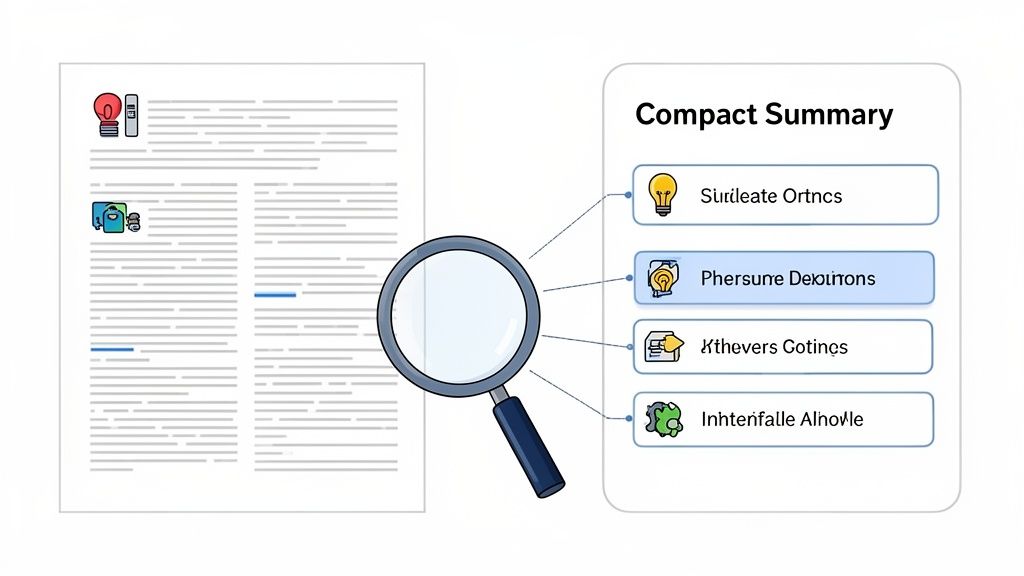
Tools like PDF Summarizer exemplify this by instantly generating summaries and highlighting key insights from research papers, lengthy reports, or complex contracts. This approach saves countless hours and ensures that teams can quickly grasp the core messages of a document without getting bogged down in details. By making knowledge more accessible, organizations empower their teams to act on information faster and more effectively, boosting overall productivity and innovation.
Real-World Examples
- Business Analysts: Teams condense lengthy market research reports and competitor analyses into executive summaries, allowing leadership to make swift, informed strategic decisions.
- Healthcare Professionals: Researchers and clinicians summarize dense clinical trial results and medical studies to stay current with the latest findings and apply them to patient care.
- Legal Teams: Paralegals and attorneys use extraction tools to identify key clauses, obligations, and precedents from contracts and legal documents, speeding up case preparation.
Actionable Implementation Tips
To effectively integrate knowledge extraction, combine powerful technology with human oversight. Start by identifying high-volume, information-dense workflows where summarization can deliver the most impact.
Next, establish clear protocols for using and verifying automated outputs.
- Verify AI-Generated Summaries: Always cross-reference AI-generated summaries against the original source for accuracy, especially for critical documents.
- Create Tiered Summaries: Develop different levels of summarization (e.g., brief, medium, detailed) to cater to the specific needs of various audiences.
- Combine with Human Review: For high-stakes information, implement a process where automated summaries are reviewed and refined by a subject matter expert.
By adopting these techniques, you can unlock the valuable insights trapped within your documents. To see how AI can transform this process, you can explore the benefits of an AI tool to summarize PDFs.
3. Interactive Knowledge Conversation (Chat-Based Interface)
Moving beyond passive document review, a modern best practice in knowledge management is implementing an interactive, chat-based interface. This transforms static documents into dynamic conversational partners, allowing users to ask specific questions and receive targeted, context-aware answers directly from the knowledge source. It creates a more engaging and efficient discovery process where users can probe for details, request clarifications, and explore topics in depth without manually scanning entire files.
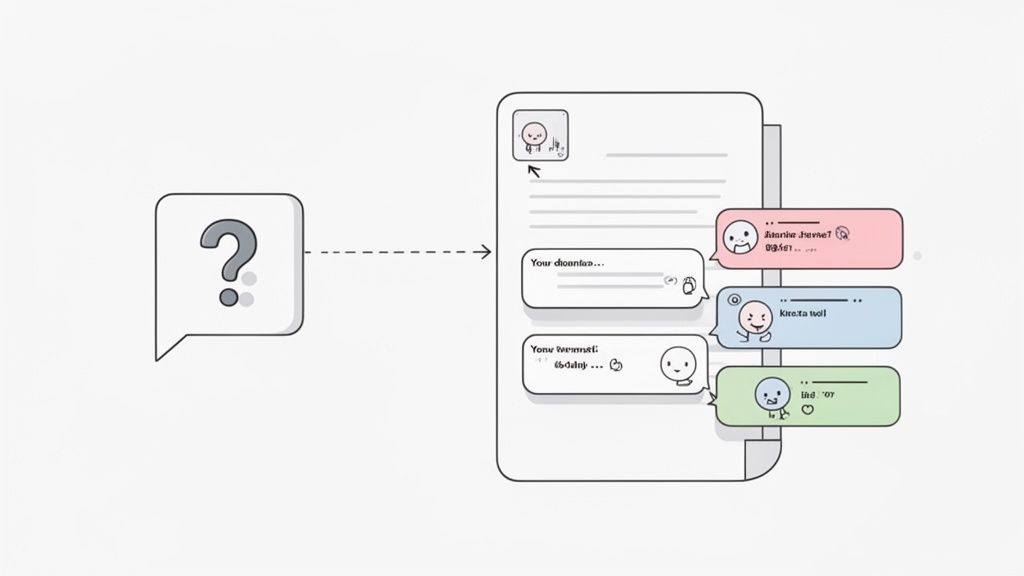
This conversational approach democratizes access to complex information. Instead of needing to be an expert to find a specific data point, anyone can simply ask. Tools like PDF Summarizer leverage this by enabling users to "chat" with their documents, turning dense reports or academic papers into interactive knowledge bases. This method significantly accelerates research, analysis, and decision-making by delivering precise information on demand.
Real-World Examples
- Academic Researchers: A Ph.D. candidate uses a multi-file chat to ask, "Compare the methodologies used in these five studies," receiving a synthesized answer with citations from each paper.
- Compliance Teams: An officer queries a 500-page regulatory document with, "What are the specific data retention requirements for customer PII?" and gets an immediate, cited response.
- Business Analysts: A professional asks a summarizer to compare the Q3 and Q4 financial reports, instantly highlighting key performance differences without manual cross-referencing.
Actionable Implementation Tips
To maximize the effectiveness of interactive knowledge conversations, adopt a strategic approach to querying. Start by formulating clear, specific questions, as the quality of your input directly impacts the accuracy of the output.
Leverage the conversational nature of the tool to refine your search.
- Use Follow-Up Questions: If an initial answer is too broad, ask follow-up questions to dive deeper into specific aspects of the topic.
- Leverage Multi-File Chat: For comparative analysis, upload multiple documents and direct questions that require cross-referencing information between them.
- Verify with Citations: Always use the provided citations to navigate back to the source text to confirm context and ensure accuracy, especially for critical data.
By treating your documents as interactive databases, you unlock a more intuitive and powerful way to manage and extract value from your organizational knowledge. To see how you can start asking questions to your documents, you can learn how to scan, question, and get answers from your files.
4. Multilingual Knowledge Access and Cross-Language Collaboration
In today's globalized landscape, enabling knowledge access across multiple languages is a critical best practice in knowledge management. It ensures that language barriers do not impede information sharing, fostering a truly inclusive and efficient international environment. This practice involves implementing systems that support document review, summarization, and Q&A in any language, often with real-time translation capabilities.
This approach breaks down knowledge silos that form along linguistic lines. By allowing team members to interact with documents regardless of the source language, organizations can tap into a wider pool of expertise and information. For users of a tool like PDF Summarizer, its multilingual support is a game-changer. It allows for seamless analysis of documents in their native tongues and facilitates cross-language reading and Q&A, effectively dismantling international knowledge barriers.
Real-World Examples
- International Research Teams: Collaborators use multilingual tools to analyze papers and data from different countries, speeding up innovation by synthesizing global research findings.
- Pharmaceutical Companies: Regulatory affairs specialists analyze crucial compliance documents submitted in various languages from health authorities around the world.
- Multinational Legal Teams: Attorneys review and compare contracts, precedents, and evidence in multiple languages without needing to wait for manual translations.
Actionable Implementation Tips
To effectively integrate multilingual capabilities, focus on both technology and process. Start by identifying the primary languages used across your organization and prioritize support for them.
Next, empower your teams with the right tools and guidelines.
- Leverage AI Translation: Use advanced tools that provide on-the-fly translation and summarization to give users immediate understanding of foreign-language documents.
- Maintain Glossaries: Create and maintain glossaries of key technical or domain-specific terms to ensure consistency and accuracy in automated translations.
- Combine with Centralization: Integrate your multilingual tools with a centralized repository, making your entire global knowledge base accessible to everyone, regardless of language.
5. Source Citation and Verification Mechanisms
Ensuring knowledge credibility is a cornerstone best practice in knowledge management. This involves establishing robust systems for citing sources and verifying information, which builds trust and accountability. By embedding citation and verification mechanisms directly into knowledge workflows, organizations empower users to trace claims back to their original documents, fostering a culture of accuracy and diligence.
This practice is not just about linking to a source; it's about providing direct, transparent pathways to the exact piece of evidence supporting a claim. For users of tools like PDF Summarizer, this is realized through clickable, in-line citations that instantly navigate to the specific passage in the source document. This creates an auditable trail, which is crucial for rigorous research, compliance checks, and high-stakes decision-making where the origin of information is paramount.
Real-World Examples
- Academic Researchers: A scholar conducting a literature review uses an AI summarizer and clicks on each generated citation to verify the context, ensuring their analysis is built on a solid foundation of correctly interpreted source material.
- Legal Teams: Paralegals verify clauses in an AI-generated contract summary by jumping directly to the source text, confirming that the interpretation is accurate before presenting it to an attorney.
- Compliance Officers: An officer traces a new internal policy recommendation back to the specific section of a regulatory document, ensuring and documenting full compliance with legal standards.
Actionable Implementation Tips
To effectively integrate source verification, focus on creating seamless and reliable workflows. The goal is to make checking sources a natural part of consuming information, not an extra chore.
Begin by promoting a critical mindset.
- Always Click Through: Train teams to treat AI-generated information with a "trust but verify" approach, making it a standard procedure to click through citations to review the original context.
- Use Side-by-Side Viewing: Where possible, use tools that allow for side-by-side comparison of a summary and its source document to quickly validate context around cited passages.
- Establish Citation Standards: Implement a consistent citation format across the organization to make references easy to understand and follow, regardless of the department or document type.
- Maintain Citation Records: For critical projects, keep a log of verified citations. This creates an audit trail that can be invaluable for future reference, quality control, or compliance reviews.
6. Multi-Document Cross-Reference Analysis
Complex decision-making requires synthesizing information across numerous sources, a core best practice in knowledge management. Multi-document cross-reference analysis involves simultaneously comparing and contrasting content from various files to identify patterns, contradictions, and correlations. This moves beyond single-document review to build a holistic understanding from a collection of knowledge assets.
By analyzing documents in parallel, teams can uncover deeper insights that would be missed in isolation. This practice is crucial for tasks like competitive analysis, academic research, and legal discovery, where the relationship between pieces of information is as important as the information itself. For users of tools like PDF Summarizer, features like multi-file chat are transformative, enabling them to ask questions across an entire set of documents and receive synthesized answers, dramatically accelerating comparative analysis.
Real-World Examples
- Clinical Researchers: Medical experts conduct meta-analyses by uploading dozens of clinical trial documents to identify overarching trends, treatment efficacy, and conflicting outcomes across studies.
- Due Diligence Teams: Analysts compare multiple vendor proposals, financial reports, and market analyses side-by-side to assess risks and opportunities comprehensively before a major investment.
- Policy Analysts: Government and NGO professionals compare regulatory frameworks from different jurisdictions to identify best practices and potential harmonization opportunities.
Actionable Implementation Tips
To effectively cross-reference documents, structure and precision are key. Begin by organizing documents into logical groups, such as by project, source type, or date, to create a coherent dataset for analysis.
Next, leverage technology to streamline the synthesis process.
- Ask Specific Comparative Questions: Frame queries to highlight differences and similarities, such as, "How do the methodologies in Document A and Document B differ?" or "Summarize the key findings on Topic X from all uploaded reports."
- Use Multi-File Chat Functionality: Upload a batch of related documents into a single conversational interface to ask questions across the entire corpus, pinpointing contradictions or corroborating data points.
- Create Comparison Matrices: Extract key data points from each document and organize them into a summary table or matrix to visualize comparisons and facilitate decision-making.
7. Continuous Knowledge Update and Refresh Cycles
Knowledge is a perishable asset; what is accurate today can become obsolete tomorrow. Establishing continuous knowledge update and refresh cycles is a crucial best practice in knowledge management, ensuring that your organization’s information remains relevant, accurate, and trustworthy. This practice involves creating systematic processes for regularly reviewing, updating, archiving, or deleting stored information to prevent the accumulation of outdated content.
In fast-moving industries, relying on stale data can lead to poor decisions, compliance risks, and wasted effort. A structured refresh cycle transforms a static knowledge base into a dynamic, living resource. By implementing scheduled audits and clear ownership for knowledge domains, organizations can proactively maintain the integrity of their information assets, ensuring team members are always working with the most current and validated insights.
Real-World Examples
- Medical Institutions: Hospitals and clinics regularly refresh clinical treatment guidelines and drug formularies to align with the latest peer-reviewed research and public health advisories.
- Compliance Teams: In response to new legislation or regulatory changes, compliance departments systematically update internal policy documents and employee training materials.
- Software Companies: Technical writing teams maintain current software documentation and API guides, releasing updates in lockstep with new product versions and feature deployments.
Actionable Implementation Tips
To embed this practice, focus on automation and accountability. Start by assigning clear ownership for specific knowledge domains, making individuals or teams responsible for their accuracy. Next, establish automated triggers and systematic workflows.
- Set Document Expiration Dates: Implement automated alerts that notify owners when a document is due for review, forcing a proactive validation process.
- Maintain Clear Versioning: Use a consistent version control system (e.g., v1.0, v1.1, v2.0) and include release notes that detail what changed in each update.
- Schedule Regular Knowledge Audits: Conduct quarterly or annual audits to identify and address information gaps, redundancies, and outdated materials across the entire repository.
- Leverage Summarization Tools: Use a tool like a PDF Summarizer to quickly analyze new research papers or regulatory updates, helping content owners determine if existing documents need to be revised or replaced.
8. Knowledge Accessibility and Universal Design
Knowledge only provides value when it is accessible to those who need it. A critical best practice in knowledge management is to ensure that systems are designed for universal access, removing barriers related to device type, operating system, physical location, or user ability levels. This principle dictates that information should be as easy to reach and comprehend as possible for everyone in the organization.
True accessibility goes beyond simple permissions. It means that knowledge is available on any device, anywhere, without the need for complex installations or specialized software. Tools like PDF Summarizer embody this by offering a browser-based experience that requires no sign-up or download, making sophisticated summarization capabilities instantly available to anyone with an internet connection. This frictionless access accelerates learning and decision-making by eliminating technical hurdles.
Real-World Examples
- Global Teams: Remote employees across different time zones and locations use browser-based knowledge hubs to access project documents and company policies without needing VPNs or specific corporate hardware.
- Students On-the-Go: Students leverage tools like PDF Summarizer on their mobile phones or tablets to quickly analyze research papers and articles between classes, maximizing their study time.
- Inclusive Organizations: Companies implement knowledge management platforms with features like screen reader compatibility and adjustable text sizes, ensuring employees with diverse abilities can fully engage with organizational knowledge.
Actionable Implementation Tips
To make knowledge truly universal, prioritize accessibility from the outset. Start by evaluating the tools and platforms your team uses, ensuring they meet modern accessibility standards and user needs.
Next, focus on removing common barriers to entry.
- Prioritize Browser-Based Solutions: Choose web-accessible tools that work across all major browsers and devices, eliminating installation and compatibility issues.
- Simplify Onboarding: Design or select systems with intuitive interfaces that require minimal training, allowing users to find and use information immediately.
- Test with Diverse Users: Conduct usability testing with a wide range of users, including those with different technical skills and physical abilities, to identify and fix accessibility gaps.
- Offer Multiple Formats: Where possible, provide information in various formats (e.g., text, video, audio) to cater to different learning preferences and needs.
9. Knowledge Sharing and Collaborative Learning Communities
Effective knowledge management transcends static repositories; it thrives on active engagement and collective growth. Fostering collaborative learning communities is a crucial best practice in knowledge management that transforms knowledge consumption into a dynamic, interactive process. This involves creating dedicated spaces, both digital and physical, where team members can share insights, ask questions, and build expertise together.
While a centralized system provides the "what," a learning community provides the "so what." It's where raw information is debated, contextualized, and turned into actionable wisdom. These communities accelerate the adoption of new knowledge and create a supportive environment for continuous improvement, ensuring that organizational intelligence grows organically through dialogue and shared experience.
Real-World Examples
- Research Teams: A molecular biology lab uses a dedicated Slack channel where researchers post summaries of new papers generated by tools like PDF Summarizer, sparking discussions on experimental design and potential implications for their own work.
- Corporate Departments: A marketing department hosts weekly "lunch and learn" sessions where team members present key takeaways from industry reports and case studies, documenting insights on a collaborative internal wiki.
- Professional Organizations: An association of project managers maintains an online forum where members can ask for advice on complex projects, share templates, and discuss best practices for risk management.
Actionable Implementation Tips
To cultivate a successful learning community, focus on structure, safety, and recognition. Begin by establishing clear community guidelines that encourage open, respectful dialogue and ensure discussions remain productive and on-topic.
Next, implement systems that encourage active participation.
- Recognize Top Contributors: Create a simple system to acknowledge and reward employees who consistently share valuable knowledge, answer questions, and help others.
- Foster Psychological Safety: Actively cultivate an environment where asking "basic" questions is encouraged and mistakes are treated as learning opportunities, not failures.
- Bridge Informal and Formal Knowledge: Appoint moderators to capture key insights and valuable discussions from community platforms and formally document them in your central knowledge base for wider organizational use.
By building these collaborative spaces, you create a powerful feedback loop where knowledge is not only stored but also constantly refined, validated, and enriched by the collective intelligence of your organization.
10. Intelligent Information Filtering and Relevance Ranking
As information volumes explode, the ability to surface the most relevant content becomes a critical best practice in knowledge management. Intelligent information filtering uses AI and sophisticated algorithms to move beyond simple keyword searches, prioritizing information based on user context, project goals, and organizational priorities. This practice ensures that users are not overwhelmed by data but are instead presented with the most impactful and pertinent knowledge first.
This advanced approach transforms a passive repository into an active, intelligent partner. By understanding user needs, it helps teams focus on what truly matters, dramatically reducing the time spent sifting through irrelevant documents and accelerating decision-making. For users of tools like PDF Summarizer, intelligent filtering manifests as features that can highlight the most salient concepts in a dense report, saving hours of manual review and allowing for quicker synthesis of key information.
Real-World Examples
- Compliance Teams: These teams use systems that automatically rank regulatory updates by applicability and urgency, allowing them to address the most critical compliance risks immediately.
- Legal Professionals: Attorneys leverage AI to prioritize key clauses, obligations, and precedents within massive contract databases, focusing their review on the most consequential sections.
- Academic Researchers: Scholars can filter vast literature review sources not just by date but by methodology, impact factor, or relevance to a specific hypothesis, streamlining their research process.
Actionable Implementation Tips
To effectively filter and rank information, a balance between automation and human oversight is essential. Start by defining the criteria that determine relevance for different roles and tasks within your organization. This provides the foundation for configuring your algorithms.
Next, implement systems that empower users while ensuring accuracy.
- Combine AI with Human Judgment: Use automated ranking to surface high-impact information, but always allow subject matter experts to validate and adjust the results.
- Provide User-Adjustable Filters: Empower users to customize filter criteria based on their specific needs, giving them control over the information they see.
- Audit for Algorithmic Bias: Regularly review your filtering and ranking algorithms to ensure they are not inadvertently hiding diverse perspectives or creating information silos.
Knowledge Management: 10-Point Best Practices Comparison
| Practice | Implementation complexity | Resource requirements | Expected outcomes | Ideal use cases | Key advantages |
|---|---|---|---|---|---|
| Document Capture and Centralized Repository | Moderate–High (infrastructure + governance) | Storage, metadata/indexing systems, admin processes | Single source of truth; faster retrieval; auditability | Research institutions, legal firms, engineering teams | Eliminates duplication; improves discoverability; version control |
| Knowledge Extraction and Summarization | Low–Moderate (AI integration, templates) | Summarization models, quality source input, review workflow | Rapid distillation of key points; reduced reading time | Students, analysts, professionals processing dense docs | Fast insights; scalable summaries; customizable depth |
| Interactive Knowledge Conversation (Chat-Based Interface) | High (context tracking, NLU, multi-turn) | Conversational AI, citation linking, compute resources | Targeted answers; exploratory Q&A; immediate clarification | Literature reviews, compliance queries, in-depth research | Context-aware responses; multi-turn follow-ups; source citations |
| Multilingual Knowledge Access and Cross-Language Collaboration | Moderate (translation + detection) | Translation models, glossaries, verification workflows | Broader access to non-English sources; cross-language Q&A | International research teams, multinational legal/regulatory work | Breaks language barriers; preserves formatting; supports side-by-side review |
| Source Citation and Verification Mechanisms | Moderate (linking and metadata systems) | Metadata extraction, citation generator, UI for navigation | Traceability and credibility; easier fact-checking | Academia, legal, compliance, healthcare | Clickable citations; audit trails; standardized sourcing |
| Multi-Document Cross-Reference Analysis | High (cross-doc indexing and synthesis) | Indexing, analytics tools, compute, curation effort | Synthesized insights; contradiction and pattern detection | Meta-analyses, due diligence, policy comparison | Aggregated insights; detects inconsistencies; supports comparative analysis |
| Continuous Knowledge Update and Refresh Cycles | Moderate (workflows and scheduling) | Ongoing staff, version control, monitoring tools | Maintained currency and relevance; reduced reliance on outdated info | Fast-moving fields (medical, legal, tech), compliance teams | Ensures accuracy; tracks changes; identifies knowledge gaps |
| Knowledge Accessibility and Universal Design | Low–Moderate (responsive UI, accessibility compliance) | Responsive design, accessibility testing, lightweight deployment | High adoption; broad device and user support | Students, remote teams, diverse user populations | Cross-device access; low friction; supports inclusive use |
| Knowledge Sharing and Collaborative Learning Communities | Moderate (platform + moderation) | Community tools, moderators, incentives, integration with docs | Peer-to-peer learning; accelerated adoption; shared insights | Organizational learning, research groups, professional communities | Builds expertise; surfaces practical insights; fosters engagement |
| Intelligent Information Filtering and Relevance Ranking | High (ML models, personalization) | Training data, ML infrastructure, tuning and audits | Reduced information overload; prioritized, relevant results | Large document corpora, time-constrained professionals | Personalized relevance; faster discovery; improves with usage |
From Theory to Transformation: Your Next Steps
We have navigated the ten pillars of a modern, effective knowledge management system, moving from foundational concepts like centralized document capture to advanced applications like cross-language collaboration and AI-driven summarization. The journey from a disorganized collection of files to a vibrant, intelligent knowledge ecosystem is not about adopting a single tool or policy. Instead, the most impactful best practice in knowledge management is to cultivate a holistic strategy that treats information as a living, dynamic asset.
Each practice we've explored, from establishing robust source citation mechanisms to fostering collaborative learning communities, represents a crucial piece of this strategic puzzle. They are not isolated tasks but interconnected components that reinforce one another. For instance, intelligent information filtering (#10) is only truly effective when built upon a foundation of comprehensive document capture (#1) and continuous knowledge updates (#7). Similarly, interactive knowledge conversation (#3) becomes a powerful tool for insight when it can draw upon multi-document cross-references (#6) and provide verified answers.
Synthesizing the Core Message: From Information Overload to Actionable Intelligence
The central theme connecting these best practices is the strategic shift from passive information storage to active knowledge utilization. The old paradigm of digital filing cabinets and siloed databases is no longer sufficient in a world of exponential data growth. The goal is to build a system that doesn't just hold information but actively helps users understand it, connect it, and apply it.
This transformation requires a dual focus:
- Technological Empowerment: Implementing tools that automate the heavy lifting of knowledge work. AI-powered summarization, for example, drastically reduces the time researchers and professionals spend on initial analysis, freeing them to focus on higher-level synthesis and critical thinking.
- Cultural Adoption: Fostering an environment where sharing knowledge is rewarded and seeking it is simple. An intuitive, accessible system built with universal design principles (#8) encourages widespread participation and breaks down barriers to entry for all team members, regardless of their technical skill or native language.
Your Action Plan: Implementing Best Practices in Knowledge Management
Embarking on this journey can feel daunting, but progress is achieved through iterative, focused steps rather than a complete, immediate overhaul. Your organization can begin its transformation by prioritizing actions that deliver the most immediate value.
Consider these starting points:
- Conduct a Knowledge Audit: Identify your most critical knowledge assets and pinpoint the biggest pain points in your current system. Where are the bottlenecks? What information is most frequently requested but hardest to find?
- Launch a Pilot Program: Select one or two high-impact practices to implement within a single department or team. For instance, you could introduce an interactive chat interface for your sales team's product documentation or use a summarization tool to create executive briefs from lengthy market research reports.
- Champion a Culture of Feedback: Create channels for users to report what’s working and what isn’t. A successful knowledge management system evolves based on the real-world needs of its users. Continuous improvement is not just a feature; it is the engine of a thriving knowledge ecosystem.
Ultimately, mastering the best practice in knowledge management is about empowering every individual in your organization, from students tackling complex readings to legal teams reviewing dense contracts. It is about turning the chaotic flood of information into a clear, navigable river of insight that drives better decisions, faster innovation, and a sustainable competitive advantage. For those looking to delve even deeper into the nuances of building such a system, you can explore further insights into knowledge management best practices for more advanced strategies and implementation frameworks.
Ready to take the first step in transforming your document analysis workflow? PDF Summarizer empowers you to instantly extract key insights from dense reports, academic papers, and legal documents, directly aligning with the best practice of knowledge extraction and summarization. Start turning your information into actionable intelligence today by visiting PDF Summarizer.
Relevant articles
Discover 10 powerful knowledge management strategies to streamline workflows. Learn to capture, share, and retain information with actionable tips.