The Ultimate 10-Point Legal Due Diligence Checklist for 2026
Master your next transaction with our comprehensive legal due diligence checklist. Covers 10 key areas from contracts to compliance for a thorough review.
In high-stakes transactions like mergers, acquisitions, or significant investments, what you don't know can absolutely hurt you. Hidden liabilities, undisclosed litigation, or messy corporate records can derail a deal or, worse, lead to costly post-closing surprises that erode value. A systematic, meticulous approach isn't just good practice; it's a non-negotiable requirement for protecting your interests.
This is where a comprehensive legal due diligence checklist becomes your most critical tool. It acts as a structured roadmap to methodically uncover risks, validate assets, and verify the overall health of a target entity. Without one, you're essentially navigating a minefield blindfolded. A thorough checklist ensures no stone is left unturned, transforming a potentially chaotic process into a manageable and insightful investigation.
This guide provides an in-depth, 10-point checklist designed to be both exhaustive and actionable. It breaks down the entire process into distinct, manageable categories, covering every crucial area from foundational corporate structure and material contracts to intellectual property, litigation history, and regulatory compliance.
Furthermore, we will explore how you can streamline this intensive process. You'll learn practical tips for using modern tools to accelerate document review, extract key clauses, and maintain an organized, verifiable record of your findings. This isn't just a list; it's a framework for executing a flawless legal due diligence process that safeguards your next major deal. We will dive into the ten essential pillars that form the backbone of any successful legal due diligence investigation.
1. Corporate Structure & Organizational Documents
Verification of a company’s legal existence and governance framework is the foundational first step in any comprehensive legal due diligence checklist. This stage involves scrutinizing the core documents that establish the company as a legal entity and define its operational rules, ownership, and authority structure. Missteps or discrepancies here can invalidate subsequent findings and pose significant risks to any transaction.
A fundamental step in legal due diligence is to verify the legal existence and foundational documents of a company, starting with its certificate of incorporation in the UAE or equivalent registration documents for its specific jurisdiction. From there, your review should expand to bylaws, operating agreements, shareholder records, and meeting minutes to build a complete picture of the corporate entity.
Key Verification Steps and Red Flags
- Document Review: Gather and analyze articles of incorporation, bylaws, shareholder agreements, and all amendments. Ensure they are properly executed, filed, and up-to-date.
- Ownership Verification: Scrutinize the capitalization table (cap table) and stock ledger to confirm the identities of all shareholders and their respective ownership percentages.
- Good Standing: Obtain a certificate of good standing from the relevant state or national authority to confirm the company is compliant with all filing and fee requirements.
- Governance Gaps: Look for missing board resolutions or shareholder consents for major corporate actions, such as stock issuances, mergers, or significant asset sales. These gaps can question the legitimacy of past decisions.
Practical Tips for Efficient Review
When faced with hundreds of pages of organizational records, leveraging technology is crucial. A PDF Summarizer can dramatically accelerate this process. Instead of manually reading through decades of board minutes, you can simply ask the tool, “Summarize all board resolutions related to stock options.”
Pro Tip: Use a chat-based tool to cross-reference documents. Ask questions like, "What does the Shareholder Agreement say about transfer restrictions?" and compare the answer with the company's bylaws to spot inconsistencies. This is particularly useful when a venture capital firm must analyze a complex cap table for a Series B investment, ensuring all prior financing rounds were correctly documented and authorized. Proper organization of these documents is key, and effective document management best practices can streamline the entire due diligence workflow.
2. Contracts & Material Agreements
A company’s web of contracts and agreements defines its operational reality, financial commitments, and key business relationships. This part of the legal due diligence checklist involves a meticulous review of all significant contracts, as these documents embody substantial legal and financial obligations that could either represent value or conceal significant risk. Understanding these agreements is critical to assessing the company's stability and future liabilities.
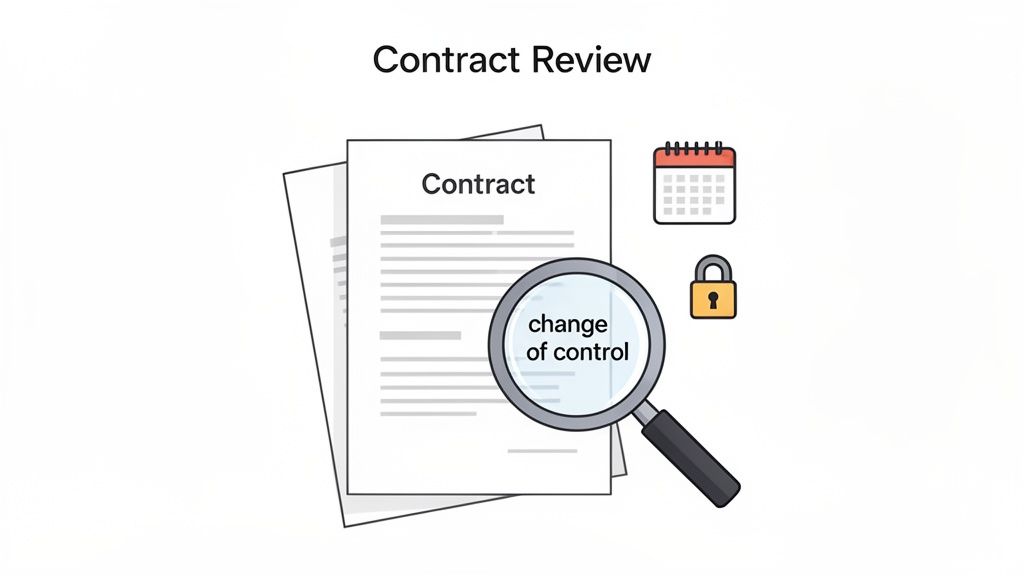
The goal is to analyze customer agreements, vendor and supplier contracts, partnership deals, licensing arrangements, and any other binding documents. This review uncovers potential risks like unfavorable termination clauses, change-of-control provisions that could be triggered by a transaction, and customer concentration that might threaten revenue stability.
Key Verification Steps and Red Flags
- Document Collection: Gather all executed contracts, including amendments, statements of work, and related correspondence. Create a master list or contract abstract to track key terms.
- Change-of-Control Provisions: Identify any clauses that allow a counterparty to terminate or alter the agreement in the event of a merger, acquisition, or change in ownership.
- Assignment and Transferability: Check for restrictions on the company’s ability to assign the contract to a new entity, which is crucial in an M&A context.
- Unusual or Onerous Terms: Look for non-standard terms, automatic renewal clauses without a clear termination process, or unusually high liability caps that could expose the business to excessive risk.
Practical Tips for Efficient Review
Reviewing hundreds of contracts manually is prone to error and incredibly time-consuming. A PDF Summarizer with multi-file chat capabilities can revolutionize this process. Instead of opening each file, you can ask a direct question across the entire document set, such as, "Which of these vendor agreements contain an exclusivity clause?"
Pro Tip: Use a template-based query approach for consistency. For each major customer contract, ask, "What are the key obligations, pricing terms, and renewal dates in this agreement?" This helps an M&A team quickly assess revenue concentration by identifying the top five customers and their contractual stability. Mastering how to extract information from a PDF is a core skill for accelerating this stage of due diligence.
3. Intellectual Property & Technology Documentation
For technology-driven companies, the assessment of intellectual property (IP) and technology assets is often the most critical component of a legal due diligence checklist. This stage involves a deep dive into the ownership, protection, and potential liabilities associated with a company's patents, trademarks, copyrights, trade secrets, and proprietary software. Overlooking IP issues can lead to catastrophic value erosion, unforeseen litigation, or the inability to commercialize core products.
A thorough review requires examining all documentation related to the creation, ownership, and licensing of IP. This includes patent filings, trademark registrations, copyright notices, and employee and contractor IP assignment agreements. For software, this extends to source code reviews, analysis of open-source license compliance, and verification of technology ownership, ensuring no third party can claim rights to the company’s "secret sauce."
Key Verification Steps and Red Flags
- Ownership & Title: Review all IP assignment agreements from employees and contractors to confirm the company legally owns all IP it claims. Gaps here are a major red flag.
- Registration & Status: Verify the status of all registered IP (patents, trademarks) in relevant jurisdictions. Check for any office actions, oppositions, or maintenance fee deadlines that have been missed.
- Freedom to Operate: Analyze whether the company’s technology infringes on third-party patents. A lack of a "freedom to operate" (FTO) analysis can signal high litigation risk.
- Open-Source Compliance: Scrutinize the use of open-source software to ensure compliance with all licenses (e.g., GPL, MIT, Apache). A violation of a "copyleft" license like the GPL could force the company to disclose its proprietary source code.
Practical Tips for Efficient Review
Reviewing complex patent claims or thousands of lines of code dependencies is daunting. A PDF Summarizer can create a master list of all licenses mentioned across various technical documents. You can then ask the tool, “What are all the open-source licenses used in this project and what are their obligations?” to rapidly identify high-risk licenses.
Pro Tip: Use an AI tool to cross-reference inventor lists with IP assignment agreements. Ask, "List all inventors on patent #XXXXXX and confirm if they have a signed IP assignment agreement on file." This helps a tech acquisition team quickly spot chain-of-title defects that could jeopardize the ownership of a critical patent.
4. Financial Records & Statements
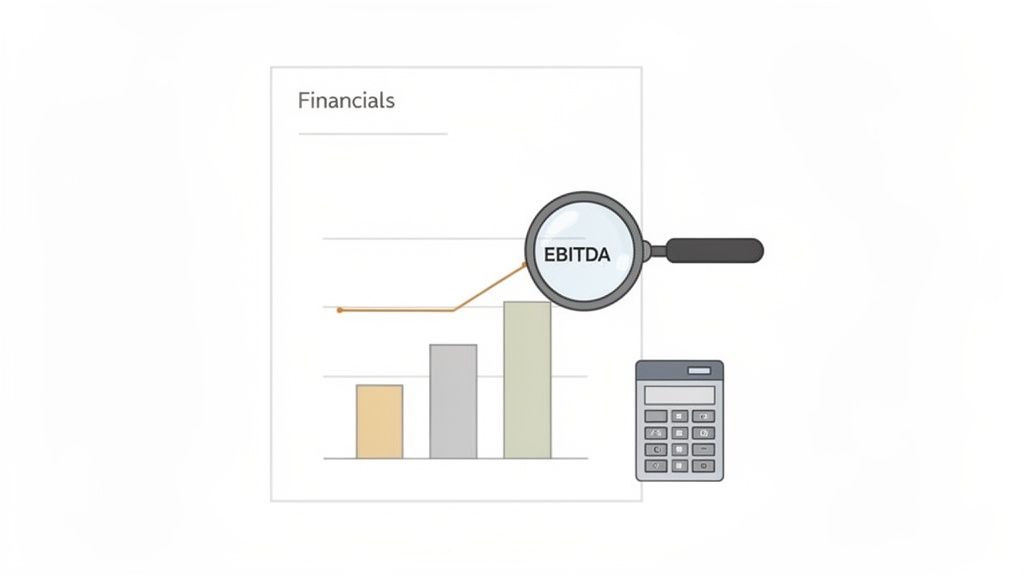
A company's financial health is a critical component of its overall value and risk profile, making a thorough review of its financial records an essential part of any legal due diligence checklist. This stage goes beyond simple numbers on a page; it involves a deep analysis of audited and unaudited financial statements, tax filings, and internal accounting controls to validate financial claims and uncover hidden liabilities.
Assessing financial records means scrutinizing balance sheets, income statements, cash flow statements, and any accompanying audit reports or management letters from external auditors. For those new to this process, understanding how to read financial reports is a crucial first step. This review confirms the company's historical performance, validates its valuation, and provides a clear view of its economic reality.
Key Verification Steps and Red Flags
- Financial Statement Review: Collect and analyze at least 3-5 years of audited financial statements. Compare them against unaudited internal financials to identify discrepancies in revenue recognition, expense allocation, or other key accounting policies.
- Tax Compliance: Verify that all federal, state, and local tax returns have been filed on time and that all taxes have been paid. Look for any ongoing tax audits or disputes with tax authorities.
- Auditor Communications: Carefully read any management letters issued by external auditors. These letters often highlight material weaknesses or significant deficiencies in internal controls that may not be apparent from the financial statements alone.
- Off-Balance-Sheet Items: Scour the footnotes of financial statements for undisclosed liabilities, such as contingent liabilities, special purpose entities, or significant long-term lease obligations that could impact future cash flows.
Practical Tips for Efficient Review
Financial documents are dense and complex, but AI tools can rapidly distill key information. A PDF Summarizer can extract crucial metrics from years of reports in seconds. Ask the tool, “List the annual revenue, gross margin, and EBITDA for fiscal years 2021 through 2023,” to generate a quick performance summary.
Pro Tip: Use a chat-based tool to investigate accounting policies and potential risks. Ask questions like, "What are the material accounting policy changes year-over-year?" or "Summarize all contingent liabilities disclosed in the footnotes of the 2023 annual report." This allows a private equity firm to quickly assess the quality of earnings and identify potential risks before committing to a valuation.
5. Litigation, Disputes & Compliance History
Uncovering a company's history of legal conflicts and regulatory scrutiny is a critical component of any legal due diligence checklist. This stage moves beyond internal governance to examine external pressures, including past, pending, and threatened litigation, regulatory investigations, and compliance violations. A clean bill of health here is rare, but understanding the nature, frequency, and potential financial impact of these issues is essential for accurately valuing a company and anticipating future liabilities.
A thorough review requires a complete disclosure of all legal disputes, from formal lawsuits to regulatory agency letters and significant customer complaints. This includes examining settlement agreements, court filings, and correspondence with government bodies. For an M&A team, identifying a pattern of product liability lawsuits or an unresolved regulatory investigation can fundamentally alter the terms of an acquisition or even halt the deal entirely.
Key Verification Steps and Red Flags
- Comprehensive Disclosure: Request and review a litigation docket listing all past, current, and threatened legal actions, arbitration, and administrative proceedings.
- Regulatory Scrutiny: Analyze all correspondence with regulatory agencies (e.g., SEC, FTC, EPA) to identify investigations, inquiries, or notices of violation.
- Settlement Analysis: Examine settlement agreements to understand financial payouts, admissions of guilt, and ongoing obligations like non-disparagement clauses.
- Pattern Recognition: Be alert for recurring issues. Multiple lawsuits related to the same product defect, employment practice, or contract term may indicate a systemic operational risk rather than an isolated incident.
Practical Tips for Efficient Review
Sifting through complex court documents and regulatory letters can be incredibly time-consuming. A PDF Summarizer can create a high-level overview of the company's entire legal risk profile. Ask the tool to "List all pending litigation cases with dates, amounts claimed, and current status" to generate a concise summary from hundreds of pages of dockets.
Pro Tip: Use a chat-based tool to connect disparate pieces of information. For instance, an insurance underwriter could ask, "What is the total financial exposure from all ongoing employment disputes?" and then cross-reference the answer with the company's Employment Practices Liability Insurance (EPLI) policy. This helps identify potential gaps in coverage and highlights under-disclosed risks that could lead to future uninsured losses.
6. Employee & Labor Documentation
A company's value is often tied to its people, making a thorough review of employee and labor documentation a critical part of any legal due diligence checklist. This stage examines the full spectrum of a company's relationship with its workforce, from individual agreements to broad compliance with labor laws. Unidentified liabilities here, such as misclassified workers or expensive change-of-control payouts, can create significant financial and operational risks post-transaction.
The process involves a comprehensive review of all employment-related documents, including contracts, compensation records, benefits plans, and HR policies. The goal is to verify compliance, identify potential disputes, and understand the true cost and stability of the target company's workforce. For an acquirer, this means assessing retention risk by reviewing executive employment agreements or calculating potential severance obligations before a restructuring.
Key Verification Steps and Red Flags
- Agreement Review: Collect and analyze all employment agreements, offer letters, and independent contractor agreements. Pay close attention to confidentiality, non-compete, and intellectual property assignment clauses.
- Compliance Check: Verify the proper classification of employees versus independent contractors to avoid significant tax and penalty risks. Audit compliance with wage and hour laws, leave policies, and anti-discrimination regulations.
- Compensation & Benefits: Scrutinize all bonus, commission, and equity plans (stock options, RSUs). Review benefit plan documents, including retirement and health plans, to identify any unfunded liabilities or termination obligations.
- Labor Relations: Identify any collective bargaining agreements or union organizing activities. Unresolved grievances or pending labor disputes can represent major contingent liabilities.
Practical Tips for Efficient Review
Reviewing hundreds of individual employment contracts is a daunting task. A PDF Summarizer can isolate critical clauses across the entire dataset. For instance, you can ask the tool, "Extract all change-of-control and severance provisions from executive employment agreements" to quickly quantify potential payout liabilities.
Pro Tip: Use a chat-based tool to aggregate and analyze data from multiple sources. Ask questions like, "What is the total unvested equity liability and its vesting schedule based on the cap table and all grant agreements?" or "Summarize all non-compete clauses for senior engineering staff." This allows a buyer to quickly model the financial impact of retaining key talent and understand potential post-acquisition integration challenges.
7. Regulatory Licenses, Permits & Compliance Certifications
A company's right to operate legally within its industry is contingent upon maintaining a complex web of licenses, permits, and regulatory approvals. This crucial section of a legal due diligence checklist involves verifying that all necessary authorizations are current, valid, and free from any pending disciplinary actions. A single lapsed permit or compliance failure can lead to severe fines, operational shutdowns, or even criminal liability, making this a high-stakes area of investigation.
The scope of this review varies dramatically by industry. For a healthcare provider, this means verifying medical licenses and facility accreditations. For a financial services firm, it involves confirming proper SEC or FINRA registrations. Even a SaaS company must often demonstrate compliance with standards like SOC 2 or HIPAA. A thorough review ensures the business has the foundational legal authority to conduct its core operations without interruption.
Key Verification Steps and Red Flags
- Comprehensive Inventory: Compile a complete list of all required federal, state, local, and industry-specific licenses, permits, and certifications needed to operate the business.
- Status and Validity: For each item on the inventory, confirm its current status, expiration date, and any conditions for renewal. Obtain copies of all permits and correspondence with regulatory agencies.
- Compliance History: Investigate any past or pending violations, fines, or disciplinary actions. A history of non-compliance can signal underlying operational weaknesses and future risks.
- "At-Risk" Licenses: Identify any licenses that are in jeopardy due to pending regulatory changes, unresolved compliance issues, or upcoming renewal challenges. These pose an immediate threat to business continuity.
Practical Tips for Efficient Review
Regulatory files are often dense with legal jargon and specific compliance requirements. A PDF Summarizer can quickly distill this information. You can upload all permit documents and ask, “List all license expiration dates and renewal requirements for the next 12 months” to build a compliance calendar instantly.
Pro Tip: Use a chat-based tool to proactively identify potential issues. Ask questions like, "Summarize all correspondence with the Environmental Protection Agency regarding permit #XYZ" to understand the history and context of any regulatory interactions. This is invaluable for a buyer acquiring a manufacturing plant, as it can uncover hidden environmental liabilities or ongoing disputes that wouldn't be apparent from the permit alone.
8. Environmental, Health & Safety Compliance
Often overlooked in non-industrial transactions, a company’s environmental, health, and safety (EHS) compliance record can hide significant liabilities. This part of a legal due diligence checklist involves assessing regulatory adherence, potential contamination issues, workplace safety protocols, and any outstanding cleanup obligations. A seemingly minor violation can lead to substantial fines, operational shutdowns, and costly remediation efforts, making this a critical area of investigation.
A thorough EHS review involves examining everything from federal and state environmental permits to Occupational Safety and Health Administration (OSHA) records. For example, a real estate acquirer must conduct a Phase I environmental site assessment before a property purchase to avoid inheriting cleanup costs. Similarly, a manufacturing company must review its OSHA inspection records and any resulting remediation plans to understand its operational risks and potential financial liabilities.
Key Verification Steps and Red Flags
- Permit and License Review: Collect and verify all necessary environmental permits, licenses, and authorizations required for current and past operations. Ensure they are valid and that the company is in full compliance with their terms.
- Compliance History: Investigate the company’s history of EHS violations, including any notices of violation, consent decrees, administrative orders, or litigation. Look for patterns of non-compliance.
- Site Assessments: Review any existing Phase I or Phase II environmental site assessment reports. The absence of such reports for industrial properties is a significant red flag.
- Workplace Safety Records: Scrutinize OSHA logs (like Form 300), workers' compensation claims history, and internal safety audit reports to identify systemic safety issues or undisclosed workplace hazards.
Practical Tips for Efficient Review
EHS documentation can be dense with technical jargon and regulatory citations. A PDF Summarizer can rapidly distill this information. Instead of manually cross-referencing years of inspection reports, you can ask the tool, "List all OSHA violations from the last five years, including dates, fines, and remediation status."
Pro Tip: Use a chat-based tool to connect disparate EHS documents. Ask questions like, “What hazardous materials are listed in the environmental permits?” and then follow up with, “Summarize the handling procedures for these materials from the safety manuals.” This allows an investor in a chemical company to quickly verify that operational protocols align with regulatory permits, preventing potential compliance gaps that could devalue the investment.
9. Tax Compliance & Statutory Filings
A company's tax history is a direct reflection of its financial health and operational discipline, making tax compliance a critical checkpoint in any legal due diligence checklist. This stage involves a deep dive into all tax-related documents to uncover hidden liabilities, assess compliance with relevant laws, and understand the company’s overall tax posture. Undiscovered tax issues can lead to significant financial penalties and legal disputes post-transaction.
The review must cover federal, state, local, and international tax filings, including income, sales, payroll, and property taxes. Additionally, understanding the nuances of jurisdiction-specific requirements, such as the process for corporate tax filing in the UAE, is essential for assessing financial liabilities in global operations. The goal is to verify that the company has met all its statutory obligations accurately and on time.
Key Verification Steps and Red Flags
- Document Review: Collect and scrutinize all tax returns for the past five to seven years, including any correspondence with tax authorities like the IRS or state agencies.
- Audit History: Analyze the history of any tax audits, reviewing notices, reports, and final resolutions. Identify any recurring issues that might indicate systemic problems.
- Contingent Liabilities: Search for any recorded tax contingencies or disputes. These represent potential future financial drains that must be factored into the transaction’s valuation.
- Transfer Pricing Risks: For companies with international subsidiaries, examine transfer pricing documentation to ensure compliance with arm's-length principles and mitigate the risk of penalties.
Practical Tips for Efficient Review
Tax records are notoriously dense, but AI-powered tools can quickly distill complex information. A PDF Summarizer allows you to bypass manual review and pinpoint crucial data points. For instance, you can ask the tool, “Summarize all tax audit notices and the current status of any disputes.”
Pro Tip: Use targeted queries to evaluate specific tax positions and financial health. Ask questions like, "What is the effective tax rate, and how has it changed over the last three years?" or "Identify any tax credits or incentives being claimed." This is invaluable for M&A teams looking to identify contingent tax liabilities before closing a deal, ensuring no costly surprises emerge after the acquisition.
10. Insurance Policies & Coverage Documentation
A company's insurance portfolio serves as a critical financial backstop against unforeseen liabilities. Evaluating these policies is a non-negotiable part of any legal due diligence checklist, as it reveals how the company mitigates operational, financial, and legal risks. A thorough review assesses not only the existence of coverage but also its adequacy, potential gaps, and the history of claims, which can signal underlying business problems.
The primary goal is to create a complete inventory of all insurance policies, including general liability, professional liability, directors and officers (D&O), property, and cybersecurity coverage. From there, you must scrutinize the coverage limits, exclusions, and claims history to determine if the protection is sufficient for the company’s risk profile and the nature of the transaction. This is crucial for an acquirer who will inherit these potential liabilities.
Key Verification Steps and Red Flags
- Policy Inventory: Gather all current and past insurance policies. Create a schedule detailing the policy type, insurer, coverage period, limits, and deductibles.
- Adequacy Assessment: Compare the coverage limits against industry benchmarks and the company's specific risk exposures identified in other areas of due diligence, like litigation and environmental reports.
- Claims History Review: Analyze the company's loss-run reports to identify patterns of frequent claims, which could indicate systemic operational issues or an elevated risk profile.
- Exclusion Scrutiny: Pay close attention to policy exclusions. A cyber insurance policy with a broad exclusion for state-sponsored attacks, for example, might offer little real-world protection for a company in a high-risk sector.
Practical Tips for Efficient Review
Reviewing dense insurance policies can be slow and tedious. A PDF Summarizer can create a high-level inventory in minutes. You can ask, "List all insurance policies, their respective coverage limits, deductibles, and expiration dates," to generate a master summary.
Pro Tip: Use a chat-based tool to probe for specific risks. For a company preparing for an IPO, you can ask, "What are the key exclusions and claim notification procedures for the D&O policy?" This helps quickly assess whether the coverage will adequately protect directors and officers from shareholder lawsuits post-offering. Verifying the availability and cost of "tail coverage" is also critical to ensure protection for pre-closing acts after the transaction is complete.
10-Item Legal Due Diligence Checklist Comparison
| Item | Implementation complexity | Resource requirements | Expected outcomes | Ideal use cases | Key advantages |
|---|---|---|---|---|---|
| Corporate Structure & Organizational Documents | Medium — legal review and cross-referencing | Corporate counsel, document indexing, cap table review | Clear legal authority, ownership structure, governance timeline | Due diligence for investments, verifying board authority before transactions | Confirms authority and ownership; quickly extracts governance provisions |
| Contracts & Material Agreements | High — many lengthy, complex agreements | Contract lawyers, reviewers, multi-document comparison tools | Identification of obligations, change-of-control and termination risks | M&A contract review, revenue concentration analysis, vendor risk assessment | Reveals material commitments and clauses; rapid clause extraction across files |
| Intellectual Property & Technology Documentation | High — technical and legal expertise required | IP counsel, engineers for code review, license auditors | Clarified ownership, patent/value assessment, license compliance | Tech acquisitions, patent portfolio analysis, open-source compliance checks | Protects against infringement, identifies valuable IP and licensing obligations |
| Financial Records & Statements | High — accounting expertise and detailed analysis | Accountants, auditors, financial modeling tools | Objective view of financial health, EBITDA quality, accounting red flags | PE valuations, lender credit reviews, comparative financial analysis | Provides audited metrics and trends; extracts key financial indicators quickly |
| Litigation, Disputes & Compliance History | Medium–High — legal assessment of exposure | Litigation counsel, case file consolidation, regulatory experts | Consolidated contingent liabilities and dispute status | M&A risk assessment, insurance underwriting, regulatory compliance checks | Identifies litigation patterns and potential liabilities; consolidates case status |
| Employee & Labor Documentation | Medium — privacy and cross-system coordination | HR, employment lawyers, payroll/equity records | Employment liabilities, retention and severance exposure, equity obligations | Assessing retention risk in acquisitions, HR compliance audits | Reveals equity and severance liabilities; extracts vesting and change-of-control terms |
| Regulatory Licenses, Permits & Compliance Certifications | Medium — jurisdiction- and industry-specific | Regulatory specialists, agency records, certification documents | Verification of legal operating status, renewal schedules, compliance requirements | Industry compliance checks, pre-close operational readiness, licensing audits | Ensures lawful operation; enables compliance calendars and renewal tracking |
| Environmental, Health & Safety Compliance | Medium–High — technical environmental assessment | EHS consultants, Phase I/II reports, OSHA records | Identification of contamination risks, remediation obligations, safety issues | Real estate transactions, manufacturing due diligence, EHS risk reviews | Detects environmental liabilities and remediation needs; summarizes violation history |
| Tax Compliance & Statutory Filings | High — complex, multi-jurisdictional analysis | Tax counsel, accountants, transfer pricing specialists | Tax contingent liabilities, audit exposure, effective tax positions | M&A tax diligence, cross-border structuring, lender tax reviews | Highlights tax risks and uncertain positions; extracts tax contingencies and accruals |
| Insurance Policies & Coverage Documentation | Medium — policy detail and exclusions analysis | Risk managers, brokers, claims history, policy documents | Coverage inventory, gaps, limits, exclusions and tail coverage needs | IPO readiness, M&A risk transfer, cyber/privacy exposure assessments | Creates complete coverage inventory; identifies exclusions and coverage gaps |
From Checklist to Confident Decisions: Your Next Steps
Navigating the labyrinth of legal due diligence is a formidable challenge, but one that is essential for the integrity and success of any major transaction. This comprehensive legal due diligence checklist, spanning ten critical areas from corporate structure to insurance coverage, is more than just a list of documents to collect. It is a strategic roadmap designed to transform a mountain of information into a clear, panoramic view of an organization's health, liabilities, and true value. By meticulously working through each category, you methodically dismantle uncertainty and replace risky assumptions with verifiable facts.
The core principle to carry forward is that due diligence is not merely a "red flag" hunting exercise. While identifying deal-breaking risks is a crucial outcome, the ultimate goal is to achieve a profound and holistic understanding of the target entity. This process empowers you to negotiate from a position of strength, accurately price the transaction, and proactively plan for post-merger integration. It reveals the unseen operational synergies just as readily as it uncovers hidden litigation risks or intellectual property disputes.
Synthesizing Diligence: From Data Points to Strategic Insight
The true mastery of legal due diligence lies not in the collection of documents but in their synthesis. Each piece of information, whether a clause in a material contract or a permit from a regulatory body, is a single data point. The real value emerges when you connect these points to form a cohesive narrative about the business.
Consider these pivotal connections:
- Contracts and Financials: Do the payment terms and revenue recognition clauses in major customer contracts align with the company's reported financial statements? A discrepancy could signal aggressive accounting or future revenue instability.
- Intellectual Property and Employee Agreements: Does the company have signed IP assignment agreements from all key developers and employees? Gaps here could jeopardize ownership of core technology, a critical insight that connects HR documentation directly to asset valuation.
- Regulatory Compliance and Insurance: Are the company's environmental permits current and in good standing? An examination of their insurance policies might reveal exclusions for pollution-related incidents, creating a significant, uninsured risk profile.
This process of cross-referencing and triangulation is what separates a perfunctory review from a deeply strategic analysis. It’s about understanding how a single issue in one area, like an expired environmental permit, can cascade into financial liabilities, operational shutdowns, and reputational damage.
The Modern Diligence Toolkit: Speed, Accuracy, and Focus
In today's fast-paced deal environment, time is a non-renewable resource. The sheer volume of documentation required by a thorough legal due diligence checklist can be overwhelming, leading to reviewer fatigue and the potential for critical details to be missed. This is where modern technology becomes an indispensable partner, not a replacement for legal expertise but an amplifier of it.
Leveraging tools designed for rapid document analysis allows legal teams to automate the initial, time-intensive phases of review. Instead of manually reading hundreds of pages to find a specific change of control clause, you can instantly extract and compare them across dozens of agreements. This technological advantage allows skilled legal professionals to shift their focus from low-value data extraction to high-value strategic analysis, risk assessment, and advisory. By combining a structured, comprehensive checklist with powerful analytical tools, you create a due diligence process that is not only faster but also more accurate and insightful. This synergy ensures that your team's expertise is applied where it matters most, leading to better decisions and more successful outcomes.
Ultimately, completing a legal due diligence checklist is the definitive step toward mitigating risk and unlocking value. It provides the empirical foundation upon which confident, strategic decisions are built, ensuring that your next major business move is informed, secure, and poised for success.
Ready to accelerate your document review process and conquer your legal due diligence checklist with unparalleled speed and accuracy? Discover how PDF Summarizer can instantly extract key clauses, answer critical questions across thousands of pages, and cite sources for verification. Visit PDF Summarizer to transform your diligence workflow today.
Recent articles

Learn how to merge pdf foxit reader PDFs quickly with step-by-step tips, free options, and 2026 updates.

Learn how to open pdf in google docs across devices, fix formatting, and edit PDFs with ease.

Discover the 12 best document collaboration tools for any team. Compare features, pricing, and use cases to find the perfect platform for your workflow.

Learn how to add citations in Google Docs using the built-in tool, add-ons like Zotero, and an advanced PDF workflow. Master APA, MLA, and Chicago styles.

Discover the best citation management software for your research. Compare Zotero, EndNote, Mendeley, and more to find the perfect tool for your workflow.

Explore critical thinking skills for students with practical strategies to analyze information, argue persuasively, and boost academic success.