8 Research plan examples You Should Know
Discover the top 8 research plan examples strategies and tips. Complete guide with actionable insights.

A well-structured research plan is the foundational blueprint for any successful inquiry, whether you're a student embarking on a thesis, a professional launching a market study, or an academic pursuing a complex scientific question. It transforms a vague idea into a tangible, actionable strategy, ensuring your efforts are focused, efficient, and methodologically sound. Without a clear plan, projects risk scope creep, wasted resources, and inconclusive results. A strong plan forces you to clarify your objectives, anticipate challenges, and define exactly what success looks like before you even begin collecting data.
This guide moves beyond abstract theory to provide a curated collection of concrete research plan examples. We will deconstruct a diverse range of plans, from quantitative empirical studies to qualitative case analyses, highlighting the strategic thinking behind each component. Instead of just showing you a finished document, we break down why certain decisions were made and how they connect to the overall research goals. You will gain a practical understanding of how to articulate research questions, select appropriate methodologies, and structure a realistic timeline.
By analyzing these detailed examples, you will learn to:
- Structure Your Thinking: See how experienced researchers frame their aims, background, and methods for maximum clarity and impact.
- Identify Key Components: Understand the non-negotiable elements every robust research plan must include, from ethical considerations to budget allocations.
- Adapt Strategies for Your Needs: Discover how to modify these templates for your specific discipline, whether it's an academic thesis, an industry project, or a compliance review.
Each example is paired with actionable takeaways and common pitfalls to avoid, providing a replicable framework for developing your own high-quality research plan. Let's dive into the examples that will help you build your project with confidence and precision.
1. Quantitative Empirical Research Plan
A quantitative empirical research plan is a systematic approach focused on collecting and analyzing numerical data to test specific hypotheses. This method emphasizes objectivity, measurement, and statistical analysis, making it a cornerstone for fields like psychology, economics, and clinical science where verifiable and generalizable results are crucial. The core idea is to translate phenomena into numbers, allowing for rigorous testing and pattern identification across large sample sizes.
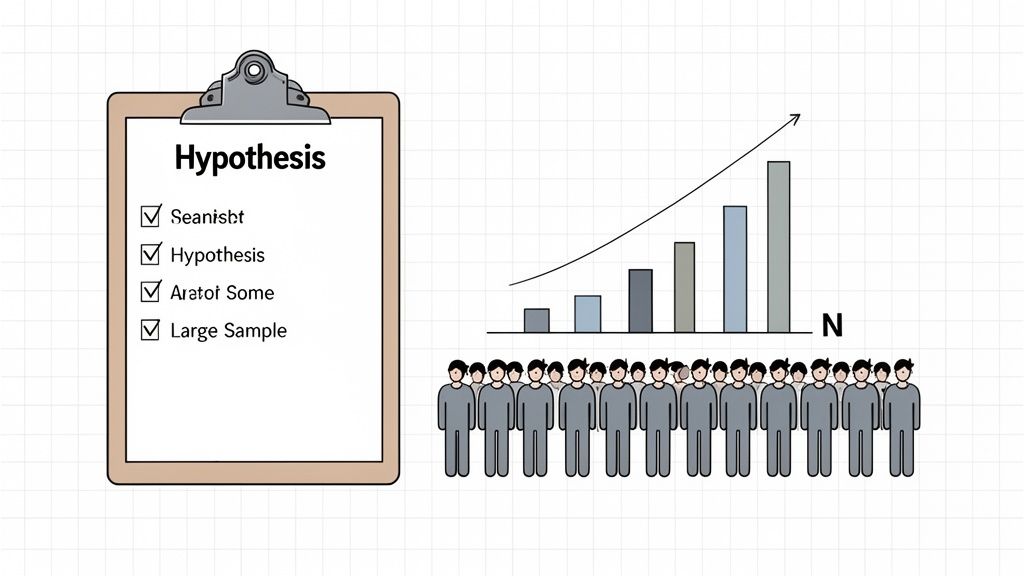
This plan is essential when your goal is to confirm or falsify a theory, measure the impact of a variable, or establish a cause-and-effect relationship. Its structured nature, from hypothesis formulation to data analysis, ensures that the research process is reproducible, a key requirement for scientific validity.
Strategic Breakdown and Application
This type of plan excels in providing clear, data-backed answers to specific questions. It's not about exploring vague ideas; it's about testing precise predictions.
- When to Use It: Employ this plan when you need to quantify a problem, such as determining the percentage of consumers who prefer a new product feature or measuring the effectiveness of a new teaching method on student test scores.
- Key Benefit: The primary advantage is its ability to produce objective and statistically significant results that can be generalized to a larger population. This makes it one of the most powerful research plan examples for evidence-based decision-making.
- Common Pitfalls: A major risk is poor experimental design, leading to biased results. For instance, using a non-random sample in a survey can skew the data and invalidate the conclusions. Another pitfall is misinterpreting statistical significance as practical importance.
Actionable Takeaways for Your Plan
To build a robust quantitative plan, focus on precision from the start. Define your variables, establish clear metrics, and pre-plan your statistical tests before collecting any data.
Pro-Tip: Before designing your study, perform a thorough literature review of existing quantitative research in your field. This helps you identify validated survey instruments, appropriate statistical methods, and potential gaps in knowledge. Using advanced AI-powered academic research tools can significantly accelerate this process, helping you synthesize information from dozens of papers quickly. Learn more about leveraging these tools for your research.
Finally, always conduct a power analysis to determine the minimum sample size needed to detect a statistically significant effect. This ensures your study is adequately equipped to produce meaningful results without wasting resources.
2. Qualitative Exploratory Research Plan
A qualitative exploratory research plan is an inductive approach designed to understand complex social phenomena through in-depth observation, open-ended interviews, and textual analysis. This method prioritizes context, nuance, and meaning over numerical measurement, making it ideal for fields like sociology, anthropology, and user experience (UX) research. Its core objective is to explore the 'how' and 'why' behind human behavior, generating rich, narrative-based insights rather than testing pre-defined hypotheses.
This plan is foundational when you are entering a new area of study or seeking to understand a topic from the participants' perspective. It is flexible by nature, allowing the research questions to evolve as data is collected and new themes emerge. This adaptability is key to uncovering unexpected patterns and developing new theories grounded in real-world experiences.
Strategic Breakdown and Application
This type of plan excels at generating deep, contextual understanding and uncovering the motivations, opinions, and feelings that drive behavior. It's about exploring the unknown, not confirming the known.
- When to Use It: Employ this plan when you need to explore a problem in detail, such as an ethnographic study of workplace culture, in-depth interviews on patient experiences with a new treatment, or a case study analyzing organizational change.
- Key Benefit: Its primary strength is the depth of insight it provides. Qualitative research reveals complex layers of meaning that quantitative methods might miss, making it one of the most effective research plan examples for developing a holistic understanding of a subject.
- Common Pitfalls: A major risk is researcher bias influencing data interpretation. Since the researcher is the primary instrument for data collection and analysis, their own perspectives can unintentionally shape the findings. Another pitfall is a lack of rigor in thematic analysis, leading to superficial or unsupported conclusions.
Actionable Takeaways for Your Plan
To develop a strong qualitative plan, focus on building rapport with participants and maintaining meticulous, reflective notes (a process known as reflexivity). Your methodology should be transparent, detailing how you will code data and identify themes to ensure credibility.
Pro-Tip: Before finalizing your interview questions or observation framework, conduct a literature review to identify established qualitative methodologies and coding frameworks. Using AI-powered tools can help you rapidly analyze existing studies, extract key methods, and identify recurring themes across different research papers. This groundwork ensures your approach is informed by best practices in the field.
Finally, consider triangulation by using multiple data sources (e.g., interviews, observations, and document analysis) to validate your findings. Incorporating different perspectives strengthens the reliability of your interpretations and provides a more comprehensive picture of the phenomenon under study. Learn more about using document analysis in your qualitative research.
3. Mixed-Methods Research Plan
A mixed-methods research plan is an integrated approach that combines both quantitative (numerical) and qualitative (contextual) data within a single study. This methodology leverages the strengths of both paradigms, using statistical rigor to identify trends and in-depth narratives to understand the "why" behind those trends. It is increasingly popular in fields like education, public health, and organizational studies for its ability to produce a comprehensive, multi-dimensional understanding of complex research questions.
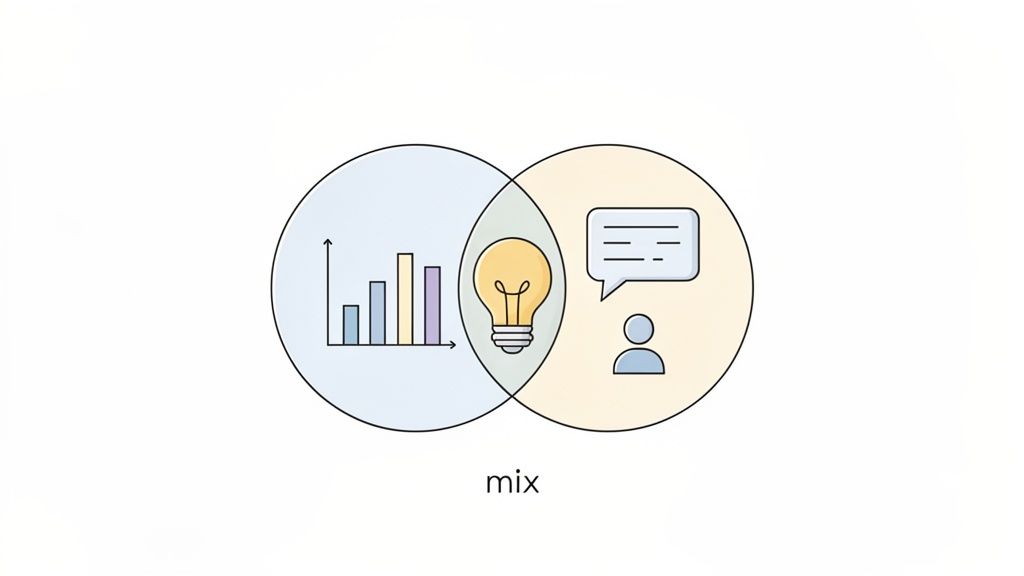
This plan is essential when one data type alone is insufficient to capture the full picture. For instance, quantitative surveys might show what percentage of employees are dissatisfied, but qualitative interviews reveal the specific management issues why they feel that way. The power of this approach lies in its ability to triangulate findings, where data from one method validates or expands upon data from the other.
Strategic Breakdown and Application
This type of plan is designed to provide richer, more nuanced insights by layering different forms of evidence. It moves beyond simple measurement to build a holistic narrative around a research problem.
- When to Use It: Employ this plan when you need to both measure a phenomenon and explore it in depth. Examples include evaluating an educational program by combining test scores with teacher interviews, or assessing a public health campaign by measuring behavior change rates alongside participant focus groups.
- Key Benefit: The primary advantage is its ability to produce more robust and credible conclusions. By integrating different data sources, it mitigates the weaknesses of a single-method approach, making it one of the most comprehensive research plan examples available.
- Common Pitfalls: A major challenge is the complexity of data integration. Researchers may struggle to effectively merge statistical results with qualitative themes, sometimes presenting them as two separate, disconnected studies. Another risk is the significant time and resource commitment required to properly execute both methods.
Actionable Takeaways for Your Plan
To develop a strong mixed-methods plan, you must clearly define the purpose of the integration from the outset. Decide whether the qualitative data will explain the quantitative results (sequential design) or if both will be collected simultaneously to provide a complete picture (convergent design).
Pro-Tip: Before finalizing your methodology, use a tool that supports multi-file analysis to compare different mixed-methods protocols from published papers in your field. Upload several relevant studies and ask the AI to summarize how each research team integrated their quantitative and qualitative findings. This helps you identify best practices for data triangulation and create a more coherent integration strategy for your own plan.
Finally, explicitly map out how and when you will integrate your data. Will you use qualitative findings to build a quantitative survey, or will you use survey results to select participants for follow-up interviews? A clear integration strategy is the hallmark of a well-designed mixed-methods study.
4. Literature Review and Meta-Analysis Research Plan
A literature review and meta-analysis research plan is a systematic approach to surveying, synthesizing, and analyzing existing academic research on a specific topic. This method aims to identify patterns, gaps, and contradictions in the body of knowledge. A meta-analysis elevates this by statistically combining results from multiple independent studies to produce a single, more powerful quantitative summary. This plan is foundational for establishing theoretical frameworks and is essential in fields like medicine, psychology, and social sciences.
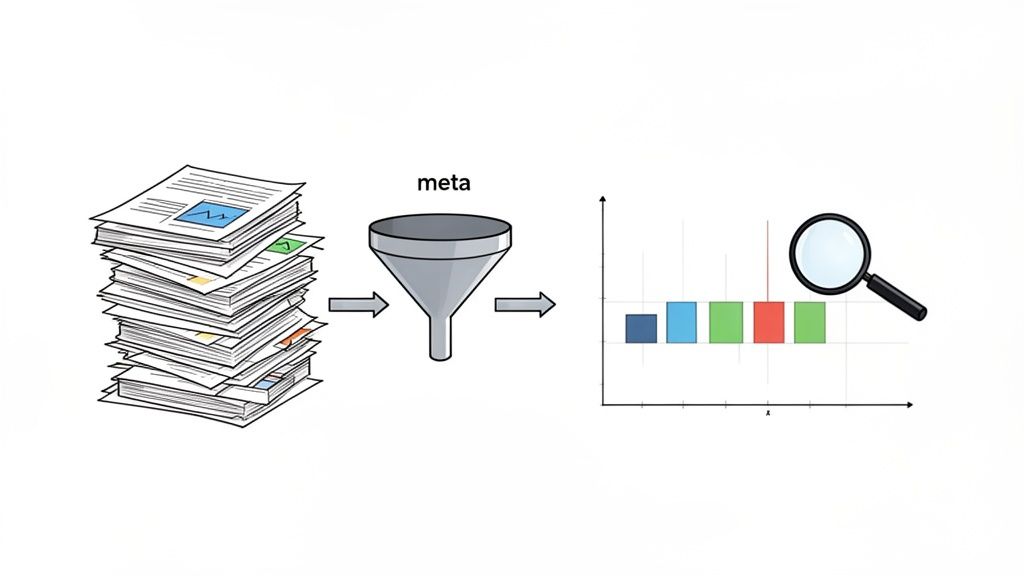
This plan is critical when you need to understand the current state of knowledge before launching a new study. Its rigorous, structured process, often following guidelines like PRISMA, ensures the review is comprehensive, unbiased, and reproducible, lending significant credibility to its conclusions.
Strategic Breakdown and Application
This plan serves as the backbone of evidence-based practice, moving beyond a simple summary to a structured synthesis of existing data. It provides a panoramic view of a research field.
- When to Use It: Employ this plan to establish the intellectual context for a new project, such as a Ph.D. dissertation, or to create a definitive summary of evidence, like a Cochrane review on a medical intervention's effectiveness.
- Key Benefit: Its primary advantage is providing a comprehensive, evidence-based answer to a broad research question without generating new empirical data. This makes it one of the most efficient and impactful research plan examples for advancing scientific understanding.
- Common Pitfalls: A major risk is "publication bias," where studies with significant findings are more likely to be published and included, skewing the results. Another pitfall is the "apples and oranges" problem, where researchers incorrectly combine studies that are too different in their methods or populations.
Actionable Takeaways for Your Plan
To develop a strong literature review or meta-analysis plan, you must define clear inclusion and exclusion criteria for studies at the outset. This ensures your review is focused and systematic. For those developing a specific literature review or meta-analysis, an excellent resource provides an actionable guide on how to write a literature review.
Pro-Tip: Use advanced AI tools to accelerate the initial screening process. You can upload dozens of research papers and use multi-file chat features to quickly extract key details like methodologies, sample sizes, and findings, creating comparison tables automatically. This helps you efficiently filter relevant studies and synthesize information. Learn more about conducting a literature review with these tools.
Finally, always pre-register your review protocol on a platform like PROSPERO. This promotes transparency and helps prevent selective reporting of results, strengthening the integrity of your findings.
5. Case Study Research Plan
A case study research plan is a qualitative approach that facilitates an in-depth, multi-faceted investigation of a single case or a small number of cases within their real-world context. This method is exceptionally powerful for understanding complex phenomena where the boundaries between the subject and its environment are not clearly evident. It is a cornerstone for fields like management, law, education, and psychology, where context is critical to understanding outcomes.
This plan is essential when your research aims to answer "how" or "why" questions about a contemporary set of events over which you have little or no control. The strength of a case study lies in its ability to draw from multiple sources of evidence, such as interviews, documents, and observations, to develop a comprehensive and holistic understanding.
Strategic Breakdown and Application
This type of plan excels at providing rich, detailed narratives and explanatory insights into real-life situations. It is not about statistical generalization but about analytical generalization, where the goal is to expand and generalize theories.
- When to Use It: Employ this plan to investigate a specific instance in great detail. Examples include an organizational case study of a company’s digital transformation journey, a legal analysis of a landmark court decision, or an educational case study on a school's successful literacy intervention program.
- Key Benefit: Its primary advantage is depth. By focusing intensely on a single or a few cases, researchers can uncover nuanced details and causal mechanisms that other methods might miss. This makes it one of the most effective research plan examples for generating new hypotheses and testing theories in natural settings.
- Common Pitfalls: A major risk is a lack of rigor. Without a well-defined research protocol, the study can become a disorganized collection of anecdotes. Another pitfall is the potential for researcher bias to influence the findings, as the investigator is deeply involved in data collection and interpretation.
Actionable Takeaways for Your Plan
To build a robust case study plan, establish a clear research protocol before you begin. This protocol should define your case selection criteria, data collection procedures, and the specific questions you will ask to guide your analysis.
Pro-Tip: Before finalizing your design, use advanced academic research tools to review multiple published case studies in your field. This helps you understand different approaches to case selection and data analysis. Analyzing how established researchers structure their case documentation and triangulate data from various sources will provide a strong foundation for your own methodology.
Finally, ensure data triangulation by using multiple sources of evidence to corroborate your findings. For example, supplement interview data with archival records and direct observations. This practice significantly enhances the validity and reliability of your conclusions.
6. Action Research and Program Evaluation Plan
An action research and program evaluation plan is a practical, cyclical approach where researchers and practitioners collaborate to solve real-world problems. This method integrates problem diagnosis, intervention, and evaluation into a continuous improvement loop, making it ideal for dynamic environments like schools, hospitals, or community organizations. Its core focus is on generating immediate, actionable insights to improve practices on the ground.
This plan is essential when the goal is not just to understand a problem but to actively solve it through iterative change. By involving stakeholders directly in the research process, it ensures that the solutions are relevant, feasible, and sustainable within a specific context, making it one of the most hands-on research plan examples.
Strategic Breakdown and Application
This type of plan thrives on collaboration and feedback, turning research into a tool for tangible improvement rather than a purely academic exercise. It is a research strategy of, by, and for the practitioners involved.
- When to Use It: Employ this plan to evaluate and enhance the effectiveness of specific programs or interventions. Examples include a teacher testing a new pedagogical technique in their classroom, a hospital unit refining a patient safety protocol, or a nonprofit assessing the impact of a community outreach initiative.
- Key Benefit: The primary advantage is its direct applicability and focus on practical outcomes. The findings immediately inform decisions and lead to demonstrable improvements, fostering a culture of evidence-based practice and continuous learning.
- Common Pitfalls: A major risk is the potential for bias, as researchers are often deeply involved in the program being evaluated. Maintaining objectivity can be challenging. Another pitfall is a lack of rigor if the cyclical process is not documented systematically, making it difficult to replicate or validate findings.
Actionable Takeaways for Your Plan
To develop a successful action research plan, establish a clear and collaborative framework from the outset. Define roles, agree on the problem, and map out the cycles of planning, acting, observing, and reflecting with all stakeholders.
Pro-Tip: Before launching your project, use a PDF Summarizer to review published action research studies and program evaluations in your field. This will help you identify proven evaluation frameworks, effective data collection methods (like interviews, observations, and surveys), and common metrics for success. Analyzing how other programs have adapted their interventions based on initial results can provide a valuable roadmap for your own cycles of improvement.
Finally, ensure your plan includes robust documentation methods. Keeping detailed records of each cycle, including the changes made and the resulting outcomes, is crucial for demonstrating the program’s impact and justifying further action.
7. Longitudinal and Cohort Research Plan
A longitudinal research plan is a powerful design that involves repeatedly observing the same subjects over an extended period, which can span from months to decades. This method is crucial for tracking change, developmental trajectories, and long-term outcomes. A specific type, the cohort study, follows a group of individuals who share a common characteristic (like birth year or exposure to an event) forward in time, enabling researchers to investigate causal relationships and temporal patterns.
This plan is indispensable for fields like epidemiology, developmental psychology, and sociology, where understanding how phenomena unfold over time is key. Studies like the Framingham Heart Study, which has tracked cardiovascular disease risk factors for generations, demonstrate the profound impact of this approach on public health.
Strategic Breakdown and Application
This plan is uniquely suited for answering "what happens over time?" questions. It moves beyond a static snapshot to capture the dynamics of development, disease progression, or the long-term effects of social policies.
- When to Use It: Implement this plan when your research question involves change, such as tracking the cognitive development of children, observing the long-term effects of a public health intervention, or studying career trajectories over a lifetime.
- Key Benefit: Its primary advantage is the ability to establish temporal sequence, which is a critical condition for inferring causality. By observing how variables change over time, researchers can more confidently link early-life factors to later-life outcomes, making it one of the most insightful research plan examples available.
- Common Pitfalls: The biggest challenge is participant attrition, where subjects drop out over time, potentially biasing the results. Another major pitfall is the high cost and significant time commitment required to maintain contact with participants and collect data consistently over many years.
Actionable Takeaways for Your Plan
To develop a successful longitudinal plan, meticulous planning for participant retention is paramount from day one. This includes building rapport, maintaining regular contact, and offering incentives for continued participation.
Pro-Tip: Before launching your study, use academic research tools to analyze the methodologies of landmark longitudinal studies like the Dunedin Study or Add Health. Focus specifically on their retention strategies, data collection intervals, and how they managed missing data. This analysis provides a proven blueprint for anticipating and mitigating the inevitable challenges of long-term research.
Finally, define your measurement instruments and data collection protocols with extreme care, as they must remain consistent over the entire study period to ensure data validity. Any changes to methods mid-stream can compromise the integrity of your longitudinal comparisons.
8. Experimental Design and Randomized Controlled Trial (RCT) Research Plan
An experimental design research plan is the gold standard for determining cause-and-effect relationships. This rigorous method involves intentionally manipulating one or more variables (the treatment) and randomly assigning participants to different groups, including a control group that does not receive the treatment. The Randomized Controlled Trial (RCT) is the most well-known application, especially in fields like medicine, public health, and social policy, where proving an intervention's direct impact is critical.
This plan is essential for answering questions like "Does this drug work?" or "Is this new educational program more effective than the old one?" By controlling variables and using randomization, researchers can minimize bias and be confident that observed differences in outcomes are due to the intervention itself, not other confounding factors.
Strategic Breakdown and Application
This plan's strength lies in its ability to isolate and measure the impact of a specific intervention, providing strong evidence for causality. It is designed for definitive testing, not preliminary exploration.
- When to Use It: Employ an RCT plan when you need to test the efficacy of an intervention. Examples include FDA clinical trials for new medications, evaluating a new teaching curriculum against the standard one, or testing the impact of a job training program on employment rates.
- Key Benefit: The primary advantage is its high internal validity. Randomization ensures that, on average, the treatment and control groups are comparable before the intervention, making it one of the most credible research plan examples for establishing causality.
- Common Pitfalls: RCTs can be expensive, time-consuming, and ethically complex. A major risk is "attrition," where participants drop out of the study, potentially biasing the results if one group has a higher dropout rate. Another pitfall is a poorly executed randomization process, which undermines the entire design.
Actionable Takeaways for Your Plan
To develop a strong RCT plan, meticulous planning of the protocol is non-negotiable. This includes defining clear inclusion/exclusion criteria for participants, establishing a robust randomization method, and pre-specifying the primary outcomes you will measure.
Pro-Tip: Before drafting your experiment, review existing RCT protocols and published trial results in your domain. This helps you grasp best practices for sample size calculation, blinding procedures (single vs. double-blind), and statistical analysis plans. AI-powered tools can help you rapidly extract and compare these critical design elements from dozens of complex research papers.
Finally, ethical considerations are paramount. Ensure you have a clear plan for informed consent and a process for monitoring participant safety throughout the trial. To further delve into the practical aspects of structuring such a plan, consider consulting a comprehensive Guide to Protocol Development for Clinical Trials.
8 Research Plan Types Compared
| Research Plan | Implementation complexity | Resource requirements | Expected outcomes | Ideal use cases | Key advantages |
|---|---|---|---|---|---|
| Quantitative Empirical Research Plan | Moderate–High (rigorous design, statistical planning) | High (large samples, instruments, statistical software) | Generalizable numeric results; hypothesis tests; effect sizes | Hypothesis testing, population estimates, policy evaluation | Statistical rigor; replicability; strong causal evidence when controlled |
| Qualitative Exploratory Research Plan | Moderate (flexible design; skilled data collection) | Low–Moderate (small samples, time-intensive analysis) | Rich contextual insights; themes; theory generation | Exploring new phenomena, lived experiences, theory building | Depth and nuance; discovery of unexpected factors; participant perspectives |
| Mixed-Methods Research Plan | High (integrating quantitative and qualitative phases) | High (expertise in both paradigms; extensive data) | Triangulated, multi-dimensional insights; convergent/divergent explanations | Complex questions needing breadth and depth; comprehensive evaluations | Combines numeric rigor and contextual explanation; enhanced validity |
| Literature Review & Meta-Analysis Research Plan | Moderate–High (systematic search; synthesis protocols) | Moderate (database access, extraction tools, meta-analytic software) | Synthesized evidence; pooled effect estimates; identified gaps | Summarizing evidence, informing policy, identifying research directions | Efficient evidence synthesis; high credibility; informs practice/policy |
| Case Study Research Plan | Moderate (in-depth, multiple data sources) | Moderate (access to case(s), intensive documentation) | Detailed contextualized explanations; practical insights | Examining specific instances, testing theory in real-world settings | Context-sensitive understanding; explanatory depth; practical relevance |
| Action Research & Program Evaluation Plan | Moderate (iterative cycles; stakeholder collaboration) | Moderate–High (ongoing engagement, implementation resources) | Immediate practical improvements; program-relevant findings | Practice improvement, participatory projects, implementation studies | Direct applicability; stakeholder buy-in; capacity building |
| Longitudinal & Cohort Research Plan | High (long-term follow-up; retention strategies) | Very High (sustained funding, repeated measures, data management) | Temporal relationships; developmental trajectories; long-term effects | Developmental studies, disease progression, life-course research | Establishes temporal precedence; strong long-term causal inference |
| Experimental Design & RCT Research Plan | High (randomization, control, ethical oversight) | High (sample sizes, control groups, monitoring) | Strong causal estimates; controlled measurement of treatment effects | Evaluating interventions, clinical trials, policy testing | Gold-standard causal inference; high internal validity; replicable protocols |
Final Thoughts
We’ve journeyed through a diverse landscape of research plan examples, from the structured precision of a Quantitative Empirical Study to the iterative, real-world application of an Action Research Plan. Each example, whether a rigorous Experimental Design or an in-depth Case Study, serves not as a rigid template but as a strategic blueprint. The goal isn't to copy these plans verbatim; it's to internalize their logic and adapt their core components to fit the unique contours of your own inquiry.
The central lesson is clear: a well-crafted research plan is your project's most critical asset. It’s more than a document for a supervisor or a funding committee. It is your intellectual compass, the architectural drawing that prevents your project from collapsing under the weight of ambiguity, and the strategic roadmap that guides you from a compelling question to a credible conclusion.
Synthesizing the Core Lessons
Across all the research plan examples we analyzed, a few universal truths emerged. Mastering these principles will elevate your research from a simple exercise to a impactful endeavor.
- Alignment is Everything: The golden thread connecting your research question, methodology, data collection, and analysis must be unbroken. The Quantitative RCT plan showcased this with its tight link between hypothesis and controlled variables, while the Qualitative Exploratory plan demonstrated how open-ended questions naturally lead to methods like thematic analysis.
- Proactive Problem-Solving: A strong plan anticipates challenges. Notice how the Longitudinal Study plan explicitly addressed participant attrition, and the Mixed-Methods plan considered potential conflicts between quantitative and qualitative findings. Your plan should be a "pre-mortem," identifying potential failures before they happen.
- Clarity Breeds Confidence: Vague objectives lead to vague results. The specificity in the Literature Review plan’s inclusion/exclusion criteria or the Case Study’s well-defined boundaries are not minor details; they are the very elements that ensure the research is focused, feasible, and defensible.
Your Actionable Next Steps
Moving from understanding to execution is the most important step. Don't let the momentum stop here. Instead, channel the insights from these examples into immediate, practical action.
- Deconstruct Your Own Idea: Choose the example from this article that most closely resembles your project. Using its structure as a guide, try to articulate each section for your own research idea, even if it’s just a rough draft.
- Identify Your Weakest Link: Is your research question still too broad? Are your proposed methods unrealistic given your timeline? Use the common pitfalls sections from our examples as a checklist to pressure-test your own plan and pinpoint areas needing more thought.
- Start with the "Why" and the "So What?": Before getting lost in methodological details, revisit the core of your project. As seen in the Action Research example, clearly articulating the project's significance and intended impact provides the motivation and focus needed to navigate the complexities of the research process.
Ultimately, the power of studying these research plan examples lies in developing your strategic thinking. It’s about learning to foresee the logistical hurdles of a budget, the ethical considerations of working with participants, and the practical steps required to produce meaningful deliverables. By embracing this structured, forward-thinking approach, you transform a daunting research project into a manageable and rewarding journey of discovery. You are not just following a plan; you are commanding the entire research process with foresight and purpose.
Feeling overwhelmed by the dense academic papers and reports needed to build your research plan's literature review? Let PDF Summarizer do the heavy lifting. Quickly extract key findings, methodologies, and conclusions from any PDF document, helping you synthesize information faster and build a stronger foundation for your research. Visit PDF Summarizer to streamline your research today.
Relevant articles

Discover the top 12 best pdf editor for mac free strategies and tips. Complete guide with actionable insights.