Ace Your Grades with homework help for college students
Struggling with assignments? Get homework help for college students with practical strategies, campus resources, and tools to boost grades.

Juggling college life can feel like a high-wire act. You're trying to balance classes, endless assignments, a social life, and maybe even a part-time job. Looking for homework help for college students isn't admitting defeat—it's one of the smartest, most strategic moves you can make to not just survive, but actually succeed.
The real trick is finding effective, ethical support that helps you learn the material, not just get the answers.
Why Smart Homework Strategies Are Essential for Survival

Let's be honest, the pressure is intense. The old-school image of a college student who does nothing but study is a complete myth. The reality for most of us is a constant juggle between a heavy course load, work, and personal commitments, leaving almost no time for sleep, let alone mistakes.
This is exactly why the idea of "homework help" has evolved so much. It's no longer about a last-minute tutoring session before a big exam. Today, it’s a whole ecosystem of resources, from your campus writing center to powerful AI tools that can make those reading-heavy assignments feel a lot less daunting.
The Modern Student's Dilemma
The demand for academic support has exploded, and it’s easy to see why. A massive 59% of US college students work part-time, which makes finding enough hours in the day for homework a real struggle.
Globally, students in major-specific courses are spending an average of 22 hours per week on homework alone. And it's taking a toll—recent surveys show 48% of students point to this workload as the main reason for burnout. It’s no wonder the use of online help platforms has jumped 150% since 2020. You can dig deeper into these numbers in this detailed homework help statistics report.
This guide is designed to cut through the generic advice and give you real, actionable strategies to manage your workload, sidestep burnout, and crush your academic goals.
The goal isn't just to get help; it's to build a system of support that helps you learn effectively while protecting your well-being. Think of it as a critical skill for your entire academic career.
A New Approach to Academic Support
It’s time to stop thinking of homework help as a last resort and start seeing it as a proactive part of your study routine. When you get the right kind of help, you can:
- Actually Understand the Material: Working with a tutor or using a smart tool can clarify complex topics, not just hand you an answer.
- Get Better at Time Management: You'll learn how to prioritize your to-do list and use resources to tackle dense readings or research more efficiently.
- Build Real Confidence: Getting help with a tough concept early on stops small struggles from snowballing into major academic problems.
Throughout this guide, we'll walk through the specific tools and techniques you can use right now. We'll cover everything from tapping into your university's free resources to ethically using modern AI tools—which can be a total game-changer for dense research papers and long reading assignments. It’s all about working smarter, not just harder.
Unlock the Hidden Resources on Your Own Campus
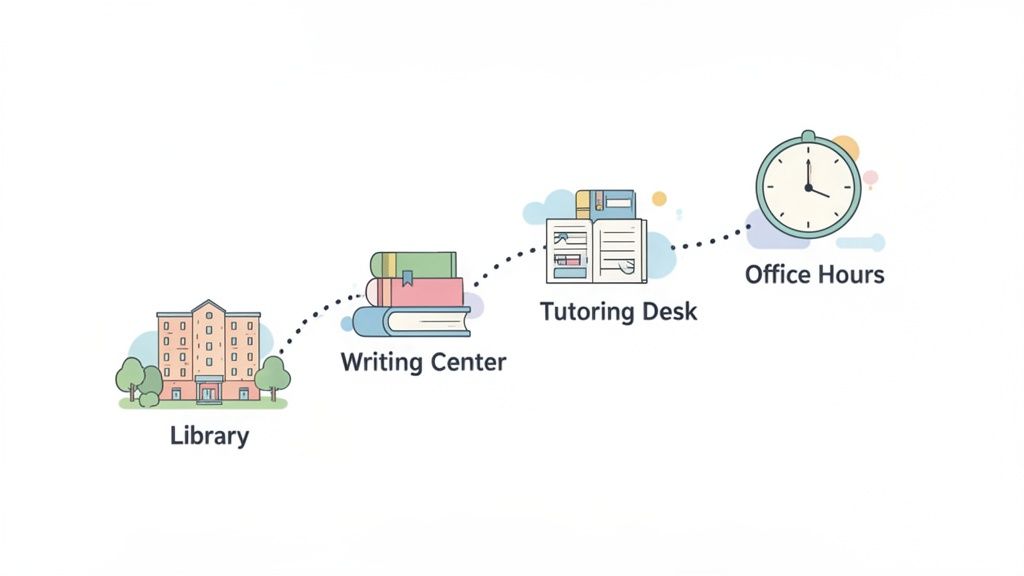
Before you even think about searching online for homework help for college students, you need to look closer to home. Your tuition is already paying for a whole network of support services designed to help you get through your toughest assignments. Honestly, using them is probably the fastest way to get real, personalized guidance.
The best thing about these on-campus services? They’re run by people who know your courses, your professors, and what the academic standards are. They offer a level of specific, targeted help that some random online service just can't touch.
Make the Writing Center Your First Stop
Pretty much every college has a writing center, and it’s not just for students who are struggling. It's where you go to take a B+ paper and turn it into an A. They can help with everything from just brainstorming a topic to doing a final polish on your citations.
To get the most out of it, though, you can't just walk in cold. Have a plan.
- Bring something with you: Even if it’s just a messy outline or a single paragraph, it gives the consultant a starting point.
- Know what you want to ask: Think about specific questions beforehand. "Is my thesis clear?" or "Does this paragraph connect back to my main argument?" are great examples.
- Have the assignment sheet: The consultant needs to see the prompt to understand what your professor is actually looking for.
When you do this, the session becomes a focused workshop on your paper, not just a generic grammar check. You'll walk out with a clear to-do list for making your work better.
Finding and Using Subject-Specific Tutors
When you’re staring at a calculus problem that makes no sense or trying to balance a chemical equation, you need a subject-specific tutor. Most departments have free peer tutoring programs where you can connect with students who have already aced the exact class you're in.
Finding them is usually easy—just check your department’s website or ask your academic advisor. Once you book a session, it’s all about preparation.
A tutor isn't there to re-teach an entire lecture. Your job is to show them exactly where you're getting stuck. Bring the homework problems you've already tried and be ready to walk them through your thought process. This lets the tutor immediately spot where you went wrong.
This strategy makes your tutoring sessions incredibly efficient because you’re not wasting time on the concepts you already understand.
How to Approach a Professor for Help
Office hours are probably the single most underused resource on any college campus. A lot of students are nervous about going, worrying they'll "sound stupid." But from a professor's perspective, a student who shows up to office hours is a student who cares.
Emailing a professor for help doesn't have to be intimidating. Just be professional, get straight to the point, and be specific.
Example Email for Requesting Help
| Section | Content |
|---|---|
| Subject | Question on Essay 2 - Jane Doe, HIST 101 |
| Greeting | Dear Professor Smith, |
| Context | I hope you're having a good week. I'm working on the second essay and have a question about the primary source analysis. |
| Show Your Work | I've read through the chapter on the topic and reviewed my lecture notes, and I tried to apply the framework we discussed. I'm just not sure if I'm interpreting the author's bias correctly. |
| The Ask | Would you have a few minutes to talk about this during your office hours on Wednesday? If not, please let me know what time would work better. |
| Closing | Thank you, Jane Doe |
An email like this shows you’ve already put in the work, which makes your professor much more invested in helping you figure out the rest.
If you're dealing with a huge reading load for an assignment, getting your thoughts organized first is a game-changer. Our guide on how to convert a PDF to notes has some great strategies for this. When you prep ahead of time, you're building a foundation for success by getting expert guidance from the people right on your campus.
Navigate Online Homework Help Without Risking Your Grades
Once you’ve tapped into everything your campus has to offer, the internet is your next best friend for homework help. It's packed with amazing resources, but it's also a minefield of services that can get you into serious academic trouble. Learning to tell the difference isn't just a good idea—it's a critical skill for any college student.
Let's be real: the sheer volume of online assignments is overwhelming. College students everywhere are feeling the pressure, with a staggering 70% reporting chronic stress from academic demands. In the U.S., over 20 million students are juggling an average of 15-20 hours of homework every week, which explains why so many are looking for a lifeline online. You can dig into more data on student workloads and see why so many students seek homework assistance.
Telling Legitimate Help from Academic Misconduct
The line between getting help and cheating can feel a little blurry, but the distinction is actually pretty clear. Legitimate help empowers you to learn the material. Academic misconduct is when someone else does the work for you.
Think of it like this: a good resource is a personal trainer for your brain. It guides you, gives you the right tools, and helps you build the mental muscle to solve problems on your own. A cheating service is like hiring someone to lift the weights for you—you get the "result" on paper, but you learn absolutely nothing and gain no strength for the final exam.
The golden rule of academic integrity is that the work you submit has to be your own. Any tool or service you use should be there to support your learning process, not replace it.
When you're using online tools, especially newer AI-powered ones, it’s vital to stay on the right side of the line. A big part of that is understanding how platforms like Turnitin detect AI-generated content. Knowing this helps you use tools ethically and avoid any accidental missteps.
Green Flags of Ethical Online Resources
Spotting a trustworthy resource is pretty straightforward once you know what to look for. These services are all about teaching you how to fish, not just giving you a fish.
- They Focus on Understanding: The best resources, like Khan Academy or the tutoring side of Chegg, are obsessed with explaining the why behind an answer. They offer step-by-step video tutorials and endless practice problems that actually help the concepts stick.
- They Offer Real Tutoring and Feedback: Reputable platforms connect you with real, live tutors who can talk you through tough concepts. It's a dialogue, not a transaction. They don't just hand over the solution; they work with you until you get it.
- They Provide Tools for Self-Sufficiency: Legitimate tools make your own study process better and faster. Think of grammar checkers like Grammarly that polish your writing or citation generators that help you manage sources correctly without doing the thinking for you.
These resources are supplements, not shortcuts. They help you get over a hurdle so you can keep running the race on your own.
Red Flags of Dishonest Homework Services
On the flip side are the services that basically scream "let us cheat for you!" These are the ones that can get you a zero on an assignment, a failing grade in a class, or even get you suspended.
Steer clear of any site that:
- Sells "Custom Essays": If a website’s main service is writing your papers from scratch, run. That's contract cheating, and it's one of the most serious academic offenses you can commit.
- Guarantees an "A": No ethical tutor or service can promise you a specific grade. Your grade depends on your own mastery of the material, which is something they can only help you achieve. A guarantee is a tell-tale sign of a scam.
- Hides Behind "Anonymous Experts": Trustworthy platforms have tutor profiles with real names, qualifications, and student reviews. If you can't see who's helping you, it's a massive red flag.
- Offers "Answer Banks": Some sites are just giant databases of answers to textbook questions. Copying from these is flat-out plagiarism and ensures you won’t be prepared for exams.
These services prey on students who feel desperate and overwhelmed. Using them doesn't just put your academic career at risk—it cheats you out of learning the skills you're paying to acquire. Choosing your homework help for college students wisely is just as important as the studying itself.
To make this easier, let's break down the different types of online help you'll encounter. Not all tools are created equal, and knowing what to use for which task is key to using them effectively and ethically.
Choosing Your Online Homework Help Resource
| Resource Type | Best For | Cost | Academic Integrity Tip |
|---|---|---|---|
| AI-Powered Tools | Brainstorming, summarizing long texts, generating study questions, checking grammar. | Free to $$ | Use it as a thought partner, not an author. Always rewrite and fact-check AI-generated text to make it your own. |
| Online Tutoring Platforms | One-on-one help with specific, difficult concepts in STEM, humanities, and more. | $$ to $$$ | Come prepared with specific questions. The goal is for the tutor to guide your understanding, not give you the answer. |
| Educational Video Libraries | Visual explanations of core concepts, step-by-step problem-solving tutorials. | Free | Pause the video and try to solve the problem yourself before the instructor does. Active learning is key. |
| Q&A Forums / Answer Banks | Seeing how others have approached a similar problem; checking your final answer. | Free to $ | Never copy-paste. Use these to verify your own work or get a hint if you're truly stuck, not as a primary source. |
Each resource has its place, but the responsibility always falls on you to use it as a learning aid. By picking the right tool for the job and keeping academic integrity at the forefront, you can get the help you need without ever putting your grades on the line.
How to Use AI Tools to Make Homework Easier
Artificial intelligence isn't some far-off concept anymore—it's a real tool that can completely change how you tackle your homework. If you're a college student drowning in reading assignments, AI can help you cut through the noise and get straight to the point. We're talking about saving hours of work while actually understanding the material better.
Imagine this: instead of spending a whole weekend slogging through a dense, 50-page research paper for your sociology class, you get a crisp summary of its core arguments, key evidence, and conclusions in minutes. That’s the kind of smart efficiency AI brings to the table.
Shifting from Manual Labor to Smart Analysis
The old-school way of studying meant hours of highlighting, re-reading, and scribbling notes from thick academic texts. AI-powered tools, especially ones designed to chat with your documents, flip that script entirely. Instead of you digging for the information, the information comes to you.
This frees you up to spend less time on the tedious grunt work and more time on what actually boosts your grades: thinking critically, analyzing concepts, and building your own arguments. It’s a game-changer for managing your workload, especially in reading-heavy courses like history, political science, or literature.
The real magic of using AI for homework is that it turns you from a passive reader into an active investigator. You can ask your documents direct questions and get instant, sourced answers, making your study sessions feel more like a conversation than a chore.
Let’s take a common assignment: the literature review. You might have five, ten, or even fifteen different PDF articles to pull from. Doing that manually could take days. With a tool like PDF Summarizer, however, you can upload them all at once and start asking comparative questions right away.
Example Use Case for a Literature Review
Suppose you're writing a paper on climate policy. You could upload several research papers and immediately ask:
- "How do Author A's and Author B's findings on carbon pricing differ?"
- "Summarize the methodologies used across all these papers."
- "What are the most common policy recommendations mentioned in these documents?"
This kind of cross-document chat gives you a massive head start on your writing. You can spot themes, contradictions, and gaps in the research much faster than you ever could by reading each paper one by one. For more ideas on what's out there, our guide on the best AI tools for academic research breaks down some of the top platforms.
A Practical Guide to Using AI for Homework
Getting started is probably easier than you think. Let's walk through how you’d tackle a typical reading assignment with an AI tool.
1. Upload Your Document
First things first, get your file into the system. It could be a scanned textbook chapter, a research article you downloaded, or a long report. A good tool will process it in seconds and have it ready for your questions.
2. Start with a Broad Summary
Don't get bogged down in the details just yet. Kick things off with a simple, high-level prompt to get your bearings.
"Give me a one-paragraph summary of this document.""What are the top three key takeaways from this paper?""Identify the main thesis or argument."
This initial summary gives you the lay of the land, making sure you grasp the core purpose of the text before you dive deeper.
3. Ask Specific, Targeted Questions
Now you can start drilling down. This is where AI becomes an incredible study partner. Your questions can be as specific as you need them to be.
"What is the definition of 'hegemony' as used on page 12?""Find all mentions of the Treaty of Versailles and explain their context.""Explain the statistical analysis in the results section in simple terms."
The ability to "chat" with your PDF is incredibly powerful. You can see the AI's response right next to the original text, often with clickable citations that take you straight to the source for quick verification.

Maintaining Academic Integrity with AI
Using AI tools smartly also means using them ethically. The goal is to support your learning, not do the work for you. It's crucial to understand where the line is between getting legitimate help and academic misconduct.
The key takeaway is that your intent matters. Using a tool to grasp a difficult concept is smart studying. Using it to avoid learning is cheating.
Best Practices for Ethical AI Use
- Never Copy and Paste Directly: Treat AI-generated text as a starting point, not a final product. Always rewrite the information in your own words and weave it into your own argument.
- Verify Everything: AI can make mistakes. Always check the sources. Click the citations and read the original text yourself to confirm the AI’s interpretation is accurate.
- Focus on "How" and "Why": Use AI to understand complex ideas, not just to pull out facts. Ask it to explain a concept in a few different ways until it finally clicks.
If you're curious about the technology behind these tools, learning more about AI tutoring software solutions can provide some interesting context. By sticking to these guidelines, you can make AI a powerful and ethical partner on your academic journey, helping you get homework done faster and with a much deeper understanding.
Build Study Habits That Prevent Homework Overwhelm

Real homework help for college students isn’t just about scrambling for answers the night before a deadline. It’s about building systems that stop you from feeling overwhelmed in the first place.
The smartest way to beat academic stress is to create proactive habits. This shifts you from putting out fires to preventing them, turning those chaotic all-nighters into predictable, manageable tasks. It's not just about getting assignments done; it's about actually learning the material and staying sane while you do it.
Tame Your Time with Focused Work Sessions
Let's be honest, one of the biggest challenges in college is just getting started. A massive research paper or a dense textbook chapter can feel so intimidating that you end up doomscrolling instead. The Pomodoro Technique is a fantastic way to break this cycle.
The idea is simple: work in short, focused bursts of 25 minutes, then take a 5-minute break. After four rounds, you take a longer break. This method keeps your brain fresh and makes even the most daunting tasks feel approachable. You're not committing to finishing the whole assignment; you're just committing to 25 minutes of focused work.
The real magic of this technique is psychological. It shatters the mental barrier to starting and helps you build momentum, one small win at a time.
Master Your Schedule with Smart Prioritization
A long to-do list can be more paralyzing than helpful. What you really need is a roadmap that tells you exactly what to work on right now. This is where prioritizing your tasks becomes a game-changer.
Start by sketching out your week. First, block off all your non-negotiables—classes, work shifts, appointments. Then, look at your assignment list and sort everything into a simple matrix:
- Urgent and Important: Your top priorities. Think papers due tomorrow or studying for a midterm in two days.
- Important but Not Urgent: This is where you work on long-term projects. Schedule dedicated time for these to avoid a last-minute panic later.
- Urgent but Not Important: Tasks that pop up and demand attention but don't move you toward your big goals. Get them done quickly and move on.
- Not Urgent and Not Important: These can wait. Push them to the end of the week or delegate if you can.
This system ensures your energy is going where it matters most, keeping you on track with big projects while still hitting every deadline.
Break Down Mountains into Molehills
That feeling of being completely swamped? It usually comes from staring at a huge project as a single, monolithic task. "Write 15-page history paper" is a terrifying item on any to-do list. The secret is to break it down into small, concrete, and actionable steps.
Instead of one monster task, your plan might look more like this:
- Research: Find and save ten credible sources.
- Reading: Summarize five of the key articles.
- Outlining: Create a detailed outline with a solid thesis statement.
- Drafting: Write just the introduction and the first body paragraph.
- Reviewing: Read over what you wrote for clarity and flow.
Each of those items is a manageable task you can knock out in a single study session. This not only makes the project feel less intimidating but also gives you a clear sense of progress, which is a powerful motivator. You’ll find similar strategies in our guide on how to study for exams effectively.
This proactive approach is especially vital in tough subjects. For instance, the statistics homework crisis is a well-known issue, with an estimated 65% of college students in STEM fields reporting struggles with data analysis. However, one study found that 85% of students who get effective help don't just improve their grades—they improve their long-term understanding. According to a recent analysis of student homework challenges, these proactive habits are the most effective form of help you can give yourself.
Answering Your Questions About College Homework Help
Figuring out how to get academic support can feel like a minefield. It's smart to be asking these questions and thinking critically about the resources you use. Let's tackle some of the most common concerns I hear from students who are just trying to get effective homework help for college students.
Is Using Online Homework Help Considered Cheating?
Honestly, it all boils down to how you use the tools.
If you're just copying answers or paying someone to write an essay for you, then yes, that's academic misconduct. Plain and simple. But using online resources for tutoring, clarifying a concept you’re stuck on, or checking your work is just a smart way to learn.
The real test is whether you're using a resource to support your own effort, not replace it. Think of it as having a high-tech study buddy. The final understanding and the work you turn in must be yours.
How Can I Ask a Professor for Help Without Sounding Clueless?
This is a big one. The secret? Go in prepared. Professors really do respect students who take the initiative, but they can get frustrated with a vague "I'm lost."
Before you head to office hours or draft that email, make a genuine attempt to solve the problem yourself. Document what you tried and where you got stuck. This one step completely changes the conversation.
Instead of saying, "I don't get it," you can frame a much more specific question: "I'm having trouble applying the regression model to question 5. I tried setting it up this way, but my results don't make sense. Could you help me see where I'm going wrong?"
That kind of question shows you’ve put in the effort and are serious about learning. It makes you look proactive, not unprepared.
What Is the Fastest Way to Understand Several Dense Articles?
When you’re staring at a stack of dense academic papers, your first instinct might be to panic. Don't. This is the perfect time to bring in an AI-powered tool built for document analysis. Instead of slogging through every single word, you can work much smarter.
A modern PDF analysis tool can be a game-changer. You can:
- Upload all of your articles at once.
- Ask for a quick, high-level summary of each one to get the main idea.
- Get a side-by-side comparison of their core arguments or methodologies.
- Instantly pull specific quotes, definitions, or data points from across all the documents.
This approach lets you zero in on the most critical information in a fraction of the time. You get to spend your energy on the actual thinking and writing—the stuff that really earns you a good grade—instead of getting bogged down in tedious reading.
Ready to tackle your reading assignments with confidence? PDF Summarizer lets you upload your research papers and reports to get instant summaries, answers, and insights. Chat with your documents and cut your study time in half. Try it now for free at https://pdfsummarizer.pro.
Relevant articles

Explore critical thinking skills for students with practical strategies to analyze information, argue persuasively, and boost academic success.