How to Study for Exams Effectively and Boost Grades
Discover how to study for exams effectively using proven, science-backed techniques. Learn practical strategies to improve retention and ace your next test.

If you really want to study for exams effectively, you have to get past the idea of just passively re-reading your notes. The secret is shifting to active, strategic learning. This means using proven methods like active recall (actually testing yourself) and spaced repetition (reviewing material at smart intervals) to lock information into your long-term memory. A solid plan built on these techniques is your best bet for earning higher grades without all the last-minute panic.
Building a Foundation for Smarter Studying

Let’s be honest, the classic image of studying—hunched over a textbook for hours, highlighting everything in sight—is completely broken. Real learning isn’t about how many hours you clock in; it’s about the quality and strategy you bring to that time. Before we get into the nuts and bolts, we need to set up the right framework.
This is all about ditching the cram session, which only helps you remember things just long enough to forget them after the test. We're aiming for methods that create knowledge that actually sticks. The point isn't just to pass the exam, but to genuinely understand the material so you can use it later on.
Start with a Strategic Mindset
Effective exam prep starts the moment you decide to be an active learner instead of just letting the material wash over you. The first thing you should do is get familiar with the best study methods for exams that have been shown to work. Knowing what’s out there helps you pick the right tool for the job.
A big part of this is also self-awareness. Do you find that drawing diagrams helps you connect ideas? Does explaining a concept out loud make it click for you? Figuring out your personal learning style means you can tailor the strategies in this guide to how your brain works best.
The most powerful shift you can make is viewing studying as a skill to be developed, not a chore to be endured. Like any skill, it improves with intentional practice and the right techniques.
Set Clear and Actionable Goals
A vague goal like "study for biology" is pretty much an invitation to procrastinate. You need to get specific and set measurable objectives for every single study session. This one small change can turn a massive, intimidating task into a series of small, achievable wins.
Here’s what that looks like in the real world:
- Instead of: "Review Chapter 3"
- Try: "Create 15 flashcards for the key terms in Chapter 3 and answer the end-of-section questions."
This approach gives you a clear finish line for each session. When you hit it, you get a little dopamine boost and build momentum for the next one. By setting tangible targets, you guarantee every minute you spend studying is actually moving you forward. Getting this planning stage right is a huge part of being able to absorb information effectively. If you want to dig deeper, check out these powerful reading comprehension strategies for students.
Before moving on, let's quickly summarize some of the most effective, evidence-backed study techniques. Think of this table as your cheat sheet for choosing the right approach.
A Quick Look at Effective Study Techniques
| Technique | Core Principle | Best For |
|---|---|---|
| Active Recall | Retrieving information from memory without looking at your notes. | Locking in facts, concepts, and processes for long-term retention. |
| Spaced Repetition | Reviewing material at increasing intervals over time. | Preventing the "forgetting curve" and moving info to long-term memory. |
| Interleaving | Mixing different subjects or topics within a single study session. | Developing a deeper, more flexible understanding of complex subjects. |
| The Feynman Technique | Explaining a concept in simple terms, as if to a beginner. | Identifying gaps in your own knowledge and solidifying understanding. |
| Mind Mapping | Visually organizing information in a hierarchical diagram. | Understanding connections between ideas and seeing the big picture. |
Keep these core methods in mind as we build your complete study plan. Each one serves a different purpose, and learning to combine them is what separates efficient students from those who just spin their wheels.
Mastering Content with Active Recall and Spaced Repetition
If your go-to study method is rereading a textbook until your eyes glaze over, it’s time for a serious change. Passive learning—things like reading, highlighting, or just listening to a lecture again—creates what I call an "illusion of competence." You start to recognize the material, but you can't actually retrieve it when it counts on an exam.
The real key to effective studying is to flip the script from passive recognition to active engagement. This is where two powerhouse techniques, backed by a ton of cognitive science, come into play: active recall and spaced repetition. Instead of just pouring information in, these methods force your brain to pull it out, which is what truly builds strong, lasting memories.
The Power of Pulling Information from Your Brain
Active recall is exactly what it sounds like: actively trying to remember something without looking at your notes. It’s a mental workout. Every time you force your brain to retrieve a fact, a formula, or a concept, you're sending a strong signal that this information is important and needs to be kept handy.
The evidence for this is overwhelming. Studies consistently show that students who practice active recall perform way better. We're talking scores that are often 15-20% higher than those who just reread their notes. In fact, a huge meta-analysis of 45 different studies found that active recall boosted long-term retention by a staggering 35% compared to passive methods.
Getting started is easy. You can build active recall into your routine with a few simple, yet powerful, techniques:
- Flashcards: They're a classic for a reason. Put a question on one side and the answer on the other. It’s a simple system that forces you to retrieve the answer from memory before you get to cheat and flip the card.
- The Feynman Technique: This one’s my favorite. Try to explain a complex topic in the simplest terms you can, as if you were teaching it to a kid. It’s amazing how quickly this reveals the gaps in your own understanding.
- Brain Dumps: Before you review a topic, grab a blank sheet of paper and just write down everything you can remember about it. Then, compare what you wrote to your actual notes. You'll immediately see what you know cold and what you missed.
These methods will feel harder than just rereading. That's a good thing. That feeling of effort is the sign that you're actually learning.
Fighting the Forgetting Curve with Smart Timing
Once you're actively recalling information, the next step is to get smart about when you review it. This is where spaced repetition comes in. Our brains are naturally wired to forget things over time—it's a phenomenon called the "forgetting curve." Spaced repetition is the perfect antidote.
The idea is simple: you review information at increasingly longer intervals. You might look at a new concept the next day, then again in three days, then a week later, and so on. Each time you successfully remember the information, you push the next review further out. This process interrupts the forgetting curve right before you’re about to forget, locking the memory in for a longer period each time.
Let's imagine a student prepping for a history final on the American Revolution. Here’s how they could combine these methods:
- First Pass & Recall: Right after a lecture on the causes of the war, they create flashcards for key events and people. They also spend ten minutes doing a "brain dump" to summarize the lecture’s main arguments from memory.
- Spaced Review: They review the flashcards the next day. Three days later, they do it again, easily recalling most of them. The few they struggle with get put into a separate pile for more frequent review.
- Deeper Connections: A week later, they use the Feynman Technique to explain the economic tensions between Britain and the colonies to a roommate. This helps them connect the isolated facts into a single, coherent story.
With this approach, they aren't just memorizing dates; they’re building a genuine understanding of how and why events happened.
Spaced repetition isn't about studying more; it's about studying smarter. It automates your review schedule so you can focus your energy on the exact material you're most likely to forget, right when it matters most.
Here's a quick look at why this approach is so much more effective than the all-nighter cramming session we've all been guilty of.
Spaced Repetition Versus Cramming a Comparison
This table really highlights the difference between building lasting knowledge and just hoping for the best on exam day.
| Attribute | Spaced Repetition | Cramming |
|---|---|---|
| Retention | Excellent long-term retention. | Poor long-term retention; information is quickly forgotten. |
| Understanding | Promotes deep understanding and connections. | Encourages shallow, surface-level memorization. |
| Efficiency | Highly efficient; focuses on difficult material. | Inefficient; wastes time on already-known material. |
| Stress Levels | Low stress, builds confidence over time. | High stress and anxiety. |
| Exam Performance | Leads to consistent, reliable high performance. | Unpredictable; relies on short-term memory luck. |
Ultimately, one method sets you up for future success, while the other is a short-term, high-stress gamble.
Tools to Automate Your Study System
Trying to manually track all your spaced repetition intervals would be a nightmare. Thankfully, you don't have to.
Digital tools like Anki or Quizlet can automate the whole process. They use smart algorithms to schedule your flashcard reviews. When you get a card right, the app automatically pushes the next review further into the future. Get it wrong, and you'll see it again much sooner. This makes sure you’re always spending your precious study time where it’s needed most.
For dense readings like textbook chapters or research articles, a different kind of tool is a lifesaver. Using a summarizer to pull out the main ideas first can give you a solid foundation before you even start making flashcards. Our guide on the art of summarizing in reading can walk you through how to do this effectively.
By bringing these techniques and tools together, you can stop wasting time on passive, ineffective reviews and start building real, lasting knowledge.
Designing Your Personalized Study Plan
A brilliant study technique is useless if you don't actually use it. The real gap between knowing how to study and actually doing it well often comes down to having a practical plan you can stick to. A good plan isn’t a rigid prison—it's more like a flexible framework that accounts for your classes, your energy levels, and your life outside of school.
This isn't about magically finding more hours in the day. It's about making the hours you already have count, using smart strategies that keep you focused and prevent burnout. When you combine a few proven frameworks with a little self-awareness, you can build a schedule that feels genuinely manageable.
Structuring Your Time for Maximum Focus
Deciding to study whenever you "feel like it" is a one-way ticket to procrastination. A much better approach is to intentionally structure your time to create dedicated pockets of deep focus. This helps you get more done in less time, freeing you up for those essential breaks.
One of the best and simplest methods is the Pomodoro Technique. You just set a timer for 25 minutes and give a single task your complete, undivided attention. When the timer dings, you take a 5-minute break. After four of these cycles, you reward yourself with a longer break, maybe 15-30 minutes.
This works so well because it makes starting a big task feel much less intimidating. Instead of staring down a three-hour study marathon, your only goal is to stay on track for just 25 minutes.
Another fantastic strategy is time blocking. This is where you look at your week ahead and literally schedule study sessions into your calendar as if they were appointments.
- Monday 10-11 AM: Review Biology lecture notes & create flashcards.
- Monday 2-3 PM: Grind through Calculus practice problems.
- Tuesday 9-10 AM: Read Chapter 5 for History.
This removes all the guesswork and decision fatigue from your day. You don't have to waste mental energy figuring out what to study next—you just look at your calendar and get started.
The Power of Mixing Things Up with Interleaving
As you're time blocking your schedule, resist the urge to dedicate an entire day to just one subject. It might feel productive, but cognitive science shows it’s far more effective to switch between different subjects or topics. This practice is called interleaving.
Let's say you're studying for a math exam. Instead of spending three hours on a single type of problem, you’d be much better off spending 45 minutes on problem type A, another 45 on type B, and a final 45 on type C.
Interleaving forces your brain to constantly retrieve different strategies and bits of information. This strengthens your long-term memory and makes you a much better problem-solver under pressure. It definitely feels harder in the moment, but the long-term payoff is huge.
This process highlights the core cycle of effective learning: you move from initial exposure to active retrieval and, finally, to strategically timed repetition.
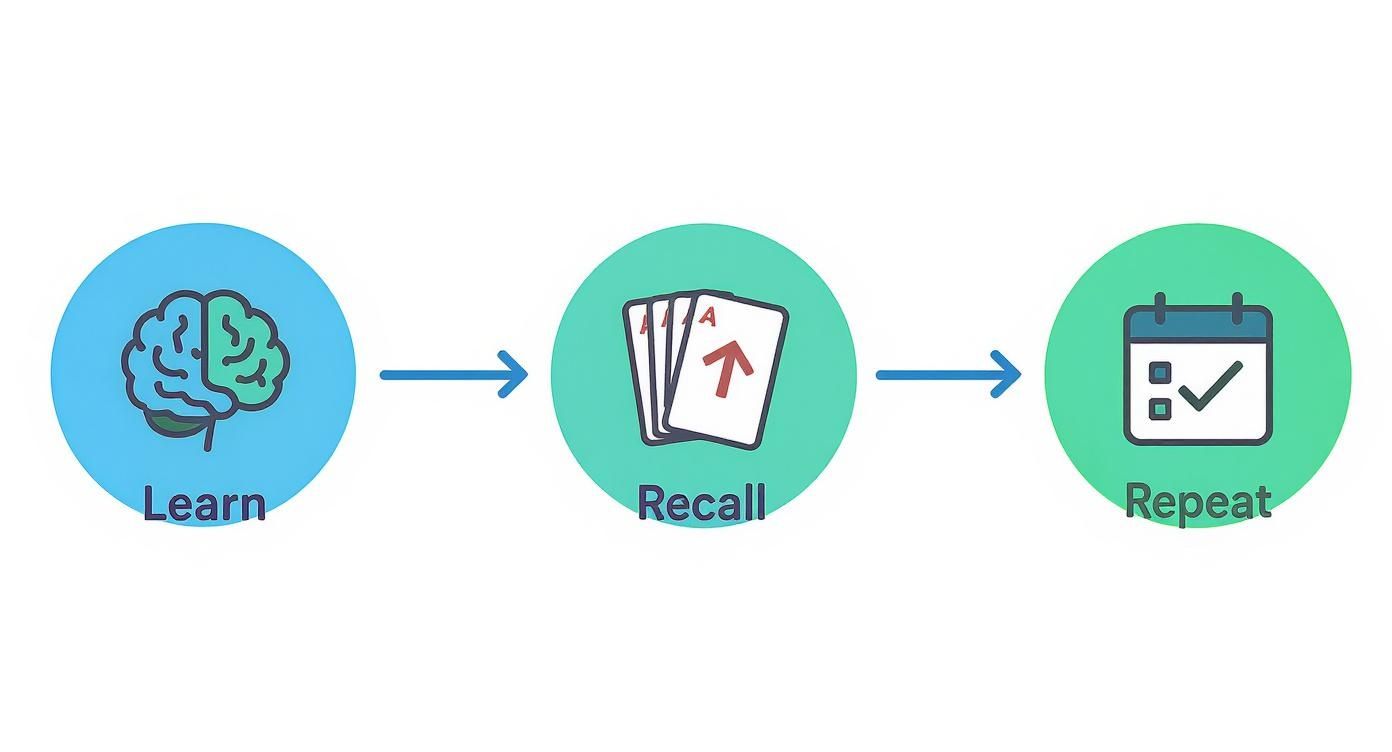
Each step in this cycle reinforces the others, creating a powerful loop that moves information from short-term recognition to genuine, long-term understanding.
Building Your Weekly Study Blueprint
Okay, let's put all these pieces together. Here’s what a sample weekly schedule could look like for a student juggling a few different courses. Remember, this is just a template—the key is to adapt it to your own needs.
Sample Weekly Study Block Schedule
| Time | Monday | Tuesday | Wednesday |
|---|---|---|---|
| 9-10 AM | Biology (Review) | History (Reading) | Biology (Practice Qs) |
| 10-11 AM | Calculus (Problems) | History (Flashcards) | Calculus (Review) |
| 1-2 PM | Break | Break | Break |
| 2-3 PM | History (Lecture Notes) | Calculus (Problems) | Flex Time |
Notice how no two consecutive blocks are for the same subject? That's interleaving in action. That "Flex Time" is also critical; it’s a built-in buffer to catch up on tough topics or just in case life gets in the way. A plan without any flexibility is a plan that's destined to fail.
To really supercharge this schedule, weave in spaced repetition. This just means reviewing material at increasing intervals over time, and it’s a game-changer for long-term retention. In fact, one study found that students who spaced their study sessions over two weeks performed 20% better on exams than those who crammed. It's a key reason the global market for digital exam prep tools has exploded, as you can see from data on the growth of these powerful learning tools.
Treat your plan as a living document. After the first week, take a look at what worked and what didn't. Maybe you’re sharper in the afternoon, so you can move your hardest subject there. The goal is to create a sustainable rhythm that makes studying a consistent habit, not a dreaded, last-minute emergency.
Using Tech to Study Smarter, Not Harder
https://www.youtube.com/embed/dYi2FY3-XNY
While the timeless techniques like active recall and spaced repetition are the bedrock of good studying, the right tech can be a game-changer. Think of it as a powerful assistant that automates the grunt work, helps you wrangle huge amounts of information, and tailors the experience to how you learn.
One of the biggest hurdles, especially early in a semester, is the sheer volume of reading. Dense textbook chapters, long academic papers, and detailed lecture notes can feel like a mountain you can't climb. This is exactly where AI-powered tools shine, helping you get through the material much more efficiently.
Condense and Conquer with a PDF Summarizer
Let's get real. You've got a 50-page research paper to get through before your class tomorrow. Instead of slogging through it for hours, you could use a tool like a PDF Summarizer to get the gist in a matter of minutes. These tools scan the document and pull out the main arguments, key evidence, and critical conclusions for you.
This isn't a replacement for deep reading, but it's an incredible head start. You get a concise summary that acts as a perfect scaffold for your own notes, flashcards, or review sheets. It immediately turns a passive chore into an active learning session.
Here’s a look at how a PDF summarizer can pull the most important points from a document you upload.
Being able to see the summary right next to the original text is huge—it lets you quickly check the source. Plus, the ability to ask follow-up questions transforms a static document into a study partner you can actually talk to.
Streamline Your Research and Review
For bigger assignments like a literature review or a term paper, you're often trying to synthesize ideas from many different sources. It’s chaotic trying to flip between a dozen different PDFs. A real game-changer is combining all those files into a single, interactive chat.
Imagine uploading all your research papers at once and then being able to ask questions that span across all of them.
- For instance: "Compare the methodologies from the Smith (2021) and Jones (2022) papers."
- Or try: "What common themes about climate impact show up across all these articles?"
This kind of cross-document analysis saves a ton of time and helps you uncover connections—and contradictions—you might have easily missed otherwise. Knowing how to organize research papers is a crucial academic skill, and this technology offers a seriously powerful way to do it.
Technology’s biggest gift to studying isn't just about speed. It’s about being able to interact with your material in entirely new ways. Chatting with your PDFs turns a one-way information dump into a two-way conversation, which does wonders for your comprehension and memory.
Build Your Modern Study Tech Stack
Beyond summarizers, a few other tools can really round out your digital study toolkit.
- Spaced Repetition Apps (Anki, Quizlet): These are non-negotiable for memorization. They automate the spaced repetition process, using smart algorithms to show you flashcards right before you forget them. It makes review sessions incredibly efficient.
- Note-Taking and Organization (Notion, Obsidian): These are so much more than digital notebooks. They let you build a personal "knowledge base" where you can link concepts together, embed diagrams, and structure everything in a way that clicks for your brain.
- Personalized Learning Platforms: These have become a major factor in modern exam prep. In fact, some data shows students using adaptive learning tech can score up to 25% higher on standardized tests. These platforms identify your specific weak spots and focus your study time where it will have the biggest impact. You can dig into the data in a market report on the exam preparation and tutoring market.
By bringing these tools into your workflow, you’re not just studying—you're building a smarter, more effective system for learning.
Your Pre-Exam Checklist for Health and Mindset
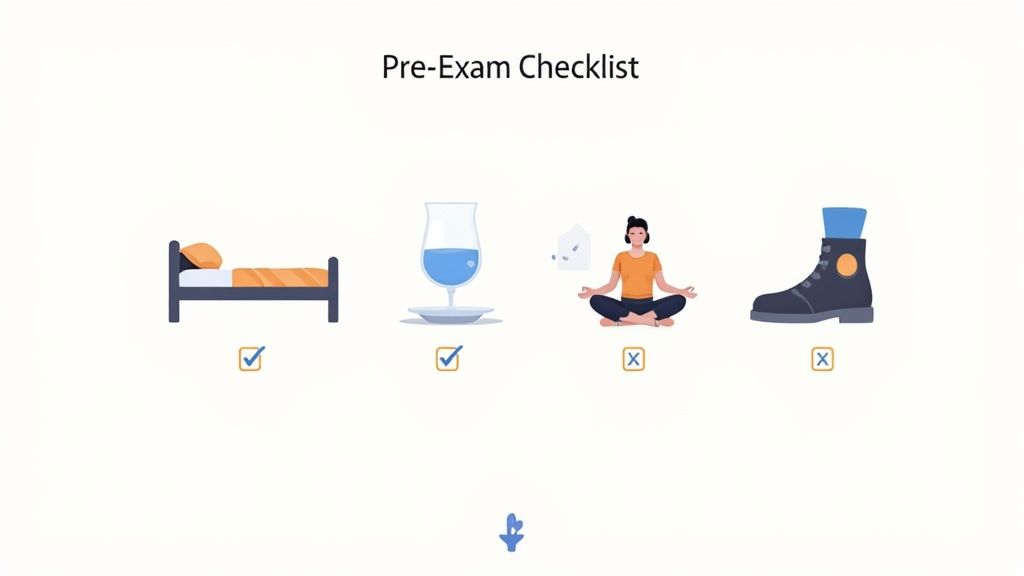
You can have the best study plan in the world, but it won’t mean much if you show up to the exam exhausted, stressed, and running on fumes. Honestly, how you take care of your body and mind in the final stretch is just as critical as any study session. Neglecting your well-being is one of the fastest ways to undermine all your hard work.
Think of it this way: your brain is a high-performance engine. It needs premium fuel, regular maintenance, and proper rest to fire on all cylinders. The last few days before an exam should be less about cramming and more about making sure that engine is perfectly tuned. This mental shift can be the difference between a good score and a great one.
Prioritize Sleep to Lock in Your Learning
The all-nighter is a terrible academic tradition. It’s completely counterproductive. While you’re sleeping, your brain is busy consolidating memories—shifting everything you learned from flimsy short-term storage into more durable long-term memory. Skimping on sleep actively sabotages this entire process.
Study after study shows that a lack of quality sleep hammers your cognitive functions. Your attention span, critical thinking, and problem-solving abilities all take a massive hit. A sleep-deprived brain is a lot like an intoxicated one. You absolutely need to aim for 7-9 hours of solid sleep a night, especially in the three nights leading up to your exam.
Sacrificing sleep for extra study time is like trying to write an essay with a pen that’s out of ink. You’re going through the motions, but nothing is actually being recorded where it counts.
To get better sleep, try building a simple pre-bed routine:
- Go screen-free: Put away your phone, tablet, and laptop at least an hour before you plan to sleep. That blue light really messes with your body's sleep signals.
- Cut the caffeine: Stop drinking coffee, tea, or energy drinks at least six to eight hours before bed.
- Create a calm space: A dark, quiet, and cool room tells your body it's time to shut down and rest.
Fuel Your Brain with the Right Foods
What you eat directly impacts your brainpower. It's so tempting to grab sugary snacks and energy drinks for a quick jolt, but that path almost always leads to a nasty energy crash right when you need to focus. You need to give your brain a steady supply of high-quality fuel instead.
First off, drink water. All day. Even being just a little dehydrated can cause fatigue, headaches, and a serious drop in concentration. Keep a water bottle on your desk so you don't forget.
As for meals, focus on foods that are known to boost brain function.
- Complex Carbs: Think oatmeal, brown rice, and whole-wheat bread. They provide a slow, steady burn of energy.
- Lean Proteins: Chicken, fish, eggs, and beans help your brain produce the neurotransmitters you need for sharp focus.
- Healthy Fats: Foods rich in omega-3s, like nuts, seeds, and avocados, are vital for long-term brain health.
This is strategic eating. A balanced meal before an exam can keep you energized and focused for hours, while a heavy, greasy one will just make you feel sluggish.
Manage Your Stress and Keep a Calm Mind
Exam anxiety is very real, and if you let it run wild, it will absolutely hurt your performance. When you’re highly stressed, your body is flooded with cortisol, a hormone that can actually block memory retrieval. The trick is to get ahead of the stress, not just try to ignore it.
Make sure to work in short breaks for some light physical activity during your final study days. A quick 20-minute walk can boost blood flow to the brain, slash your stress levels, and lift your mood. It doesn't have to be an intense workout—just get your body moving and clear your head.
Mindfulness and simple breathing exercises are also incredibly powerful tools for calming those pre-exam jitters.
- Box Breathing: Inhale for a count of four, hold your breath for four, exhale for four, and hold again for four. A few minutes of this can physically slow your heart rate.
- A Mindful Moment: Just take two minutes. Close your eyes and focus only on the sensation of your breath. If anxious thoughts pop up, just acknowledge them and let them float by without judgment.
Walking into that exam room feeling centered and calm is the final piece of the puzzle. It allows you to access all the information you’ve worked so hard to learn. By taking care of yourself, you’re completing the most crucial step in your study plan.
Common Questions I Hear About Studying for Exams
Even with the best-laid plans, specific questions always pop up when it's time to get serious about exam prep. Let's walk through some of the most frequent ones I get from students and tackle them with practical, no-nonsense advice.
How Far in Advance Should I Really Start Studying for a Big Test?
Look, real studying starts on day one with consistent review. But for dedicated exam prep? You want to give yourself a solid 3-4 weeks at a minimum. That's the sweet spot for using techniques like spaced repetition without descending into a panic-fueled cram session.
If you're facing a cumulative final that covers the entire semester, I'd even push that back to 5-6 weeks. Consistent, steady effort over a longer period beats a frantic, last-minute sprint every single time.
Think of it like training for a marathon. You wouldn't wait until the week before the race to start running. Building academic endurance requires the same kind of steady, long-term preparation.
Is It Better to Grind One Subject All Day or Mix It Up?
It's so much better to switch between subjects. This is a technique called interleaving, and it’s a game-changer for long-term memory. It forces your brain to work a little harder to recall different types of information, which feels tough in the moment but really cements the knowledge.
A simple way to do this is with time blocking. Assign focused chunks of 1-2 hours to different subjects throughout the day, and don't forget to take short breaks in between. This not only helps your memory but also keeps you from burning out on a single topic. For a deeper dive, there are great resources on how to study better in college that can help boost your grades.
I'm Short on Time—What’s the Single Most Effective Thing I Can Do?
If you're up against the clock, your absolute highest-yield activity is active recall through practice testing. Nothing else comes close. Dig up past papers, work through end-of-chapter questions, or make your own quick quizzes from your notes.
Doing a practice test under exam-like conditions hits three birds with one stone:
- It forces you to actively retrieve information, which is way more powerful than just rereading.
- It shines a spotlight on your weak spots, telling you exactly where to focus your limited time.
- It gets you comfortable with the exam format, which helps cut down on test-day anxiety.
After a practice run, the real magic happens in the review. Go through every single question you got wrong and figure out why you missed it. That’s how you turn mistakes into points.
I've Got a Mountain of Material to Cover. How Do I Stay Motivated?
Here's a secret: motivation doesn't just show up. It follows action. The key is to make that first action ridiculously small. Your goal isn't to "Study for History." It's to "Make three flashcards for the first page of Chapter 5." See the difference?
The Pomodoro Technique is a lifesaver here. Working in short, 25-minute bursts makes starting feel so much less intimidating. Every time you complete one, you get a small win, and that builds momentum. Track your sessions and give yourself a small reward for hitting your daily goal. This creates a positive feedback loop that makes it easier to keep going.
Ready to make your study sessions more efficient? PDF Summarizer can help you quickly grasp the key points of dense readings, extract crucial information for your notes, and even analyze multiple research papers at once. Stop wasting time and start understanding your material faster. Try it for free today at https://pdfsummarizer.pro.
Relevant articles

Discover the best way to study textbooks with our top 10 methods. Learn active reading, SQ3R, and AI-powered tips for maximum retention and efficiency.

Discover how to read faster and retain information with practical strategies, exercises, and science-backed tips you can apply today.