Master Techniques: how to read faster and retain information for Faster Learning
Discover how to read faster and retain information with practical strategies, exercises, and science-backed tips you can apply today.
If you feel like you're constantly falling behind on your reading list, whether it's for work, study, or just for fun, you're in the right place. Most of us assume that to really understand something, we have to read it slowly and carefully. But what if I told you that very assumption is what's holding you back? The truth is, reading faster and remembering more are skills that work together, not against each other.
The key is to move past the slow, inefficient habits we picked up in elementary school and adopt a more active, strategic approach.
Moving Beyond Old-School Reading Habits
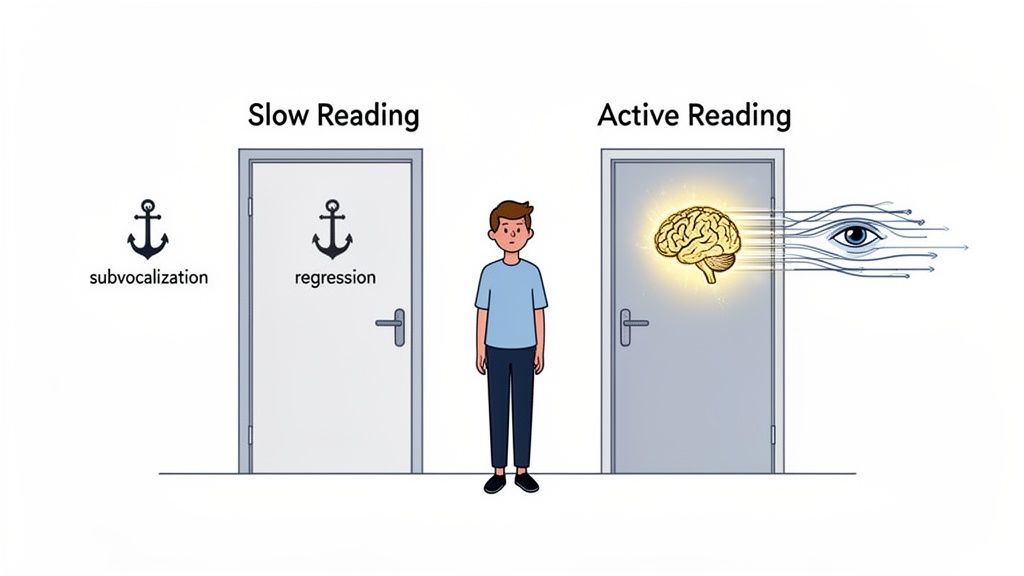
Let's be honest, the way most of us read is stuck in the past. We learned to sound out each word, one by one, and that method has followed us into adulthood. This creates a couple of major speed bumps that keep our reading pace locked at the speed of speech.
This guide isn't about gimmicks. It's about systematically rewiring how your eyes and brain work together to process text, turning you from a passive reader into an active one.
Your Reading Speed Is a Habit, Not a Limit
The two biggest culprits slowing you down are habits you probably don't even realize you have.
- Subvocalization: This is that little voice in your head that "says" every word as you read it. It’s a direct link to how we learned to read aloud, but as an adult, it's a bottleneck. It caps your reading speed at around 150-250 words per minute—the average talking speed.
- Regression: This is the constant, almost unconscious, flick of your eyes back to re-read words you just passed. We do it for clarity, but it happens far more often than necessary, breaking your flow and slowing you down dramatically.
Breaking these two habits is the first—and most powerful—step you can take. When you stop "saying" the words and train your eyes to move smoothly forward, you can see an immediate and significant jump in your speed.
Think of it this way: You wouldn't drive a car by staring at every single pebble on the road. You scan ahead, taking in the whole scene to understand where you're going. Reading effectively is the same—it’s about absorbing ideas and concepts, not just processing individual words.
The Core Principles of Active Reading
Becoming a faster, more effective reader means shifting your mindset. Instead of just letting the words flow past you, you need to engage with the material purposefully. It's about taking control of your learning.
These foundational concepts are what separate passive readers from active, efficient ones.
Core Principles for Faster Reading and Better Retention
| Principle | What It Means | Key Benefit |
|---|---|---|
| Purposeful Reading | Knowing why you're reading a text before you start. | Filters out irrelevant information and keeps you focused on your goal. |
| Active Engagement | Interacting with the text by asking questions, making notes, and connecting ideas. | Boosts comprehension and moves information from short-term to long-term memory. |
| Chunking | Training your eyes to see and process groups of words (3-5 at a time) instead of single words. | Dramatically increases the amount of information you can absorb per glance. |
| Forward Momentum | Intentionally minimizing regressions and maintaining a steady forward eye movement. | Builds reading rhythm and prevents the stop-and-start habit that kills speed. |
Mastering these principles lays the groundwork for all the specific techniques that will transform your ability to read and learn. They're the building blocks for a more powerful and efficient reading experience.
Get Your Hands Dirty With Core Speed and Focus Techniques
Alright, enough with the theory. If you're serious about reading faster and actually remembering what you read, you need to get your hands on some practical techniques. These aren't magic tricks; they’re physical and mental drills that retrain your eyes and brain to work together more efficiently.
The real goal here is to break the bad habits that have been holding you back for years.
The good news? These foundational skills are surprisingly easy to learn. With a little consistent practice, you’ll see noticeable results pretty quickly.
Use Meta Guiding to Find Your Rhythm
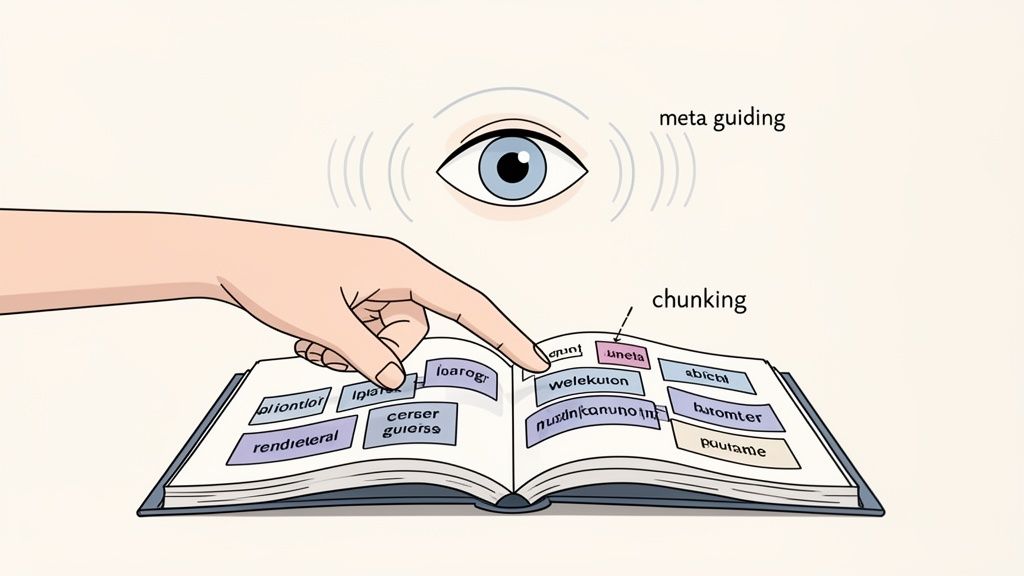
One of the simplest yet most effective things you can do is called meta guiding, or the pointer method. All it means is using your finger, a pen, or even a stylus to physically guide your eyes across each line of text.
This tiny action does two huge things for you. First, it forces you to set a consistent pace, stopping your eyes from getting stuck on a single word. Second, it creates a constant forward motion, which helps kill the habit of regression—that annoying little jump your eyes make to re-read words you just saw.
Think of your finger as a pacesetter in a race. It keeps your eyes on track and moving ahead without all the stops and starts. This technique alone can keep you far more engaged and focused, a huge part of learning how to process information faster.
Start Chunking to See Phrases, Not Just Words
Your brain is a powerhouse, capable of taking in information way faster than you think. The biggest bottleneck is the habit of reading word-by-word, something we’re all taught as kids.
The fix is chunking. It’s the skill of training your eyes to see and absorb whole groups of words—or chunks—in a single glance.
Instead of your eyes making 8 to 10 stops per line, you want to get that down to just 3 or 4. This means expanding your peripheral vision so you can grab multiple words at once.
Try these drills for just 5-10 minutes a day to get started:
- The Triangle Drill: Quickly glance at the first word of a line, then the middle, then the last. Don't worry about reading everything; just focus on seeing the word groups.
- Indentation Reading: Start reading from the second or third word in and stop before the last few words on each line. Your peripheral vision will naturally scoop up the words at the beginning and end.
Over time, this practice trains your brain to recognize entire phrases and ideas, not just a string of individual words. It's a game-changer.
Don't just take my word for it. Formal training in these methods has shown some seriously impressive results. One study found that after just 28 hours of practice, students boosted their reading speed for dense, informative texts by 40%. They went from an average of 115 to 161 words per minute, all while keeping their comprehension intact.
Reframe Skimming as Your Strategic First Pass
Skimming and scanning get a bad rap. People think it’s "cheating" or just lazy reading, but that’s a total misunderstanding of what they're for. When you use them right, they’re powerful strategic tools for previewing material and finding what you need without getting bogged down.
Skimming isn't about reading every word. It's about getting the lay of the land before you dive deep. Before you start a chapter or a long article, give yourself 60 seconds to skim:
- Read the title, the intro, and the conclusion.
- Scan all the subheadings and any bold text.
- Glance at images, charts, or diagrams.
This pre-reading process primes your brain. You’re essentially building a mental map of the content, which makes the actual read-through faster and more effective because you already know where the author is going.
Scanning is more like a search-and-rescue mission; you're hunting for a specific piece of information—a name, a date, a statistic—without reading all the text around it. To really make these techniques stick, you need to be able to concentrate. Learning some practical strategies to improve focus will make every reading session more productive.
Make What You Read Actually Stick
Blazing through a chapter means nothing if you can't remember a single key point an hour later. The real win isn't just about speed; it's about making what you read become a permanent part of your knowledge base. This is where we stop just seeing words and start using proven cognitive strategies to actually embed information.
Let's be honest: passively highlighting a page or rereading the same paragraph five times is a waste of time. It feels productive, but it rarely works. To truly learn, you have to make your brain engage with the material, not just skim over it.
From Passive Review to Active Recall
If you make only one change to how you study, let it be this: switch to active recall. This simply means pulling information out of your brain instead of passively shoving it back in. Rereading creates a dangerous illusion of knowing something because it feels familiar. You recognize it, sure, but you can't explain it.
Active recall destroys that illusion.
For instance, after reading a section on the causes of the French Revolution, shut the book. Seriously. Now, try to explain the key events, people, and economic pressures out loud. It’s going to feel tough, and that mental struggle is the entire point. That’s your brain building stronger connections to the memory.
Here are a few practical ways to do this:
- Explain It: After finishing a section, pretend you're teaching it to a friend. Can you explain the main ideas clearly?
- Brain Dump: Grab a blank piece of paper and write down the 3-5 most important things you just learned without peeking at the book.
- Question Everything: Turn the subheadings in your textbook into questions. Before reading the section, try to answer the question. After, see how well you did.
The Power of Spaced Repetition
Your brain is wired to forget things it deems unimportant. Spaced repetition is a clever way to work with this system, not against it. The idea is to review information at increasing intervals—just as you’re on the verge of forgetting it.
Think about it. Instead of cramming a new concept ten times in one night, you review it after a day, then again after three days, then after a week. Each time, you’re signaling to your brain, "Hey, this is important! Don't delete it." This smart, strategic approach is far more effective than brute-force studying. To see how this fits into a larger framework, check out these effective study strategies for AP exams which build on these very principles.
Key Insight: Spaced repetition works by hacking the "forgetting curve." Every time you successfully recall something, the memory gets stronger, and the time it takes to forget it gets longer.
Use the Feynman Technique for True Understanding
Want to know if you really understand something? Try to explain it to a five-year-old. That's the core of the Feynman Technique, a brilliantly simple method from Nobel Prize-winning physicist Richard Feynman.
It breaks down like this:
- Grab a Concept: Pick a single idea you just read about.
- Teach It Simply: Write out an explanation using only simple words and analogies. No jargon allowed.
- Find the Gaps: The second you get stuck or have to use a complicated term, you’ve found a weak spot in your understanding.
- Go Back & Simplify: Revisit the source material to fill in that gap, then work on your simple explanation until it’s crystal clear.
This forces you to go beyond just recognizing a concept to genuinely grasping it. Of course, this all starts with good notes. For a deeper dive, our guide on how to take notes from textboooks can help you create the right foundation.
Build a Consistent Practice Routine
Knowing the theory behind faster reading is just the first step. The real magic happens when you turn those techniques into second nature, and that only comes from practice. The goal here isn't to cram drills but to slowly integrate these new skills into your daily routine until they become your default way of reading.
You don't need to clear your schedule for hours on end. In fact, that's a surefire way to burn out. All it takes is a commitment of 15-20 minutes a day. Consistency is what builds momentum and rewires your brain, not marathon study sessions.
Your Progressive Training Plan
Starting a new habit can feel overwhelming without a clear path. A structured, progressive approach lets you build a strong foundation before you start tackling more complex material. Think of it like a workout plan for your brain—you gradually increase the intensity as you get stronger.
Here’s a simple set of drills you can run in your daily 15-minute slot:
- Timed Sprints: Grab a non-critical article, set a timer for five minutes, and read using your finger as a pacer (the meta-guiding technique). Your only job is to keep your eyes moving smoothly forward. Once the timer dings, just make a note of how far you got.
- Comprehension Checks: Right after the sprint, spend one minute jotting down the main points of what you just read. This is crucial for making sure you’re not just skimming words but actually understanding them.
- Chunking Drills: For the next five minutes, focus exclusively on seeing groups of words. Look at a line of text and try to absorb three or four words at once. The goal here isn't deep comprehension; it's a visual exercise to train your eyes to take in more with each glance.
This structure gives you a balanced workout, pushing your speed while making sure your retention keeps up.
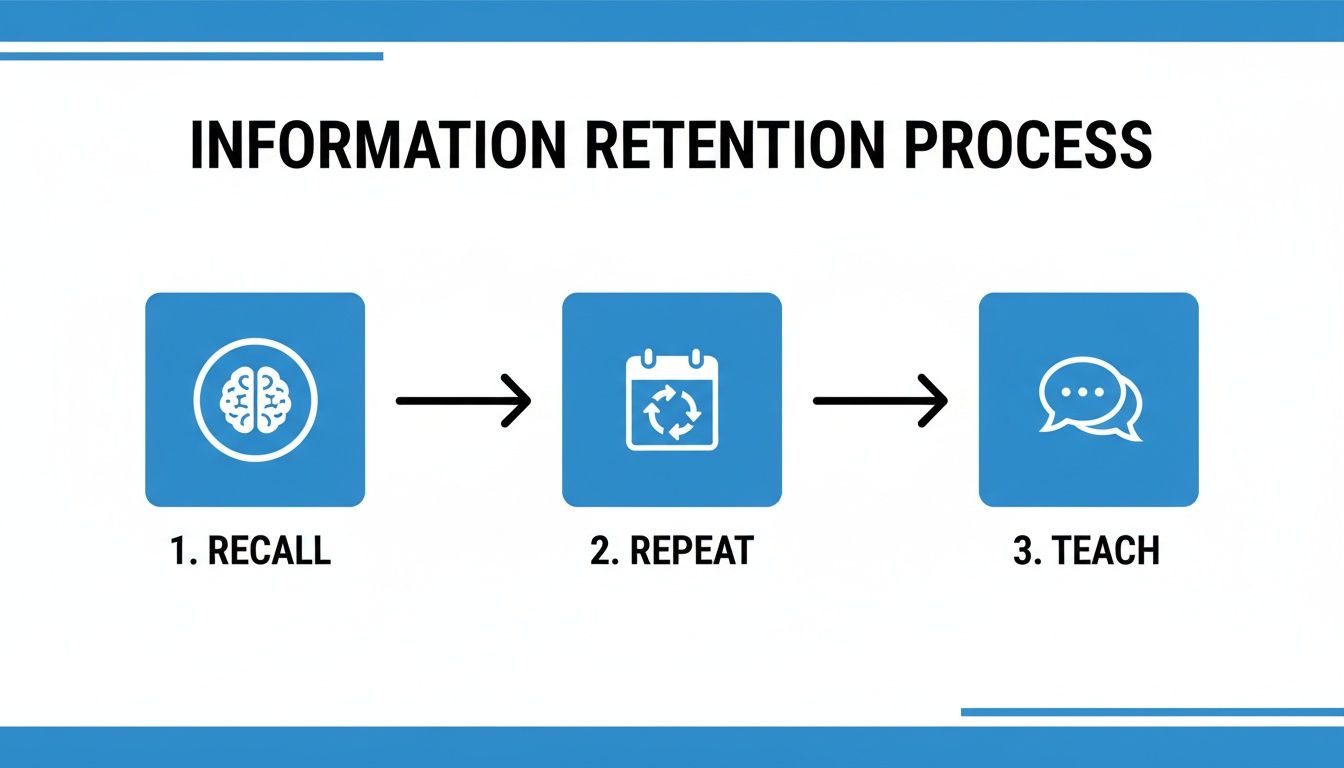
As this graphic shows, making information stick is an active game. You have to pull it out of your memory (recall), reinforce it over time (repeat), and truly master it by explaining it to someone else (teach).
This sample schedule offers a structured way to build these habits over a month. It’s designed to prevent you from getting stuck and ensures you’re always building on the skills from the week before.
Sample 4-Week Progressive Training Schedule
| Week | Daily Focus (15-20 Mins) | Goal |
|---|---|---|
| 1 | Foundation: 5 min meta-guiding, 5 min chunking drills, 5 min free reading for enjoyment. | Get comfortable with the basic mechanics without pressure. |
| 2 | Building Speed: 10 min timed sprints with comprehension checks, 5 min subvocalization reduction. | Increase your Words Per Minute (WPM) while tracking comprehension. |
| 3 | Retention Focus: 10 min reading with active recall breaks, 5 min summarizing key points. | Shift focus to solidifying what you read, not just speed. |
| 4 | Integration: Apply all techniques to your regular reading (articles, reports, books). | Make the techniques feel natural and automatic in real-world scenarios. |
By the end of the month, these exercises won't feel like drills anymore; they’ll just be how you read.
The Value of Extensive Reading
Beyond the timed drills and focused exercises, one of the most effective ways to become a more fluent reader is simply to read a lot. This is called extensive reading, and it involves devouring large amounts of easier, enjoyable material—think page-turner novels, engaging non-fiction, or anything you read purely for pleasure.
This kind of reading builds a natural rhythm and boosts your confidence. You start chunking words and silencing that inner voice automatically, all without the pressure of a ticking clock. The evidence backing this up is solid. Studies show that extensive reading programs consistently lead to big gains in speed without sacrificing comprehension. For example, one comparison found that students saw a 33.72% increase in reading speed, while another study noted a 50% improvement after a course that incorporated extensive reading.
Pro Tip: Don't start your practice with dense, difficult texts. If you’re trying to master a new technique, you don't want to be wrestling with complex ideas at the same time. Grab a news article or a blog post to practice on so your full attention can go to the how of reading, not the what.
Use Technology to Read Smarter, Not Harder
All the reading techniques in the world can't always conquer the mountain of digital information we face every day. Think about it: dense research papers, long-winded business reports, and complex manuals land on our desks constantly. The right tech can act as a filter, helping you cut through the noise and focus your energy where it actually counts.
This is about making smarter choices before you even start reading. Instead of just diving in and hoping for the best, you can use modern tools to get a high-level overview first. It's like supercharging the "previewing" technique we talked about earlier, turning what could be hours of reading into a few minutes of targeted analysis.
Get the Gist in Seconds with AI Summaries
Let's be real. You’ve been there—handed a 50-page PDF report that you need to understand by the end of the day. The old way was to start on page one, slug through it, and pray you absorbed the important parts.
A much better approach is to let an AI-powered tool do the initial heavy lifting.
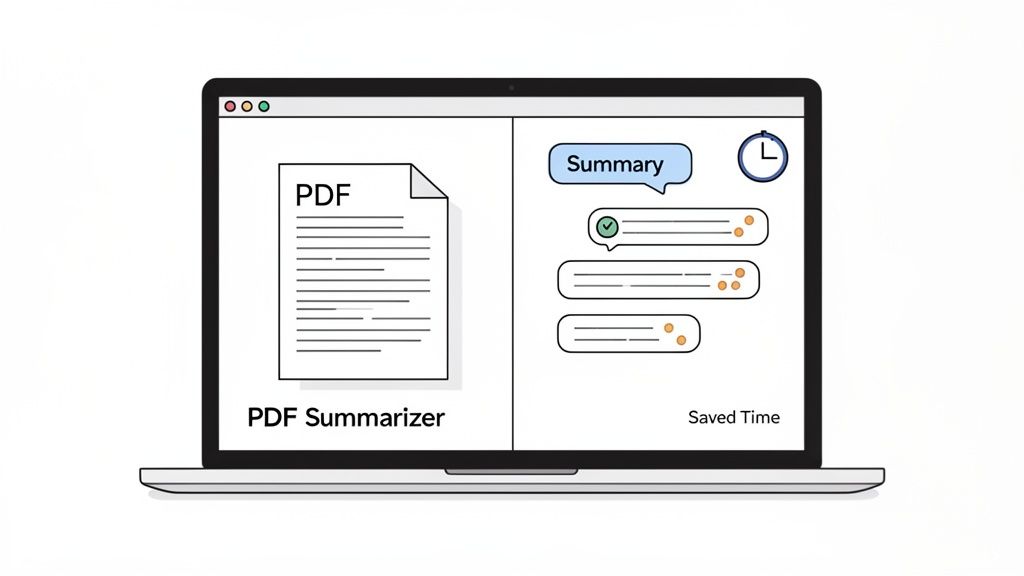
This is exactly what tools like PDF Summarizer were built for. You upload a document, and within seconds, it generates a concise, bulleted summary of the entire file. This isn't just a time-saver; it’s about building a mental roadmap before you begin the journey. You immediately grasp the core arguments and key findings, which lets you read the full document with a clear purpose.
This initial summary helps you answer critical questions upfront:
- Does this document need a deep, careful read, or can I just skim for the key parts?
- Which sections are most relevant to what I'm working on?
- What's the author's main point or conclusion?
Knowing this transforms you from a passive reader into an active investigator. You're no longer just consuming words; you're on a mission, seeking out and verifying specific information.
Turn Documents into Conversations
The real magic of modern reading tools is their ability to let you interact with your documents. A static PDF suddenly becomes a dynamic source of information you can question and explore. For anyone trying to read faster and retain more, this is a total game-changer because it directly supports active recall.
Instead of slowly scanning for a specific statistic or quote, you can just ask. For instance, you could upload a dense market research report and type, "What was the projected growth rate for the North American sector in Q4?" The tool will find and present the answer instantly, often with a direct citation.
Here’s what that looks like in action. You can see your question on one side and the answer highlighted right in the original text on the other.
Verification is seamless. You're not just taking the AI's word for it; you're seeing the proof right in the source.
The ability to ask direct questions and get sourced answers turns reading from a one-way street into a two-way dialogue. This engagement massively boosts comprehension because you are actively pulling information out rather than just letting it wash over you.
Synthesize Information Across Multiple Sources
One of the toughest jobs for any student, researcher, or professional is pulling together insights from multiple sources. Juggling several PDFs while trying to compare findings and track down conflicting data is a recipe for a headache and a wasted afternoon.
This is another area where technology gives you a massive leg up. The best tools now offer multi-file chats, letting you upload several documents into a single, unified conversation.
Imagine you're working on a literature review. You could upload five different academic papers and simply ask:
- "Summarize the key differences in methodology between these studies."
- "Which of these papers discuss the long-term effects of X?"
- "Create a table comparing the main conclusions from each source."
A task that would have taken hours of painstaking manual work can now be done in minutes. This frees you up to focus on the important stuff—analysis and synthesis—rather than getting bogged down in the grunt work. The great news is that you can find a free PDF summarizer to make these powerful techniques accessible to everyone.
Common Questions and Sticking Points
Let's be honest, picking up any new skill comes with its share of questions and a few roadblocks. When it comes to something as ingrained as reading, it’s only natural to have some skepticism. Let's tackle the most common concerns I hear from people so you can move forward with confidence.
"Won't Reading Faster Just Wreck My Comprehension?"
This is the big one—the myth that holds so many people back. And it's a fair question. If you just blast through a page without a plan, your comprehension will absolutely plummet. But that's not what we're doing here.
Structured techniques are about efficiency, not skipping information. When you consciously work to stop re-reading sentences (regression) or sounding out every word in your head (subvocalization), you're forcing your brain to engage on a deeper level. I've found that most people actually see their comprehension go up because they have to maintain such a high degree of focus.
Here’s the golden rule: Never divorce speed from understanding. After a speed drill, force yourself to summarize what you just read in a few sentences. This simple check ensures you’re actually absorbing ideas, not just glossing over words.
"Okay, But How Long Until I Actually See Results?"
You won't be waiting months, I promise. With focused, daily practice—we’re talking just 15-20 minutes a day—most people start feeling a real difference in their speed and recall within three to four weeks.
Your progress won't be a straight line up. Some days you'll feel like a genius, and others you'll feel like you're slogging through mud. Totally normal. The first big jump usually comes from breaking those old, bad habits. The more advanced skills, like seeing entire phrases as single "chunks," will take a bit longer to master.
Just remember, consistency beats intensity every time. A little bit of practice each day is far more effective than a marathon session once a week.
"Do These Tricks Work for Everything, Like My Textbooks or a Dense Legal Doc?"
Great question, and the answer is no—but that's actually the point. You shouldn't read a complex legal contract with the same speed you use for a blog post. The goal isn't to find one magic speed for everything; it's to build a flexible toolkit.
Think of it like driving. You have a speed for the highway, another for a winding country road, and a much slower one for a school zone. You adapt.
These techniques are incredibly powerful for the bulk of what most of us read daily:
- Business reports and industry articles
- Non-fiction books
- Research papers
- Online news and blog posts
But when you hit a dense philosophical argument or a beautiful piece of literature, you'll naturally slow down to wrestle with the ideas or savor the prose. You’re in control, choosing the right gear for the terrain.
"Is It Possible to Do This on a Computer Screen?"
Absolutely. In fact, some of these techniques are even easier to apply digitally. Every principle we’ve discussed translates perfectly from the page to the pixel.
You can use your mouse cursor as a pacer just like you’d use your finger. "Chunking" groups of words works just as well on your monitor. The real challenge with digital reading isn't the technique; it's the environment. Our screens are battlefields of distraction.
Before you start a reading session, prepare your digital space for focus:
- Close every browser tab you don't need.
- Silence notifications on your computer and your phone.
- Use a browser's "reader mode" to eliminate the clutter of ads and sidebars.
By clearing out the digital noise first, you create the mental runway you need for these skills to really take off.
Ready to stop drowning in dense documents and start extracting key insights in seconds? PDF Summarizer uses AI to instantly summarize lengthy reports, answer your specific questions, and help you synthesize information across multiple files. Transform how you read and research by trying it for free today.
Relevant articles

Explore critical thinking skills for students with practical strategies to analyze information, argue persuasively, and boost academic success.
Feeling buried in data? Learn how to process information faster using strategic reading, smart note-taking, and AI tools designed to end information overload.

Discover how to study for exams effectively using proven, science-backed techniques. Learn practical strategies to improve retention and ace your next test.