The 10 Best Way to Study Textbooks for Deeper Learning in 2026
Discover the best way to study textbooks with our top 10 methods. Learn active reading, SQ3R, and AI-powered tips for maximum retention and efficiency.

Textbooks are the foundation of academic learning, yet many students struggle to extract knowledge from their dense pages. The traditional method of passively reading and highlighting often leads to forgotten facts and wasted hours. This guide reveals the definitive best way to study textbooks by breaking down ten powerful, evidence-based strategies designed for deep comprehension and long-term retention. We move beyond surface-level tips to provide actionable workflows, common pitfalls to avoid, and practical advice on integrating modern tools to accelerate your learning.
Prepare to transform your study sessions from a passive chore into an active, efficient, and rewarding process that builds lasting knowledge. We will explore methods like the SQ3R Method, the Feynman Technique, and Spaced Repetition, offering step-by-step instructions for each. You’ll learn not just what to do, but how and when to apply these techniques for maximum impact, whether you're a student tackling heavy reading loads, a researcher conducting a literature review, or a professional analyzing complex documents.
To truly master your textbooks and move beyond basic methods, it's essential to adopt effective learning approaches. For a broader perspective on academic success, explore additional strategies to study better in college and boost your grades. This article, however, focuses specifically on turning your textbook from a challenge into your most powerful learning asset. Get ready to stop just reading and start truly understanding.
1. Active Reading with Annotation
Passive reading, where your eyes simply scan the words, is one of the least effective ways to study textbooks. Active reading, in contrast, transforms this process into a dynamic conversation with the material. By engaging directly with the text through highlighting, underlining, and making notes in the margins (annotation), you force your brain to process, question, and synthesize information as you go. This method is fundamental for building a deep, lasting understanding of complex subjects.
The core principle is simple: don't just read, interact. This technique is exceptionally useful when you need to deconstruct dense, information-rich material. Medical students, for instance, often annotate anatomy diagrams with clinical correlations, while law students highlight key phrases in statutes and add relevant case law references in the margins. This turns the textbook from a static source of facts into a personalized study guide tailored to your course and learning style.
How to Implement Active Reading
To make this the best way to study textbooks for you, avoid the common mistake of over-highlighting. Instead, follow a structured approach:
- First Pass - Skim: Quickly read a chapter or section to get the general gist. Pay attention to headings, subheadings, and summary paragraphs.
- Second Pass - Annotate: Reread the section with a pen or digital stylus in hand. This is where you engage.
- Highlight Sparingly: Limit highlighting to only the most crucial phrases or concepts, ideally no more than 10-15% of the text on a page.
- Use a Symbol System: Develop a consistent key. For example, use a star (⭐) for main ideas, an exclamation point (❗) for surprising facts, and a question mark (❓) for points of confusion.
- Write in the Margins: This is the most critical step. Summarize complex sentences in your own words, ask questions, and connect ideas to other concepts you've learned.
Pro Tip: Before you even begin annotating, you can use a tool like PDF Summarizer to get a high-level overview. Chat with your document and ask, "What are the three most important concepts in this chapter?" This helps you focus your attention on what truly matters, making your annotations more targeted and effective. For more strategies, you can learn about improving reading comprehension skills.
2. SQ3R Method (Survey, Question, Read, Recite, Review)
The SQ3R method is a time-tested, systematic approach that transforms reading from a passive activity into a structured, strategic process. Developed by educational psychologist Francis P. Robinson, this five-step strategy (Survey, Question, Read, Recite, Review) guides you to actively engage with textbook material before, during, and after reading. This structured framework prevents mindless skimming and ensures you are focused on comprehension and retention.
The core principle is purposeful engagement. SQ3R is particularly effective for dense, foundational textbooks where understanding the structure and key concepts is as important as remembering facts. For example, an engineering student can use it to break down complex physics chapters, while a foreign language learner can apply it to master grammar rules. The method builds a mental framework first, making it easier for new information to stick.
How to Implement the SQ3R Method
To make this the best way to study textbooks for deep comprehension, treat each of the five steps as a distinct phase with a clear objective. Avoid rushing or combining steps.
- Survey (S): Before reading, skim the chapter. Look at headings, subheadings, diagrams, charts, and the introduction and summary paragraphs. The goal is to get a high-level overview of the chapter’s structure and content.
- Question (Q): Turn headings and subheadings into questions. For a heading like "The Laws of Thermodynamics," your question might be, "What are the laws of thermodynamics and why are they important?" This primes your brain to look for answers.
- Read (R1): Read the section with the goal of answering the questions you just formulated. This active search for answers keeps you focused and engaged with the material.
- Recite (R2): After reading a section, look away from the textbook and try to recall the key points and answer your question in your own words. You can say it aloud, write it down, or explain it to someone else.
- Review (R3): Once you've completed the chapter, go back over your notes and the chapter summary. Reread the questions you created and see if you can still answer them confidently without looking at the text.
Pro Tip: Use PDF Summarizer to accelerate the "Question" phase. After uploading your chapter, ask it, "Generate a list of key questions based on the main headings in this document." This gives you a pre-built set of targeted questions, allowing you to dive into the active reading phase with a clear purpose and a roadmap for what to look for.
3. Cornell Note-Taking System
The Cornell Note-Taking System is a highly structured method designed to turn passive note-taking into an active learning process. Developed by Walter Pauk at Cornell University, it divides a single page into distinct sections for notes, cues, and a summary. This format forces you to process, organize, and review information systematically, making it an incredibly efficient way to study textbooks and retain knowledge for the long term.
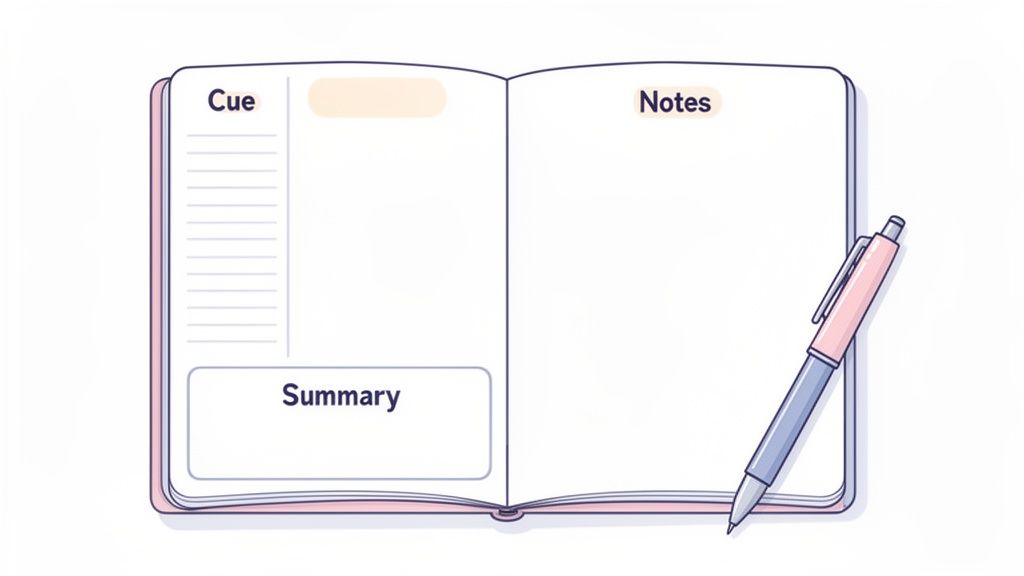
The core principle is to organize information for active recall. This technique is perfect when you need to condense dense textbook chapters into a functional study guide. For example, a history student might record key dates and events in the main notes column, with "Causes of WWI?" in the cue column. An engineering student could write formulas on the right and their practical applications or variable definitions on the left. This systematic organization is one of the best ways to study textbooks for exams, as it creates built-in flashcards.
How to Implement the Cornell Note-Taking System
To make this method work, prepare your page before you begin reading. Divide your paper into three sections: a large main column on the right (Notes), a narrower column on the left (Cues), and a section at the bottom (Summary).
- During Reading - Notes Column: As you read, take notes in the main right-hand column. Use shorthand, abbreviations, and bullet points to capture key concepts, data, and examples.
- After Reading - Cues Column: Within 24 hours, review your notes. In the left-hand cue column, pull out main ideas, key terms, or potential test questions that correspond to the notes on the right.
- Synthesize - Summary Section: At the bottom of the page, write a one or two-sentence summary of the entire page's content. This forces you to synthesize the material at a high level.
- Review and Recite: Cover the right-hand notes column and try to answer the questions or define the terms in your cue column. This active recall practice is crucial for memory consolidation.
Pro Tip: Speed up the initial note-taking process by using PDF Summarizer to generate a concise summary of a chapter first. Ask it to "Create a bulleted list of the main arguments and key definitions in this section." Use this output to guide your focus as you create your Cornell notes, ensuring you capture the most critical information. For more in-depth strategies, explore these tips on how to take notes from textbooks.
4. Spaced Repetition and Interleaving
Cramming information the night before an exam is a recipe for short-term recall and long-term forgetting. The best way to study textbooks for lasting knowledge is to work with your brain's natural memory system, not against it. Spaced repetition and interleaving are two powerful, evidence-based techniques that hack the "forgetting curve," ensuring information moves from your short-term to long-term memory.
The core principle is to review smarter, not harder. Spaced repetition involves revisiting material at increasing intervals over time, while interleaving involves mixing different subjects or problem types in a single study session. This approach is ideal for subjects that require cumulative knowledge, such as languages, mathematics, and sciences. For example, instead of studying chapter one, then chapter two, a student would study chapter one, then chapter two, then review a key concept from chapter one again before moving to chapter three.
How to Implement Spaced Repetition and Interleaving
To make these techniques work, you need to shift from "blocking" (studying one topic at a time) to mixing and spacing. This forces your brain to retrieve information repeatedly, which strengthens neural connections.
- Schedule Your Reviews: After learning a concept, plan your first review within 24-48 hours. Subsequent reviews can be spaced further apart, like after 3 days, 1 week, and then 1 month.
- Mix It Up: Don't practice 20 similar math problems in a row. Instead, create practice sets that include problems from chapters 1, 3, and 5. This forces your brain to identify the correct strategy for each problem, rather than just mechanically applying the same one.
- Use Digital Flashcard Tools: Apps like Anki or Quizlet have built-in spaced repetition algorithms. You can create digital flashcards for key terms, formulas, and concepts, and the app will automatically schedule them for review.
Pro Tip: Use a tool like PDF Summarizer to quickly generate flashcards for your digital tools. Ask the tool to "Create a list of key terms and definitions from this chapter" or "Summarize the main formula applications in this section." This saves you hours of manual creation and lets you focus on the active recall part of studying. To further explore the power of this technique, you can delve deeper into a guide on Spaced Repetition.
5. Mind Mapping and Concept Mapping
Traditional linear note-taking can stifle creativity and obscure the big-picture connections within a textbook chapter. Mind mapping and concept mapping are visual study methods that break free from this rigid format. They organize information radially around a central topic, using branches, colors, and images to represent related ideas and their relationships. This approach activates both hemispheres of your brain, making it a powerful and engaging way to study textbooks.
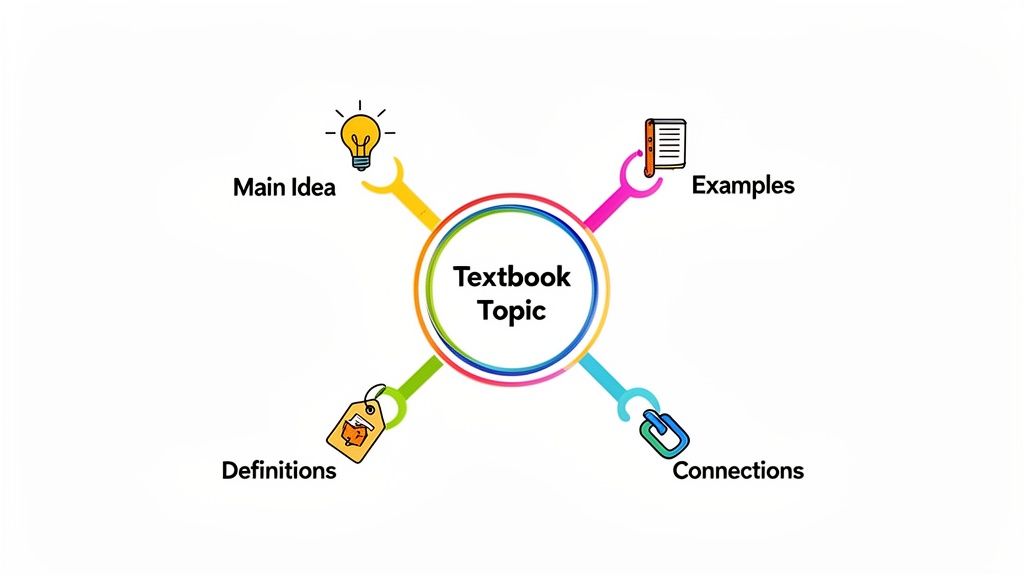
The core principle is to visualize connections, not just list facts. This technique is exceptionally useful for subjects with complex, interconnected systems. For example, a biology student could map out cellular respiration, with branches for glycolysis, the Krebs cycle, and oxidative phosphorylation. Similarly, a history student could create a concept map connecting the causes, key events, and long-term consequences of the French Revolution. This turns abstract information into a tangible, memorable structure.
How to Implement Mind Mapping
To make this the best way to study textbooks for visual learners, focus on creating clear, logical, and visually appealing diagrams. Avoid clutter and overly complex branching.
- Start with a Central Idea: Place the main chapter topic in the center of a blank page or digital canvas.
- Branch Out with Main Sub-Topics: Draw thick branches radiating from the center for each major subheading or key concept in the text. Label them with single keywords or short phrases.
- Add Supporting Details: Create smaller, thinner branches extending from your main branches to add supporting details, examples, and definitions.
- Use Color and Images: Assign different colors to different themes or branches to create visual groupings. Add small icons or drawings to make concepts more memorable.
- Keep It Concise: Use one or two words per branch. Avoid writing full sentences, as this defeats the purpose of the visual summary.
- Show Relationships: Use arrows or labeled connecting lines to show how ideas on different branches relate to one another (this is a key feature of concept mapping).
Pro Tip: Before creating your map, use a tool like PDF Summarizer to generate a list of the main themes and sub-topics from a chapter. Ask it, "What are the five key concepts in this document and what are their definitions?" This gives you an instant, high-level structure to use as the main branches for your mind map, ensuring you don't miss any critical information.
6. Elaborative Interrogation (Asking 'Why' and 'How')
Simply memorizing facts from a textbook creates a fragile understanding that crumbles under pressure. Elaborative interrogation transforms this shallow learning into deep comprehension by forcing you to question the material. This technique involves constantly asking 'why' a concept is true and 'how' it works, turning you into a detective who actively seeks out the underlying logic and connections within the text. This is a powerful method for building a robust mental framework.
The core principle is to move beyond acceptance to inquiry. This technique is exceptionally useful for subjects that rely on cause-and-effect relationships or complex processes. For example, a chemistry student might ask, "Why does this reaction produce heat?" or "How does this molecular structure allow it to bond with other elements?" Similarly, an economics student could ask, "Why does this policy lead to inflation?" This active questioning creates richer, more interconnected memories that are easier to recall and apply.
How to Implement Elaborative Interrogation
To make this the best way to study textbooks for your needs, integrate questioning directly into your reading workflow. Avoid passively reading a whole chapter and then trying to ask questions later.
- Read in Chunks: Read a paragraph or a small section, then pause. Don't move on until you've engaged with it.
- Generate Questions: Formulate at least one 'why' or 'how' question about the material you just read.
- Start with 'How': Begin by asking 'how' something works. For instance, "How does photosynthesis convert light into energy?"
- Deepen with 'Why': Follow up with 'why' questions to understand the reasoning. "Why is chlorophyll essential for this process?"
- Connect Concepts: Ask questions that link the new information to what you already know. "How is this different from cellular respiration?"
- Articulate the Answers: Try to answer your questions out loud or by writing them down in your own words. If you can't, you've pinpointed a gap in your understanding that needs review.
Pro Tip: Use a tool like PDF Summarizer to accelerate this process. After reading a section, ask your document direct 'why' and 'how' questions. For example, upload your history chapter and ask, "Why did the Roman Empire fall?" or "How did its economic policies contribute to its decline?" This gives you immediate, context-based answers to check against your own understanding and deepens your inquiry.
7. Pomodoro Technique with Strategic Breaks
Reading a textbook for hours on end is a recipe for burnout and diminishing returns. The Pomodoro Technique, a time management method developed by Francesco Cirillo, offers a structured alternative that prioritizes focused bursts of work with deliberate rest. It breaks study sessions into 25-minute intervals, known as "pomodoros," separated by short breaks, which is a powerful way to maintain high levels of concentration, prevent mental fatigue, and make daunting chapters feel manageable.

The core principle is simple: work with your attention span, not against it. This technique is exceptionally useful for conquering procrastination and tackling long, dense reading assignments that seem overwhelming at the start. For example, law students use it to systematically work through lengthy case law readings without losing focus, and undergraduates find it invaluable for staying engaged during marathon exam prep sessions. The short, built-in breaks are key to resetting your focus and absorbing information effectively.
How to Implement the Pomodoro Technique
To make this the best way to study textbooks for your needs, the key is discipline in both work and rest periods. Avoid the common mistake of skipping breaks or letting them stretch on for too long.
- Set a Clear Goal: Before starting your timer, define a specific, achievable task. For instance, "Read and take notes on pages 45-52" or "Complete the first three practice problems."
- Work for 25 Minutes: Start your timer and give the task your undivided attention. No multitasking, no phone notifications, no distractions.
- Take a Short Break: When the timer rings, take a 5-minute break. It is crucial to step away from your textbook. Stretch, get some water, or look out a window.
- Repeat and Take a Long Break: After completing four pomodoros, take a longer break of 15-30 minutes. This longer rest allows your brain to consolidate the new information you've learned.
Pro Tip: Supercharge your pomodoros by setting a clear goal before you start. Use a tool like PDF Summarizer to ask your textbook, "Summarize the key arguments in the introduction of this chapter." This gives you immediate context and a focused objective for your 25-minute session, ensuring you dive right into the most critical material.
8. Summarization and Self-Explanation
Rereading a chapter multiple times often creates a false sense of mastery known as the illusion of competence. To truly embed knowledge, you must actively process and reformulate it. Summarization and self-explanation are powerful generative learning strategies that force you to move beyond passive recognition and into active recall and synthesis. By condensing information into your own words and explaining it to yourself, you build durable mental models.
The core principle is: if you can't explain it simply, you don't understand it well enough. This technique is invaluable for solidifying your grasp on conceptual subjects. For example, a business student might self-explain the principles of supply and demand using a real-world product, while a psychology student could create a one-page summary connecting different developmental theories. This process transforms abstract textbook language into concrete, personal knowledge, making it one of the best ways to study textbooks for long-term retention.
How to Implement Summarization and Self-Explanation
The key is to make this a two-step process: first condense, then elaborate. Avoid summarizing as you read, which often leads to simply rephrasing sentences. Instead, read a full section first to grasp the context.
- Read First, Summarize Second: Finish a complete section or chapter before you start writing. This forces you to recall the main ideas rather than just copying them.
- Set a Condensation Target: Aim to reduce the content to about 20-30% of its original length. This constraint forces you to identify only the most critical information.
- Use Your Own Words: Strictly avoid lifting phrases directly from the textbook. The act of translation into your own vernacular is where the deep learning happens.
- Self-Explain with “Why” and “How”: After summarizing, ask yourself questions. "Why is this concept important?" "How does this connect to what I learned last week?" Articulate the answers out loud or in writing.
- Create a Hierarchy: Build your summaries from small to large. Start with a paragraph summary for each major section, then combine those into a one-page summary for the entire chapter.
Pro Tip: Manually summarizing dense chapters can be time-consuming. Use a tool to generate an initial draft summary to serve as a foundation. You can ask an AI tool to "Summarize the key arguments in this 30-page PDF" to get a starting point. Then, your task becomes refining, personalizing, and self-explaining that summary, which is a much more efficient and focused study session. For more ideas on how to leverage this technology, explore these insights on how to summarize a PDF with AI.
9. Feynman Technique (Learning Through Teaching)
Studying often feels like a one-way street: information flows from the textbook into your brain. The Feynman Technique, named after Nobel Prize-winning physicist Richard Feynman, flips this model on its head. It operates on a simple but powerful premise: the best way to understand a concept is to explain it to someone else in the simplest terms possible. This process forces you to confront what you truly know versus what you think you know.
The core principle is: if you can't explain it simply, you don't understand it well enough. This technique is exceptionally powerful for abstract or highly technical subjects where complex jargon can mask a shallow understanding. For instance, a physics student might use it to explain quantum mechanics using everyday analogies, or a computer science student might teach a sorting algorithm to a family member. By attempting to simplify, you immediately expose gaps in your own knowledge.
How to Implement the Feynman Technique
To make this the best way to study textbooks for conceptual mastery, follow this structured four-step process. Avoid the mistake of keeping the explanation in your head; the act of externalizing it is key.
- Step 1 - Choose a Concept: Take a single concept from your textbook, like "photosynthesis" or "Keynesian economics," and write the name at the top of a blank page.
- Step 2 - Teach It Simply: Write down an explanation of the concept as if you were teaching it to an intelligent 12-year-old. Use your own words, simple language, and practical analogies. Avoid quoting directly from the textbook or using its complex terminology.
- Step 3 - Identify Knowledge Gaps: As you explain, you will inevitably get stuck or realize you are using jargon you can't simplify. This is the most important part of the process. These are your knowledge gaps. Go back to your textbook and source material to fill them in until your explanation is clear and smooth.
- Step 4 - Refine and Simplify: Review your explanation one last time. Read it out loud. Is it confusing? Is it too wordy? Refine the language and simplify your analogies until the explanation is elegant and easy to grasp.
Pro Tip: Accelerate the "Identify Knowledge Gaps" step with a tool like PDF Summarizer. When you get stuck, instead of rereading the entire chapter, you can ask your document a direct question like, "Explain the role of the Calvin Cycle in photosynthesis in simple terms." This provides a quick, targeted review to patch your understanding so you can refine your explanation and solidify your learning more efficiently.
10. Dual Coding and Visual Learning Strategies
Reading dense, text-heavy chapters can feel like trying to build a complex structure with only one type of material. Dual coding introduces a second, powerful building block: visuals. This learning strategy is based on the theory that our brains process information through two distinct channels, a verbal one for text and an auditory one, and a visual one for images. By combining both, you create stronger, more interconnected memory pathways, making abstract concepts concrete and easier to recall.
The core principle is to translate words into images and vice versa. This method is a game-changer for subjects that rely on processes, structures, or relationships. For instance, a biology student can better understand the Krebs cycle by drawing the molecular transformations rather than just reading descriptions. Similarly, a literature student can map out a complex plot or character web to see the connections that text alone might obscure. This active translation process is a highly effective way to study textbooks, as it forces deep engagement with the material.
How to Implement Dual Coding
To make dual coding one of the best ways to study textbooks for you, move beyond passive viewing of illustrations and become an active creator of visuals:
- Draw as You Read: Don't wait until you finish a section. Sketch diagrams, flowcharts, or simple stick figures in the margins as you encounter new concepts. This keeps you engaged and helps process the information in real time.
- Use Color Strategically: Assign specific colors to related concepts. For example, in an anatomy diagram, use one color for arteries and another for veins to highlight their distinct roles and pathways.
- Create Diverse Visuals: Don't limit yourself to one type of visual. Use timelines for historical events, mind maps for brainstorming central ideas, and charts to compare and contrast theories.
- Practice Retrieval with Drawing: As a powerful review technique, try to redraw a key diagram or flowchart from your textbook entirely from memory. Then, compare your drawing to the original to identify knowledge gaps.
Pro Tip: Your textbook's existing diagrams are a great starting point. Use a tool like PDF Summarizer to quickly locate all the images or tables in a chapter. Ask it to "List all the figures in this document," and then use that list as a checklist for your own drawing and retrieval practice, ensuring you cover all the key visual information provided by the author.
Top 10 Textbook Study Methods Comparison
| Technique | Implementation complexity | Resource requirements | Expected outcomes | Ideal use cases | Key advantages |
|---|---|---|---|---|---|
| Active Reading with Annotation | Low–Moderate (learn marking habits) | Text/PDF, highlighters or note app | Improved focus, better retention, personalized notes | Dense textbooks, close reading, exam prep | Quick identification of key ideas; encourages critical engagement |
| SQ3R (Survey, Question, Read, Recite, Review) | Moderate–High (five-step routine) | Time, note-taking materials, checklist | Structured comprehension, improved long-term retention | Textbook chapters and structured learning | Systematic framework that directs purposeful reading and review |
| Cornell Note-Taking System | Moderate (page layout practice) | Template/notebook or digital note app | Organized notes, efficient review, recall practice | Lectures and textbook reading with review needs | Built-in cue-testing and concise summary for revision |
| Spaced Repetition & Interleaving | Moderate (scheduling + discipline) | Scheduling tools or apps (Anki, Quizlet), time | Durable long-term retention, improved transfer | Memorization-heavy subjects; skill practice | Maximizes retention efficiency and reduces forgetting |
| Mind Mapping & Concept Mapping | Moderate–High (visual design skill) | Paper or mapping software (XMind, MindMeister) | Clear visualization of relationships, enhanced recall | Complex, interconnected subjects (theories, systems) | Reveals connections and gaps; supports creative synthesis |
| Elaborative Interrogation (Ask "Why/How") | Moderate (metacognitive skill) | Time for reflection, prior knowledge | Deeper understanding and stronger memory traces | Conceptual material needing causal/mechanistic reasoning | Promotes deeper processing and identifies misunderstandings |
| Pomodoro Technique with Strategic Breaks | Low (simple routine) | Timer or app (Pomofocus, Forest) | Sustained focus, reduced fatigue, better time management | Long reading sessions, procrastination-prone tasks | Time-boxing boosts focus and prevents burnout |
| Summarization & Self-Explanation | Moderate–High (writing skill & time) | Writing tools, time for synthesis | Deep processing, concise study materials, improved transfer | Exam synthesis, literature reviews, complex chapters | Forces identification of essentials and clarifies reasoning |
| Feynman Technique (Teach to Learn) | Moderate (explanation & iteration) | Audience or recording device, time | Rapid gap detection, clear mental models | Complex or abstract concepts needing clarity | Exposes misunderstandings and builds transferable explanations |
| Dual Coding & Visual Learning Strategies | Moderate–High (visual creation skill) | Drawing tools/software, time for diagrams | Enhanced recall via dual channels, clearer structures | Spatial, sequential, or system-based subjects | Combines verbal and visual representations for stronger memory |
Your Blueprint for Effective Textbook Study
Navigating the dense landscape of academic textbooks can often feel like a monumental task, but as we've explored, it's a challenge that can be met with the right strategy. The journey through methods like Active Reading, the SQ3R framework, and the Feynman Technique reveals a powerful truth: the best way to study textbooks isn't about finding a single, secret formula. Instead, it’s about constructing a personalized, adaptable toolkit tailored to your unique learning style and the specific demands of your course material.
The most profound shift in mastering your reading is moving from passive consumption to active engagement. Simply letting your eyes scan the page is worlds away from truly interrogating the text. Techniques like Elaborative Interrogation, where you constantly ask "why" and "how," or creating Mind Maps to visually connect complex ideas, force your brain to build meaningful connections. This active process is the cornerstone of genuine comprehension and long-term retention.
Key Takeaways and Your Action Plan
To transform these concepts into tangible results, it's crucial to consolidate the core principles and create a clear path forward. Your immediate goal should be to move from theory to practice.
- Synthesize and Select: Don't try to implement all ten methods at once. Review the strategies discussed, from the structured Cornell Note-Taking System to the time-management prowess of the Pomodoro Technique. Choose one or two that resonate most strongly with you or seem best suited for your current coursework.
- Combine for Power: The true magic happens when you layer these techniques. For example, you can use the Pomodoro Technique to create focused 25-minute blocks for applying the SQ3R method. The "Recite" and "Review" stages can then be used to generate questions for the Feynman Technique, where you explain the concepts to a friend or simply to a whiteboard.
- Embrace Spaced Repetition: Knowledge fades without reinforcement. Whatever methods you choose for initial learning, integrate Spaced Repetition as your long-term retention strategy. Use flashcard apps or a simple calendar system to revisit your Cornell notes, mind maps, or summaries at increasing intervals. This is non-negotiable for success in cumulative exams.
The Modern Learner's Edge
In today's digital age, efficiency is a critical advantage. While the cognitive work of learning cannot be outsourced, the preparatory work can be streamlined. This is where modern tools become indispensable allies. Manually summarizing a 50-page chapter before you even begin studying can be a significant time sink.
Leveraging a tool to generate an initial summary allows you to kickstart the "Survey" and "Question" phases of SQ3R with unprecedented speed. It can provide a high-level overview, helping you create a mental framework before diving into the details. This isn't about replacing the work; it's about reallocating your finite time and energy toward the activities that build deep understanding, like self-explanation and teaching the concepts to others.
The ultimate goal is to transform every textbook from an intimidating obstacle into a powerful asset. By adopting these active, strategic approaches, you are not just studying for a test; you are building a robust intellectual framework that will serve you throughout your academic and professional life. The skills you cultivate by mastering your textbooks-critical thinking, synthesis, and effective learning-are the very skills that define success. Start small, be consistent, and watch as your confidence and competence grow.
Ready to supercharge your study sessions and reclaim hours of your time? Let PDF Summarizer handle the initial heavy lifting by generating concise summaries, extracting key terms, and answering your questions about any chapter. Start studying smarter, not just harder, by visiting PDF Summarizer to get your first summary in minutes.
Relevant articles

Learn how to summarize a book with our expert guide. Master practical pre-reading, note-taking, and drafting techniques for any nonfiction or fiction work.
Discover the best way to read textbooks with practical, time-saving techniques, active reading, and note-taking strategies to boost comprehension and memory.

Discover how to study for exams effectively using proven, science-backed techniques. Learn practical strategies to improve retention and ace your next test.