Discover the best way to read textbooks: 5 proven strategies
Discover the best way to read textbooks with practical, time-saving techniques, active reading, and note-taking strategies to boost comprehension and memory.
Staring at a dense, 500-page textbook can feel overwhelming. Many students and professionals fall into the trap of passive reading, letting their eyes scan the words without truly absorbing the information. This common habit leads to hours of wasted effort, poor retention, and stressful last-minute cramming. The goal isn't just to get through the chapter; it's to understand, retain, and apply the knowledge contained within it.
What if you could transform reading from a chore into an active, efficient learning process? The key isn't to read harder, but to read smarter. Finding the best way to read textbooks for your specific needs can dramatically improve comprehension, cut down on study time, and boost your overall performance, whether you're a student, researcher, or professional. This guide is designed to move you beyond generic advice like 'take notes' and 'highlight important parts.'
Instead, we will explore eight powerful, evidence-backed methodologies that provide a structured approach to learning. Each method is a complete system for deconstructing complex topics, building lasting knowledge, and turning your reading material into an invaluable resource. From time-tested academic frameworks like the SQ3R method and Cornell Notes to modern strategies incorporating active recall and metacognitive monitoring, this comprehensive roundup provides the specific, actionable protocols you need. You will learn not just what to do, but how and when to implement each technique to conquer your reading list and achieve your goals.
1. SQ3R Method (Survey, Question, Read, Recite, Review)
The SQ3R method is a time-tested, systematic approach that transforms passive reading into an active, strategic process. Developed by educational psychologist Francis P. Robinson in the 1940s, this five-step technique is one of the best ways to read textbooks because it forces you to engage with the material before, during, and after you read, significantly boosting comprehension and long-term retention. Instead of simply letting your eyes scan the page, you actively construct a mental framework for the information.
How the SQ3R Method Works
This method breaks down the reading process into five manageable phases, each with a clear objective. It’s a structured workflow designed to prevent passive highlighting and promote deeper understanding.
- Survey: Before reading, get a bird's-eye view. Skim the chapter title, introduction, headings, subheadings, and summary. Look at any charts, graphs, or end-of-chapter questions. This creates a mental outline of the content.
- Question: Turn each heading and subheading into a question. For a section titled "The Causes of the Industrial Revolution," your question might be, "What were the primary causes of the Industrial Revolution?" This primes your brain to actively search for answers.
- Read: Read the section to answer the question you just formulated. Focus on finding the specific information needed, which keeps you engaged and prevents your mind from wandering.
- Recite: After reading a section, look away from the text and try to answer your question in your own words. You can do this out loud, by writing a brief summary, or by explaining it to a study partner. This step is crucial for transferring information from short-term to long-term memory.
- Review: Once you've finished the entire chapter, go back over your notes and questions. Reread key sections and solidify your understanding of the material as a whole. Regular, spaced reviews are essential for lasting retention.
When to Use This Method
The SQ3R method is ideal for dense, information-heavy textbooks in subjects like history, biology, psychology, or sociology. It excels when you need to not only understand complex concepts but also remember them for exams. While it requires more initial effort than passive reading, the investment pays off through greatly improved retention and reduced need for last-minute cramming. For a deeper dive into structured reading techniques, you can find more information about effective reading and summarizing strategies on pdfsummarizer.pro.
2. Cornell Note-Taking System
The Cornell Note-Taking System is a highly organized method that merges the act of reading with the process of note-taking, creating an integrated study tool. Developed by Cornell University professor Walter Pauk in the 1950s, this technique is one of the best ways to read textbooks because it structures your notes for easy review and active recall. Instead of passively jotting down information, you create a dynamic document that helps you process, question, and summarize the material as you go.

How the Cornell Note-Taking System Works
This method divides a single page into four distinct sections, each serving a unique purpose in the learning cycle. The structured layout encourages you to interact with your notes rather than just transcribe them.
- Preparation: Before reading, divide your page. Draw a horizontal line about two inches from the bottom. Then, draw a vertical line about 2.5 inches from the left edge, running from the top of the page down to the horizontal line.
- Notes Column (Right): As you read the textbook, take your main notes in the large, right-hand column. Focus on capturing key ideas, concepts, examples, and formulas. Use abbreviations and short sentences to be efficient.
- Cues Column (Left): After your reading session, review your notes and pull out main ideas or formulate questions in the narrow left-hand column. These cues act as prompts for later review, helping you test your knowledge without looking at your detailed notes.
- Summary Section (Bottom): Use the space at the bottom of the page to write a one- or two-sentence summary of the information on that page. This critical step forces you to synthesize the material and confirm your understanding.
When to Use This Method
The Cornell system is exceptionally effective for lecture-based courses and dense textbook readings where both detail and conceptual understanding are important, such as in law, medicine, or advanced sciences. Its structure is perfect for creating study guides directly from your reading notes, making exam preparation more efficient. While the Cornell system offers a structured approach, it's beneficial to explore other effective note-taking methods to discover what best aligns with your learning style and the material. For those working with digital documents, converting a PDF into structured notes using a similar template in apps like OneNote or Notion can streamline the process.
3. Active Reading and Annotation
Active reading and annotation is a fundamental strategy that shifts you from being a passive consumer of information to an active participant in a dialogue with the text. Rather than just letting your eyes scan words, this method involves physically and intellectually engaging with the material by highlighting, underlining, and writing notes directly in the margins. It is one of the best ways to read textbooks because it forces you to slow down, question arguments, and identify the most critical information, creating a personalized study guide as you read.
How Active Reading and Annotation Works
This method transforms your textbook into an interactive workspace. It’s about leaving your intellectual footprint on the page, making the content your own through a system of deliberate marks and comments.
- First Pass Reading: Read a paragraph or a short section first without marking anything. This initial read-through gives you the necessary context to understand the main point.
- Strategic Highlighting/Underlining: On a second pass, go back and highlight or underline only the most crucial information. This includes key terms, main ideas, and supporting evidence. The goal is to be selective to avoid the "sea of yellow" effect.
- Marginal Notes: This is the core of active reading. Use the margins to write summaries, ask questions, define terms in your own words, or connect the idea to another concept.
- Symbol System: Develop a consistent shorthand or symbol system. For example, use a question mark (?) for points of confusion, an exclamation point (!) for significant insights, and an asterisk (*) for important examples.
- Summarize at the End: After finishing a chapter, use your annotations to write a concise summary. This final step synthesizes your notes and solidifies your understanding of the material as a whole.
When to Use This Method
Active reading and annotation is universally effective, but it is especially powerful for complex, argument-driven texts common in the humanities, law, and social sciences. It’s perfect for literature students analyzing themes, law students breaking down case materials, or researchers synthesizing multiple academic articles. This hands-on approach is ideal when you need to deconstruct arguments, trace evidence, and form your own critical interpretations rather than just memorizing a list of facts. It ensures that your study time is focused and productive, building a deep, lasting comprehension of the subject matter.
4. Feynman Technique (Learning Through Explanation)
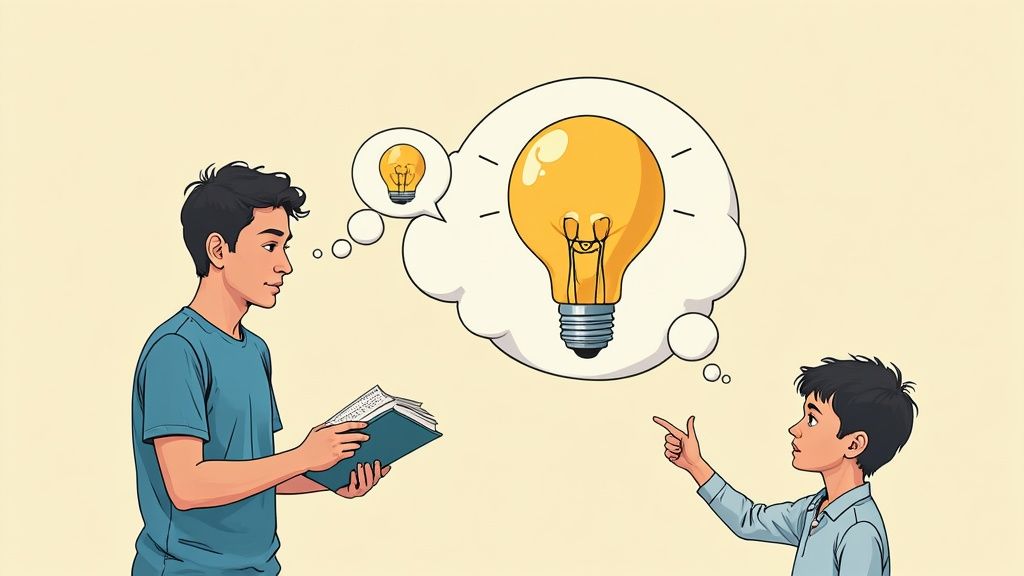
The Feynman Technique is a powerful mental model that shifts the goal from memorizing textbook information to truly understanding it. Named after Nobel Prize-winning physicist Richard Feynman, this approach centers on one simple idea: if you can't explain a concept in simple terms, you don't really understand it. This method is one of the best ways to read textbooks because it forces you to deconstruct complex ideas and confront the gaps in your knowledge, leading to a much deeper and more durable command of the material.
How the Feynman Technique Works
This technique transforms reading into a teaching exercise, breaking down the process into four actionable steps. It is a workflow designed to expose and repair flawed or incomplete understanding.
- Choose a Concept: After reading a section in your textbook, select a single core concept you want to master, such as "photosynthesis" or "supply and demand."
- Teach It to a Novice: Write down an explanation of the concept as if you were teaching it to a 12-year-old or someone completely unfamiliar with the subject. Avoid technical jargon and use simple language, analogies, and everyday examples.
- Identify Gaps and Simplify: As you explain, you will inevitably stumble or find areas where your explanation is clunky or overly complicated. These are the exact points where your understanding is weak. Return to your textbook to fill in these gaps.
- Review and Refine: Reread your source material to clarify the points you struggled with, then refine your simple explanation. Repeat the process until you can explain the concept fluently, clearly, and concisely.
When to Use This Method
The Feynman Technique is exceptionally effective for conceptual or theoretical subjects like physics, economics, philosophy, and complex biological processes. Use it when your goal is not just to pass a test but to achieve genuine mastery of foundational principles. For instance, a medical student might use it to grasp complex diagnostic reasoning, while a business professional could apply it to understand financial models. It’s an indispensable tool for anyone who needs to move beyond surface-level familiarity and build a robust, interconnected knowledge base.
5. Spaced Repetition System (SRS)
A Spaced Repetition System (SRS) is less of a reading method and more of a scientifically-backed retention strategy. This technique leverages the "spacing effect," a cognitive phenomenon showing that we learn more effectively when study sessions are spaced out over time. Instead of cramming information from your textbook, SRS has you review it at increasing intervals, directly combating the natural forgetting curve and embedding knowledge into your long-term memory. It transforms review from a guessing game into a precise, algorithm-driven process.
How a Spaced Repetition System Works
At its core, SRS is a systematic way to schedule reviews. You learn a concept from your textbook and then review it just before you are likely to forget it. Each time you successfully recall the information, the interval until the next review increases, from hours to days, to weeks, and eventually months. This is one of the best ways to read textbooks for long-term mastery, as it automates the review process for maximum efficiency.
- Initial Learning: First, you must learn the material. Read a chapter section, identify a key concept, and create a flashcard (digital or physical).
- First Review: You review the new flashcard relatively soon, perhaps within the same day.
- Active Recall: During review, you practice active recall. Look at the prompt (e.g., a question or a term) and try to retrieve the answer from memory before checking it.
- Rate Your Recall: After retrieving the answer, you rate how difficult it was to remember. This feedback is crucial for the system's algorithm.
- Scheduled Next Review: Based on your rating, an SRS algorithm (like in the app Anki) schedules the next review. An easy recall pushes the next review far into the future, while a difficult one schedules it sooner.
When to Use This Method
Spaced Repetition is unparalleled for subjects that require memorizing large volumes of specific information, such as medicine (anatomy, pharmacology), law, language learning (vocabulary), and hard sciences (formulas, definitions). It is the ultimate tool for turning the key takeaways from your textbook into durable knowledge that lasts well beyond the final exam. While it requires consistent daily commitment (even 15-20 minutes), the long-term payoff in retention is immense. To integrate this technique with other study habits, you can learn more about how to study for exams effectively on pdfsummarizer.pro.
6. Mind Mapping and Visual Note-Taking
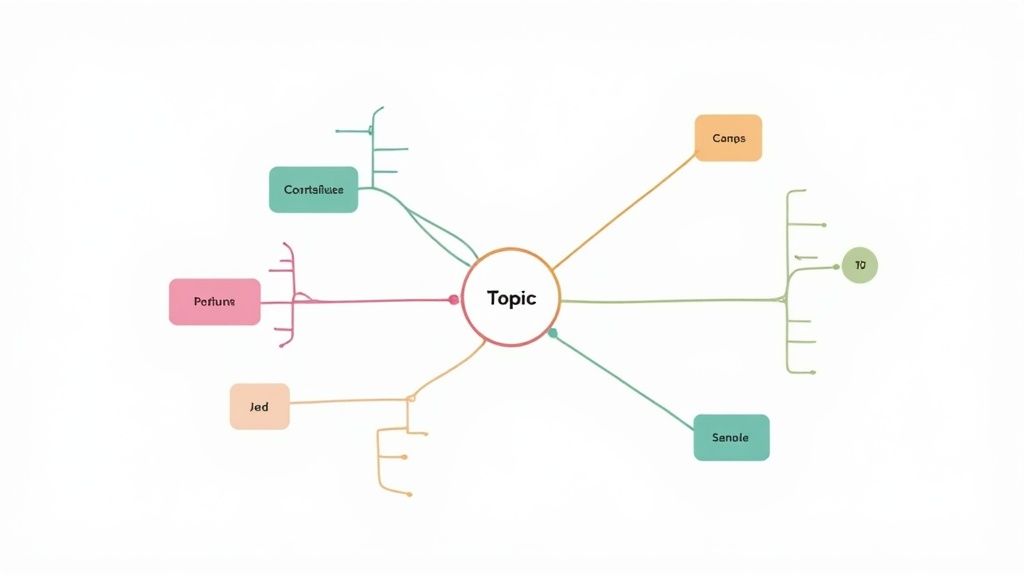
Mind mapping is a powerful, non-linear technique that visually organizes information around a central concept. Pioneered by Tony Buzan, this approach mirrors the brain's natural way of thinking by radiating ideas outward from a core topic. This is one of the best ways to read textbooks because it leverages your visual-spatial memory, making it easier to see connections, hierarchies, and relationships between complex ideas that linear notes often obscure. Instead of a rigid, top-to-bottom list, you create an intuitive, interconnected web of knowledge.
How Mind Mapping Works
This method transforms note-taking from a passive transcription task into an active process of synthesis and organization. It encourages you to think critically about how information is connected, rather than just writing it down.
- Start with the Central Idea: Place the main chapter topic or concept in the center of a blank page. For example, if reading about "Photosynthesis," that becomes your central hub.
- Create Main Branches: As you read, draw branches radiating out from the center for each major sub-topic or theme. These might be "Light-Dependent Reactions," "The Calvin Cycle," and "Factors Affecting Photosynthesis."
- Add Sub-Branches: Add smaller branches extending from your main branches to capture key details, definitions, examples, and supporting facts. Use keywords and short phrases instead of full sentences to keep the map clean and scannable.
- Use Visual Cues: Incorporate colors, symbols, and small drawings to categorize information and make key concepts more memorable. For instance, use green for all process-related notes and blue for key terminology.
- Refine and Connect: After reading, review your map. Draw lines or arrows to connect related ideas across different branches, revealing deeper relationships that you might have missed with linear notes.
When to Use This Method
Mind mapping is exceptionally effective for subjects that involve complex systems, interconnected events, or hierarchical structures. It’s perfect for visual learners and anyone who finds traditional note-taking restrictive. Use it in subjects like biology to map out ecosystem relationships, in history to connect causes and effects of major events, or in literature to track character relationships and plot developments. Digital tools like MindMeister or XMind make it easy to edit, expand, and share your maps, making this a flexible and powerful study technique.
7. Pomodoro Technique with Structured Reading
The Pomodoro Technique is a powerful time management method that can be adapted to make textbook reading more focused and less daunting. Developed by Francesco Cirillo in the late 1980s, this approach combats mental fatigue by breaking down study sessions into short, timed intervals, known as "Pomodoros," separated by brief breaks. Instead of facing a multi-hour reading marathon, you commit to short, intense bursts of concentration, making it one of the best ways to read textbooks for sustained periods without burnout.
How the Pomodoro Technique with Reading Works
This method applies a structured work-rest cycle to your study sessions, which helps maintain high levels of focus and prevents the cognitive decline that comes from prolonged effort. It’s a simple yet effective workflow for managing your attention.
- Set a Goal: Before starting, define a clear, achievable reading goal for one interval. For example, "Read and take notes on the section about cellular respiration" (pages 112-118).
- Set a Timer: Set a timer for a focused work period, traditionally 25 minutes. This is one Pomodoro. During this time, you must only work on your reading goal with zero distractions.
- Read Actively: Engage with the textbook using an active reading strategy (like SQ3R or taking Cornell notes) until the timer rings. The sense of urgency created by the timer helps you stay on task.
- Take a Short Break: When the timer goes off, mark one Pomodoro as complete and take a 5-minute break. It is crucial to step away from your desk. Stretch, get water, or look out a window, but avoid checking your phone.
- Repeat and Take a Long Break: After completing four Pomodoros (about two hours of work), take a longer break of 15-30 minutes. This extended rest allows your brain to recharge and consolidate the information you've just learned.
When to Use This Method
This technique is exceptionally effective for anyone who struggles with procrastination, short attention spans, or feeling overwhelmed by large reading assignments. It is particularly beneficial for students with ADHD, as the structured intervals provide a clear framework for maintaining focus. It’s also ideal for professionals and graduate students who need to fit dense reading into a busy schedule. By breaking the task into manageable chunks, the Pomodoro Technique makes consistent progress feel achievable and rewarding. For those looking to manage their time digitally, apps like Forest, Be Focused, or Toggl Track are excellent tools for implementing this structured reading approach.
8. Metacognitive Monitoring and Self-Testing
Metacognitive Monitoring is an advanced learning technique centered on "thinking about your thinking." This reflective method transforms reading from a passive intake of information into an active, self-aware process. Instead of just reading and hoping you understand, you constantly check your comprehension levels, identify knowledge gaps in real-time, and adjust your study strategies accordingly. This approach is one of the best ways to read textbooks because it directly combats the Dunning-Kruger effect, where students often overestimate their mastery of a subject.
How Metacognitive Monitoring Works
This method integrates self-assessment directly into the reading workflow. It’s about building a continuous feedback loop between reading, understanding, and validating that understanding. The goal is to make your learning process transparent to yourself.
- Read with Awareness: As you read a section, pause periodically and ask yourself, "Do I truly understand this?" or "Could I explain this concept to someone else right now?"
- Self-Test Frequently: At the end of each major section or chapter, close the book and quiz yourself. Use end-of-chapter questions, create your own, or use digital flashcards. The key is to force your brain to retrieve the information without looking.
- Rate Your Confidence: For each question you answer, rate how confident you feel about your response (e.g., certain, somewhat certain, uncertain). This helps you identify areas where you might be "confidently incorrect."
- Analyze and Adjust: Review your self-test results. Pay close attention to questions you answered incorrectly, especially those you were confident about. This analysis reveals your blind spots and signals which topics require more focused rereading or a different learning approach.
- Reflect and Repeat: Maintain a log of common errors or persistent misunderstandings. This data helps you recognize patterns in your learning and adjust your overall study plan for future chapters.
When to Use This Method
Metacognitive Monitoring and Self-Testing is exceptionally powerful for complex, high-stakes subjects like medicine, law, engineering, or advanced sciences. It is essential when a deep, accurate understanding is non-negotiable and you need to be certain of your knowledge for exams, practical applications, or clinical practice. While it requires discipline, this method builds a robust and reliable understanding, preventing the dangerous illusion of competence and ensuring you are genuinely prepared.
8-Method Textbook Reading Comparison
| Method | Implementation complexity | Resource requirements | Expected outcomes | Ideal use cases | Key advantages |
|---|---|---|---|---|---|
| SQ3R Method (Survey, Question, Read, Recite, Review) | Medium — five sequential steps requiring discipline | Textbook access, note paper or digital notes, time for review | Improved comprehension and structured long-term retention | Dense textbook chapters, course study, structured learning | Systematic comprehension, reduces re-reading, built-in review |
| Cornell Note-Taking System | Medium — requires page layout habit and consistency | Notebook or digital template, time to format and summarize | Organized notes that support quick review and self-testing | Lecture capture, textbook note conversion, large-volume courses | Highly organized, cue-driven self-quizzing, summary reinforcement |
| Active Reading and Annotation | Low–Medium — skill in selective marking and marginalia | Highlighter/pen or digital annotator, time for a second pass | Better focus, personalized study material, improved analysis | Close reading: law, literature, research articles | Encourages critical engagement and personalized notes |
| Feynman Technique (Learning Through Explanation) | Medium–High — iterative explanation and gap identification | Paper or recorder for explanations, time per concept | Deep conceptual understanding and ability to teach concepts | Complex, abstract subjects (physics, theory-heavy topics) | Reveals gaps, enforces simple explanations, transferable skills |
| Spaced Repetition System | Medium — initial setup then low-maintenance scheduling | Flashcards or SRS app (Anki, SuperMemo), consistent review time | Durable long-term memory and efficient recall | Vocabulary, factual learning, medical and language study | Maximizes retention with minimal total study time |
| Mind Mapping and Visual Note-Taking | Medium — non-linear organization skill; creative input | Paper/whiteboard or mind-mapping software, time to design | Enhanced visual memory and insight into concept relationships | Complex systems, brainstorming, subjects needing integration | Visualizes relationships, boosts creativity and recall |
| Pomodoro Technique with Structured Reading | Low — easy to adopt but requires timer discipline | Timer app or device, short scheduled breaks | Sustained focus, reduced fatigue, steady productivity | Heavy reading loads, time-boxed study sessions, ADHD supports | Maintains concentration, prevents burnout, easy tracking |
| Metacognitive Monitoring and Self-Testing | High — requires honest self-assessment and frequent checks | Practice questions, quizzes, logging tools, time for reflection | Accurate awareness of knowledge gaps and improved learning efficiency | Exam prep, mastery learning, self-directed study | Prevents illusion of competence, targets remediation efficiently |
Creating Your Ultimate Textbook Reading Workflow
You've journeyed through eight powerful strategies, from the foundational SQ3R method to the self-awareness of metacognitive monitoring. The crucial takeaway is this: the single best way to read textbooks isn't a one-size-fits-all prescription. Instead, it’s a personalized, dynamic workflow you construct by selecting, combining, and adapting these methods to fit the material, your learning style, and your specific goals.
Reading a dense philosophy text for a seminar requires a different approach than cramming key definitions for a multiple-choice biology exam. The true mastery lies not in rigidly following one system, but in building a flexible toolkit. You become the architect of your own learning, not just a passive consumer of information.
From Passive Reader to Active Architect
Think of the strategies we've covered as individual tools in your academic toolbox. An expert craftsperson doesn't use a hammer for every task. Similarly, an expert learner knows when to deploy each tool for maximum impact.
Your personalized workflow might look something like this:
- Initial Engagement: Start with the SQ3R method to get a bird's-eye view of a new chapter. Use the survey and question steps to create a mental map before diving in.
- Focused Reading Sessions: Employ the Pomodoro Technique to break your reading into manageable, 25-minute sprints. During these sprints, practice active reading and annotation, highlighting key concepts, questioning assumptions in the margins, and connecting ideas.
- Knowledge Consolidation: After a reading session, use the Feynman Technique to test your true understanding. Try to explain a complex topic like cellular respiration or contract law in simple terms to a friend or even just to yourself. This immediately reveals gaps in your knowledge.
- Synthesis and Organization: Transform your annotations and insights into a structured format. This could be a visual mind map that shows relationships between concepts or a meticulously organized page using the Cornell Note-Taking System.
- Long-Term Retention: The final, crucial step is moving this knowledge into your long-term memory. Convert your key takeaways, questions, and summaries into digital or physical flashcards and integrate them into a Spaced Repetition System (SRS) like Anki or Quizlet. This ensures you fight the "forgetting curve" and retain what you've learned for weeks and months to come.
This integrated approach transforms reading from a chore into a strategic process of inquiry, synthesis, and retention. It’s the difference between temporarily memorizing facts and genuinely building a deep, lasting understanding.
Supercharging Your Workflow with Modern Tools
Building this system requires discipline and focus. Maintaining peak mental performance during long study sessions can be a significant challenge. To further support sustained concentration, especially when tackling complex or dry material, many students find it helpful to create an optimal mental environment. For those looking to enhance their cognitive function during these demanding tasks, you might consider incorporating nootropics and focus aids for students into your routine.
Moreover, technology can act as a powerful accelerator for your workflow. An AI-powered tool like a PDF summarizer can revolutionize the initial stages. Imagine generating an instant summary and list of key takeaways for a 50-page chapter, completing the "Survey" step of SQ3R in seconds. When you encounter a confusing paragraph, you can simply ask the AI to explain it in simpler terms or find the definition of a key term, with citations that link directly back to the source text. This turns a static PDF into a dynamic, interactive learning partner.
Ultimately, your goal is to create a reading process that is active, strategic, and sustainable. Start small. Pick one or two methods from this list and apply them to your next reading assignment. Experiment, see what clicks, and gradually build a system that empowers you to read with confidence, purpose, and unparalleled comprehension.
Ready to transform your textbook reading from a passive chore into an active, efficient learning experience? PDF Summarizer uses AI to instantly generate summaries, key takeaways, and answer your questions directly from your documents. Stop wasting time and start understanding more with your own interactive learning assistant at PDF Summarizer.
Relevant articles

Explore critical thinking skills for students with practical strategies to analyze information, argue persuasively, and boost academic success.
Discover the best way to study textbooks with our top 10 methods. Learn active reading, SQ3R, and AI-powered tips for maximum retention and efficiency.
Discover how to improve your workflow for taking notes on PDF files. Learn core techniques, AI-powered tools, and advanced strategies for better recall.
Learn how to summarize a PDF efficiently using both manual techniques and AI tools. Get actionable advice for students, researchers, and professionals.
Struggling with dense texts? Learn how to read research papers efficiently with our concise guide and practical strategies.