How to Read Research Papers: how to read research papers for beginners
Struggling with dense texts? Learn how to read research papers efficiently with our concise guide and practical strategies.
Trying to read a research paper from the first word to the last is a classic rookie mistake. It’s a surefire way to burn hours of your time and remember almost nothing. If you want to learn how to read research papers without losing your mind, the secret is a structured, multi-pass approach that turns a dreaded chore into a manageable workflow.
This method helps you do two things brilliantly: quickly decide if a paper is even worth your time, and then systematically pull out exactly what you need.
Why You Need a New Approach to Reading Research
Ever stared at a dense wall of text, full of jargon you’ve never seen, and felt completely overwhelmed? You’re not alone. This is a universal struggle for students and seasoned professionals alike.
When you're knee-deep in a literature review, this inefficiency is a killer. Without a system, most people spend 70-80% of their time on an initial skim, yet they only retain about 20-30% of the key findings. That's a terrible return on investment. This statistic really highlights the core problem with just reading a paper from start to finish. If you're curious about global reading habits, you can find more insights here.
The solution isn't about forcing yourself to concentrate harder; it's about reading smarter. Adopting a system gives you a roadmap to navigate complex information, so you don't get bogged down in the nitty-gritty details right away. It's about being strategic, not exhaustive.
Introducing the Three-Pass Method
One of the most effective strategies out there is the three-pass method. It’s popular for a reason—it works. This system breaks the reading process into distinct stages, each with a very specific goal. Think of it as building your understanding layer by layer, not trying to absorb it all at once.
- The First Pass (Scan): This is a quick-and-dirty, 5-10 minute scan to get the lay of the land. You’re just looking at the title, abstract, section headings, and conclusion to figure out the paper’s main idea and decide if it’s relevant.
- The Second Pass (Grasp): Now you're investing a bit more time, maybe up to an hour. The goal here is to understand the main arguments. You’ll read more carefully but can still skip over heavy mathematical proofs or super-technical details. Focus on the key takeaways and the evidence used to support them.
- The Third Pass (Review): This is the deep dive. In this final pass, you critically engage with the material. You’ll challenge the authors' assumptions, question their methodology, and think about how these findings fit into the bigger picture of your own research.
This structured process moves you from a bird's-eye view to a detailed, critical analysis.
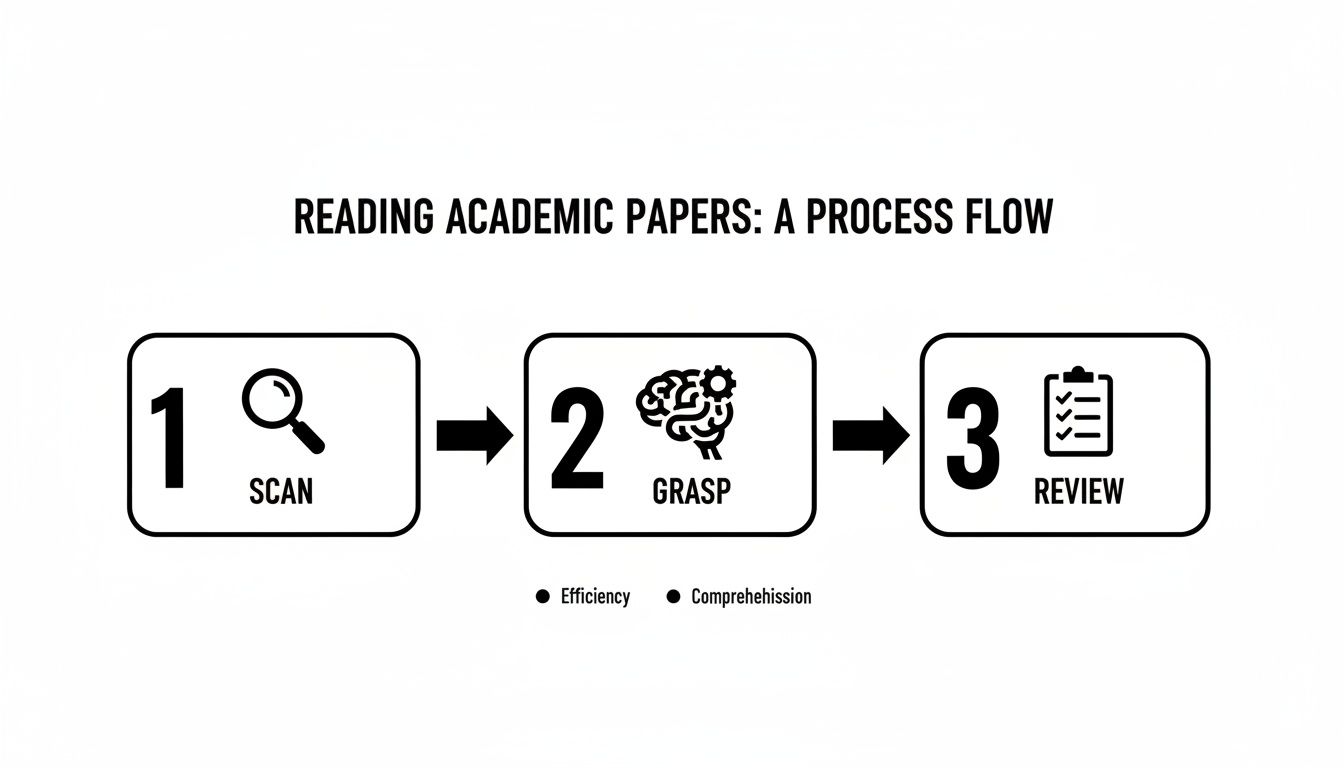
The visual above really captures the flow, showing how you progress from a quick scan for relevance to a deep review of the paper's validity. It’s all about investing your time where it counts.
To make this even clearer, here’s a quick summary of what each pass involves.
The Three-Pass Reading Strategy At a Glance
| Pass | Objective | Time Commitment | Key Actions |
|---|---|---|---|
| Pass 1: Scan | Get a high-level overview and assess relevance. | 5–10 minutes | Read the Title, Abstract, Introduction, and Conclusion. Glance at section headings and figures. |
| Pass 2: Grasp | Understand the paper’s main points and arguments. | Up to 1 hour | Read the paper more thoroughly, but skip complex details (e.g., proofs). Take initial notes on key contributions. |
| Pass 3: Review | Critically analyze and deeply comprehend the content. | 1–5 hours | Read in-depth, challenging assumptions and methodology. Recreate the work in your mind to spot flaws. |
This table serves as a great cheat sheet as you get comfortable with the process.
Treat research papers less like novels and more like puzzles. The goal of your first encounter isn't total comprehension—it's triage.
This mindset shift is everything. It empowers you to sift through dozens of papers, quickly filtering out the noise and identifying the handful that truly matter. Once you start using this strategy, you'll find academic reading becomes far less intimidating and much more productive.
The rest of this guide will break down exactly how to execute each of these three passes like a pro.
Your First Pass: The 15-Minute Relevance Check
Not every paper deserves your undivided attention. Before you sink hours into a deep, methodical read, you need a quick, almost ruthless, triage process. This is the 15-minute relevance check—your gatekeeper for deciding whether a paper is worth your time or should be tossed aside.
Think of it like being a detective at a crime scene. You're not there to solve the whole case just yet; you're just looking for the most critical clues to see if this lead is even worth pursuing. The goal is to make a swift "read or reject" decision without getting bogged down in the minutiae.
What to Focus On In Your Initial Scan
Forget reading from start to finish. That's a recipe for wasted time. You have to be surgical and jump straight to the sections that deliver the most bang for your buck.
Here’s where I always look first:
- The Title and Keywords: This is your most basic filter. Do they immediately scream "relevant" to your research question? If not, it's a weak start.
- The Abstract: This is the paper's entire pitch in about 250 words. Read it carefully to get a handle on the core question, the methods they used, their main findings, and what they concluded. A confusing or irrelevant abstract is a huge red flag.
- The Introduction and Conclusion: I always read the first couple of paragraphs of the intro to understand the "why"—the problem they're tackling. Then, I jump straight to the conclusion to see the "so what"—their final answer. This gives you the entire story, from problem to solution, in a nutshell.
This targeted approach lets you stitch together the paper’s main narrative in just a few minutes. You're basically reading the beginning and the end to see if the middle is worth the journey.
The Power of Visuals and Headings
Here’s a pro-tip that many people overlook: go straight for the figures, graphs, and tables. These visuals are often the most concise and powerful summary of the paper's key results. A well-designed graph can communicate more than an entire page of dense text.
When you're scanning the figures, ask yourself these quick questions:
- What do the axes represent?
- What’s the main trend, pattern, or outlier?
- Does the caption make sense and clearly explain the result?
After you've glanced at the visuals, do a quick scroll through the section headings. They act as a roadmap, showing you the logical flow of the authors' argument. This gives you a mental outline of the paper's structure and helps you see if it aligns with what you're looking for.
The goal of this 15-minute check is simple: Is this paper’s core question and its findings actually useful to me? You are filtering, not studying.
This rapid-fire assessment saves you from the painful experience of reading a paper for an hour, only to realize it's barely relevant. By the end of this pass, you’ll know with confidence whether to discard it or move it into the "read later" pile.
Accelerating Triage with a PDF Summarizer
Today's tools can make this initial screening process even more efficient. Instead of manually hunting for the key sections, an AI-powered tool can give you the CliffsNotes version almost instantly. A dedicated research paper summarizer can pull out a condensed version of the abstract, findings, and methods in seconds.
For instance, you can just upload a PDF and immediately get a bulleted summary of the most critical points.
This screenshot shows exactly how a tool can extract the key takeaways, letting you judge a paper's relevance without having to read a single full paragraph. When you automate the hunt for core ideas, you can make that "read or reject" call in a fraction of the time and seriously speed up the process of building a literature review.
Your Second Pass: Getting to the Heart of the Argument
Alright, you've done the initial triage and confirmed the paper is worth your time. Now, it's time to roll up your sleeves and really dig in. This second pass is where you move beyond a surface-level glance and start to understand what the authors are actually trying to say.
This isn't about memorizing every last detail or getting bogged down in the statistical weeds. Think of it as an active conversation with the paper. You're no longer just scanning; you're connecting the dots, highlighting key arguments, and scribbling questions in the margins. How did they get from their methods to their results? Do those results really back up what they claim in the discussion?
Breaking Down the IMRaD Structure
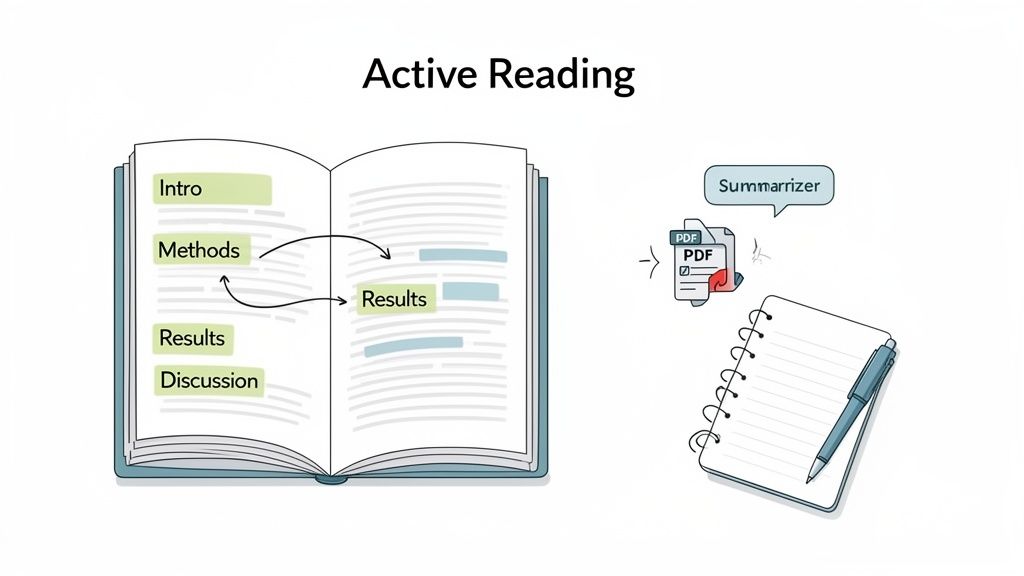
Most scientific papers follow a predictable formula called IMRaD: Introduction, Methods, Results, and Discussion. Knowing what each section is for is like having a map. It tells you where to find specific information so you don't get lost.
It helps to think of it as a story with four parts:
- Introduction: Why did they even do this? This part sets the scene, points out a problem or a gap in our knowledge, and clearly states their research question.
- Methods: How did they do it? This is the nitty-gritty, the technical blueprint of the study. It details all the procedures, tools, and statistical tests they used.
- Results: What did they find? This section is just the facts—the raw data, usually presented in figures and tables, without any spin or interpretation.
- Discussion: What does it all mean? Here’s where the authors interpret their findings, talk about the bigger picture, and (if they're good) admit the study's limitations.
This structure isn't just a tradition; it's designed for efficiency. In fact, some studies on comprehension suggest that by focusing 20% of your effort on the Introduction and Results, you can often pull out 80% of the paper's main ideas. Experienced researchers who lean on the IMRaD structure can slash their analysis time by up to 45%—a huge deal when you're facing a mountain of PDFs for a literature review. For a broader look at how research is presented and understood, you can explore global literacy statistics here.
The whole point of this second pass is to nail down the paper's central contribution. By the end, you should be able to explain the main argument, in your own words, to someone else.
Forcing yourself to summarize it like this is a gut check. It proves you've actually processed the information, not just let the words wash over you.
Reading Is Not a Spectator Sport
Passively highlighting sentences is one of the least effective ways to read. To really get it, you have to actively engage with the text. Make it a habit to constantly question what you're reading.
Here are a few questions I always keep in my back pocket:
- Does the evidence actually support the claims? I jump straight to the figures and tables in the Results. Do they tell the same story the authors are spinning in the Discussion?
- Is the methodology sound? You don't have to be a world-class expert on every single technique, but you should be able to ask, "Was this the right tool for the job?"
- What are the hidden assumptions? Every study is built on a foundation of assumptions. Your job is to find them and decide if they're solid or shaky.
Instead of just highlighting what looks important, use a system. I like to use one color for the main hypothesis, another for the evidence that supports it, and a third for anything that seems confusing, questionable, or worth coming back to.
Using AI as Your Research Assistant
We’ve all been there—stuck on a dense paragraph, rereading it for the fifth time. This is where modern tools can be a game-changer. Instead of grinding to a halt, you can use a PDF summarizer’s chat feature to ask for help, turning a frustrating monologue into a productive dialogue.
Imagine you're trying to figure out the experimental design. Instead of hunting through the Methods section, just ask the tool directly.
- For quick clarification: "What was the control group in this study?"
- To pull out key info: "Explain the main limitation mentioned in the discussion."
- To cut through jargon: "In plain English, what does 'in situ hybridization' mean here?"
This gives you instant, sourced answers without derailing your focus. The tool can point you to the exact sentence where it found the information, so you can check the context yourself. It makes this second pass of learning how to read research papers so much faster and more effective.
Your Final Pass: Reading Like a Reviewer
You’ve scanned the paper, you get the gist of the argument, and now it’s time for the final—and most intellectually demanding—pass. This is where you put on your critic’s hat. You’re no longer just a student absorbing information; you're a peer reviewer, actively questioning every claim, probing for weaknesses, and deciding if the work truly stands up to scrutiny.
The goal shifts from simple comprehension to critical evaluation. You stop asking, "What did they find?" and start asking, "Do I believe what they found?" This is where true understanding is forged, and it’s how you connect the paper's findings to the wider academic conversation and your own research.
Asking the Hard Questions
To really read like a reviewer, you need a mental checklist to guide your analysis. This framework helps you break free from simply accepting the authors' conclusions and forces you to dissect their entire thought process.
Here are the questions I always ask myself during this deep dive:
- Do the results actually back up the claims? I’ve seen it a thousand times—a gap between the raw data in the Results section and the grand interpretations in the Discussion. Be skeptical of authors who overstate the significance of their findings.
- Could there be another explanation? Think about confounding variables or alternative factors that might explain the results. A well-written paper will address these, but sometimes you'll spot something the authors missed.
- How does this fit into the bigger picture? Context is everything. Does this work build on established theories, or is it trying to overturn them?
- What are the real limitations here? No study is perfect. Acknowledge the limitations the authors mention, but be on the lookout for ones they may have conveniently downplayed or ignored.
A huge part of this is digging into the experimental design. If you're not sure what to look for, exploring different examples is a great way to start understanding research paper methodology and how to properly assess it.
Synthesizing for True Retention
Here’s the ultimate test of your understanding: can you explain the paper's core idea, in your own words, to someone else? If you can't explain it simply, you haven’t fully grasped it. This final act of synthesis is essential for locking the knowledge in your brain. For more on this, check out our guide on how to summarize a research paper.
This isn't some new-age trick; it’s a core component of proven learning frameworks. The SQ3R method (Survey, Question, Read, Recite, Review), developed way back in 1946, is built around this very idea. It's not just theory, either. Cognitive studies show that this kind of active engagement can boost retention by a massive 50-70%.
More recent data confirms this. Professionals who spend just 9-10% of their reading time surveying a document before the deep read can comprehend it twice as fast.
A paper isn't truly 'read' until you can distill its core contribution into a few sentences and connect it to what you already know. This is the bridge between consumption and creation.
That summary becomes a permanent node in your personal knowledge base, ready to be pulled into your own writing, presentations, and future projects.
Streamlining Synthesis with Multi-File Chat
When you’re deep in a literature review, this critical analysis has to happen across dozens of papers. Juggling multiple PDFs while trying to spot connections, contradictions, and trends is a recipe for a headache. This is where a multi-file chat tool is a game-changer.
Instead of flipping between windows, you can upload a whole collection of relevant papers and start asking comparative questions directly.
| Query Type | Example Question for Multi-File Chat |
|---|---|
| Comparing Methods | "How did the methodology in Paper A differ from Paper B?" |
| Contrasting Results | "Contrast the main conclusions of Paper A and Paper C on this topic." |
| Identifying Gaps | "Which of these papers addresses the long-term effects of this intervention?" |
| Finding Consensus | "Summarize the points where all three papers agree." |
This approach basically puts the "Review" stage of the SQ3R method on steroids, applying it across your entire reading list at once. A tool like PDF Summarizer, which supports multi-file conversations and provides clickable citations, automates this cross-document analysis. It can handle complex queries across many documents, turning what used to be days of work into just a few minutes of focused inquiry.
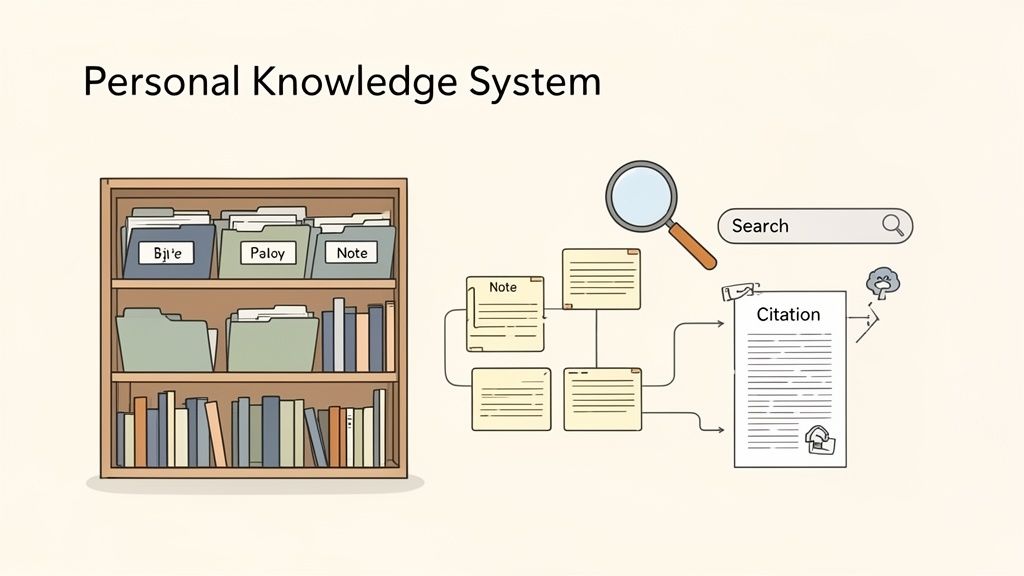
Building Your Personal Knowledge System
Getting through a research paper is only half the battle. If all those brilliant insights you've gathered just end up lost in a folder of PDFs or scribbled on random notes, what was the point? The real payoff comes when you can easily find and connect these ideas for your next project, and that requires building a personal knowledge system.
Think of this system as your second brain—a searchable, interconnected library of everything you’ve learned. It’s about moving beyond simply highlighting text and turning passive reading into an active process of building real, lasting knowledge. The goal is to make sure the hard work you put into reading pays off for years to come.
Choosing Your Knowledge Management Tools
Your system doesn't need to be overly complicated, but the right tools can make a world of difference. The trick is finding a workflow that actually clicks with your personal style.
Here are a few popular routes people take:
- Citation Managers: Tools like Zotero and Mendeley are non-negotiable for serious researchers. They do more than just store PDFs; they automatically pull bibliographic data, making citations practically effortless. Consider these the foundation of your system—the digital bookshelf where every source has its place.
- Digital Note-Taking Apps: This is where the magic of connecting ideas happens. Apps like Obsidian, Roam Research, or even Notion are designed for creating linked notes, letting you build a web of interconnected thoughts. You might link a note about a specific methodology in one paper to a related theory in another, sparking connections you would have otherwise missed.
- The Zettelkasten Method: For those who prefer a more hands-on approach, this classic German system uses index cards. Each card holds one single, "atomic" idea. By linking cards with unique IDs, you create a sprawling, non-linear network of thoughts that grows with you. It forces you to get to the core of an idea, which is a powerful way to make sure you truly understand it.
No matter which path you choose, the core idea is the same: break down what you learn into its fundamental components and then intentionally build bridges between them. For a much deeper dive, our guide on effective knowledge management strategies lays out more detailed workflows.
The Unbreakable Rule of Consistent Citation
Trust me on this one: one of the biggest future headaches you can create for yourself is getting lazy with citations. It's so easy to think, "I'll remember where I found that," but after you've read a few dozen papers, they all start to blur together. Make it a non-negotiable habit to capture the full citation for every paper the moment you decide it's useful.
This simple discipline will save you from that last-minute, panicked scramble to find sources when a deadline is looming. Modern citation managers make this incredibly easy, often grabbing all the metadata you need from a PDF with just one click.
Your future self will thank you for the discipline you practice today. A well-organized reference library is one of the most valuable assets a researcher can have.
This habit should extend to your notes, too. Always link your thoughts directly back to the specific paper they came from. Doing this creates a bulletproof chain of evidence, so you can quickly verify facts and properly attribute ideas when it's time to write.
Streamlining Your Workflow with Modern Tools
Building this kind of system doesn't have to be a slow, manual grind. AI-powered tools like PDF Summarizer can seriously accelerate how you capture and organize information. For instance, when you get a summary, it often includes clickable citations that jump you directly to the source page in the document.
This is a game-changer for note-taking. You can copy a key finding from a summary straight into your notes, and the built-in citation gives you an instant link back to the original context. It becomes effortless to double-check a detail or grab a direct quote later without having to hunt through a 50-page paper.
To get the most out of these tools, it helps to integrate solid knowledge management best practices into your routine. When you combine smart tools with a structured system, you transform reading from a one-off task into a continuous cycle of learning and creating.
Common Questions About Reading Research Papers
As you start to build a solid routine for reading academic work, you're bound to run into a few common hurdles. Everyone does. Learning to navigate these sticking points is what separates a novice from an expert who can confidently and efficiently learn how to read research papers.
Let's tackle some of the questions I hear most often.
One of the biggest anxieties is about speed. How long should it really take to read a single paper? The honest answer is: it depends entirely on what you need from it.
A quick first pass just to see if a paper is relevant might only take 10-15 minutes. If you're trying to really understand the main argument, budget an hour or so. For a deep, critical analysis—the kind where you’re questioning every assumption—you could be looking at several hours over a few days. The trick is to match your time to your goal.
What If I Don’t Understand the Statistics?
It’s an incredibly common feeling to get lost in the Methods or Results sections, especially when they’re full of complex statistical tests. The first thing to remember is that you're not supposed to be a statistics whiz on your first read.
The authors have likely dedicated years to this narrow topic; it’s perfectly normal to feel a bit out of your depth. Your goal isn't to replicate their analysis but to understand the story the data tells.
Here are a few things that help me cut through the noise:
- Go straight to the figures. What do the graphs and tables actually show? The captions are your best friend here, as they usually offer a plain-language summary of the key takeaway.
- Jump to the Discussion. This is where the authors translate the numbers into meaning. They’ll explain what their statistical findings mean for their central research question.
- Look for signs of significance. Keep an eye out for phrases like “statistically significant” and p-values (like p < 0.05). This is the authors' way of saying they believe a result is real and not just a random fluke.
Don't let the statistical jargon shut you down. Focus on the conclusion, which is often hiding in plain sight in the paper's visuals and final sections.
How Many Papers Should I Read for a Literature Review?
Ah, the classic "how many?" question. Unfortunately, there's no magic number here. The right amount of reading depends entirely on the scope of your project. A term paper for a class might be satisfied with 10-20 sources, while a PhD dissertation could easily cite hundreds.
Instead of aiming for a number, you should be aiming for saturation. That’s the point where you start seeing the same names, theories, and studies cited over and over again. When new papers stop bringing new core ideas to the table, you're getting close.
The goal of a literature review isn’t to hit a quota. It’s to map the existing conversation in your field so you know exactly where your own work fits in.
Once you can confidently lay out the key debates, the foundational studies, and the big unanswered questions, you’ve probably read enough.
What Should I Do When I Get Stuck?
Every single researcher—no matter how many papers they’ve published—gets stuck. When you hit a wall and a paper just isn't making sense, the worst thing you can do is try to muscle through it.
Take a break. Seriously. Put the paper down and come back to it tomorrow. A fresh set of eyes can make all the difference.
Another great strategy is to work backward. If the primary research article is too dense, find a review article on the same topic. Review articles give you a bird's-eye view of the field and provide the foundational context you might be missing. Think of them as a guided tour—they’re a fantastic way to get your bearings before diving back into the nitty-gritty of a specific study.
Ready to make reading research papers faster and more efficient? PDF Summarizer uses AI to help you understand any document in seconds. Chat with your PDFs, get instant summaries with sourced answers, and analyze multiple files at once. Start turning complex information into clear insights today by visiting https://pdfsummarizer.pro.
Relevant articles

Uncover what is qualitative data analysis with this guide. Learn the core methods, see real-world examples, and find out how to analyze qualitative data.

Understand what is evidence based research through this practical guide. Learn the core principles, steps, and tools to make data-driven decisions that work.

Streamline your research and summary tasks with AI. Analyze documents, synthesize insights, and craft sharper reports, faster and with confidence.
Curious about what is contextual analysis? See real-world examples and learn how data context reveals actionable insights.
Discover how to improve your workflow for taking notes on PDF files. Learn core techniques, AI-powered tools, and advanced strategies for better recall.
Learn how to summarize a PDF efficiently using both manual techniques and AI tools. Get actionable advice for students, researchers, and professionals.