Write literature review: A practical start-to-finish guide
Discover how to write literature review effectively—from planning and searching to synthesis and writing.
To write a literature review that actually makes a difference, you need to start with a rock-solid foundation. This isn’t the fun part, I know, but skipping it is a recipe for disaster. It's all about turning that vague idea floating in your head into a sharp research question, sketching out a realistic timeline, and figuring out the right keywords to get your search started.
Getting this initial planning phase right is more than just good organization—it's what gives your entire project a clear direction from day one.
Laying the Groundwork for Your Literature Review
The thought of starting a literature review can feel like standing at the base of a mountain. The sheer scale is intimidating. Where do you even begin? The trick is to break the whole process down into smaller, manageable pieces. Before you download a single paper or write one sentence, you need a plan.
This upfront strategic work saves you from endless backtracking later on. It moves you from the fuzzy goal of "I need to write a lit review" to a concrete set of actions. The immediate goal is to get from a broad topic to a focused research question that will act as your north star for the entire project.
From Broad Topic to Focused Question
Every great literature review begins not with a topic, but with a question. A topic like "climate change and agriculture" is just too big; it’s a starting point, but it won’t guide you. You have to whittle it down to something you can actually answer.
For example, you could refine that topic into a much tighter question: "What are the most effective soil management techniques for mitigating drought effects in North American corn farming?" See the difference? This question is specific. It sets clear boundaries for your search by defining the scope (soil management, drought), the population (North American corn farms), and the desired outcome (mitigation). This kind of clarity is your best friend for staying on track.
A well-defined research question is the single most important part of your literature review. It acts as a filter for every decision you make, from which articles to read to which themes to include in your final draft.
Mapping Your Keywords and Search Strategy
Once your question is locked in, it's time to brainstorm keywords. Think about synonyms, related concepts, and even the scientific jargon. For our example, your list might look something like this:
- Primary Concepts: soil management, drought mitigation, corn farming
- Synonyms & Related Terms: soil conservation, water scarcity, agricultural adaptation, Zea mays
- Methodological Terms: systematic review, meta-analysis, field trials
This list is your initial ammo for searching academic databases like Google Scholar, Scopus, or PubMed. Don't just stick to the obvious terms. Try to think laterally about how different researchers might talk about the same ideas.
This simple workflow—refining your topic, planning your approach, and then building your search strategy—is fundamental.
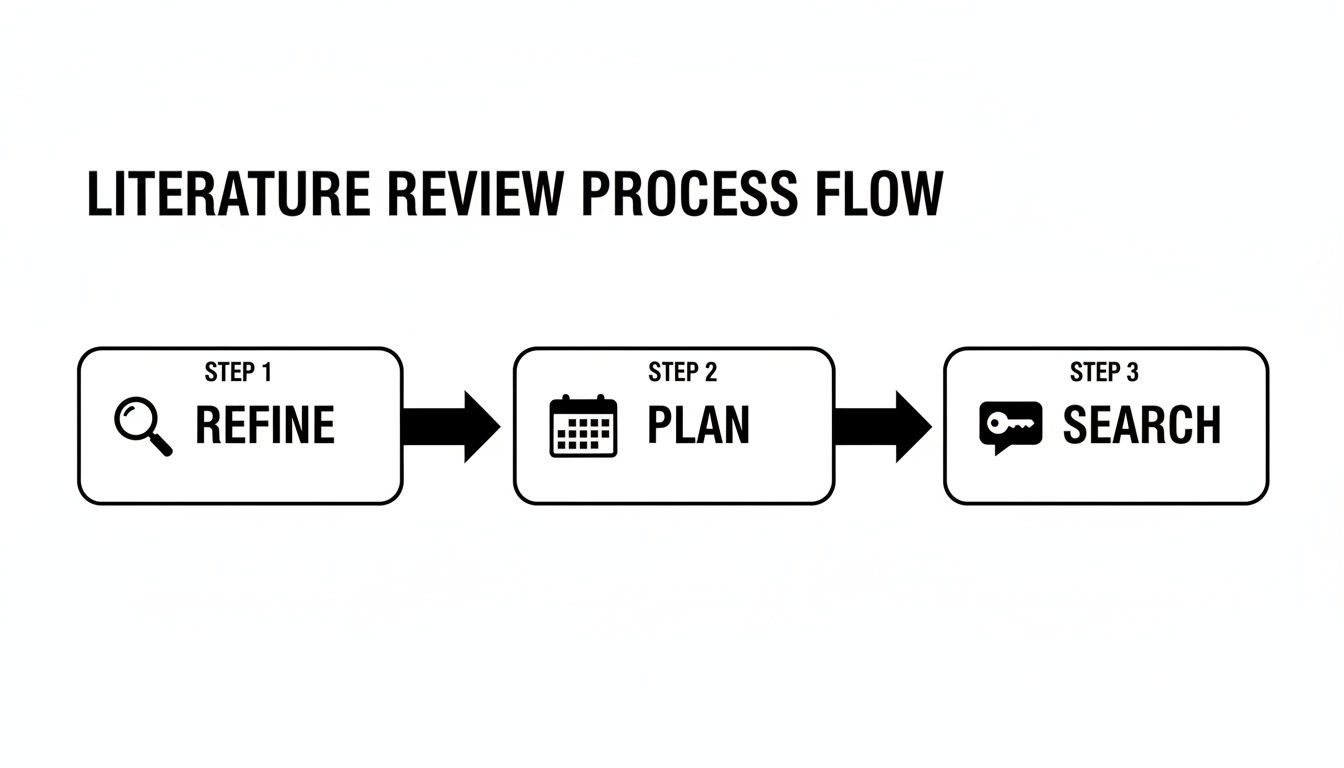
Following this three-part process ensures you lay a strong groundwork before you get lost in the weeds of reading and synthesizing dozens of papers.
The Importance of Planning Ahead
This foundational work matters because it directly shapes the quality and impact of your review. A well-planned review is far more than a simple summary; it's a genuine scholarly contribution. In fact, comprehensive literature reviews significantly boost a paper's citation impact. Studies have shown that systematic reviews and meta-analyses get, on average, 2.5 to 4.3 times more citations than original research articles in the same field.
This planning phase also includes setting up your digital workspace. As you start gathering PDFs, having a system is non-negotiable. It’s a small effort that pays off massively as your collection of sources grows.
To help you stay on track, I've put together a simple checklist to make sure all your bases are covered before you dive in.
Literature Review Planning Checklist
| Phase | Key Task | Status (Not Started / In Progress / Complete) |
|---|---|---|
| Topic Refinement | Transform broad topic into a specific research question. | |
| Scope Definition | Clearly define the inclusion and exclusion criteria. | |
| Keyword Strategy | Brainstorm a comprehensive list of search terms and synonyms. | |
| Database Selection | Identify the top 3-5 academic databases for your field. | |
| Timeline Creation | Set realistic deadlines for searching, reading, and writing. | |
| Organization System | Choose a reference manager and folder structure. |
Making sure you can check off each of these tasks will give you a much smoother start. If you want more detailed strategies on this, check out our guide on how to organize research papers for maximum efficiency. A logical structure makes the writing process a whole lot easier.
Diving In: How to Conduct a Systematic and Thorough Search
A literature review is only as strong as the search that underpins it. Once you've honed your research question and brainstormed some initial keywords, it’s time to get serious. This isn't about a quick Google Scholar search; it's about a systematic hunt to ensure you find the most relevant, high-impact studies, not just the low-hanging fruit.

The goal here is to construct search queries with surgical precision. Instead of just plugging in "soil management," you'll learn to build sophisticated search strings that give you complete control. This is the secret to avoiding two common pitfalls: missing critical papers and drowning in irrelevant ones.
Crafting Powerful Search Strings
The real power in academic searching comes from mastering a few key tools built into every database. The most important ones you'll use constantly are Boolean operators and truncation.
Here’s a quick rundown:
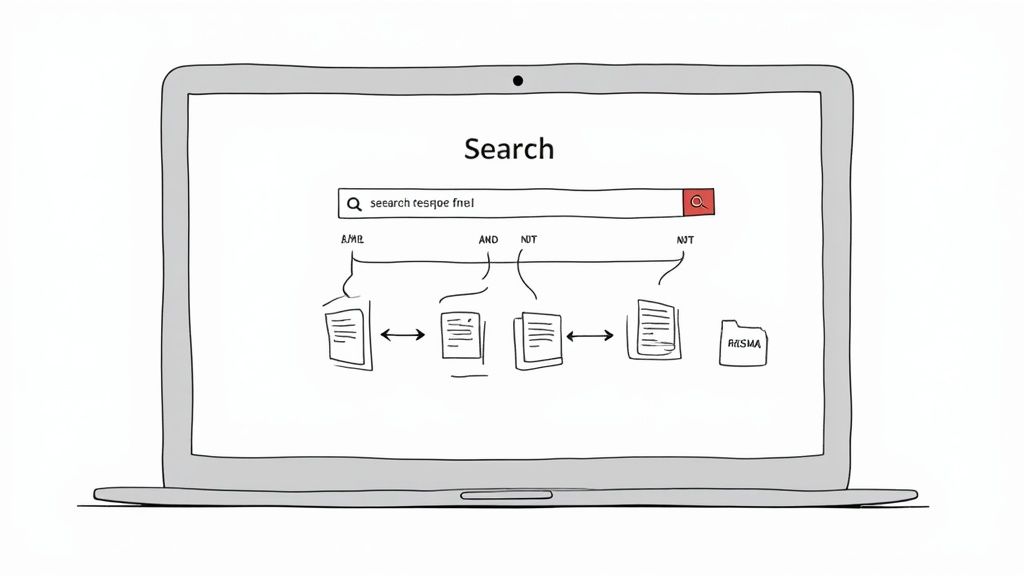
- AND is your tool for focus. It narrows the search by ensuring all your terms appear in the results. For example, searching
“soil management” AND drought AND cornwill only pull up papers that discuss all three concepts. - OR broadens your horizons. It’s perfect for synonyms or related concepts, like
drought OR “water scarcity”. This way, you catch papers that use different terminology for the same idea. - NOT is for exclusion. If you’re getting a lot of noise, use it to filter out irrelevant topics. For instance,
agriculture NOT forestrykeeps your results centered on farming, not trees.
Truncation is another pro-level trick. By adding a wildcard character (usually an asterisk *) to a word's root, you can find all its variations. A search for manage* will find manage, management, manager, and managing all at once.
Putting it all together, a powerful search string might look something like this:(“soil management” OR “soil conservation”) AND (drought OR “water scarcity”) AND (corn OR “Zea mays”)
This query is specific enough to be relevant but flexible enough to capture the full breadth of the conversation on the topic.
Uncovering Hidden Gems with Citation Chaining
Even the best databases have blind spots. Some of the most foundational—and groundbreaking—papers are found not through keywords, but through a wonderfully manual technique called citation chaining. Think of it as following a trail of academic breadcrumbs.
- Backward Chaining: Once you find a highly relevant paper, immediately scan its bibliography. The sources it cites are often the foundational works you need to know.
- Forward Chaining: Use a tool like Google Scholar to see who has cited that same key paper since it was published. This shows you how the research has evolved and who is building on that work today.
This method often leads you to seminal articles and recent developments that your keyword searches might have completely missed.
A quick but crucial tip: Document everything. Keep a simple log of the databases you searched, the exact strings you used, and the dates. This isn't just for you; it makes your methodology transparent and reproducible, which is the hallmark of a credible review.
This push for transparency isn't just a trend; it's had a real impact. For instance, after reporting standards like PRISMA were introduced, the proportion of health and social-science reviews reporting their search strategies jumped from under 30% to about 72% between 1999 and 2019. It’s a practice that dramatically improves research quality. Learn more about global economic trends and research practices on imf.org.
Organizing Your Findings for Analysis
As the papers pile up, you'll quickly descend into chaos without a system. This is where reference management software saves the day. Tools like Zotero, Mendeley, or EndNote are non-negotiable for serious researchers.
They allow you to store, tag, and annotate everything you find. You can create folders by theme, methodology, or relevance, making it easy to see the connections between papers. If you're looking to modernize your workflow even further, our guide on the best AI tools for academic research has some great suggestions.
Trust me on this: setting up a reference manager from day one is a small investment of time that prevents a massive headache later. It keeps your sources organized and ready for the next, most important phase: actually writing the review.
From Reading Sources to Synthesizing Ideas
Finding a stack of relevant papers is a great start, but let's be honest—that's not the hard part. The real intellectual heavy lifting begins now, as you transform that pile of individual studies into a coherent, insightful conversation. This is the synthesis phase, and it’s what separates a mediocre summary from a genuinely valuable piece of scholarship.
So many graduate students and new researchers fall into the same trap: simply listing what they’ve read. It looks something like, "Author A found this, Author B argued that, and Author C concluded something else." This approach is little more than an annotated bibliography in paragraph form, and it completely fails to build an argument.
Synthesis is different. It’s about weaving those disparate threads together to create a new tapestry of understanding. You're not just a reporter; you're an interpreter.
Understanding Summary vs. Synthesis
It's easy to confuse summarizing with synthesizing, but the difference is critical. Summarizing looks at each source in isolation. Synthesizing forces them into a dialogue with one another, helping you see the bigger picture—the patterns, debates, and unanswered questions that bubble up when you look at the field as a whole.
For instance, instead of just stating that three different studies found a link between social media use and anxiety, a synthesized approach groups them. You might point out that two studies used correlational data while the third used a longitudinal design, which allows for stronger causal claims. See the difference? Your analysis instantly moves from a simple list to a critical evaluation.
This kind of analysis is at the heart of genuine scholarship. Developing critical thinking skills is non-negotiable for academic work, as it pushes you beyond just describing what you've read.
To really nail this down, think about the key differences.
| Attribute | Summarizing (What to Avoid) | Synthesizing (What to Do) |
|---|---|---|
| Focus | Reports on one source at a time. | Compares and contrasts multiple sources. |
| Structure | Organized by author or article. | Organized by theme, trend, or debate. |
| Goal | To describe the content of each source. | To build an argument and identify gaps. |
| Outcome | A disconnected list of findings. | A coherent narrative about the state of research. |
Mastering synthesis is what will give your literature review its analytical power and scholarly weight. Of course, this all starts with knowing how to pull the right information from your sources efficiently. For a deep dive on that, our guide on how to read scientific papers is a great place to start.
Use a Synthesis Matrix to Map Your Ideas
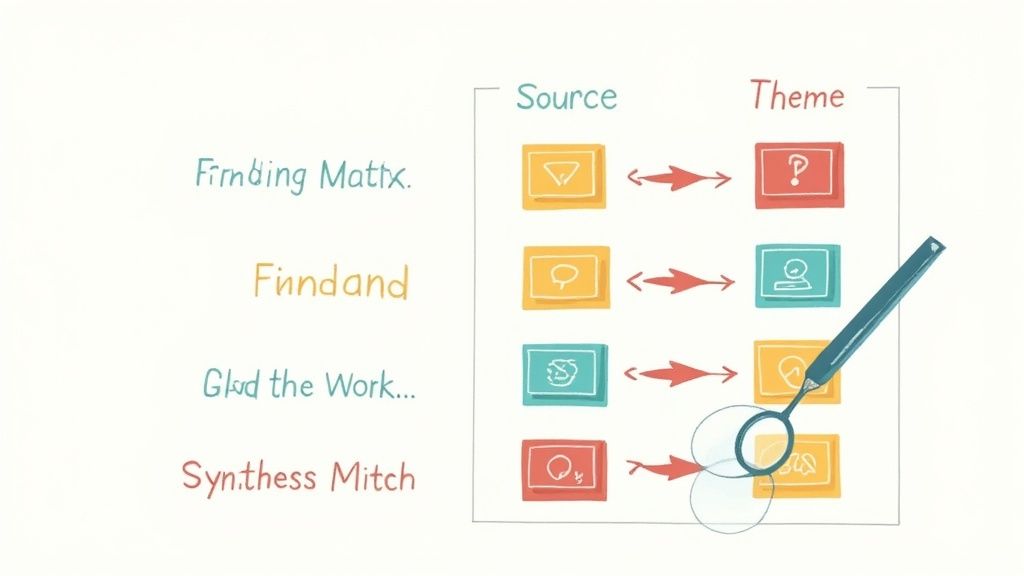
One of the most powerful tools I've ever used for this is the synthesis matrix. It’s basically just a detailed spreadsheet, but don't let its simplicity fool you. This tool is a game-changer for visually mapping the literature and spotting connections you'd almost certainly miss otherwise.
Setting one up is easy.
- Each row represents a different source (e.g., Smith et al., 2022).
- Each column represents a key theme, variable, or concept from your research question (e.g., Methodology, Key Findings, Limitations, Population Studied).
As you read each paper, you simply fill in the cells. The magic happens when you stop looking at the rows and start reading down the columns. By scanning a single column—say, "Methodology"—you can immediately see how different authors have approached the same concept.
This column-based view is where true synthesis begins. It allows you to quickly identify recurring patterns, pinpoint major disagreements in findings, and spot glaring gaps where no research currently exists.
Build Your Argument from the Matrix
Once your matrix starts to fill up, the themes for your literature review will practically jump off the page. You're no longer staring at a blank document; you have a clear, evidence-based roadmap.
Here’s how to turn those matrix columns into the backbone of your review:
- Spot the Major Themes: Look for columns that are full of rich, comparable information. These are your future subheadings.
- Group Authors by Perspective: Stop talking about one author at a time. Instead, group them. You can now confidently write, "Researchers like Smith (2022) and Jones (2023) argue for X, using quantitative methods to support their claims."
- Highlight Debates and Contradictions: Where do authors disagree? This is where your critical voice shines. "In contrast, the qualitative work of Chen (2021) offers a different perspective, suggesting that..."
- Pinpoint the Gaps: The empty cells in your matrix are pure gold. They represent the unanswered questions and unexplored areas that justify your own research project. This is how you position your work as a necessary next step in the scholarly conversation.
Ultimately, this systematic approach helps you build a compelling argument that forms the intellectual core of your entire project. You’re no longer just reporting what others have said; you are actively shaping the narrative to show where your own work fits in—and exactly why it matters.
Structuring and Writing Your Narrative
You've done the heavy lifting—the analysis, the synthesis, the organizing. Now it's time to shift gears from researcher to writer. Your goal is to take all those organized themes and insights and weave them into a compelling narrative that tells the story of the existing research.
This is where many people get stuck. They have all the pieces but aren't sure how to assemble them. Don't just assume the structure will magically appear; a powerful literature review is built with intention. It needs a clear beginning, a robust middle, and a definitive end.
The Three Pillars of a Strong Structure
Think of your review's structure in three acts: the introduction, the body, and the conclusion. Each part has a very specific job to do.
- The Introduction: This is your roadmap. It needs to hook the reader by establishing why your topic matters. State your research question, define the scope of your review, and give a quick preview of the key themes you'll discuss. No fluff, just a clear signpost of what's to come.
- The Body: Here’s the main event. This is where you unpack the evidence, but you do it thematically, not chronologically or author-by-author. You'll build out each section around the concepts, debates, and trends you uncovered earlier.
- The Conclusion: This isn't just a summary. A strong conclusion synthesizes the most important findings from the body, definitively points out the gaps in the literature, and proposes concrete directions for future research. It’s your chance to explicitly state how your work will contribute.
A common pitfall is writing an introduction that's too broad or a conclusion that just repeats what you’ve already said. Keep your intro focused and make your conclusion a forward-looking springboard for your own research.
Crafting the Body of Your Review
The body is where your synthesis matrix truly shines—it's your blueprint for writing. Each major theme you identified can become its own section or subheading.
Within each section, you’ll start to weave together the findings from different authors. The key is to lead with your ideas and use the literature as evidence. Use strong topic sentences to make your argument clear from the get-go.
Instead of writing, "Smith (2022) studied X," which is just a summary, try making a claim: "One major methodological debate in the field revolves around the use of quantitative versus qualitative approaches (Smith, 2022; Jones, 2023)."
See the difference? The second example puts you in control. It shows you’re not just listing sources; you’re leading the conversation.
Ensuring a Smooth and Logical Flow
A literature review shouldn't feel like a list of disconnected paragraphs. You need to build bridges between your ideas to guide the reader smoothly from one point to the next. That’s where transition phrases come in.
- To show agreement: "Similarly," "Likewise," "Building on this point..."
- To show contrast: "In contrast," "However," "On the other hand..."
- To show causation: "Consequently," "As a result," "Therefore..."
These simple phrases are the glue that holds your narrative together, making it feel polished and professional. Developing this kind of authoritative academic voice takes practice. For anyone looking to sharpen their skills, exploring online writing courses can be a great way to build a stronger foundation.
Ultimately, you are telling the story of the scholarly conversation in your field—what we know, what the big debates are, and where we need to go next. By building your review with a sharp introduction, a thematically organized body, and a forward-thinking conclusion, you create a piece of work that is not just informative but truly insightful.
Why Mastering the Literature Review Matters
After wrestling with planning, searching, and synthesizing sources, you might be asking yourself, "What's the real point of all this?" It's a fair question. The answer is simple but powerful: mastering how to write a literature review is one of the most durable, high-impact skills you can build. Its value goes far beyond this one assignment.
This isn't just an academic hoop to jump through. It's a mental workout that trains you to do something essential in any serious field: take a mountain of information, figure out what's credible, spot the important patterns, and then explain what it all means with authority. You're building the muscles for high-level thinking.
A Skill Set for Any Career
The ability to conduct a solid review isn't just for academics; it's a skill that employers are desperate for. Put yourself in their shoes. They need people who can navigate a sea of complex, often conflicting, information and make sense of it all.
Whether you end up in R&D, policy-making, market research, or strategic consulting, the fundamental challenge is the same. You'll be thrown a new topic and expected to get up to speed fast, understand the key debates, and deliver an evidence-based recommendation. That's a literature review in a nutshell.
This process proves you can:
- Synthesize complex information without getting bogged down in the weeds.
- Critically evaluate sources, separating the solid evidence from the noise.
- Identify trends and gaps that can inform smart decisions.
- Build a logical, evidence-backed argument to justify a plan of action.
These aren't just "soft skills." They are the bedrock of any role that demands strategic thinking and sound judgment.
The Growing Demand for Evidence Synthesis
And the professional world is catching on. The data shows a clear, rising demand for these exact skills. In a 2022–2024 survey of 1,200 R&D and policy organizations, a striking 57% of hiring managers said the ability to conduct systematic reviews was a critical or very important skill for their roles. That’s a huge leap from just 34% in a similar 2012 survey, signaling a major shift in what employers value. You can read more about these global trends on greenbook.org.
Academia is responding, too. Between 2015 and 2024, enrollment in graduate-level research methods courses—where this kind of synthesis is a core component—jumped by an average of 38% across major university systems.
When you master the literature review, you’re not just finishing an assignment. You are building a portable skill set that makes you a credible, effective analyst and thinker in any field you enter.
Beyond the Grade: A Lasting Advantage
Ultimately, learning to write a literature review is about so much more than checking a box for a good grade. It’s an exercise that forces you to engage with your subject on a much deeper level. You stop being a passive consumer of information and become an active participant in the conversation.
You start to see the hidden architecture of knowledge in your discipline—who the foundational thinkers are, what the big debates have been, and where the most interesting new questions are popping up. That perspective is priceless. It gives you the context and confidence to position your own ideas and make a real contribution, a skill that will pay dividends throughout your entire career.
Tackling Common Literature Review Stumbling Blocks
Let's be honest, even with the best-laid plans, writing a literature review can feel like you're navigating a maze. Questions pop up, you hit dead ends, and sometimes you just feel stuck. Here are a few of the most common hurdles I've seen researchers face, along with some practical advice to clear them.
The Million-Dollar Question: How Many Sources Do I Actually Need?
If I had a dollar for every time I've been asked this, I could fund my own research lab. The classic, and slightly infuriating, answer is: it depends. There’s no magic number that works for everyone.
The real answer is tied directly to your project's scope and how developed your research area is.
- A term paper for an undergraduate class? You might get by with 15-25 solid sources to show you've done your homework.
- A master's thesis? You're probably looking at a deeper dive, somewhere in the 50-75 source range.
- A Ph.D. dissertation? Buckle up. You could easily be working with 100+ sources to prove you have an exhaustive command of your field.
Forget the number for a second. The real finish line is something called theoretical saturation. It's that moment when you pick up a new paper and think, "I've seen all this before." The names, the debates, the core concepts—they're all familiar. When new articles start to feel like reruns, you know you’re getting close.
The goal isn't to hit a quota. It's to demonstrate a comprehensive grasp of the scholarly conversation. Quality and relevance will always trump a raw count.
What Do I Do When Studies Contradict Each Other?
First, don't panic! Finding studies with conflicting results isn't a sign that you've done something wrong. It's actually a golden opportunity. This is where the real work of a scholar begins, and it's your chance to make a meaningful contribution.
Your job isn't to pick a winner or sweep the disagreement under the rug. Instead, you get to play detective and figure out why the findings don't align. The answer often lies in one of these areas:
- Different Methods: Was one study a large-scale quantitative survey while another was a series of in-depth qualitative interviews? The tools they used shape the results they got.
- Different Populations or Contexts: Did the studies look at university students in the US versus elderly farmers in Japan? Context is everything.
- Different Definitions: Did the researchers have slightly different ways of defining a key concept like "burnout" or "engagement"? These small shifts can lead to big differences in outcomes.
By digging into the reasons for the conflict, you're not just summarizing—you're analyzing at a high level. This allows you to position your own research as the missing piece of the puzzle, a study that might just resolve the tension.
How Far Back in Time Should I Go?
This also depends on your field. For a fast-moving area like AI or gene editing, the literature from just three years ago might feel ancient. For philosophy or history, a paper from 1920 could be essential.
A good general rule is to concentrate most of your energy on the last 5-10 years. This ensures your review is current and plugged into the very latest conversations.
But that absolutely does not mean you can ignore the classics. Every field has its foundational, "must-cite" works that everyone builds upon. You have to include these to show you understand where the conversation started. A great trick is to use newer papers to "citation chain" your way back in time, following their references to uncover the seminal studies that shaped the field.
Ready to supercharge how you write a literature review? Stop juggling dozens of tabs and losing track of key insights. PDF Summarizer lets you upload all your research papers and chat with them at once. Ask questions across multiple documents, get instant answers with clickable citations, and find the themes and gaps you need in seconds.
Try PDF Summarizer for free and turn your research into a conversation.
Relevant articles

Learn how to add citations in Google Docs using the built-in tool, add-ons like Zotero, and an advanced PDF workflow. Master APA, MLA, and Chicago styles.

Uncover what is qualitative data analysis with this guide. Learn the core methods, see real-world examples, and find out how to analyze qualitative data.

Understand what is evidence based research through this practical guide. Learn the core principles, steps, and tools to make data-driven decisions that work.
Curious about what is contextual analysis? See real-world examples and learn how data context reveals actionable insights.
Struggling with research? Our literature review matrix template helps you synthesize sources, spot patterns, and write faster. Learn how to use it effectively.
Struggling with dense texts? Learn how to read research papers efficiently with our concise guide and practical strategies.