What is contextual analysis? A Practical Guide to Actionable Insights
Curious about what is contextual analysis? See real-world examples and learn how data context reveals actionable insights.
You can't really understand something by looking at it in a vacuum. Contextual analysis is the practice of stepping back and examining the world around an object, event, or piece of data to truly grasp what it means. It’s about digging into the history, the environment, and the relationships that give information its real significance.
This approach is what turns raw facts into actual insights. It’s the difference between merely observing something and deeply understanding it.
What Is Contextual Analysis? More Than Just a Definition

Think of a detective at a crime scene who finds a single footprint. On its own, the print is just a piece of evidence. But when the detective starts factoring in the context—the recent rainfall, the type of soil in that specific location, the time of day it was discovered—that lone footprint suddenly starts telling a story. That's contextual analysis in a nutshell.
It's a framework for interpretation. Instead of taking information at face value, you investigate the forces and circumstances that shape it. Without that surrounding context, even perfectly accurate data can point you in the wrong direction.
To give you a quick reference, here’s a simple breakdown of what goes into a contextual analysis.
Contextual Analysis at a Glance
| Component | Description | Example |
|---|---|---|
| The Subject | The specific item, event, or data point you are analyzing. | An unusual 20% spike in website traffic for an e-commerce store in July. |
| Historical Context | What has happened in the past that might influence the subject? | The store has run a successful "Christmas in July" sale for the past 3 years. |
| Environmental Context | What external factors are at play right now? | A major competitor's website was down for 48 hours that same week. |
| Cultural/Social Context | What societal norms, trends, or behaviors might be relevant? | A product sold on the site went viral on a popular social media platform. |
| Technological Context | What tools, platforms, or technical elements are involved? | A recent algorithm change in a search engine favored the store's product listings. |
Seeing how these different layers connect helps build a complete and reliable picture.
The Power of Looking Around the Data
Data almost never tells the whole story on its own. A sudden jump in website traffic might look like a huge marketing win, but is it from a brilliant new campaign or a malicious bot attack? Contextual analysis is the tool that helps you tell the difference.
It forces you to ask the right questions to add depth and clarity. This method operates on a simple but powerful idea: every piece of information exists within a larger system. To really get it, you have to explore its connections.
- Historical Trends: How does this data point stack up against past performance? Is this increase a true anomaly, or does it fit a predictable seasonal pattern?
- Environmental Factors: What else was going on at the time—in the market, in the news, or with competitors? An industry-wide downturn might explain a dip in sales far better than any internal metric ever could.
- Behavioral Drivers: Who are the people behind the numbers? Understanding the motivations and behaviors of your users reveals the human story hidden in the data.
By looking at these surrounding factors, you move from simply reporting numbers to explaining why they matter. This is what separates basic data reporting from genuine strategic intelligence.
Ultimately, contextual analysis gives you a richer, more dependable understanding of any topic you’re exploring. It’s an incredibly versatile skill that’s just as useful for interpreting a historical text as it is for refining a product's user experience.
For a look at a related but distinct methodology, you can also learn about what is document analysis in our other guide.
Why Context Is the Missing Piece in Your Data
Data, on its own, rarely tells the whole story. Let's say you see a sudden surge in website traffic. That looks great on a chart, but does it mean your latest marketing campaign is a runaway success, or is it just a bot attack? The numbers alone can't tell you why something happened.
This is precisely where contextual analysis comes in. It’s the practice of looking beyond the raw figures and considering all the surrounding information—what’s happening in the market, how customers are behaving, historical patterns, and even what your own teams are doing. It’s about turning isolated numbers into real, actionable intelligence.
From Misleading Metrics to Accurate Insights
Without context, it's dangerously easy to draw the wrong conclusions. A company might celebrate a 20% jump in quarterly sales, which sounds fantastic. But what if a major competitor went out of business that same quarter? Suddenly, that "growth" looks less like a strategic win and more like a temporary market shuffle.
Here's another one: imagine a sharp drop in user engagement on your app. Panic sets in. But what if that drop happened during a major holiday week, or right after you rolled out a confusing new feature? The problem might not be a sudden loss of interest, but an external event or an internal decision that temporarily skewed the data.
Contextual analysis is your safeguard against these kinds of misinterpretations. It forces you to zoom out and look at the entire landscape, ensuring your decisions are based on the full picture, not just a convenient snapshot.
Gaining a True Competitive Advantage
Companies that get this right don't just make better decisions—they operate on a different level. Instead of just reacting to numbers, they start to anticipate market shifts and spot opportunities that competitors completely miss. This proactive approach is a massive advantage.
Adding context gives your data much more depth and predictive muscle in a few key ways:
- Deeper Understanding: You can finally connect the dots between different events. For instance, you can see how a marketing campaign (internal factor) launched during a seasonal peak (historical context) and was amplified by a social media trend (external factor), all combining to drive record sales.
- More Confident Decisions: When leaders have the full story, they can act decisively. It's no surprise that organizations using contextual analytics report better decision-making; they're basing their choices on a complete understanding of a situation, not just isolated figures. You can find more on how context drives better business outcomes on linkurious.com.
- Uncovering Hidden Opportunities: Sometimes, the most powerful insights lie in the relationships between data points. A slight dip in sales for one product might be directly tied to a surge in sales for a newer, better alternative—a crystal-clear signal that customer preferences are changing.
Turning Numbers into a Strategic Asset
At the end of the day, context is what makes data strategically valuable. A number in a spreadsheet is just a fact; it tells you what already happened. But when you wrap that number in context, you give your team the power to ask much smarter questions.
You stop asking, "Why did sales drop?" and start asking, "Did a shift in our customer demographics, a new competitor promotion, or a change in our supply chain contribute to this sales trend?"
This more profound line of questioning is what transforms a simple metric into a powerful strategic asset. It helps you move past surface-level observations to build a solid, evidence-based strategy that can handle the messiness of the real world. By embracing contextual analysis, you ensure that every decision is informed, insightful, and intelligent.
How To Perform A Contextual Analysis
This is where the theory hits the road. A contextual analysis isn't some stuffy academic exercise; it's a practical way to dig beneath the surface and uncover what's really going on. By breaking the process down into clear, manageable steps, you can apply it to just about anything—from sifting through user feedback to deconstructing historical documents.
At its core, the process is about moving from a wide-angle view to a sharp, focused conclusion. You're systematically gathering clues, connecting them to your subject, and then building a cohesive story that explains the bigger picture.
Let's walk through how it's done.
This visual shows how raw data gets transformed into meaningful insight once you apply the lens of context.
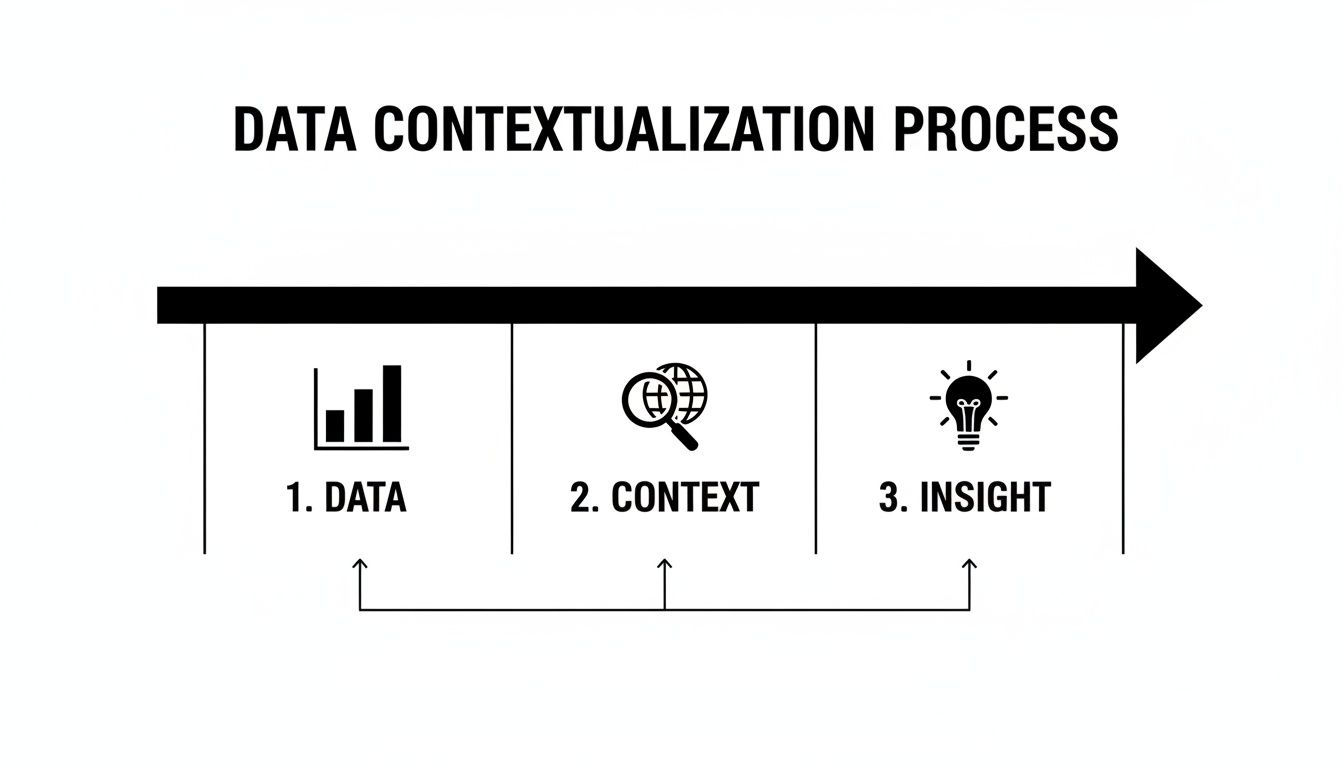
It’s a simple but powerful progression. Data is just the starting point; context is the critical bridge that leads to genuine understanding.
Step 1: Define Your Subject and Scope
Before you can analyze the context, you have to know exactly what you're analyzing. Is it a specific dataset? A historical event? A novel? User behavior on your website?
Be precise. A vague goal like "customer satisfaction" is far too broad to be useful. A much better starting point is something like, "the 15% drop in customer satisfaction scores in Q3 for our enterprise clients."
Next, define your scope. You can't analyze every piece of related information in the universe, so you need to set practical boundaries. For example, you might limit your research to the last two years, focus on three specific competitors, and only pull data from your primary market. This keeps your analysis tight and prevents you from drowning in irrelevant details.
Step 2: Gather Relevant Contextual Information
With a clear subject in hand, you can start gathering the surrounding information. Think of yourself as a detective building a case file. Your goal is to collect evidence from different layers of context that might have influenced your subject.
Your information hunt should pull from a mix of sources:
- Historical Context: What are the long-term trends? Dive into past reports, old project files, and historical data to see how the current situation stacks up against what came before.
- Environmental Context: What’s happening in the outside world? This includes market trends, competitor moves, economic reports, and any recent news that could have an impact.
- Internal Context: What’s going on inside your organization? This might involve recent product launches, new marketing campaigns, policy changes, or even a team restructuring.
- Cultural or Social Context: Are there any broader societal shifts at play? This is absolutely crucial for understanding user behavior, artistic works, or political movements.
Step 3: Analyze Connections and Identify Patterns
Now for the fun part. You're no longer just collecting facts; you're actively searching for the connections between your subject and all the contextual data you've gathered. Lay out all your evidence and start asking the tough questions.
How does that Q3 drop in satisfaction scores line up with a competitor's new product launch? Did your company's recent price increase happen around the same time? Is there a pattern of satisfaction dipping every third quarter because of seasonal business cycles?
Use tools like timelines or simple mind maps to visualize these connections. This is where you transform a boring list of facts into an interconnected web of influences. To do this well, you absolutely have to know how to build critical thinking skills so you can properly evaluate all the moving parts.
Step 4: Synthesize Findings Into a Cohesive Narrative
The final step is to weave everything together into a coherent story. Synthesizing information means combining all these different elements to create a new, unified understanding. Your goal is to explain why something happened, backed up by all the contextual evidence you've uncovered.
A strong synthesis does more than just list findings; it builds a compelling argument. It should clearly state your main conclusion and then guide the reader through the evidence, showing how each piece of context supports that conclusion.
For example, your final narrative might sound something like this: "The 15% drop in Q3 satisfaction wasn't an isolated event. It was driven by a perfect storm of our recent price increase, which coincided with a competitor's aggressive new marketing campaign, all amplified by a known seasonal dip in our industry."
This is the step that turns your analysis from a pile of data points into a powerful, actionable insight. To really master this skill, take a look at our guide on what is synthesizing information.
Comparing Contextual Analysis Methods Across Disciplines
While this four-step process provides a solid, universal framework, how you apply it can look quite different from one field to another. The table below shows how various disciplines adapt this methodology to fit their unique goals and questions.
| Discipline | Primary Focus | Key Contextual Factors | Example Application |
|---|---|---|---|
| Humanities | Understanding the meaning and significance of texts, art, or historical events. | Historical period, author's biography, cultural norms, political climate, philosophical movements. | Analyzing a Shakespearean play by considering the political anxieties of Elizabethan England. |
| Social Sciences | Explaining social phenomena, behaviors, and societal structures. | Socioeconomic status, cultural background, political systems, institutional policies, demographics. | Studying voting patterns in a specific region by analyzing local economic conditions and media coverage. |
| Computational/NLP | Improving model accuracy and relevance by understanding the context of language. | Surrounding words (local context), document topic (global context), user intent, conversational history. | Enhancing a chatbot's ability to answer questions by considering the previous turns in the conversation. |
| Business/UX | Solving business problems or improving user experience. | Market trends, competitor actions, internal company goals, user environment, technological constraints. | Redesigning a mobile app's checkout flow after observing how users get distracted in busy, real-world settings. |
As you can see, the core idea—looking beyond the immediate subject to understand the forces shaping it—remains the same. It’s a versatile approach that brings depth and clarity to almost any challenge.
Contextual Analysis in the Real World
Theory is one thing, but seeing contextual analysis in action is where its power really clicks. Across completely different fields, the approach consistently uncovers the "why" behind the data. The core principle is always the same: to understand the subject, you first have to understand its environment.
Let's move past the abstract and look at a few real-world stories. These examples show just how practical contextual analysis is, turning it from a lofty concept into a tangible tool you can actually use.

Crafting Smarter Retail Marketing
Imagine a national retail chain notices a sudden spike in online raincoat sales in a specific city. A surface-level look might just credit a recent digital ad. But a contextual analysis digs much deeper, layering different data points to get the full story.
The marketing team starts connecting the dots:
- Weather Data: They pull local meteorological reports and find the city was hit with an unexpected week of heavy rain.
- Local Events: Checking city calendars, they see a major outdoor music festival was happening that exact same week.
- Purchase History: A quick look at customer data shows many of the raincoat buyers had also bought festival gear in the past.
Suddenly, the picture is clear. The sales spike wasn't just about their ad. It was a perfect storm of environmental context (the rain), social context (the festival), and historical context (past customer behavior). This insight is gold. Instead of running generic ads, they can now create targeted, event-based campaigns that feel personal and perfectly timed.
This is a prime example of moving from reactive observation to proactive strategy. The company now knows to monitor local events and weather forecasts to anticipate demand, giving them a significant competitive edge.
Building Software People Actually Love
In the world of user experience (UX) design, context is everything. It’s a classic mistake to test a new software feature in a sterile, controlled lab. While you get some feedback, you completely miss how people will actually use the product in their messy, real lives.
A UX team wants to figure out why their new mobile checkout feature has a high cart abandonment rate. Instead of just staring at analytics, they run a contextual inquiry, which means they go out and observe users in their natural environments.
They quickly discover people are trying to make purchases while:
- Riding a bumpy bus with a spotty internet connection.
- Standing in a noisy coffee shop line.
- Holding a toddler with one arm.
The lab tests missed all of this. Armed with this real-world knowledge, the designers can make changes that matter. They might simplify the checkout to require fewer taps, make the buttons bigger for easier use on the move, and add an offline mode to handle a flaky connection. This is how you build software that solves real problems for real people.
Making AI and NLP Smarter
Context is also the secret ingredient that makes modern artificial intelligence so powerful, especially in Natural Language Processing (NLP). An AI model can’t understand a word in isolation; it has to analyze the surrounding text to grasp the true intent. It’s a form of computational contextual analysis.
Take the sentence: "The band played a great set."
Without context, "band" could mean anything—a music group, a rubber band, a radio frequency. An NLP model figures it out by looking at its neighbors, like "played" and "set." This local context tells the AI that we're talking about musicians.
This same principle is at work in much more complex tasks. When a customer service chatbot analyzes a frustrated user's message, it doesn't just scan for keywords like "angry." It looks at the entire conversation history to understand the user's journey, what they've already tried, and why they're upset. That full context allows the AI to give a much more helpful and empathetic response.
Tools to Power Your Contextual Analysis
Let's be honest: a proper contextual analysis involves wading through a sea of information. We're talking academic papers, market reports, user interviews, historical archives—the sheer volume can be a real roadblock. Thankfully, we don't have to do all the heavy lifting ourselves anymore.
The right tools can make all the difference, helping you move from wrestling with raw data to actually interpreting what it all means. They range from classic research software to newer AI assistants that can read and synthesize dozens of sources at once. The trick is finding a workflow that complements your expertise, not one that tries to replace it.
Traditional Qualitative Data Analysis Software
For years, researchers in fields like sociology and history have leaned on Qualitative Data Analysis (QDA) software. Think of tools like NVivo or MAXQDA. They're designed from the ground up to help you bring order to messy, unstructured data—interview transcripts, survey answers, and field notes.
These platforms are essentially digital workbenches for deep analysis. They let you:
- Code and Categorize Data: You can tag snippets of text with thematic codes, which makes spotting recurring patterns much easier.
- Visualize Connections: It's one thing to see themes, but another to see how they connect. These tools help you build charts and models to map out those relationships.
- Query Your Data: You can run detailed searches to check a hunch, like finding every time a user mentioned "frustration" alongside a specific product feature.
While incredibly powerful, these tools can have a steep learning curve. They're best for in-depth, project-based research where that hands-on, manual coding is crucial for building a rock-solid argument.
AI-Powered Platforms for Accelerated Research
A new wave of AI tools is changing the game, especially in the early stages of research. Platforms like PDF Summarizer are built to fast-track the literature review and information gathering—often the most time-consuming part of the whole process. Instead of spending a week reading dense reports, you can pull out the core arguments in a matter of minutes.
The real power of an AI assistant is its ability to process information at a scale that's simply not humanly possible. This frees you up to do what you do best: ask tough questions, spot the nuances, and build a compelling narrative.
These tools are a natural fit for contextual analysis because they're great at pinpointing relevant information across huge sets of documents. If you want to make your workflow more efficient, learning about automatic document processing is a fantastic starting point.
Here’s a look at an AI chat interface where you can upload multiple documents and ask direct questions about them. As you can see, the AI pulls answers from different sources and provides clickable citations, so you can jump straight to the original page to verify everything.
Synthesizing Across Multiple Sources Instantly
One of the toughest parts of contextual analysis is connecting the dots between different sources. You might have a market report saying one thing, a batch of user reviews saying another, and three academic papers offering a completely different perspective. Trying to weave all that together manually is tedious and it’s easy to miss things.
This is where features like multi-file chats really shine. You can drop all of your documents into one conversational window and ask broad questions that cover the entire collection. For example: "Based on all these documents, what are the primary market drivers and user frustrations related to our product category?"
The AI reads, connects, and synthesizes the information for you, delivering a single, consolidated answer with all its sources clearly cited. What used to take a week of reading can now be done in an afternoon of focused, strategic questioning.
Common Mistakes to Avoid in Your Analysis
Contextual analysis is an incredibly insightful method, but it’s not without its traps. It’s surprisingly easy, even for seasoned pros, to fall into a few common pitfalls that can weaken your conclusions. Knowing what to watch out for is half the battle.
The real challenge isn't just collecting contextual information; it's interpreting it without letting your own assumptions get in the way. Let's walk through the mistakes that can trip you up and how to sidestep them.
Ignoring Confirmation Bias
This is the big one. Confirmation bias is our natural human tendency to hunt for evidence that proves what we already believe is true. It’s a sneaky trap. You might start with a gut feeling about why a marketing campaign underperformed, and before you know it, you're only paying attention to data that backs up your theory.
The best way to fight this is to actively play devil's advocate. Force yourself to look for evidence that disproves your initial hypothesis. What are the alternative explanations? This kind of self-correction is what separates a flimsy analysis from a rock-solid one.
Gathering Insufficient Data
Another frequent misstep is ending your research too early. A quick, surface-level look might give you a neat and tidy explanation, but it’s probably not the whole story. For instance, you can't just blame a drop in website traffic on a recent Google algorithm update without also considering seasonal slumps, a competitor's new campaign, or technical issues on your site.
To avoid this, always triangulate your data. Pull information from different, unrelated sources—think quantitative sales figures, qualitative customer interviews, historical performance reports, and broad market trends. When all signs point to the same conclusion, your confidence level should skyrocket.
Misapplying Context Across Situations
Context is specific. Just because one set of factors explained an event in the past doesn't mean it's a universal rule. It’s a huge mistake to take insights from a product launch in, say, Japan and assume they'll apply directly to a launch in Brazil. What works in one cultural, economic, or social environment often doesn't in another.
Treat every analysis as a brand-new case. Past findings can offer clues, but you have to verify that the contextual elements are genuinely relevant to the situation you're studying right now. This keeps you from making sweeping generalizations from a single data point.
Finally, one of the toughest challenges is simply knowing when you have enough information to make a call. To avoid the all-too-common trap of analysis paralysis, you have to set clear goals and a defined scope for your investigation from the very beginning.
Got Questions? We’ve Got Answers.
Still have a few things you're wondering about when it comes to putting contextual analysis into practice? You're not alone. Let's tackle some of the most common questions we hear from researchers, students, and professionals alike.
Contextual Analysis vs. Content Analysis: What’s the Real Difference?
It’s easy to mix these two up, but they serve very different purposes. Content analysis is about the what. It catalogs and quantifies the explicit data you have in front of you—counting word frequency, sorting information into categories, or pinpointing recurring themes.
Contextual analysis, on the other hand, is all about the why. It digs deeper to understand the circumstances surrounding the data.
Here’s a simple analogy: imagine a photograph. Content analysis would describe what’s in the picture—a person, a building, a tree. Contextual analysis would tell you who took the photo, when and where it was taken, what was happening at that moment, and why that picture is significant. One describes the pieces; the other tells the story.
How Do I Know When I Have Enough Context?
This is the million-dollar question, and there's no magic number. The goal is to reach a point of "saturation," a term researchers use for when new information stops yielding fresh insights and starts confirming what you already know.
The best approach is to start with the most direct context—the author, the date, the immediate publication—and work your way outward. You’re aiming for a rich, supportive framework for your argument, not an endless rabbit hole of every tangentially related fact.
Pro Tip: Your analysis is solid when your core conclusions hold up, even when you introduce new contextual data. If your findings remain stable and compelling, you've likely gathered enough information to make your case.
Can AI Just Do This For Me?
Not quite, but AI tools are fantastic partners in the process. Think of AI as a brilliant research assistant, not a replacement for your own critical thinking.
AI is incredibly good at the heavy lifting. It can scan and process mountains of text, spot patterns across hundreds of documents, and summarize key points in seconds. This dramatically cuts down the time you spend just gathering information.
But the final step—interpreting nuance, understanding cultural subtleties, and connecting the dots—still requires a human brain. Your expertise is what transforms all that data into genuine insight. The AI handles the scale; you provide the wisdom.
Ready to stop drowning in research and start understanding it? PDF Summarizer helps you chat with your documents, synthesize information across multiple files instantly, and get clear answers with verifiable sources. It's the perfect assistant for accelerating your contextual analysis.
Relevant articles

Uncover what is qualitative data analysis with this guide. Learn the core methods, see real-world examples, and find out how to analyze qualitative data.

Understand what is evidence based research through this practical guide. Learn the core principles, steps, and tools to make data-driven decisions that work.

Unlock business insights with our guide to financial analysis reports. Learn to interpret statements, use key ratios, and leverage AI for faster analysis.

Struggling with dense texts? Learn how to read research papers efficiently with our concise guide and practical strategies.

Discover how to write literature review effectively—from planning and searching to synthesis and writing.

Discover how to conduct a literature review with a practical, step-by-step guide covering scope, synthesis, and reporting findings.