What Is Synthesizing Information A Guide to Creating New Insights
Learn what is synthesizing information and move beyond simple summaries. Discover how to connect ideas from multiple sources to create powerful new insights.
Synthesizing information isn't just about collecting facts—it's the art of weaving together ideas from different sources to create something entirely new. Think of it as connecting the dots between various reports, articles, or studies to form a brand new, original insight that wasn't explicitly stated in any single one of them.
This is an active process. It pushes you beyond simply understanding what you've read and into the realm of genuine knowledge creation.
The Art of Creating New Knowledge
Imagine you're a detective working a complex case. You have witness statements, forensic reports, and security footage. You wouldn't just staple them together and call it a day. You’d actively look for connections, spot inconsistencies, and piece together all the disparate clues to build a single, coherent story of what happened.
That final theory—your new, unified understanding of the crime—is the direct result of synthesis. You've taken separate pieces of information and constructed a new, more complete picture.
More Than Just a Summary
People often mix up synthesizing with summarizing or analyzing, but they're very different skills. Each plays a role, but synthesis is the final, most creative step.
- Summarizing is about condensing. You're just repeating the main points of a single source in your own words, making it shorter.
- Analyzing is about deconstructing. You're breaking down a text to understand its structure, arguments, and underlying assumptions. Our guide on what is document analysis dives deeper into this skill.
- Synthesizing is about constructing. You're taking the key ideas from multiple sources and combining them to build a new argument, model, or perspective.
Let's look at this with a simple analogy.
Synthesis vs Summarizing vs Analysis At A Glance
Imagine you're a chef in a busy kitchen. You have three distinct tasks you might perform with your ingredients, each mirroring one of these critical thinking skills.
| Concept | Core Action | Analogy (Chef's Kitchen) | Outcome |
|---|---|---|---|
| Summarizing | Condensing | Reading a recipe and listing the ingredients needed. | A shorter, accurate list of the basics. |
| Analyzing | Deconstructing | Tasting each ingredient alone to judge its quality. | An understanding of the individual parts. |
| Synthesizing | Constructing | Combining select ingredients to invent a brand-new dish. | An original creation with a unique flavor. |
As you can see, the chef doesn't truly create until they start synthesizing. That’s where the magic happens, combining individual elements into a unique and cohesive whole.
The true power of synthesis is that its outcome is an original insight—an idea that is far greater than the sum of its parts. It's that "aha!" moment when different facts suddenly click into place, revealing a much bigger picture.
Why This Skill Matters
Getting good at synthesizing information is a massive advantage in almost any field. It’s the engine behind real innovation, sharp critical thinking, and powerful communication.
For a student, it’s the key to moving beyond a simple book report to writing a truly compelling research paper. For a business leader, it's how you blend market data, customer feedback, and competitor movements to build a winning strategy.
Ultimately, learning to synthesize is the first step in your journey from being a passive consumer of information to an active creator of new knowledge.
The Core Process of Information Synthesis
So, how do you actually do synthesis? It might sound intimidating, but it's a skill you can break down into a few manageable steps. Think of it like being a detective piecing together a complex case. You don't just find one clue and call it a day. You have to gather all the evidence, see how seemingly random pieces connect, and then build a convincing story that explains the whole picture.
It’s less of a rigid checklist and more of a creative cycle. You’ll move through three main stages, but you'll likely find yourself looping back and forth between them as your understanding grows and new connections click into place. This back-and-forth is what makes the process so effective; it allows your ideas to evolve and become stronger.
This diagram shows the basic workflow, highlighting how summarizing and analyzing are the building blocks that lead to true synthesis.

As you can see, you first have to understand the individual pieces (summarizing) and take them apart (analyzing) before you can hope to build something new and meaningful.
Step 1: Understand and Organize Your Sources
Before you can start building, you need to know your materials inside and out. This first step is all about deep comprehension, not just skimming. Your goal is to really internalize the core message, argument, and evidence from each source. If you rush this part, the whole structure you build later will be shaky.
A structured approach is your best friend here. Many researchers, for example, use different qualitative data analysis methods to systematically pull out important themes from all the information they've gathered.
To really get a grip on the content, make sure you’re doing the following:
- Active Reading: Don't just let the words wash over you. Engage with the text by highlighting key arguments, questioning the author's assumptions, and jotting down your own thoughts in the margins.
- Initial Summarization: For every source, write a quick, neutral summary of its main points. This is a great way to confirm you actually understood what the author was trying to say.
- Identify the Thesis: What’s the single most important idea the author wants you to walk away with? Pinpoint that central claim for each document.
A simple matrix is an excellent tool for keeping everything organized. You can learn how to set one up with our guide to creating a literature review matrix template. It helps you visually map out your sources and see their key ideas side-by-side.
Step 2: Find the Hidden Connections
Okay, you've got a solid handle on your individual sources. Now the real detective work begins. You're shifting from just understanding what each source says on its own to figuring out how they talk to each other. You’re searching for the invisible threads that tie them together.
These connections aren't always about agreement. In fact, some of the best insights come from spotting where sources clash, contradict each other, or where there are noticeable gaps in the conversation.
Key Insight: Synthesis isn't just about finding where everyone agrees. It's about mapping the entire conversation—the agreements, the arguments, and even what’s not being said at all. Your unique perspective often comes from exploring these areas of friction.
Step 3: Weave a New Narrative
This is it. The final stage is where true synthesis happens. You go from being a spectator watching the conversation to an active participant who brings something new to the table. Using the themes, patterns, and contradictions you’ve uncovered, you’ll start to construct your very own argument.
This isn’t about just stringing a bunch of quotes together. It’s about using the ideas from your sources as evidence to support your unique thesis. Your voice should lead the way, orchestrating the other ideas to build a fresh, coherent, and insightful conclusion. Your final product is the "solved case"—a new perspective backed by carefully chosen evidence.
How Synthesis Works in the Real World
Knowing the theory is one thing, but seeing synthesis in action is where you really grasp its power. This isn't some dusty academic exercise; it’s a practical skill that gets real results, whether you're in a boardroom, a classroom, or a research lab.
The ability to connect the dots between different ideas is what separates basic reporting from true innovation. Let's look at how this plays out for students, researchers, and business professionals and see how they move from just repeating information to creating something entirely new.
For Students: From Book Report to A+ Literary Analysis
Think back to the classic book report. It's a summary. You recount the plot, describe the characters, and maybe touch on the main themes of one book. It proves you read it, but it doesn't create any new insight.
Now, let's level up with synthesis. Imagine your professor assigns a paper arguing that The Great Gatsby is a critique of the American Dream. This requires more than just summarizing the novel. You have to build an argument.
- Source 1: The novel itself, full of direct quotes and plot points.
- Source 2: A critical essay arguing that Gatsby’s failure is a statement on social class.
- Source 3: A historical article on the roaring twenties, detailing its economic excess and cultural shifts.
- Source 4: A biography of F. Scott Fitzgerald that reveals his own complicated relationship with wealth and success.
A summary would just talk about each of these sources one by one. Synthesis, on the other hand, is about weaving them together. You’d use the critic’s argument (Source 2) as a lens, support it with the historical context of the era (Source 3), and then connect it all to the author's personal struggles (Source 4) to build a compelling, original take on the novel.
You've just gone from reporting on a book to creating a fresh piece of literary analysis.
For Researchers: Finding the Gaps to Justify New Studies
In research, the literature review is everything. A weak one is just a long, boring list of summaries: "Smith (2021) found this," followed by "Jones (2022) found that." It shows you’ve done your reading, but it doesn’t advance the field.
A truly great literature review is a masterclass in synthesis. Imagine a researcher looking into burnout among remote workers. They'll gather dozens of studies on everything from virtual team communication and work-life balance to digital collaboration tools.
The point isn't just to list what everyone else has discovered. The real goal is to synthesize all those findings to pinpoint what's missing—the critical gap in our collective knowledge.
By mapping out all the existing research, they might see a clear pattern: tons of studies focus on corporate employees, but almost nothing has been published about remote worker burnout in the non-profit sector. That discovery, born from synthesis, becomes the entire justification for a new study.
Synthesis doesn't just rehash old research; it creates the rationale for new discoveries.
For Business Professionals: Weaving Data into a Winning Strategy
In business, you never make big decisions based on a single piece of information. A marketing analyst tasked with launching a new product has to pull together insights from completely different worlds.
Just look at the variety of sources they're dealing with:
- Hard Market Data: Sales figures, market share reports, and pricing models.
- Customer Voices: Survey results, focus group transcripts, and raw online reviews.
- Competitor Intel: Analysis of rival products, their marketing campaigns, and what their customers are saying.
- Internal Realities: Production costs, supply chain limitations, and budget constraints.
Simply summarizing each of these would give you four separate, disconnected reports. The magic happens when you synthesize them. By connecting a dip in sales (market data) with customer complaints about a missing feature (customer voices) that a top competitor just launched (competitor intel), the analyst can make a powerful case for a product update.
This is where modern tools can be a game-changer, letting you ask questions across all your documents at once.
You can literally chat with multiple files to instantly spot connections between market reports, customer feedback, and internal memos.
This gives an analyst the power to see patterns that would have been completely buried otherwise.
The final strategy is a direct result of this synthesis—a cohesive plan built from interconnected insights. It’s far smarter and more durable than any plan based on a single data point. This is how raw data becomes a real competitive advantage.
Common Synthesis Mistakes and How to Avoid Them
Even with a solid game plan, it's surprisingly easy to fall into a few common traps when synthesizing information. Learning to spot these pitfalls is just as important as learning the process itself, because sidestepping them is what separates a truly insightful piece of work from a mediocre one.
The biggest hurdle for most people? Simply confusing synthesis with a fancy summary. It's a subtle difference, but it changes everything.
Let's walk through the three most common mistakes I see people make and cover some practical ways to keep your own work on the right track.
Mistake 1: Mistaking Summarizing for Synthesizing
This is, without a doubt, the number one issue. It's when your final piece reads less like a cohesive argument and more like a string of book reports. Your own voice disappears, and the reader is just left with a list of what everyone else thinks, not what you think.
- What it looks like: Your paragraphs are a repetitive march of "Source A says this..." followed by "Source B argues that..." You’re presenting each source’s ideas one after another without ever connecting them into a new, bigger idea.
- How to fix it: Always lead with your point. Start each paragraph with your own claim or topic sentence. Then, bring in evidence from your sources to back it up, explicitly showing the reader how their ideas fit together to support your argument.
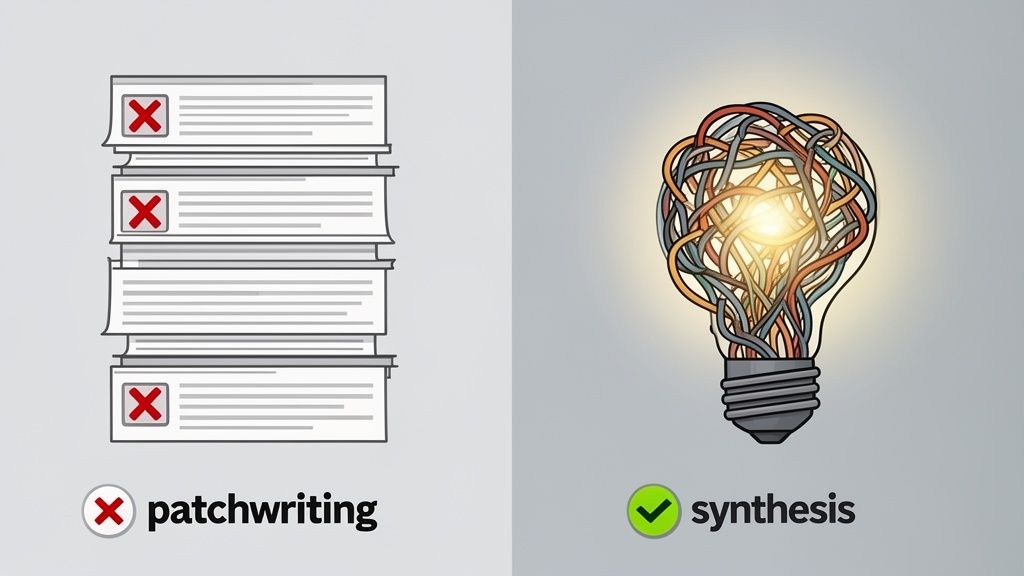
Mistake 2: Patchwriting Instead of Paraphrasing
Patchwriting is a sneaky trap. It’s what happens when you take sentences from your sources, swap out a few words, and stitch them together, keeping the original sentence structure mostly intact. This shows you haven't really digested the information; you're just rearranging someone else's words.
While it's not a direct copy-paste, it isn't genuine synthesis either. No original thought has been added to the mix.
Key Takeaway: Real synthesis means you understand the concepts so well that you can explain them entirely in your own words—with your own sentence structure—without even peeking at the original text.
Here’s a great way to avoid this: After reading a section, close the book or tab. Then, try to explain the core idea out loud as if you were talking to a friend. This forces you to process the concept and reframe it in your own mental language.
Mistake 3: Cherry-Picking Evidence
This mistake happens when you have an idea in your head and you only look for evidence that proves you're right, completely ignoring anything that contradicts you. Good synthesis isn't about winning an argument you already decided on; it's about building a fair and complete understanding of a topic.
Ignoring conflicting information doesn’t make your position stronger. In fact, it makes it fragile and easy to poke holes in.
- What it looks like: You found five sources that support your claim and one that challenges it. That one challenging source is nowhere to be found in your final paper.
- How to fix it: Go out of your way to find and engage with opposing views. Acknowledging a counterargument and then explaining why your position still holds up makes your synthesis so much more persuasive. It demonstrates to your reader that you’ve done your homework and considered the topic from every angle.
Tools That Amplify Your Synthesis Skills
Let's be honest, the amount of information we have to wade through today is staggering. But thankfully, we don't have to go it alone. Modern tools can act as a research co-pilot, helping you process mountains of data without losing the depth of your understanding.
Think of these platforms not as a replacement for your own critical thinking, but as a way to handle the heavy lifting. They're built to process information so you can focus on the real work: making connections and generating new insights. Imagine having an assistant who can read a 100-page report in seconds and give you the main argument. That’s what these tools bring to the table. They cut down the initial comprehension time, freeing up your brainpower for the tougher job of true synthesis.
From Manual Labor to AI-Powered Insight
We've all been there: juggling multiple documents, covered in highlighter marks, with sticky notes everywhere, trying to build a mental map of how everything connects. This old-school method works, but it’s painfully slow and just doesn't scale when you're dealing with dozens of sources.
AI-powered platforms completely change the game. They offer features that make the most time-consuming parts of the synthesis workflow feel almost effortless.
- Instant Summaries: Get the gist of a dense document in moments, making sure you understand the core message before you dive in.
- Targeted Q&A: Instead of re-reading entire sections, you can ask a document a specific question and get a precise answer.
- Key Takeaway Extraction: Let the tool automatically pull out the most critical conclusions or findings from long reports.
These features don't do the synthesizing for you. They just give you the organized, digestible building blocks you need to start seeing connections and forming your own original ideas—much, much faster.
Chatting Across Multiple Documents
One of the most powerful new developments is the ability to have a single conversation with an entire library of sources at once. This multi-document chat function is a game-changer for anyone trying to put synthesis into practice. It allows you to ask complex, comparative questions that would otherwise take hours of manual cross-referencing.
For example, you could upload three different market analysis reports and ask, "What are the key contradictions between these reports regarding consumer sentiment in Q4?" The system will scan all three documents simultaneously to pinpoint and present the conflicting data points.
This is especially helpful when dealing with massive, complex datasets. Take the landmark effort from the Information and Policy Engagement Institute (IPIE) in 2023, which surveyed 289 scientists across 54 countries to analyze the global information environment. Synthesizing that much diverse data required advanced techniques, much like how modern tools help you pull together actionable insights from multiple dense research papers.
Key Insight: The goal isn't just to find information faster. It's to uncover hidden patterns, contradictions, and relationships between sources that you would likely miss through manual review alone. This is where AI moves from a simple summarizer to a true synthesis partner.
Maintaining Accuracy and Trust
Of course, a big question with AI is whether you can trust the information it gives you. The best tools tackle this head-on with features designed for verification and trust. Clickable citations are a perfect example.
When an AI answers your question, it provides a direct link back to the exact sentence or paragraph in the original document where it found the information. This simple but essential feature allows you to:
- Verify Accuracy: Instantly check the context to make sure the AI got it right.
- Deepen Understanding: Jump straight to the source material to explore the surrounding data and nuance.
- Maintain Academic Integrity: Easily and accurately cite your sources in your final work.
By combining speed with verifiability, these tools help you synthesize information with confidence. To see these features in action, you might be interested in our deep dive on using a free PDF summarizer AI for research.
And synthesis isn't just for text anymore. To truly bring ideas together from all kinds of media, you can use specialized video to text converter tools. This lets you pull transcripts from lectures, interviews, and documentaries, integrating their insights directly with your text-based research. Turning spoken words into searchable text allows you to connect ideas across different formats, building a much more complete picture of your topic.
Case Study: Synthesizing Global Climate Reports
To see what synthesis looks like in the real world, let's zoom in on one of the biggest intellectual tasks happening today: making sense of global climate change. This isn't just about collecting facts; it's about weaving thousands of complex, often disconnected, studies into a single, cohesive story about our planet's future.
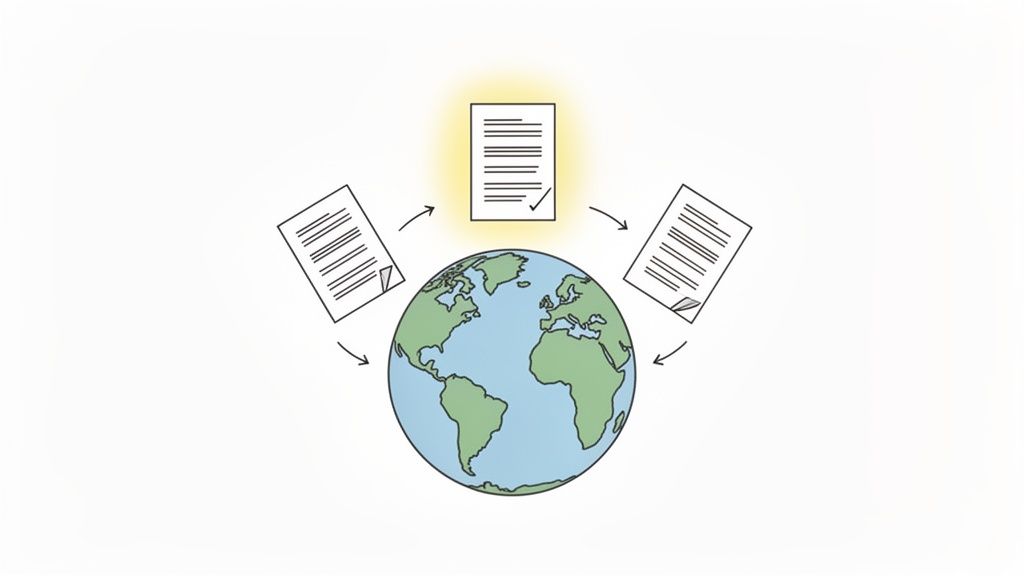
The Intergovernmental Panel on Climate Change (IPCC) offers a masterclass in this very process. Their famous reports aren't just summaries. They are powerful, large-scale examples of synthesis, combining decades of data from every corner of the globe into a unified understanding.
The Challenge: A Planet's Worth of Data
Think about the sheer scale of this undertaking. The IPCC has to pull together findings from thousands of separate scientific papers. These aren't all on the same topic; the sources are incredibly diverse:
- Physical Science: Hard data on rising sea levels and atmospheric CO2 concentrations.
- Impacts and Adaptation: Studies detailing how heatwaves affect crop yields in Southeast Asia or how coastal communities are adapting to erosion.
- Mitigation Strategies: Economic reports analyzing the cost and benefit of different renewable energy sources.
If they just summarized each study one by one, you'd end up with a massive, unreadable encyclopedia of facts. The real magic—the synthesis—happens when they connect these disparate threads to answer the big, urgent questions.
The landmark 2023 IPCC Sixth Assessment Report (AR6) Synthesis Report is a perfect example. Finalized after an eight-year cycle, it involved over 782 scientists from around the world. They distilled the findings from three enormous Working Group reports and other special assessments to produce the most authoritative overview of climate science since 1988. You can learn more about these groundbreaking climate change findings on WRI.org.
A Practical Synthesis Scenario
You can apply the same core principles to your own work, just on a smaller scale. Imagine you want to understand the gap between what scientists say we need to do about climate change and what governments are actually doing.
You might start with three key documents:
- The IPCC AR6 Synthesis Report: This gives you the scientific baseline—the expert consensus on what action is required.
- A UNFCCC Analysis: This document outlines the official climate pledges countries have made.
- National Policy Documents: These detail the specific laws and regulations one country has put in place.
Your goal isn't to create three separate summaries. Instead, you'd ask a focused question that forces you to connect the dots between them: “Where are the biggest disconnects between the IPCC’s recommended emission cuts and the policies this government has implemented?”
This approach takes you far beyond simple comprehension. By weaving together information from these varied sources, you create a brand-new insight—a clear map showing exactly where policy falls short of the science. That's the power of synthesis: turning a flood of information into a single, focused conclusion that can actually drive change.
A Few Common Questions About Synthesizing Information
Even after you get the hang of it, a few questions tend to pop up. Let's clear those up so you can start connecting ideas with more confidence.
How Is Synthesizing Different From a Literature Review?
Think of a literature review as one of the most common jobs for synthesis. A basic literature review might just be a collection of summaries, but a really strong one is a masterclass in synthesis. It tells a much bigger story.
A great lit review doesn't just list what others have found. It weaves those findings together around key themes, highlights where researchers agree or fiercely disagree, and—most importantly—shines a spotlight on the gaps. Synthesis is the engine that turns a laundry list of studies into a coherent map of the research field, which in turn justifies why your new project even needs to exist.
Can I Synthesize Information From Videos or Charts?
Absolutely. Synthesis is all about connecting the ideas, not the formats they come in. You can—and should—pull information from a documentary, trends from a data visualization, and key arguments from an article to build a richer, more complete picture.
For instance, you could take data showing a sharp rise in social media usage (from a chart), combine it with an expert’s commentary on mental health (from a video), and pull in findings from a research paper on teen anxiety (from a PDF). Blending these pieces allows you to forge a new, much more compelling argument.
The core principles don’t change whether you’re looking at text, visuals, or audio. Your job is to find the hidden threads connecting the main ideas, no matter where you find them.
How Do I Know if I'm Synthesizing or Just Summarizing?
This is the big one. Getting this right is crucial. To figure it out, ask yourself one simple question: "Am I making a new point that isn't explicitly stated in any one of my sources?"
If your work is mostly just restating the main ideas from your sources, even if you combine them, you're summarizing. But if you're using those sources as building blocks to construct your own unique argument, that's synthesis. It’s about letting your own voice and perspective take the lead, using the evidence to prove your case.
Ready to stop juggling documents and start uncovering hidden insights? PDF Summarizer lets you chat with multiple files at once, turning hours of research into minutes of focused analysis. Upload your reports, ask the tough questions, and start synthesizing information faster than ever. Try PDF Summarizer for free today at pdfsummarizer.pro.
Relevant articles

Master taking notes on a pdf with practical annotations, smart organization, and AI tools to boost understanding and retention.

Discover how to conduct a literature review with a practical, step-by-step guide covering scope, synthesis, and reporting findings.
How to read scientific papers: Learn planning, annotation, and critical appraisal to extract actionable insights and improve your research outcomes.