Mastering how to write review paper: A practical guide
Discover how to write review paper with a practical approach. Learn topic selection, literature synthesis, and crafting a compelling narrative to boost impact.
Before you even think about diving into academic databases, the most crucial work happens. A great review paper isn’t just a summary of what’s out there; it’s a focused, strategic project. It all starts with turning a vague idea into a sharp, manageable plan. You need to find a real gap in the conversation, frame a question that drives your entire inquiry, and draw clear lines in the sand to define your scope. This is the foundation. Get this right, and everything else falls into place.
Laying the Groundwork for a Powerful Review
Many academics make the mistake of jumping straight into the literature search. But the difference between an impactful review and a forgotten one often comes down to the planning you do with nothing more than a blank page. This is where you set the purpose, direction, and boundaries for your work.
One of the most common pitfalls is picking a topic that’s way too broad. Think "climate change effects"—a subject so vast it could fill a library. A truly successful review narrows that down to something specific and meaningful, like "the impact of rising sea temperatures on coral reef biodiversity in the Pacific Ocean since 2010." That kind of focus is what makes a project both achievable and valuable to the field.
Choosing Your Topic and Framing the Question
The best topics come from a place of genuine curiosity, sparked by a gap you've noticed in the existing research. As you read, you start to see the weak spots: areas where findings are contradictory, theories are underdeveloped, or the field is changing so fast that no one has connected the dots yet. That's your opening.
Your job is to transform that general interest into a precise research question. This question becomes your compass, guiding every decision you make from here on out. A good one is:
- Debatable: It can’t be answered with a simple "yes" or "no."
- Focused: It's narrow enough to be explored deeply within the confines of a single paper.
- Relevant: It speaks to a current conversation or problem in your discipline.
For instance, "Is remote work effective?" is a dead end. A much better question is, "What are the documented effects of mandatory remote work policies on employee productivity and mental well-being in the tech sector?" See the difference? That framing gives you a clear path forward.
A well-crafted research question is the cornerstone of your review. It dictates your search terms, informs your inclusion criteria, and provides the central theme around which you will build your entire argument.
Defining the Scope of Your Review
With a solid question in hand, it’s time to define your scope. Think of this as building a fence around your project. It keeps your research from wandering off in a dozen different directions and protects you from the dreaded scope creep.
You’ll need to set clear inclusion and exclusion criteria. These are the specific rules that determine which studies make the cut. Common parameters include:
- Time Period: Are you only looking at research from the last 5, 10, or 20 years?
- Geography: Is your focus on a particular country, a specific region, or global patterns?
- Methodology: Will you stick to quantitative studies, or are qualitative and theoretical papers fair game?
- Publication Type: Are you limiting your search to peer-reviewed journals, or will you also include conference proceedings, books, and dissertations?
This isn’t about randomly limiting your work. It's about making conscious choices that strengthen the focus and credibility of your review. A clearly defined scope makes your process transparent and your conclusions more powerful. Setting these boundaries early on also helps you figure out https://pdfsummarizer.pro/blog/how-to-organize-research-papers from the get-go.
Creating a Preliminary Outline
The final step in this planning phase is to sketch out a rough outline. This isn’t set in stone; it’s a flexible roadmap that breaks the huge task of writing into smaller, less intimidating pieces.
A simple outline should have a working title, an introduction that lays out the problem, a few thematic headings for the body of the review, and a section for your conclusion. This early structure gives you a sense of direction and makes the actual writing process feel much more manageable. For more detailed insights on this, you can find excellent guidance on how to write a literature review that complements this process.
Mastering the Literature Search
A powerful review paper rests on a foundation of deep, meticulous research. This isn't just about plugging keywords into a search bar; it's a strategic excavation of the entire scholarly conversation around your topic. Your real aim is to get past the surface-level papers and dig up the foundational and bleeding-edge studies that truly define the field.
Think of yourself as a detective. Your first set of keywords is just the initial lead. To really crack the case, you need to follow the evidence wherever it takes you, and that means getting good with the tools of the trade—the powerful academic databases that hold millions of articles.
Advanced Search Strategies in Academic Databases
Relying solely on something like Google Scholar is a classic rookie mistake. Seasoned researchers live in specialized databases like PubMed, Scopus, and Web of Science for a reason: they offer a level of precision that general search engines just can't match.
The trick to unlocking their power is mastering Boolean operators. These are simple words like AND, OR, and NOT that let you construct highly specific queries. For instance, searching for "employee productivity" AND "remote work" will only show you articles containing both phrases. On the other hand, using "mental health" OR "well-being" casts a wider net, pulling in papers that mention either term.
Beyond operators, get comfortable with the advanced filters. They’re your best friend for cutting through the noise. You can narrow your results by:
- Publication Date: Essential for focusing on the most current findings.
- Journal Type: Lets you zero in on articles from top-tier, peer-reviewed sources.
- Study Design: Helps you find specific methodologies, like randomized controlled trials or meta-analyses.
This degree of control is crucial. You’re not just looking for any information; you’re looking for the right information. And that’s more important than ever, considering the explosion in published research. A bibliometric analysis revealed that the number of scientific journals nearly doubled between 2000 and 2018. You can explore the research on scientific writing evolution if you're curious about the trends.
The Art of Citation Chasing
One of the most powerful, yet often overlooked, techniques is citation chasing (some call it "snowballing"). When you find a truly seminal paper—one that seems central to your topic—don't just stop at reading it. Dive into its reference list. This backward search is how you find the foundational studies that everyone else built upon.
Then, do the opposite. Look up which newer articles have cited that key paper. This forward search helps you trace how an idea has evolved and see who the current heavyweights are in the conversation. Combining both moves gives you a surprisingly comprehensive map of the literature.
Citation chasing is like following a conversation through time. By examining who cited whom, you can piece together the intellectual lineage of an idea and identify the most influential voices in the debate.
Keeping Your Sources Organized from Day One
As the papers start piling up—and they will, into the dozens or even hundreds—organization becomes non-negotiable. Trust me, trying to manage all this with a chaotic system of desktop folders and a clunky spreadsheet is a recipe for pure frustration. This is where reference management software becomes indispensable.
Tools like Zotero, Mendeley, or EndNote are lifesavers. They let you grab citations and PDFs directly from databases with a single click, automatically organize everything, and help you take notes. Best of all, they will generate your bibliography in whatever citation style you need when it’s time to write.
Do yourself a huge favor: set up your reference manager before you download a single article. It will save you from a world of pain and countless lost hours down the road. Keeping this system tidy is a core part of the research workflow, and our guide on how to conduct a literature review has even more strategies to keep you efficient and sane.
Synthesizing Research: More Than Just a Summary
This is the make-or-break moment for your review paper. It's where you move from being a collector of information to a creator of insight. So many early-career researchers get stuck here, producing what amounts to a high-effort annotated bibliography—a list of who found what.
True synthesis is different. It’s about weaving individual research threads into a cohesive new fabric. You’re not just reporting on what others have said; you're building a narrative that reveals the bigger picture, showing what the collective body of work means. To do this well, you first need to be able to represent others' work accurately. For a deep dive on that, check out a complete guide to writing clear, unbiased summaries.
Finding the Conversation in the Literature
Once you're deep into your reading, start looking for the invisible threads connecting the papers. It’s easy to get lost in the details of each study, but your job is to zoom out and see the landscape. Think of yourself as a detective mapping out the intellectual terrain of your field.
Start by asking yourself some pointed questions as you read and take notes:
- Where's the friction? Pinpoint the core debates. Are there competing theories? Do some empirical findings directly contradict others? These disagreements are often the most interesting part of the story.
- What's the momentum? Look for emerging trends. Has there been a shift in methodology over the last decade? Is a new theoretical framework gaining traction?
- What's being ignored? Pay close attention to the silences. Are certain populations, contexts, or variables consistently left out of the conversation? These gaps are where your paper can make a real contribution.
By identifying these key elements, you’re creating a map that shows exactly where your own argument will fit in and why it matters.
Tools to Help You See the Connections
Trying to juggle the nuances of dozens of papers in your head is a recipe for disaster. This is where visual aids can be a lifesaver, turning abstract connections into something you can actually see and manipulate.
A synthesis matrix is a surprisingly powerful tool for this. It’s basically a detailed spreadsheet. Each row represents a source, and each column represents a key theme, variable, or question you're tracking. As you fill it out, you're forced to systematically compare how each study tackles your core concepts, making patterns jump out.
Another great option is a concept map. This is a more freeform, visual way to cluster ideas and draw lines between related findings from different authors. It helps you see how different pieces of the puzzle fit together. For instance, the literature search process itself can be mapped out to show how different activities are linked.
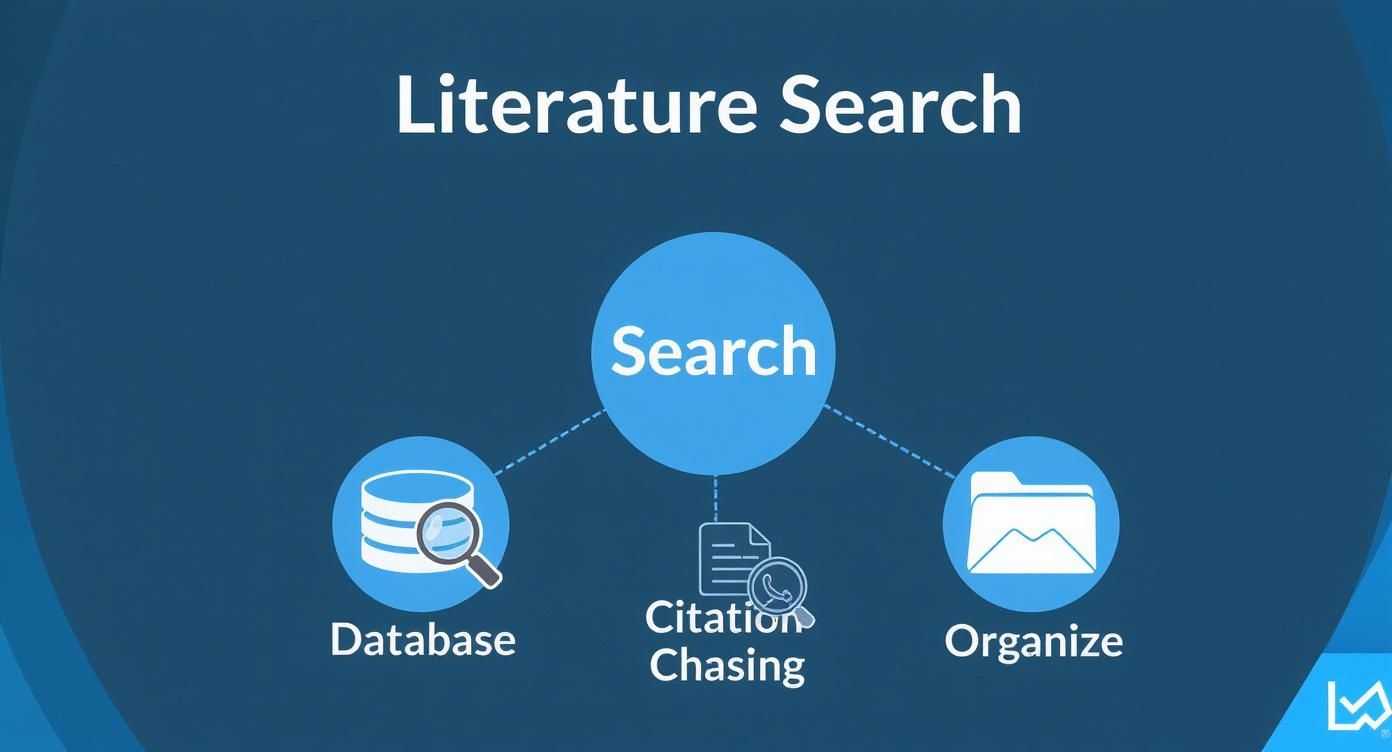
This simple map shows that searching isn't a single action but a process involving databases, citation chasing, and organization—all interconnected parts of a cohesive strategy.
Building Your Narrative
With your patterns mapped out, you can finally start building the central argument of your paper. This is the story you are telling about the state of the field, and it should be organized thematically, not by author or chronologically.
Avoid this common mistake: "Smith (2020) found X, then Jones (2022) found Y."
Instead, group the ideas: "One dominant perspective in the literature suggests X (Smith, 2020), but this view has been challenged by recent findings on Y (Jones, 2022)." This simple shift in structure transforms your writing from a summary into a genuine analysis. Your voice becomes the guide, leading the reader through a complex conversation between scholars.
Your goal is to create new knowledge. A great review paper doesn’t just report on the field; it actively shapes it by offering a fresh perspective, clarifying a complex debate, or pointing the way toward a new research frontier.
You can seriously accelerate this process with tools like PDF Summarizer. Instead of endlessly re-reading papers to find a specific point, you can ask direct questions across your entire library of PDFs. For example, upload your top 10 papers and ask, "Which of these studies used a longitudinal design, and what did they conclude about long-term effects?"
This lets you rapidly group sources by methodology, findings, or theoretical approach. Use the chat feature to pinpoint contradictions ("How do the findings in Paper A conflict with Paper C?") and identify gaps ("Do any of these papers address the topic in a non-Western context?"). The best part? The clickable citations let you instantly jump to the source text to verify the AI's response, so you maintain scholarly rigor while saving a huge amount of time.
Drafting Your Review Paper with Clarity and Impact
https://www.youtube.com/embed/vtIzMaLkCaM
Alright, you’ve done the hard work of synthesizing your research and mapping out your central argument. Now comes the part where you translate all those brilliant ideas into a clear, persuasive paper. This is where you move from abstract connections to a concrete manuscript that guides your reader through the intellectual landscape you've charted.
The structure of your paper is everything. A disorganized draft will bury your best insights, but a logical, well-signposted structure makes your argument feel airtight and inevitable. Each piece, from the introduction to the conclusion, has a specific job to do in building your case.
Crafting a Powerful Introduction
Your introduction is your handshake with the reader. It needs to do more than just announce your topic—it has to establish the "so what?" factor immediately. A great introduction hooks them by identifying a clear problem or gap in the current literature and stating exactly how your review fills it.
Think of it like an inverted pyramid. You start broad with the general topic, then quickly zero in on the specific debate or question your paper is about. The most critical piece is your thesis statement, which should be a concise declaration of your central argument and a quick roadmap of how the paper will unfold.
Don't ever let anyone tell you review papers are less impactful than original research. The data says otherwise. Review articles are, on average, cited three times more frequently than primary research papers. That's a massive difference, and you can read the full analysis on citation impact to see just how valuable these papers are in shaping academic conversations.
Structuring the Body of Your Review
The body of your review is where you deliver on the promises you made in the introduction. The secret to a strong body section is organizing it thematically, not just chronologically or by author. Each subheading should represent a key theme, concept, or debate that directly supports your thesis.
Your job is to lead the reader through a logical progression of ideas, and your headings are the signposts that keep them on track. This is where all your synthesis work truly shines. Instead of simply listing who said what, you need to:
- Group related findings to show where the evidence converges.
- Highlight disagreements and analyze why researchers might contradict one another.
- Identify patterns over time to discuss how the field's understanding has evolved.
- Critique methodologies, pointing out the strengths and weaknesses of key studies.
A solid outline is your best friend here. While it will almost certainly evolve as you write, starting with a clear plan is non-negotiable. For a deeper dive, our article on creating an outline for research offers a fantastic framework for getting your thoughts in order.
A thematic structure shifts the focus from a "who said what" summary to a "what it all means" analysis. This is the fundamental difference between a mediocre literature list and an impactful review paper that pushes the field forward.
Writing a Conclusion That Leaves an Impression
A conclusion is so much more than a summary. A weak one just rehashes what you've already said, leaving the reader feeling like you've run out of things to say. A powerful conclusion provides a sense of closure while also opening up new avenues for thought.
Your conclusion really needs to nail three things:
- Synthesize Your Main Argument: Restate your thesis in a fresh way, reminding the reader of the unique perspective your review brought to the table.
- Highlight the Broader Implications: Explain why your findings matter. What are the practical or theoretical consequences of the narrative you’ve constructed?
- Propose Directions for Future Research: This is your chance to directly shape the field. Based on the gaps you've found, suggest specific, tangible questions that future researchers should explore.
By ending on a forward-looking note, you frame your paper not as the final word, but as a catalyst for the next wave of research. This solidifies your contribution and makes sure your review has a lasting impact.
Refining and Polishing Your Final Manuscript
Finishing your first draft feels like a massive win, and it is. But the real craft of shaping a publishable review paper is just getting started. This next phase—revision—is what elevates a solid collection of ideas into a polished, persuasive piece of scholarship. It’s far more than a simple spell-check.
This is where you need to step back and look at your manuscript with a critical eye, first from 30,000 feet and then with a magnifying glass. A sloppy paper riddled with errors can completely undermine even the most brilliant synthesis.
Self-Editing for Clarity and Flow
Before you get bogged down in commas and typos, zoom out and focus on the big picture. Read your manuscript from beginning to end, but not as the author—read it as a skeptical colleague. Does your central argument unfold logically? Is the transition from one section to the next seamless?
Now is the time to be ruthless with your own words. Search for paragraphs where the logic feels weak or the connections are blurry. Be on the lookout for a few key things:
- Conciseness: Kill your darlings. If a sentence doesn't add real value, cut it. Swap out complex jargon and convoluted phrases for simple, direct language.
- Consistency: Make sure you're using key terminology the same way from the introduction to the conclusion.
- Logical Gaps: Does your argument make any unsupported leaps of faith? Every single claim needs to be clearly supported by the literature you've cited.
A classic mistake is assuming the reader can follow your internal train of thought. You have to make that intellectual journey explicit. Use strong topic sentences and transitional phrases to act as signposts, guiding them every step of the way.
The Non-Negotiable Proofreading Pass
Once you're satisfied with the structure and flow, it’s time to zoom in on the details. Meticulous proofreading isn't optional; it's essential. Grammatical errors, typos, and sloppy punctuation scream a lack of care and can tank your credibility with journal editors before they even get to your ideas.
It's notoriously difficult to catch your own mistakes because your brain already knows what you intended to write. One of the best tricks I've learned is to read the paper aloud. You'll hear awkward phrasing and find typos your eyes would have skipped right over. Another great tip is to temporarily change the font and text size to trick your brain into seeing the document for the first time again.
The final polish separates a submission from an acceptance. Trivial errors can create a negative first impression that is hard to overcome, regardless of the quality of your research.
It’s also crucial to double-check every number, date, and author name. A misspelled name or an incorrect statistic can cast a shadow of doubt over the accuracy of your entire paper.
Formatting for Your Target Journal
Every academic journal has its own detailed submission guidelines, usually under a heading like "Instructions for Authors." Ignoring these is probably the single fastest way to get a desk rejection without a second thought.
Before you even think about hitting "submit," you have to reformat your manuscript to their exact specifications. This almost always includes:
- Citation Style: Following their required format (e.g., APA, MLA, Chicago) to the letter.
- Manuscript Structure: Adhering to their rules for headings, abstract length, and the order of sections.
- Figures and Tables: Making sure all your visuals meet their requirements for resolution, labeling, and style.
Yes, this part is tedious. But it’s a non-negotiable sign of professionalism that shows you respect the journal's process, which makes an editor’s job easier—and that’s always a good thing.
Seeking External Feedback
Finally, no matter how many times you've edited it, you need a fresh set of eyes. You are simply too close to the project to spot all its weaknesses. Ask a trusted colleague, your mentor, or a peer from a writing group to give your draft an honest read.
Their feedback is invaluable for finding passages where your argument is unclear or your evidence feels unconvincing. This external perspective is a fundamental part of the scholarly process. The culture of peer review is growing globally, with a massive 193% increase in reviews from emerging nations between 2013 and 2017. This shift underscores the value of community feedback, and you can discover more insights on global peer review trends to see its impact firsthand. Learning to embrace criticism is how you learn to write a review paper that gets published.
Common Questions About Writing Review Papers
As you get deeper into writing a scholarly review, you're bound to run into some practical questions and sticking points. It happens to everyone. Tackling these common hurdles head-on can help you regain clarity and keep your project moving forward, especially when you feel stuck.
Let's dive into some of the most frequent questions researchers have when they're figuring out how to write a review paper.
How Do I Know When I Have Read Enough?
This is the question that keeps every researcher up at night. The truth is, it’s less about hitting a magic number and more about reaching a point of theoretical saturation.
You’ll know you're there when new articles stop offering genuinely new ideas. You'll see the same names, the same concepts, and the same findings popping up over and over again. Another good sign? When you can confidently lay out the major debates, key figures, and big unanswered questions in the field without constantly peeking at your notes. Once you hit that point, your energy should naturally shift from gathering more papers to synthesizing what you've already found.
What’s the Difference Between a Literature Review and a Systematic Review?
They might sound alike, but their purpose and process are worlds apart.
Here's a simple way to think about it:
- A traditional literature review gives a critical overview of a topic. The author has more freedom to select sources that help build a specific argument or narrative. It's driven by a central thesis.
- A systematic review is incredibly rigorous. It uses a strict, predefined, and repeatable protocol to find, select, and analyze all the available evidence related to a very narrow research question.
Basically, a systematic review is designed to be as objective as possible and is often treated as a formal research study itself. A narrative literature review, on the other hand, offers a more curated, expert perspective on a field.
The biggest difference is reproducibility. If another researcher followed the exact steps of a systematic review, they should end up with the same collection of articles. A traditional literature review is far more interpretive and shaped by the author's unique perspective.
How Do I Avoid Just Stringing Together Summaries?
This is where your work goes from being a book report to a real scholarly contribution. The key is to organize your paper around themes, concepts, or debates—not just by author or publication date. Don't fall into the trap of writing a simple annotated bibliography.
For example, instead of this common pitfall:
"Smith (2020) found X, and then Jones (2021) found Y."
Try creating a dialogue between the sources:
"One school of thought argues for X, as shown in the work of Smith (2020), while a competing perspective championed by Jones (2021) suggests Y."
Your unique voice comes through in how you connect, critique, and interpret the existing literature. You're not just reporting what others have said; you're the guide leading the reader through a complex scholarly conversation, building a new argument that wasn't there before. This is what makes your review a valuable piece of scholarship.
Ready to get a handle on your literature review? With a tool like PDF Summarizer, you can upload all your research papers and ask direct questions across the entire collection. It helps you spot themes, contradictions, and gaps in seconds. Get instant answers with clickable citations to speed up your synthesis. You can try it for free and start turning your pile of research into clear insights.
Relevant articles

Learn how to add citations in Google Docs using the built-in tool, add-ons like Zotero, and an advanced PDF workflow. Master APA, MLA, and Chicago styles.

Streamline your research and summary tasks with AI. Analyze documents, synthesize insights, and craft sharper reports, faster and with confidence.

Unlock what is meta analysis in research. This guide explains how it combines studies for powerful insights, covering key concepts, steps, and common pitfalls.
Struggling with research? Our literature review matrix template helps you synthesize sources, spot patterns, and write faster. Learn how to use it effectively.
Learn the systematic literature review methodology from start to finish. A practical guide on defining questions, searching, screening, and synthesizing data.
Struggling with dense texts? Learn how to read research papers efficiently with our concise guide and practical strategies.