A Modern Literature Review Writer's Guide to AI
Become a more effective literature review writer with our guide. Learn to plan, research, and write faster using AI tools ethically and efficiently.
Being a literature review writer used to be about methodically summarizing one source after another. That world is long gone. Today, the real skill lies in strategic synthesis—the ability to connect disparate ideas, pinpoint what’s missing, and lay a rock-solid foundation for new research.
This guide is for moving past the basics and adopting a modern workflow for what has become a critical academic and professional skill.
The New Reality for the Literature Review Writer
We're drowning in information. With the digital publishing market hitting a staggering $97.36 billion in 2024, the sheer volume of papers, articles, and data is more than any single person can handle. This explosion of research has completely redefined the job.
The most effective writers aren't human search engines anymore. They're analytical thinkers who can step back, see the entire intellectual landscape, and weave a compelling narrative from dozens of sources that might not seem related at first glance.
The core task is not just to report what others have said, but to evaluate their arguments, identify controversies, and map the intellectual terrain for future researchers.
What Modern Research Demands
Modern research projects require a much higher level of analytical horsepower and efficiency. A simple list of summaries just won't cut it. To stand out, a literature review writer needs to master a few key areas.
Here's a quick look at the core competencies that separate a basic summarizer from a strategic research synthesizer.
Key Skills of an Expert Literature Review Writer
| Core Skill | Description | Why It Matters |
|---|---|---|
| Strategic Synthesis | Weaving individual studies into a cohesive narrative that reveals patterns, conflicts, and gaps. | Moves beyond a simple list to create a story that justifies the need for new research. |
| Critical Evaluation | Assessing the credibility, methodology, and impact of each source to determine its value. | Ensures the review is built on a foundation of high-quality, relevant evidence, not just a collection of papers. |
| Efficient Info Management | Using a systematic approach to find, organize, and cite sources to maintain clarity and avoid chaos. | Prevents you from getting lost in a sea of PDFs and allows for a more focused and productive writing process. |
Mastering these skills means blending deep critical thinking with the smart, ethical use of technology. For example, AI tools can act as powerful research assistants, helping you process information faster so you can dedicate your brainpower to the high-level analysis that truly matters.
Ultimately, your goal is to produce a document that’s both a reliable launchpad for new research and a valuable scholarly contribution in its own right. On a practical level, this also means mastering the final steps of document preparation. Knowing the best practices for converting Word to PDF is a small but crucial skill that ensures your final submission is polished, professional, and accessible to everyone, with all formatting and citations locked in place.
Building a Bulletproof Research Plan
An exceptional literature review starts long before you write a single word. It all begins with a solid plan—your compass for navigating the vast sea of academic research. Without one, you're just drifting, and it's easy to get lost.
A good plan is the difference between a chaotic, frustrating slog and a focused, efficient project. It prevents you from sinking hours into papers that, in the end, don’t even make it into your final draft. It ensures every article you read serves a purpose and directly supports your core argument.
Start with a Razor-Sharp Research Question
Everything hinges on your research question. It's the North Star that guides every decision you make, from the keywords you search to the final analysis you write. A fuzzy question will always lead to a fuzzy, unfocused review.
A strong research question needs to be:
- Focused: It zeros in on a specific problem. Don't ask, "What is the effect of social media on teenagers?" That's way too broad. Instead, try something like, "How does daily Instagram use affect the self-esteem of female adolescents aged 13-18?"
- Researchable: You have to be able to find sources that can actually answer it. If your question is too niche or brand new, you might find yourself with a pile of nothing.
- Complex: It can't be a simple "yes" or "no" question. It needs to invite debate, analysis, and the synthesis of different perspectives.
Getting this right from the start forces you to clarify what you're actually trying to achieve. From here on out, every potential paper gets filtered through one simple test: "Does this help me answer my question?" If not, you can confidently move on.
Develop a Visual Literature Map
With your question nailed down, it's time to visualize the intellectual terrain. A literature map is an incredibly powerful tool for organizing key themes, influential authors, and foundational theories. Think of it as creating a geographical map of your research territory.
I always start by finding a few seminal works in the field. As I read through them, I jot down the major concepts and pay close attention to who they cite. This process quickly reveals the ongoing scholarly conversations and the connections between different ideas. You’ll start to see clusters of research, pinpointing who is in dialogue with whom and which ideas are central to the debate.
This map doesn't just organize what's already there; it makes it much easier to spot the gaps—the perfect place for your own research to make a contribution.
Set Clear Inclusion and Exclusion Criteria
To keep your review systematic and defensible, you need to set some ground rules for which sources make the cut. These are your inclusion and exclusion criteria. I like to think of them as the bouncers at the door of my research project—they only let in the most relevant, high-quality information.
This kind of systematic approach is a hallmark of serious academic work. The PRISMA flow diagram is a great example of what this looks like in practice.
As you can see, you start with a massive number of potential records and systematically filter them down based on your pre-defined rules, leaving you with a focused set of studies for your final review.
Make sure your criteria are specific, and write them down before you start searching.
Examples of Inclusion Criteria:
- Date Range: Articles published between 2015 and 2024.
- Publication Type: Peer-reviewed journal articles only.
- Language: Studies published in English.
- Methodology: Only quantitative studies using randomized controlled trials.
Examples of Exclusion Criteria:
- Book reviews, editorials, and opinion pieces.
- Studies involving non-human subjects.
- Research not available in full-text.
A well-defined set of criteria is your best defense against scope creep. It keeps your research focused and makes your final selection process transparent and justifiable to others.
Having these rules in place from day one is a huge time-saver. It gives you a clear framework for making quick decisions on every potential source you find. This disciplined approach is what separates a professional literature review writer from an amateur. For more tips on wrangling your sources, check out our guide on how to organize research papers.
Speeding Up Your Research and Synthesis with AI
Let's be honest: manually sifting through hundreds of dense academic papers is a soul-crushing task. It's slow, tedious, and often feels like searching for a needle in a haystack. But that old-school approach is quickly becoming a relic. Today, you can use powerful AI tools to completely change how you tackle the research phase, turning a daunting chore into a dynamic process of discovery.
What if you could ask complex questions across your entire library of PDFs and get synthesized answers back in seconds? This isn't a futuristic concept; it’s a practical workflow available right now. It helps you uncover connections and contradictions you might have easily missed, all while saving an incredible amount of time.
This isn't just about fancier keyword searches. You can now prompt your research library for abstract concepts, compare methodologies across papers, or trace the evolution of a specific argument. The AI does the heavy lifting of finding the information, freeing you up to do what you do best: think critically and generate new insights.
The research plan below outlines the foundational steps—defining a clear question, mapping the existing literature, and setting your inclusion criteria. AI can drastically accelerate this entire process, especially when you’re trying to quickly vet sources to build that map.
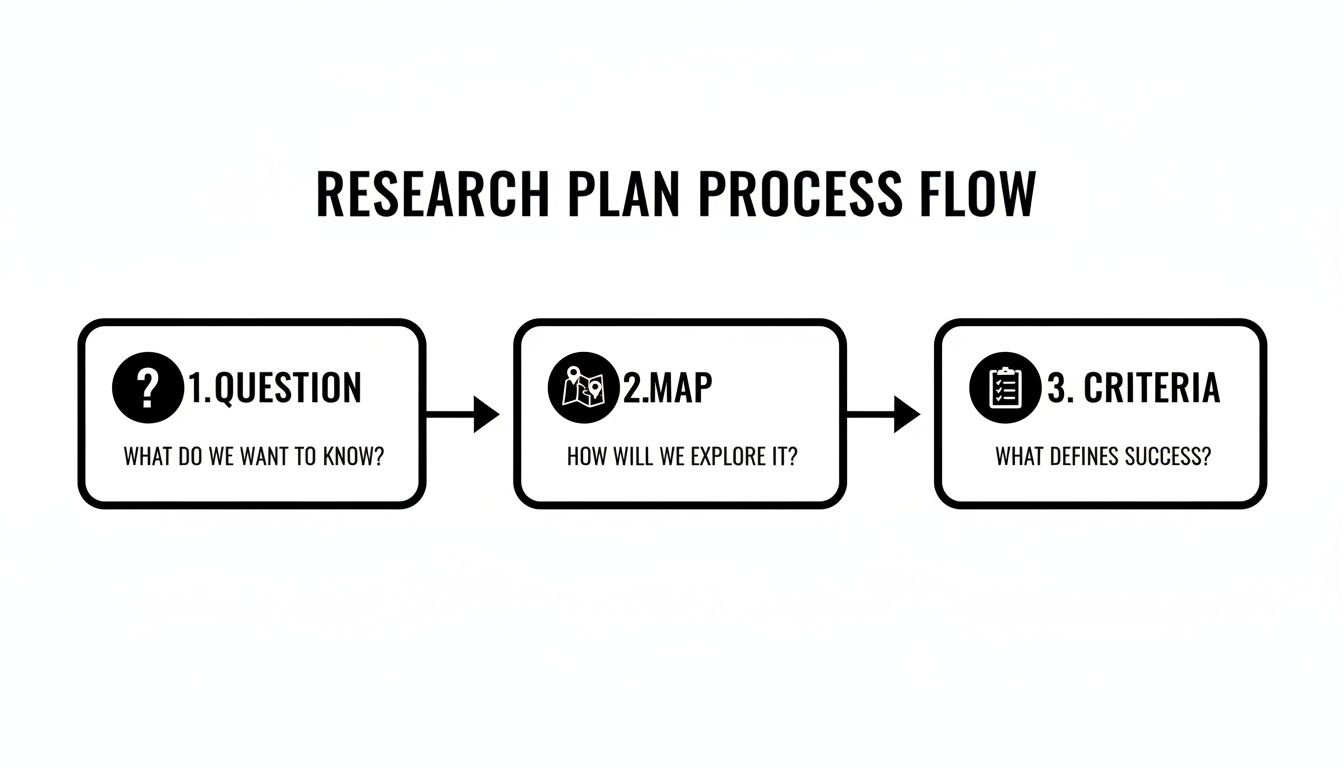
This simple flow is where AI tools give you an immediate advantage. They can summarize potential sources in moments, helping you decide what's relevant and what's not without getting bogged down in reading every single word.
The shift in workflow is dramatic. Integrating a tool like PDF Summarizer doesn’t just speed things up; it changes the entire dynamic of how you interact with your source material.
Traditional vs AI-Augmented Literature Review Workflow
| Task | Traditional Method (Time/Effort) | AI-Augmented Method (Time/Effort) |
|---|---|---|
| Initial Screening | Reading abstracts one-by-one (Hours/Days) | AI summaries of dozens of papers (Minutes) |
| Deep Reading | Reading full papers to find relevance (Days/Weeks) | Targeted reading based on AI-flagged sections (Hours) |
| Finding Connections | Manual note-taking, spreadsheets (High Effort) | Multi-file Q&A identifies themes instantly (Low Effort) |
| Locating Citations | Searching PDFs and notes for quotes (Hours) | Clickable citations jump to the exact source (Seconds) |
| Verifying Data | Manually cross-referencing papers (High Effort) | Ask AI to compare methodologies/data points (Minutes) |
As you can see, this isn't about minor tweaks. It's a fundamental upgrade to your entire research process, reclaiming countless hours and focusing your energy on high-level analysis instead of manual drudgery.
From Quick Summaries to Deep Synthesis
The most obvious win is speed. Instead of spending 30 minutes reading a dense paper only to realize it's irrelevant, you can get a concise AI-generated summary in about 30 seconds. This means you can screen dozens of articles in the time it used to take to read just one or two.
But the real magic happens with synthesis. With a tool like PDF Summarizer, you can chat with multiple files at once. You just upload your curated collection of PDFs and treat them as a single, intelligent database.
Here’s a practical example. Say you're researching the impact of remote work on employee productivity. You could ask your collection of papers:
- "What are the main arguments against remote work mentioned in these studies?"
- "Which papers discuss the effect on junior employee mentorship?"
- "Compare the methodologies used in the studies published before 2020 to those published after."
Suddenly, your static library of PDFs becomes an interactive research partner. The AI pulls out themes, contradictions, and supporting evidence from across all your sources and presents it to you in a neat, digestible summary.
Building a Searchable Citation Library as You Go
Another game-changer is creating a searchable citation database automatically. As you ask questions and get answers, the AI tool pinpoints the exact source for every piece of information it provides.
With features like clickable citations, you can instantly jump to the specific passage in the original PDF to verify the context and accuracy of a claim. This completely eliminates that painful moment when you're writing and can't remember where you read a specific quote or statistic.
The point isn’t to let AI do your thinking—it's to let it handle the information retrieval so you have more time for thinking. You are still the analyst, the critic, and the storyteller.
This approach is quickly becoming the new normal. Researchers are already using AI for outlining (71.7%), brainstorming (68%), and drafting (57.4%). In R&D settings, these tools can slash review times by up to 70%, a staggering testament to their efficiency.
Working with AI Ethically
Of course, with great power comes great responsibility. It's absolutely crucial to draw a clear ethical line. Using an AI to generate paragraphs and passing them off as your own is just plagiarism, plain and simple.
The key is to use AI for augmentation, not automation.
- Good Practice (Augmentation): Using AI to summarize papers for you, identify key themes across 50 documents, find specific data points, or check your grammar.
- Academic Misconduct (Automation): Copy-pasting AI-generated text directly into your review without any original analysis, synthesis, or proper attribution.
Always be transparent about the tools you're using. Academia is still adapting, but honesty and integrity are non-negotiable. Think of AI as your incredibly efficient research assistant—it finds and organizes the information, but you provide the insight. To get the most out of these tools, it helps to learn how to ask the right questions, and a good primer on understanding Prompt Engineering can make a huge difference.
By embracing this modern workflow, you can produce a more insightful and thoroughly supported literature review in a fraction of the time. If you're ready to get started, you can explore a curated list of the best AI tools for academic research and find the right fit for your needs.
Crafting a Compelling Research Narrative
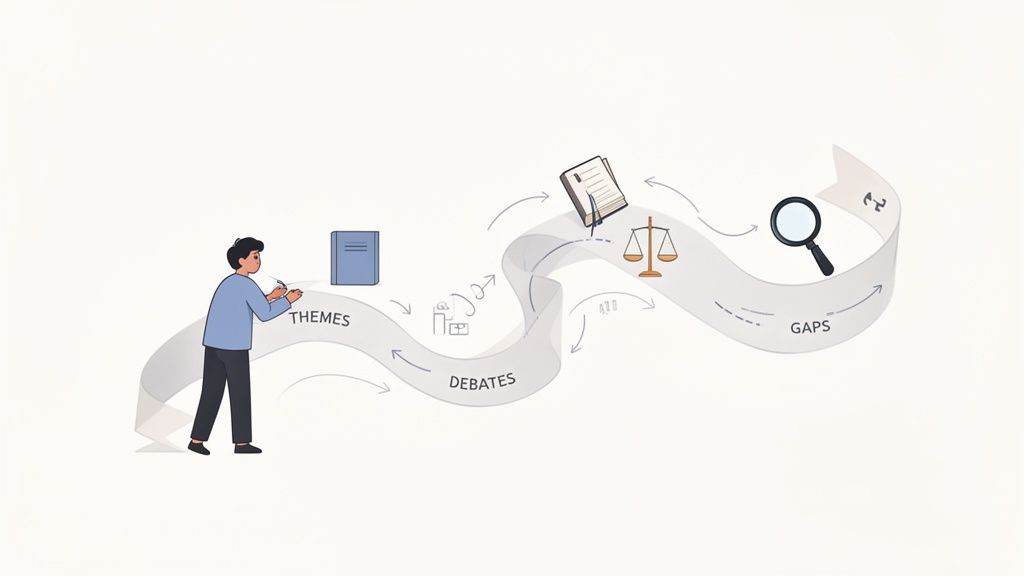
A great literature review is so much more than a list of summaries. It’s a story. Your job is to guide the reader through the landscape of existing research, pointing out the major debates, tracking the trends, and finally, shining a spotlight on what’s missing. This is the moment where all your organized notes and synthesized insights come together to form a persuasive argument.
Think of it as building your case, brick by brick. Each paragraph should move your core idea forward, taking the reader from a broad understanding of the topic to the very specific gap your research is poised to fill. It’s all about creating a logical flow that makes your conclusion feel not just earned, but inevitable.
Choosing Your Narrative Structure
Before you type a single word, you need a blueprint. How are you going to organize this story? The best structure really depends on your research question and the kind of literature you’ve been reading. There's no single "right" answer, but a couple of tried-and-true approaches work for most situations.
- Thematic Structure: This is usually the most powerful way to go. You build your review around key themes, recurring concepts, or ongoing debates you’ve found in your sources. Each section tackles a different theme, weaving together what different authors have to say about it. This structure is fantastic for showcasing intellectual conversations and highlighting contradictions.
- Chronological Structure: This approach lays out the research by publication date, which is perfect for showing how an idea or theory has evolved over time. It’s incredibly useful if you need to trace the development of a concept, demonstrate how methodologies have improved, or map the growth of an entire field.
Most experienced researchers lean toward a thematic structure because it shows a deeper level of synthesis. But you can absolutely blend the two. For instance, you could organize by theme, but within each thematic section, discuss the sources chronologically to show how the conversation on that specific topic has changed.
Moving From Description to Critical Analysis
Here's the single biggest trap for a novice literature review writer: simply describing studies one after the other. We’ve all seen it: "Smith (2020) found X. Then, Jones (2021) found Y. Finally, Davis (2022) argued for Z." That’s not a review; it’s an annotated bibliography that’s been stitched together.
Real synthesis means you have to step up from just describing to critically analyzing. You need to get your sources talking to each other.
The real work is in creating a narrative that connects the dots for the reader. Don't just report what others have said; evaluate their arguments, compare their findings, and explain what it all means when viewed together.
To make that leap, start building your paragraphs around ideas, not authors. Kick off a paragraph with a topic sentence that makes a claim or introduces a theme. Then, pull in evidence from multiple sources to support, challenge, or expand on that idea. This simple shift in focus forces you to synthesize information instead of just listing it.
Using Signposting for a Clear Journey
As you lead your reader through this complex terrain, you have to be a good guide. That means using signposting—clear transitional phrases and sentences that signal where you’re going next. You’re constantly orienting your audience so they never get lost.
Good signposting is what makes a review easy to follow. It helps readers see the structure and understand how different ideas connect to one another.
Examples of Signposting Language:
- Introducing a new theme: "Another key area of debate concerns..."
- Highlighting a contrast: "While most studies focus on X, a smaller body of work offers a contrasting view..."
- Signaling a conclusion: "Taken together, these findings suggest that..."
- Pointing out a gap: "However, what remains unclear is how these factors interact..."
These little phrases are the connective tissue of your review. They ensure a smooth, logical flow from one point to the next. Without them, even the most brilliant analysis can feel confusing and disjointed. By crafting a clear narrative with a solid structure and strong signposting, you elevate your work from a simple summary to a truly compelling piece of scholarship.
Navigating Ethics and Academic Integrity
In academic writing, your credibility is everything. There’s no question that AI tools can dramatically speed up your research, but they also bring a new set of ethical questions to the table. Every writer tackling a literature review needs to confront these head-on.
The core principle is actually quite simple: use technology to enhance your thinking, not to replace it. Your integrity hinges on drawing a sharp line between legitimate assistance and academic misconduct.
Think of it this way: asking a colleague to proofread your draft for typos is standard practice. Paying someone to ghostwrite the paper is a serious offense. The same logic applies to AI. Using a tool to summarize dense articles so you can grasp the key points quickly? Smart. Checking your grammar and flow? Absolutely. But copying and pasting AI-generated text directly into your manuscript is plagiarism, plain and simple.
Your voice, your critical analysis, and your unique synthesis of ideas are what make the work yours. AI is a powerful assistant, but you must always be the author, the intellectual force driving the project.
The Line Between Support and Misconduct
It’s crucial to know exactly where the ethical boundaries are. While institutions and publishers are still catching up with their official policies, the foundational principles of academic honesty haven't changed.
- What’s fair game? Using AI to find relevant papers, generate summaries for rapid vetting, organize your notes, or polish your grammar. This is no different from using a sophisticated search engine or a tool like Grammarly.
- What crosses the line? Directing an AI to write entire sections of your review, create arguments from scratch, or pass off generated text as your own original thought. This is ghostwriting, and it’s a clear violation of academic integrity.
It’s worth noting that the rise of self-publishing has created a legitimate market for writing support. Many indie authors hire researchers to help build credibility, and the demand for outsourced research has grown alongside ethical writing services. You can discover more about the indie author market on writtenwordmedia.com. But this professional context is worlds away from an academic setting where your personal, original contribution is the entire point.
Transparency Is Your Best Policy
When you’re not sure, just be transparent. It's the safest and most honest approach. Most academic journals and universities now have specific guidelines on disclosing the use of AI tools. It’s your job to know these rules and stick to them. A professional literature review writer is someone who can confidently stand behind their methods, tools and all.
This means you should be ready to explain precisely how you incorporated technology into your workflow.
Here’s a practical example of what that might look like in a "methods" or "acknowledgments" section:
Example Disclosure Statement:
"During the initial research phase of this literature review, PDF Summarizer (v. 2.1) was used to generate preliminary summaries of 150 articles to expedite the screening process and identify relevant themes. The final analysis, synthesis, and writing were conducted entirely by the author."
A clear disclosure like this builds trust. It shows you’ve used these powerful tools responsibly and ethically. The goal is to prove the critical thinking is still yours. You can learn more about how to create an AI summary of an article while keeping your analytical mind in the driver's seat.
Ultimately, you want to produce work that is not only insightful but also undeniably your own.
Answering Your Top Literature Review Questions
When you’re staring down the barrel of a literature review, a lot of questions pop up. It’s a beast of a task, and for good reason—you're not just reading, you're building the entire foundation for your own research.
Let's cut through some of the noise and tackle the questions I hear most often from students and researchers. These are the practical, "how-do-I-actually-do-this" issues that can grind your progress to a halt if you don't have clear answers.
How Long Should a Literature Review Be?
This is the classic "how long is a piece of string?" question. There's no single magic number, and anyone who tells you there is hasn't been in the trenches. The length of your literature review is all about its job—what it needs to accomplish for your specific project.
Before you write a single word, check for guidelines from your professor, department, or the journal you’re targeting. The expectations vary wildly:
- Dissertation or Thesis Chapter: This is the big one. You're mapping out an entire field to prove your research has a place in it. Expect this to be substantial, often running from 10,000 to 15,000 words or more.
- Standalone Review Article: If you’re writing a review for publication, the sweet spot is typically 4,000 to 6,000 words. But again, check the journal's author guidelines—some disciplines prefer longer, more exhaustive pieces.
- Section Within a Research Paper: Here, your goal is precision. You’re just setting the stage for your own study, not covering every historical debate. A focused review of 1,500 to 3,000 words is usually right on the money.
The real goal isn't to hit a word count; it's to build a robust, logical case for your research. The length should be whatever it takes to tell that story convincingly and thoroughly.
What Is the Difference Between a Literature Review and an Annotated Bibliography?
This one trips a lot of people up, but the distinction is critical.
An annotated bibliography is basically an organized list. You have a citation, and underneath it, a short paragraph summarizing and maybe critiquing that single source. It’s a great organizational tool, but each entry stands on its own. Think of them as individual Lego bricks.
A literature review, on the other hand, is what you build with those bricks. It's a single, flowing essay that weaves the sources together into a coherent story. You’re not just describing what others have said; you’re synthesizing their ideas to show how they connect, where they disagree, and—most importantly—where the gaps are.
| Feature | Annotated Bibliography | Literature Review |
|---|---|---|
| Structure | A list of discrete entries | A cohesive essay with paragraphs and sections |
| Purpose | To summarize and catalogue sources | To synthesize sources into a coherent argument |
| Writer's Voice | Largely descriptive, focused on individual works | Analytical and prominent, guiding the reader's interpretation |
| Final Product | A collection of parts | A new, whole narrative |
Put simply, an annotated bibliography reports on your sources. A literature review argues with them to create something new.
How Do I Know When I Have Read Enough?
Ah, the researcher's anxiety. That nagging feeling that the one perfect, field-changing paper is still out there, just waiting to be found.
The truth is, you can’t read forever. You’ll know it’s time to stop searching and start writing when you hit what’s called theoretical saturation. It’s a concept from qualitative research, but it fits perfectly here.
Saturation is that point where every new article you open feels familiar. You start seeing the same names, the same seminal studies, and the same arguments being rehashed. When you can look at a new paper's title and abstract and already have a good guess at its main points and key citations, you're there. You've got the map.
At that point, your energy is much better spent analyzing and weaving your narrative, not hunting for one more source.
Is Using AI to Help My Review Considered Plagiarism?
This is the big ethical question on everyone's mind right now. The answer is clear: using an AI to generate text and passing it off as your own is 100% plagiarism. No shortcuts, no gray areas.
But that’s not the whole story. Using AI as a powerful research assistant is a completely different—and ethically sound—approach. Smart researchers are already doing it.
The line is drawn between automating your work and augmenting your thinking.
- Ethical Use (Augmentation): This is about efficiency. You can use an AI to get a quick summary of a dense paper to see if it’s relevant, pull out key themes across 50 documents at once, or find a specific citation you can't quite remember. You’re still the one doing the critical thinking.
- Unethical Use (Plagiarism): This is intellectual dishonesty. You’re asking the AI to write paragraphs for you, formulate your arguments, or synthesize ideas. You’re outsourcing the thinking, and that’s a major academic offense.
Transparency is everything. Be prepared to disclose what tools you used and how you used them. The final analysis, the unique connections you draw between sources, and the words on the page must be yours.
Feeling overwhelmed by your stack of PDFs? PDF Summarizer can help you vet sources, synthesize themes, and find citations in a fraction of the time. Chat with multiple documents at once and get instant, sourced answers to your toughest research questions. Try it for free today at https://pdfsummarizer.pro.
Relevant articles

Streamline your research and summary tasks with AI. Analyze documents, synthesize insights, and craft sharper reports, faster and with confidence.
Struggling with dense texts? Learn how to read research papers efficiently with our concise guide and practical strategies.
Discover how to write review paper with a practical approach. Learn topic selection, literature synthesis, and crafting a compelling narrative to boost impact.
Discover the best AI tools for academic research. Our curated list covers literature reviews, data extraction, writing, and summarization to speed up your work.

Discover how a research paper summarizer uses AI to distill key insights from dense texts. Learn how these tools work and how to use them effectively.
How to read scientific papers: Learn planning, annotation, and critical appraisal to extract actionable insights and improve your research outcomes.