A Guide to Reading and Summarizing Dense Texts
Master the art of reading and summarizing complex texts. Learn proven techniques and AI-powered workflows to gain clarity and save time.
Reading and summarizing is all about getting to the heart of a text. You take a piece of writing, digest its main points, and then rephrase them in a much shorter version, using your own words. It's a fundamental skill for anyone who needs to learn quickly and communicate clearly.
Why Reading and Summarizing Feels So Hard

Does staring at a dense, 50-page report fill you with a sense of dread? If so, you're in good company. In an age of information overload, the simple act of reading has become surprisingly difficult. Our brains are constantly ping-ponging between emails, articles, and notifications, which has wrecked our ability to focus deeply on any one thing.
This non-stop context-switching has trained us to be expert skimmers, but it comes at a cost. We lose the deep engagement needed to actually understand and summarize complex material. We get to the end of a document and realize we've barely retained a thing, which makes boiling it down to its core ideas feel like an impossible task.
The Modern Reader's Dilemma
This isn't just a feeling; it's a measurable trend. Adult reading habits have taken a nosedive over the past decade. Recent data shows that in the US, only 48.5% of adults read a single book in the past year. That's a significant drop from 54.6% in 2012. It points to a growing disconnect with the kind of deep, focused reading that builds critical thinking skills. You can discover more insights about these reading trends and why they're so important.
This cultural shift has created a real skills gap in the workplace and in academia. We're expected to process more complex information than ever before, but our foundational reading habits are getting weaker.
The core problem is that we often treat all reading the same. We apply the same casual skimming we use for social media to a technical manual or legal contract, which is like trying to use a screwdriver to hammer a nail—it’s the wrong tool for the job.
The Tangible Benefits of a Better System
Learning a structured way to read and summarize isn't just a nice-to-have skill anymore; it's a professional superpower. And the benefits go way beyond just clearing your reading list faster.
A solid workflow helps you:
- Improve Information Retention: When you actively engage with a text—questioning it, annotating it, looking for the main thread—you're telling your brain this information is important, moving it from short-term to long-term memory.
- Make Faster, More Informed Decisions: Being able to quickly pull the essential arguments from a report or proposal means you can respond with confidence and clarity. No more guesswork.
- Communicate with Greater Impact: A sharp, well-crafted summary allows you to share key findings with your team or stakeholders without wasting anyone's time. You get right to the point.
- Reduce Cognitive Overload: Instead of feeling buried under a mountain of text, a clear process gives you a roadmap. It makes the task manageable and a lot less stressful.
Ultimately, mastering this skill turns you from a passive consumer of information into an active analyst who can find the signal in all the noise.
Prepare to Read with Purpose
Let's be honest, most of us dive into a dense document completely cold. We grab a highlighter, take a deep breath, and hope for the best. That’s like starting a road trip without a map—you’ll get somewhere, but it won't be efficient, and you'll probably miss the important sights.
The real key to effective reading and summarizing starts before you even read the first sentence. It’s about shifting from a passive reader into an active investigator. This doesn't mean dusting off some rigid method from high school. It’s about creating a flexible strategy to prime your brain, helping you anticipate the author's points and understand the structure before you get bogged down in the details. A few minutes upfront saves you a ton of time and confusion later.
Define Your Reading Mission
First things first: why are you reading this? If you can't answer that question clearly, you're guaranteed to get lost in the weeds. Your purpose is the filter that separates the crucial information from the noise.
Think about it in real-world terms:
- Hunting for a specific number? If you're scanning a financial report for the Q3 net profit margin, you can skip right past the CEO's letter and head straight for the financial statements.
- Understanding a core argument? For a literature review, you need the main thesis of an academic paper. Focus your energy on the abstract, introduction, and conclusion. For a deeper dive, check out our guide on how to read scientific papers for more specialized techniques.
- Looking for actionable steps? Reading a technical manual to fix something? You should be scanning for headings, diagrams, and bulleted lists that spell out a process.
Setting a clear mission transforms reading from a passive chore into a targeted search. You’re no longer just absorbing words; you're actively hunting for answers.
Perform a Structural Skim
With your goal locked in, it’s time for a quick reconnaissance mission. This "structural skim" should only take a few minutes, but the payoff is huge. You aren't reading for deep meaning just yet—you're building a mental map of the terrain.
As you skim, keep an eye out for these signposts:
- Headings and Subheadings: These are the skeleton of the document, revealing its logical flow.
- Introduction and Conclusion: Authors almost always put their main point at the beginning and wrap it all up at the end. Read these first.
- Visuals: Don't ignore charts, graphs, and tables. Their captions often pack in high-value information at a glance.
- Bolded Text and Bullet Points: The author is literally flagging what they think is most important. Pay attention!
This quick flyover shows you how the author organized their argument, making it far easier to follow along when you start reading for real. Even when tackling long narratives, a similar logic applies; exploring different methods for reading novels in order shows how understanding structure can improve comprehension across different types of texts.
A structural skim isn't cheating; it's strategic. You're getting the lay of the land before you start the expedition. This keeps you from getting lost in a dense paragraph with no sense of where you're headed.
Prime Your Brain with Questions
The final prep step is to turn your mission into a set of questions. Based on your goal and what you saw during your skim, what do you need this document to tell you? This simple act fires up your critical thinking and puts you in the driver's seat.
For instance, if you’re reviewing a project proposal, your questions might look something like this:
- What’s the core problem they're trying to solve?
- What are the exact deliverables and timelines?
- What’s the budget, and what are the biggest risks?
Jotting these down gives you a practical checklist. As you read, you're actively seeking the answers. This targeted approach is the foundation of efficient reading, ensuring you pull out exactly what you need without wasting time.
Adopt Active Reading Strategies
Once you’ve prepped your material, it’s time to actually dig in. But here’s where many people go wrong: they just let their eyes glaze over the words. That kind of passive reading is a surefire way to forget everything almost immediately. To really get a handle on dense material, you have to become an active participant—it's less like reading and more like having a conversation with the text.
This isn’t just about highlighting. It's about questioning what you're reading, connecting the dots between different ideas, and marking up the document with a real purpose. This is how you turn a static block of text into a dynamic space for discovery. It’s the essential bridge between getting ready to read and actually writing a summary that makes sense.
Think of it this way: your reading should be driven by a clear goal, an understanding of the document's structure, and specific questions you want answered.
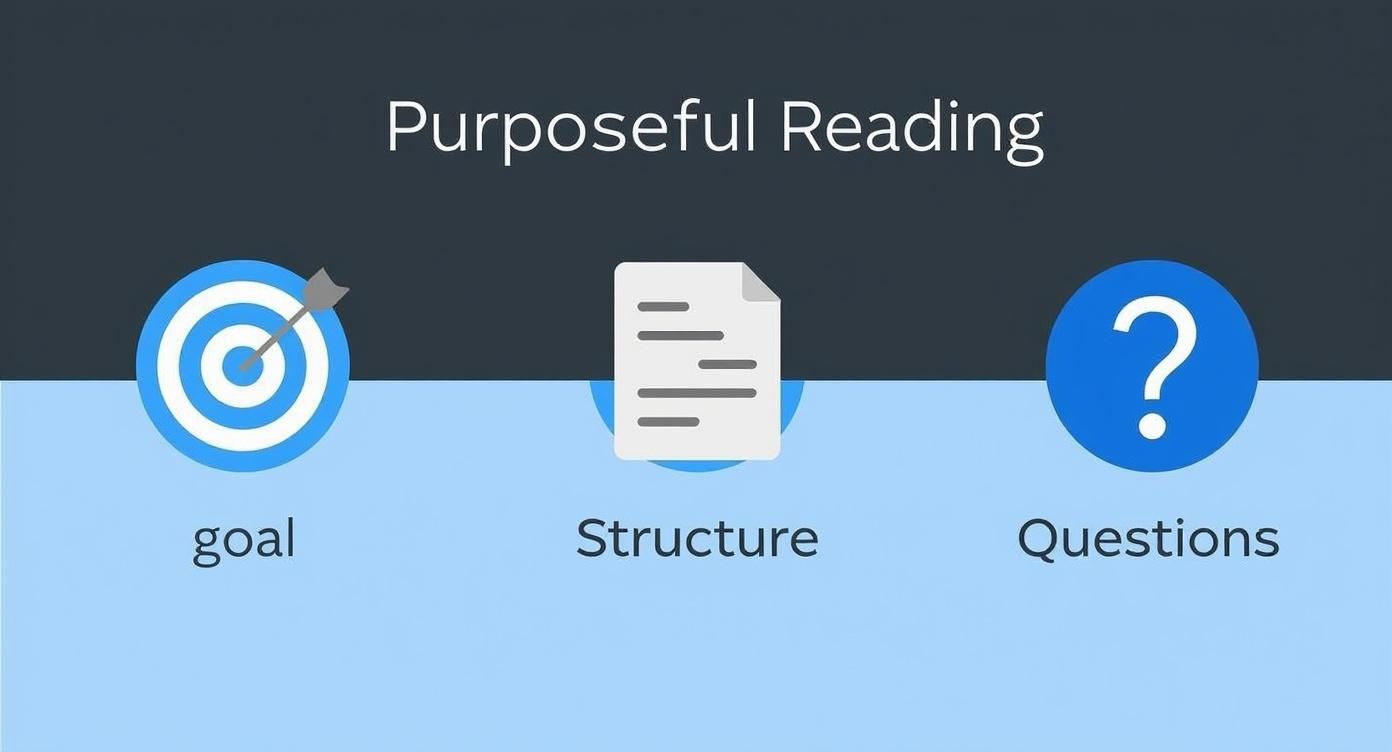
This visual really drives home the point that great reading isn't just a straight line from start to finish. It’s a strategic cycle where your goals shape every interaction you have with the material.
Make Your Annotations Meaningful
Let's be honest, a page drenched in yellow highlighter doesn't mean you've understood anything. More often than not, it just creates visual noise. Highlighting without a system is a waste of time. Your annotations need to have a job—to help you find key information again in a flash.
Come up with a simple, consistent system you can stick to. For example:
- Use one color to highlight the main argument or thesis statement.
- Use a different color to underline key evidence, data, or statistics.
- Box up any jargon or unfamiliar terms you need to look up later.
- Scribble quick questions or thoughts in the margins as they occur to you.
When you do this, your document becomes a personalized study guide. The next time you open it, you’ll instantly see the logical framework you uncovered, which makes the summarization part a whole lot easier.
Create a Dialogue with the Text
One of the most effective techniques I’ve found is to treat reading like a back-and-forth conversation. As you go, constantly ask the text questions. This mental chatter keeps you locked in and stops your mind from wandering off.
For example, if you're tackling a dense scientific study, your internal monologue might sound something like this:
- What are these authors actually trying to prove?
- Is their methodology solid? How big was their sample?
- Do these results really support their conclusion?
- What are the limitations here? What are they not telling me?
This kind of critical engagement is the secret to deep comprehension. It takes practice, but there are methods that can help build this muscle. Many people have great success with specific reading comprehension strategies for students that provide a ready-made framework for this kind of active questioning.
The single biggest shift you can make is moving from being a passive recipient of information to an active analyst who is constantly evaluating the author's claims.
Leverage Note-Taking Systems
While scribbling in the margins is great for quick thoughts, you'll need a more robust system for truly complex texts. The Cornell Method is a classic for a reason—it just works.
Here’s the breakdown:
- Divide your page: Draw a line down your paper to create a large column on the right (for notes) and a smaller "cue" column on the left. Leave a few inches at the bottom for a summary.
- Take notes: In the main column, jot down key points from your reading. Don't write full sentences—use shorthand, abbreviations, and bullet points.
- Formulate cues: Afterward, review your notes and write corresponding keywords or questions in the left-hand cue column.
- Summarize: In that bottom section, write a one- or two-sentence summary of the entire page.
This forces you to engage with the information multiple times, which is a fantastic way to lock it into your memory. It’s a powerful technique, but sadly, this kind of deep engagement with texts is on the decline. Recent research shows that reading enjoyment is at an all-time low, with only a third of young people saying they like to read. This is a big deal, because reading for pleasure is a key predictor of academic success across the board.
Use AI as Your Reading Co-Pilot
This is where modern tools can give you a serious edge. Instead of getting bogged down by a convoluted paragraph or an unfamiliar concept, you can use an AI assistant like PDF Summarizer for instant clarification without losing your momentum.
Think of it as having an expert on call. Stuck on a dense legal clause? Just ask the AI to "explain this paragraph in simple terms." Unsure about a technical term? Prompt it to "define [jargon term] and give me an example." This kind of immediate support keeps you moving forward, preventing small points of confusion from derailing your entire reading session.
Translate Your Notes Into a Clear Summary
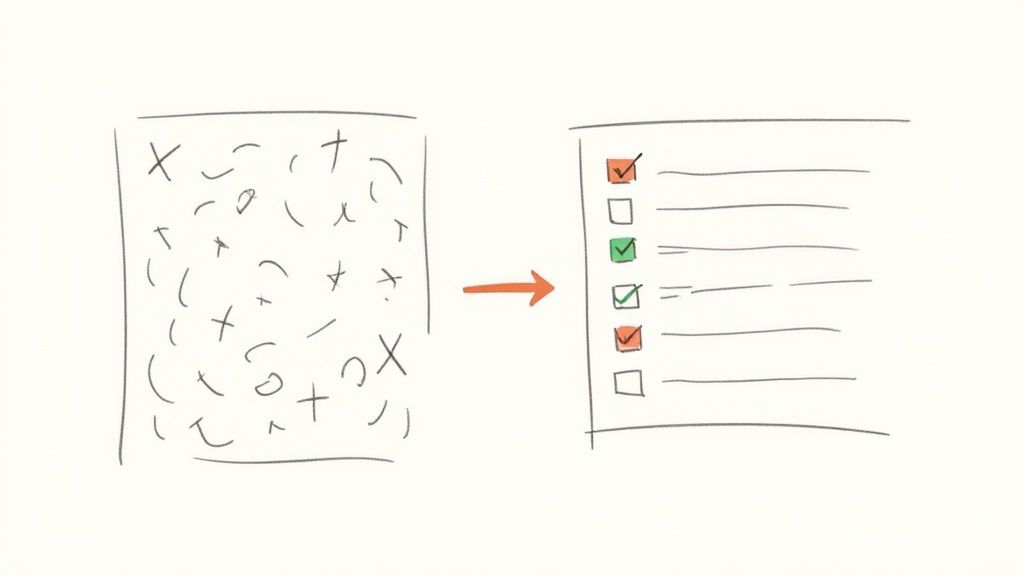
You've done the hard work of prepping and engaging with the text. Now you're left with a collection of highlights, margin notes, and half-formed questions. This is where the real magic happens—synthesis.
A great summary isn't just a jumbled list of your notes. It's a coherent, standalone piece of writing that gets to the absolute heart of the original document. The goal is to transform those fragmented annotations into a smooth, easy-to-understand narrative. This is the final and most important step, turning your deep dive into a useful, shareable asset.
First, Nail Down the Central Thesis
Before you write a single word, you need to be able to state the author's main argument in one sentence. Seriously, just one. If you can't, it's a sign you need to revisit the text. I usually find the thesis hiding in plain sight in the introduction or conclusion.
This single sentence becomes your north star. Every other point you include must directly support this central idea. Think of it as the sun, with all the supporting details as planets orbiting it. This focus keeps your summary tight and prevents you from getting lost in interesting but ultimately non-essential details.
Once you have that core sentence, it’s time to gather your evidence.
- Scan your notes: Pull out the key data, evidence, and arguments you highlighted earlier.
- Group related ideas: Start clustering your notes by theme. You’ll begin to see a natural structure take shape.
- Be ruthless: For every point, ask yourself, "Is this absolutely essential for understanding the main argument?" If the answer is no, cut it.
This filtering process is what separates a sharp summary from a long-winded one. The most common mistake I see is people trying to cram too much in, which completely defeats the purpose. A good summary is defined as much by what you leave out as by what you put in.
A summary should be an opinion-free zone. Your job is to accurately represent the author's ideas, not to critique or add your own spin. Save your personal analysis for a separate section or a different document entirely.
Structure Your Summary for Clarity
With your thesis locked in and your key points selected, it's time to build the framework. A word of advice: don't just list the points in the same order they appeared in the original. Instead, organize them in a way that tells the clearest story for your reader.
I’ve found that a simple, effective structure works best:
- Opening Sentence: Start by stating the author and the document's central thesis.
- Body Paragraphs: Dedicate each short paragraph to a single key supporting argument, explaining it briefly.
- Concluding Sentence: Wrap it up by restating the main takeaway or the implication of the author's work.
This structure makes your summary logical and easy to follow. The skills here are universal—they’re just as relevant when writing clear and concise notes in a professional setting as they are to summarizing an article.
Draft, Refine, and Perfect
Your first draft is never going to be pretty. Just focus on getting the ideas down. Don't stress over perfect phrasing yet. Once you have the skeleton in place, you can go back and polish the language to be more concise and accurate.
This is also a perfect spot to bring in an AI tool like PDF Summarizer to speed things up without sacrificing quality. You can feed it your rough notes or even a clunky first draft and ask it to generate a more polished version.
The AI can give you a well-structured draft, which you can then edit for tone, context, and nuance—that essential human touch.
This hybrid approach gives you the best of both worlds: the raw speed of automation paired with the critical eye of a human expert. This is an incredibly powerful technique when you're dealing with dense academic texts. We walk through this process in more detail in our guide on how to summarize a research paper, showing how AI can help untangle complex findings.
In the end, your summary must be able to stand on its own. Someone who has never seen the original document should be able to read your summary and walk away with a crystal-clear understanding of its most important points.
Putting It All to the Test: Real-World Scenarios
Theory is one thing, but the real test is how a workflow performs in the wild. Let's see how these strategies hold up against three common—and often intimidating—types of documents you'll definitely run into.
Each one has its own quirks. A dense academic paper is built to defend a thesis, a financial report uses numbers to tell a story, and a legal contract is written to be airtight and precise. The key is knowing how to adapt your approach for each.
Here's a practical playbook for tackling these documents, walking you through the entire process from that initial skim to the final summary. I'll even include some checklists and a few of my go-to AI prompts to get you started.
Tackling the Dense Academic Paper
Imagine a 25-page cognitive psychology study lands on your desk. It's thick with jargon, loaded with citations, and your deadline is looming. It’s easy to feel overwhelmed.
First thing's first: define your mission. Why are you reading this? Are you just pulling out the main findings for a literature review, or do you need to dissect its methodology for your own research? Your answer sets the direction for everything that follows.
Now, do a quick structural skim. Your best friends here are the Abstract, Introduction, and Conclusion. These sections are a goldmine, giving you the high-level story of the entire paper. After that, scan the headings to get a mental map of the study's flow—how it moves from methods to results and finally, to the discussion.
As you start reading more actively, focus your notes on answering a few critical questions:
- What's the core research question or hypothesis?
- How did the researchers actually test it?
- What were the main findings, and what's the "so what"?
- What limitations did they mention, or what do they suggest for future research?
This kind of focused reading is more important than ever. We're seeing a sharp drop in how much people engage with long-form text. In fact, recent data from 2025 shows the decline in daily reading habits among young people has hit an all-time low. The current figure is nearly 20 percentage points lower than it was back in 2005, which really highlights how dramatically reading habits have shifted in just two decades. You can explore the full research on this trend and its implications if you're curious.
AI Prompt for Academic Papers: "Summarize the methodology section of this paper, focusing on the sample size, research design, and statistical tests used. Then, list the three main conclusions from the discussion section."
Decoding the Quarterly Financial Report
Alright, new scenario. You're a junior analyst, and the latest quarterly report just dropped. You need to give your manager the key takeaways on the company's performance, and you need to do it fast. These reports can be a confusing mix of narrative, charts, and financial statements.
Your goal here is crystal clear: find the key performance indicators (KPIs) and understand the story the numbers are telling. Don't just start reading from page one. Go straight for the good stuff: the financial highlights, the income statement, and the cash flow statement.
When you skim, let your eyes gravitate to the tables and charts. Look for trends. Is revenue climbing? Are profit margins getting squeezed? What's going on with operating expenses?
As you do your active read, pay close attention to the Management's Discussion and Analysis (MD&A) section. This is where the executives explain why the numbers look the way they do. Your job is to connect their story back to the raw data you saw in the statements.
AI Prompt for Financial Reports: "Analyze this income statement and summarize the key revenue drivers, major cost centers, and the overall net profit margin trend compared to the previous quarter."
Navigating the Complex Legal Contract
For our last challenge, let's say you're a small business owner reviewing a new vendor agreement. It's a wall of legalese that feels intentionally confusing. Your mission is to spot your obligations, liabilities, and any potential red flags before you put ink to paper.
With legal documents, the initial skim is all about hunting for key clauses. Look for headings like "Term and Termination," "Confidentiality," "Indemnification," and "Limitation of Liability." These are the sections where the real make-or-break details live.
Active reading here is basically an act of translation. You're turning dense legal jargon into plain English. Don't hesitate to lean on an AI tool like PDF Summarizer to help with this part. As you go, create a simple checklist of what you're responsible for and what the vendor is responsible for.
You need to walk away with clear answers to these questions:
- What is the exact scope of the services?
- What are the payment terms and deadlines?
- How can either party get out of the agreement?
- If something goes wrong, who is on the hook?
This systematic approach demystifies the entire document. It stops being an intimidating block of text and becomes a manageable set of agreements you can actually understand.
Quick-Reference AI Prompts
To make this even easier, I've put together a table with some sample prompts you can adapt for different documents. Think of it as a starting point to help you get the most out of your AI assistant.
Sample AI Prompts for Different Document Types
| Document Type | Pre-Reading Prompt | Active Reading Assist Prompt | Summarization Prompt |
|---|---|---|---|
| Academic Paper | "Identify the core research question, hypothesis, and the primary conclusion from the abstract of this paper." | "Explain the statistical method used in the 'Results' section in simple terms. What does a p-value of <0.05 signify here?" | "Provide a 300-word summary covering the paper's objective, methodology, key findings, and implications for future research." |
| Financial Report | "Extract the key financial highlights from this report, including total revenue, net income, and earnings per share (EPS)." | "Analyze the 'Management's Discussion' section. What reasons do they give for the 15% increase in operating expenses?" | "Create a bullet-point summary of the company's financial performance this quarter. Include 3 positive trends and 2 areas of concern." |
| Legal Document | "Scan this agreement and list all section headings related to liability, termination, and intellectual property rights." | "Translate the 'Indemnification' clause (Section 8.2) into plain English. What are my specific obligations under this clause?" | "Summarize the key terms of this contract, including the agreement's duration, payment schedule, confidentiality obligations, and the conditions under which it can be terminated by either party." |
| Technical Manual | "Generate an outline of this user manual based on its table of contents to give me a high-level overview of its structure." | "I'm on page 45, the 'Troubleshooting' section. Explain the steps for resolving 'Error Code 501' in a simpler way." | "Create a quick-start guide based on this manual, listing the 5 essential steps a new user needs to follow to set up and operate the device for the first time." |
These prompts are designed to be specific and action-oriented, helping your AI tool cut through the noise and deliver precisely what you need at each stage. By tailoring your strategy—and your prompts—to the document in front of you, the entire process of reading and summarizing becomes far less daunting and a whole lot more effective.
Frequently Asked Questions
Even with a great workflow, you're bound to hit a few snags when you're in the thick of reading and summarizing. Let's tackle some of the most common questions I hear. Think of this as a quick-reference guide for those tricky situations, from figuring out summary length to using AI the right way.
How Long Should a Summary Be?
This is the million-dollar question, isn't it? The honest answer is, it completely depends on what you need the summary for. There’s no magic word count or golden percentage to follow. The best summary is the one that's built for its specific job.
A good rule of thumb is to be as concise as possible without gutting the core message.
Here’s how I think about it for different tasks:
- For an executive briefing: I might need to boil down a 50-page report into one tight, hard-hitting paragraph. The goal is a high-level snapshot for someone who has no time to spare.
- For my own study notes: The summary could be much longer, maybe a full page for a dense textbook chapter. Here, the purpose is to help me remember and recall the information later.
- For an academic literature review: A summary of a research paper usually lands around 250-300 words. It needs to capture the study's purpose, methods, key findings, and why it matters.
The real measure of a good summary isn't its length, but its efficiency. It succeeds if it gives the reader exactly what they need to know—and nothing more. Before you start writing, always ask: "Who is this for, and what do they need to do with this info?" Let that be your guide.
Is It Ethical to Use AI for Summarizing?
Absolutely. Using AI tools to get through your reading is a massive time-saver, but you have to be smart and ethical about it, especially in your professional or academic life. The line between a helpful assistant and cheating can feel a bit blurry, but it all comes down to transparency and taking ownership of the final work.
I like to think of an AI tool as a super-advanced calculator. It handles the heavy lifting, but you're still the one responsible for understanding how it got the answer and double-checking the result.
- For personal understanding: Using AI to break down a complex paragraph, explain jargon, or whip up a first draft from your own highlighted notes is perfectly fine. You're using it as a learning aid.
- For work you submit: Passing off an AI-generated summary as your own original thought is plagiarism, plain and simple. You always have to rework, edit, and add your own critical perspective to whatever the AI gives you.
When in doubt, check your company's or university's policy on AI. It’s always a good practice to be upfront about the tools you used in your process.
How Do I Summarize Poorly Written or Super Technical Texts?
We’ve all been there—staring at a document that's dense, disorganized, or packed with jargon. This is where your pre-reading and active reading habits really pay off. The key is not to try and summarize it all in one go.
First, just break it down into smaller, more digestible pieces. Concentrate on one section at a time. Your initial goal isn't to write the summary, but to translate the confusing text into plain English for yourself.
This is actually a perfect job for an AI assistant. You can feed it a specific chunk of text and use prompts that act as a translator, like:
- "Explain this section like I'm a complete beginner in this field."
- "What is the single most important point in this confusing paragraph?"
- "Pull out the key takeaways from this technical data and put them in a bulleted list."
By using a tool to clarify the material piece by piece, you're building the solid foundation of understanding you need to write an accurate summary. You’re not asking the AI to do the work for you; you’re asking it to be your personal interpreter.
Ready to change how you deal with dense documents for good? With PDF Summarizer, you can chat with your files, get instant answers with sources, and turn complex information into clear, actionable insights in seconds. It’s the ultimate tool for students, researchers, and professionals who need to understand more, faster. Try PDF Summarizer for free and see the difference.
Relevant articles
Discover how text summarization AI turns dense documents into clear, actionable insights. Our guide explains the models, methods, and real-world applications.
Discover the best pdf article summarizer to boost your productivity. Our 2026 review covers top AI tools for students, researchers, and professionals.
Discover the top 12 tools for any PDF summarizer AI free workflow. Get instant, accurate summaries from dense documents, reports, and research papers today.
Learn how to take notes from textbooks using proven methods that boost retention. Go beyond highlighting with actionable strategies for effective learning.
Learn how to improve reading comprehension skills with practical, proven strategies for active reading, vocabulary, and retention.
Save hours of reading with a free PDF summarizer. Learn how these AI tools work, discover key features, and see how to integrate one into your workflow today.