How to Improve Reading Comprehension Skills: A Practical Guide
Learn how to improve reading comprehension skills with practical, proven strategies for active reading, vocabulary, and retention.
Before you can really master the techniques of better reading, you have to connect with what you're reading. I can't stress this enough. Genuine interest is the fuel for understanding. It's what makes information stick, and it's the real secret to unlocking deeper meaning in any text.
Find Your Reading Spark Before You Learn to Read Better

So many guides on this topic jump right into the heavy stuff—annotation, speed-reading drills, critical analysis. Those are all great tools, but they’re putting the cart before the horse if they don’t address the most fundamental part of the equation: your personal connection to the material.
If reading feels like a chore, every page is going to be a slog. The real key is to shift your mindset from obligation to genuine curiosity.
This is all about reducing mental friction. When you're actually interested in a subject, your brain is primed to learn. You start asking questions naturally, you see connections without trying, and you remember details effortlessly. This isn't just a nice thought; it's how our brains are wired.
Discover What Truly Interests You
The first practical step is simple: find something you actually enjoy reading. Forget what you think you should be reading and explore what you want to read. The goal here is to find texts that don't feel like work.
Need some ideas?
- Lean into your hobbies. Love gardening? Find a great blog or magazine about horticulture. Big into gaming? Dive into lore books or articles on game design.
- Follow your curiosity. Was there a historical event or a scientific discovery you always wanted to know more about? Find a well-written biography or a compelling non-fiction book on it.
- Mix up the formats. Not everyone is built for dense novels. Maybe you'd prefer short stories, graphic novels, or even well-researched long-form journalism.
When you enjoy the process, every other comprehension strategy becomes ten times more effective. It turns passive reading into an active hunt for knowledge and entertainment.
"When reading becomes a choice rather than a task, comprehension follows naturally. The desire to understand is the most powerful tool a reader can possess."
Create a Positive Reading Environment
Your surroundings have a massive impact on your ability to focus and absorb what you're reading. Trying to tackle a complex article in a noisy, chaotic room is just setting yourself up for failure. Instead, build a space that invites you to settle in and read.
This doesn't mean you need a private library. It can be as simple as a comfy chair in a quiet corner, good lighting, and the discipline to put your phone on silent. Creating a dedicated "reading nook" sends a powerful signal to your brain that it’s time to focus.
Start by scheduling short, dedicated blocks of time—even just 15-20 minutes a day. This helps build a consistent, enjoyable habit.
This link between enjoyment and skill isn't just anecdotal. The Progress in International Reading Literacy Study (PIRLS) 2021, a massive assessment of around 400,000 students, found a direct correlation. In all 57 countries studied, students who actually liked reading scored significantly higher than those who didn't. This landmark study on the global state of reading makes it clear: a positive mindset and a good environment are directly tied to better comprehension.
Building a consistent habit is the bedrock of improvement. This table breaks down a few simple actions you can take to make reading a regular part of your routine.
Building a Sustainable Reading Habit
| Action | Frequency | Expected Outcome |
|---|---|---|
| Find one article/chapter you want to read | Daily | Builds positive association and reduces reading friction. |
| Set a timer for 15-20 minutes of reading | Daily | Establishes a low-pressure routine that feels achievable. |
| Read in a designated, comfortable spot | Consistently | Creates a mental cue to focus and improves concentration. |
| Discuss something you read with a friend | Weekly | Reinforces memory and helps you articulate key ideas. |
Starting small and staying consistent is far more effective than trying to read for hours on end and burning out. These simple steps will help you build the momentum needed for long-term growth.
Master the Core Mechanics of Comprehension

If finding your reading spark is the engine, then mastering the core mechanics is like having a perfectly tuned car. Strong comprehension isn't some kind of magic. It’s a skill built on a solid foundation, and when all the parts work together, your brain is free to focus on what the text means, not just what the words are.
Think of it like learning an instrument. You can’t play a beautiful song without first mastering scales, chords, and rhythm. Reading is no different. Let's break down the six essential pillars that form the blueprint for excellent comprehension.
The Six Pillars of Reading Comprehension
These skills don't exist in a vacuum; they build on each other to create a powerful system for understanding. A weak link in one area can easily create a bottleneck that slows the whole process down.
- Phonological Awareness: This is all about recognizing and working with the sounds in spoken language. It’s the ability to hear the individual sounds (phonemes) in a word like "cat" (/k/ /a/ /t/). It’s a foundational skill that often starts long before we even learn the alphabet.
- Phonics: Think of this as the bridge between spoken sounds and written letters. Phonics connects the letters on a page to the sounds they represent, which is what allows you to decode new words instead of having to memorize every single one.
- Fluency: This is the ability to read with speed, accuracy, and proper expression. When you're fluent, you aren't stuck sounding out every word. That frees up your mental energy to actually think about the message of the text.
- Vocabulary: This is your personal word bank. Simply put, the more words you know, the more meaning you can pull from a text. A rich vocabulary is one of the single best predictors of strong reading comprehension.
- Comprehension Strategies: These are the active plans you use to make sense of what you're reading. This includes practical skills like asking questions as you go, making predictions, and summarizing key points in your own words.
- Writing: The connection between reading and writing is a two-way street. Writing about what you've read forces you to organize your thoughts, pin down the main ideas, and truly solidify your understanding of the material.
The importance of these six pillars isn’t just theoretical. A massive report analyzing over 500,000 students found that direct, systematic instruction in these core skills dramatically improves reading comprehension. This groundbreaking analysis from the World Bank shows that when learners focus on these fundamentals, their ability to understand complex texts skyrockets. You can read the full research about these powerful findings on the World Bank's official site.
Strengthening Your Vocabulary and Fluency
If you're looking for a place to start, focusing on vocabulary and fluency can give you significant and immediate gains. These are high-impact skills that pay dividends across every single thing you read.
When it comes to vocabulary, don't just memorize definitions from a list. The most effective way to learn new words is by seeing them in context. When you hit a word you don't know, try to figure out its meaning from the surrounding sentences before you look it up. This active engagement makes the new word stick.
A great practical tip is to keep a "word journal." When you learn a new word, write it down along with its definition, the sentence you found it in, and a new sentence you create yourself.
Improving fluency is all about practice and reducing the mental load. One of the best ways to do this is through rereading. Find a short, interesting article or a few paragraphs from a book. Read it once for general understanding, then read it again, this time focusing on a smooth and natural pace. This trains your brain to recognize words and phrases more quickly.
Connecting Reading to Deeper Understanding
As you build up these foundational skills, you can start layering on more advanced strategies. This is where you move from just reading the words to truly questioning and interpreting them. It's the heart of critical reading—a skill that allows you to analyze an author's argument, spot potential biases, and evaluate the evidence they present. For a deeper dive, check out our guide on what is critical reading.
To really level up your comprehension, it helps to start understanding what constitutes comprehensible input. This is a key concept in learning that applies perfectly to reading. The idea is that we improve best when we engage with material that is just slightly beyond our current ability. This creates a gentle challenge that pushes our skills forward without causing frustration.
By focusing on these core mechanics, you’re not just learning tricks; you’re building a robust, reliable system for understanding. Each skill supports the others, creating a positive feedback loop that makes every reading session more productive and, ultimately, more enjoyable.
Adopt Active Reading Strategies That Actually Work
Have you ever read a page, or even a whole chapter, only to realize you have no idea what it said? That’s passive reading. It’s like having music on in the background—you hear it, but you're not really listening. To get better at understanding what you read, you need to shift from being a passive bystander to an active participant. It’s about turning reading into a dynamic conversation with the text.
Instead of just letting your eyes glaze over the words, your job is to question, connect, and even challenge what the author is saying. This mental gear-shift is where true comprehension clicks into place. It’s the difference between recognizing words on a page and actually building a mental blueprint of the ideas.
Turn the Page into a Conversation
One of the most effective ways to read actively is to treat it like a dialogue. This means you’ve got to ask questions as you go. Don't just accept everything at face value.
Make it a habit to pause and ask yourself a few things:
- What’s the author’s core message here? Can I say it back in my own words?
- What evidence are they using to back this up? Does it actually hold water?
- How does this fit with what I already know? Does it confirm my views or make me rethink them?
- What isn't the author saying? Is there another perspective missing?
This constant back-and-forth keeps your mind locked in and stops you from drifting off. You’re no longer just a sponge for information; you're an investigator, piecing the puzzle together as you go.
Use Annotation to Pinpoint Key Ideas
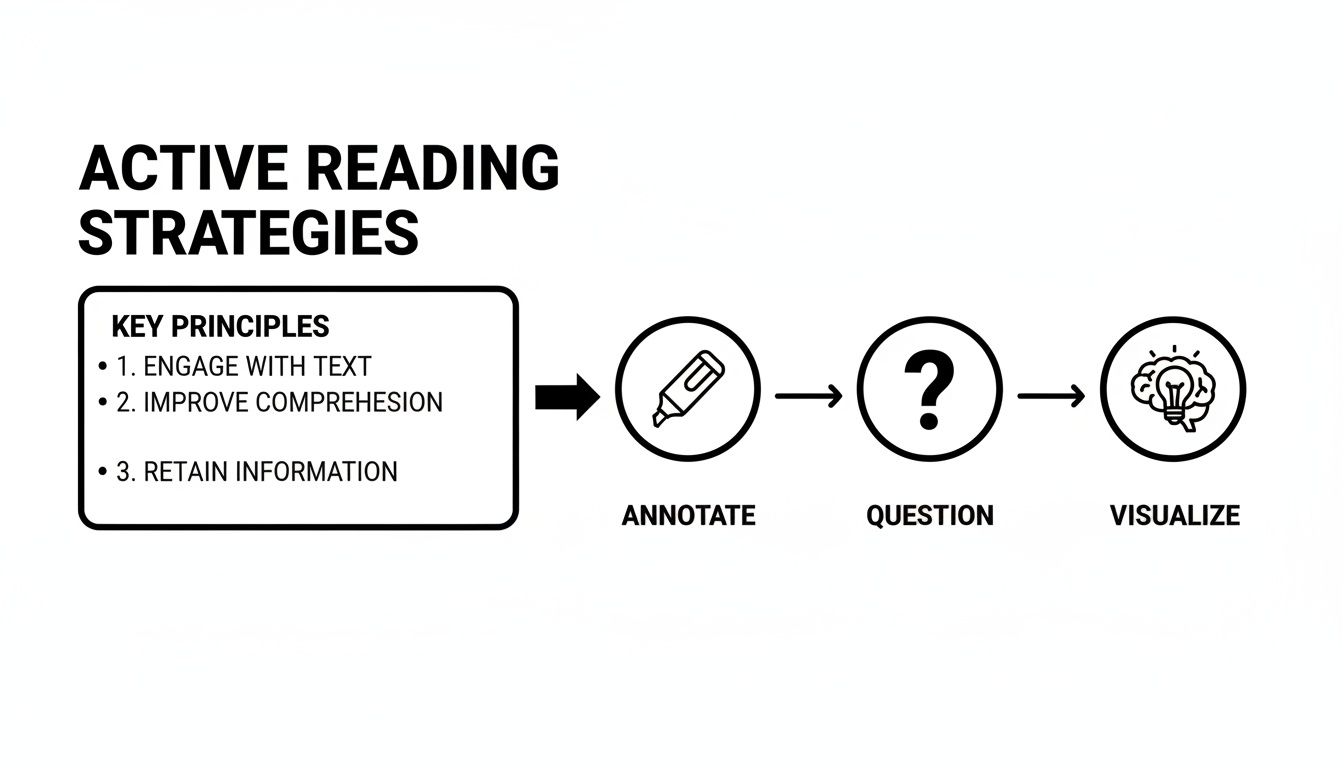
Annotation is your secret weapon against forgetting what you just read. It’s the simple act of marking up the text—highlighting, underlining, and scribbling notes in the margins—to create a visual map of your thought process.
But there’s a trick to it. Highlighting entire paragraphs is just a waste of ink and a fast track to forgetting. The key is to be selective.
Smart Annotation in Action
Let’s say you’re reading a dense article on renewable energy. Here’s what a smart annotation strategy might look like:
- Highlight the Topic Sentence: In each paragraph, just mark the one sentence that carries the main idea.
- Underline Supporting Data: Zero in on specific numbers or evidence, like "solar power capacity has increased by 50% in the last five years."
- Write Questions in the Margin: If a section feels confusing, jot down, "How does this compare to wind power costs?"
- Connect Ideas with Symbols: Use a simple system. A star for a major takeaway, an exclamation point for something surprising, or a checkmark for a point you agree with.
Of course, annotation goes hand-in-hand with taking good notes, which is a game-changer for retention. Learning how to improve note-taking skills can completely transform your reading from passive to active.
By actively marking up a text, you force your brain to decide what's important. This filtering and prioritizing is a powerful comprehension-building exercise in itself.
Create Mental Models Through Visualization
Another fantastic strategy is to visualize what you’re reading. You don’t need to be an artist for this. It’s all about creating mental pictures or simple diagrams that represent the information. This works especially well for complex or abstract subjects.
For example, if you're tackling a history chapter on the causes of a war, you could quickly sketch out a concept map. Put the main conflict in a circle in the middle, then draw lines out to boxes for key factors like "economic tensions," "political rivalries," and "social unrest."
This small act helps you see the relationships between different pieces of information, building a much stronger and more memorable understanding. You're no longer trying to recall isolated facts; you're building a framework that shows how they all connect. When you can successfully boil down complex info into a simple visual, you're well on your way to mastering it. You can explore this more in our article about the art of summarizing in reading.
Build a Supportive Environment for Reading
Your ability to really understand what you read isn’t just about the techniques you use while your eyes are on the page. The world around you plays a huge part. A supportive, encouraging atmosphere can make all the difference, whether you're a parent helping your child, a student buried in coursework, or just an adult looking to learn something new.
When you create an environment where reading is a normal, enjoyable part of the day, it strips away the pressure and helps build positive feelings around books.
Think about it like learning an instrument. You'll get better much faster practicing with a band that jams and learns together, rather than just playing scales alone in your room. The same goes for reading. When it becomes a shared experience, it stops feeling like a chore and starts feeling like an adventure.
Weave Reading into Daily Family Life
For parents and guardians, your home is the first and most important classroom. Simply weaving reading into your everyday routines can have a massive impact on a child's comprehension skills, and it never has to feel like a lesson. The goal is to make books, and conversations about them, a completely natural part of your family's rhythm.
This doesn't need to be some grand, complicated plan. Here are a few simple, practical ways to build a home that loves to read:
- Make Books a Dinner Topic: Chat about what everyone's reading. Ask easy, open-ended questions like, "What do you think is going to happen next?" or "Who's your favorite character and why?" This gives kids a low-stakes way to practice summarizing and sharing their thoughts.
- Turn Library Trips into a Regular Outing: Frame a visit to the library as an exciting event, not a task. Letting kids pick their own books based on what genuinely interests them gives them a sense of ownership and makes them far more eager to dive in.
- Read Aloud Together: This is incredibly powerful, no matter the age. Reading aloud models fluent reading, introduces new words in a natural context, and is just a wonderful way to connect.
These small, consistent habits send a loud and clear message: reading is valuable, it's fun, and it's something we do together.
The link between a supportive home and strong reading skills isn't just a nice idea; it's a fact backed by major global research. When reading is a daily, encouraged activity, comprehension ability climbs dramatically.
The data from the Progress in International Reading Literacy Study (PIRLS) 2021, which assessed a staggering 400,000 fourth-graders, drives this point home. Students with high levels of home engagement scored better in every single nation that was tested, regardless of their family's income.
For instance, in top-performing Singapore, where the average score was 587 (well above the midpoint of 500), simple home practices like discussing books were a key ingredient to success. You can explore more of the findings in the official PIRLS 2021 achievement results.
Find Your Reading Community as an Adult
For adult learners, the power of a supportive environment is just as real. Trying to get through dense academic papers or build a new reading habit all on your own can feel incredibly isolating. Finding other people to share the journey with provides accountability, motivation, and fresh perspectives you'd likely miss otherwise.
Engaging with a community forces you to process what you're reading on a deeper level. When you have to explain a concept from a book to someone else, you have to sharpen your own understanding first. This kind of social reinforcement is a fantastic tool for improving your own comprehension.
This diagram breaks down a few core strategies that become even more effective when you can discuss and practice them with others.
Here are a few ways adults can build their own reading support network:
- Join a Book Club: Whether it’s focused on fiction, industry journals, or non-fiction, a book club gives you a deadline and a dedicated space for real discussion.
- Find a Study Partner: If you're taking a course, team up with a classmate. You can tackle tough chapters, quiz each other on key ideas, and work through confusing material together.
- Jump into Online Forums: There are communities for everything. Look for subreddits, Goodreads groups, or specialized forums related to your field or interests. Engaging in written debate is an excellent way to flex your comprehension muscles.
Home vs. School Support Strategies
While the goal is the same—to foster better reading comprehension—the way we support learners at home and in school can look a bit different. At home, the focus is often on creating positive associations and habits. In school, it's more about structured instruction and targeted practice. Both are essential, and they work best when they complement each other.
Here’s a quick breakdown of how these strategies play out in different settings.
| Strategy Type | At-Home Implementation | In-School Implementation |
|---|---|---|
| Reading Aloud | Parents read bedtime stories, take turns reading chapters, or listen to audiobooks in the car. Focus is on enjoyment and exposure. | Teachers use "read-alouds" to model fluency, introduce complex texts, and guide discussions on theme and character. |
| Vocabulary Building | Naturally discussing new words encountered in books, on TV, or in conversation. Using a "word of the day" at dinner. | Direct vocabulary instruction with word lists, context clue exercises, and morphology (studying root words, prefixes). |
| Making Connections | Asking questions like, "Does this remind you of our trip to the beach?" to connect the text to personal experiences. | Using structured activities like K-W-L charts (Know, Want to Know, Learned) to connect new information to prior knowledge. |
| Asking Questions | Encouraging curiosity by asking "I wonder why..." questions and modeling how to look for answers in the text. | Teaching specific questioning strategies (e.g., QAR - Question-Answer Relationship) to help students identify different types of questions. |
Ultimately, a child who experiences reading as a fun, engaging activity at home is much more likely to be receptive to the formal comprehension strategies taught in the classroom. This dual approach creates a powerful ecosystem for growth.
Weave Digital Tools Into Your Reading Routine

Let's be clear: the core principles of understanding what you read haven't changed. But the tools we can use to get there have. When used thoughtfully, technology can be a fantastic partner, helping you process information more efficiently and get a deeper grip on complex topics.
The trick is to be intentional. You want tools that support your learning, not just add another layer of distraction. When you get it right, you'll find yourself tackling dense texts, picking up new vocabulary, and organizing your thoughts with surprising ease.
Get a Head Start with Smart Pre-Reading
One of the biggest mental blocks is staring down a massive, intimidating document. Think of a 40-page research paper or a convoluted legal brief. Just diving in cold is a surefire way to get lost and frustrated. This is where a little tech assistance can give you a real advantage.
A good PDF summarizer, for example, can scan a long document and spit out the core arguments, key findings, and main points in seconds. This isn't about cheating or skipping the actual reading. It's about creating a mental map before you start your journey. When you already have the big picture, all the details you encounter in the full text have a place to land.
This initial overview gives you the context you need to absorb the full document far more effectively. If this approach is new to you, trying out a quality PDF summary generator is a great way to see it in action.
Upgrade Your Active Reading Workflow
Technology can also put your active reading strategies on steroids. Highlighting with a marker is fine, but digital annotation tools open up a whole new world of engagement.
With the right setup, you can:
- Organize notes on the fly. Tag your highlights by theme, create links between related sections, and then export all your annotations into a clean, single study guide.
- Look up words instantly. Most e-readers and browser extensions let you tap a word for its definition. This removes the friction that often stops us from actually learning new vocabulary as we go.
- Connect ideas visually. Try using a digital mind-mapping tool as you read. This is a powerful way to sketch out the relationships between different concepts, helping you see the bigger picture.
The real win is creating a smooth, integrated workflow where your tools do the heavy lifting for you. The right combination can save you hours and make your study or research time significantly more productive.
How to Pick the Right Tools
Not every app is a winner. The best tools are the ones that simplify things and help you focus, not add more digital clutter to your life. Before you download that shiny new app, run it through a quick mental checklist.
Your Quick Tool-Selection Checklist:
- Does it solve a real problem? It should have one clear job, like summarizing dense articles or organizing your notes.
- Is it intuitive? If you spend more time learning the software than actually reading, it's a failure.
- Does it fit my current process? The best tools slot right into your existing habits. Look for integrations with apps you already use.
- Does it kill distractions? Avoid anything with a chaotic interface, annoying ads, or constant notifications that pull you out of your flow.
By being strategic about the technology you use, you can genuinely improve your reading comprehension skills. The right tools will give you the confidence to tackle more challenging material, help you remember what you read, and ultimately, make reading a much more rewarding experience.
Common Questions About Improving Reading Skills
As you start putting these strategies into practice, you're going to have questions. That's a good thing. It means you're actually engaging with your own reading process and thinking about how to make it better. Let's dig into some of the most common questions that come up on this journey.
How Long Does It Take to See Real Improvement?
This is the big one, isn't it? The honest answer is, it depends. But you can expect to notice small, encouraging changes pretty quickly.
With consistent daily practice—and I'm talking just 20-30 minutes—most people start to feel a shift in their focus within a few weeks. You'll catch your mind wandering less, and you'll actually remember the main points of a chapter without having to re-read it three times.
The real, lasting improvement, where these active reading strategies become second nature, usually takes a few months of steady effort. The secret isn't intensity; it's consistency. Reading for 20 minutes every day will do more for you than a three-hour cram session once a week ever could.
Can Adults Genuinely Improve Their Reading Skills?
Absolutely. There's a persistent myth that our brains are "set" after a certain age, but that's just not true. The brain's ability to forge new connections, what scientists call neuroplasticity, is with us for life.
For adults, it's less about learning to read from scratch and more about consciously overwriting old, passive habits with new, more effective ones. You already know how to read; you're just learning how to read with intent.
By deliberately applying strategies like questioning the author, summarizing paragraphs in your own words, and actively building your vocabulary, you can make huge leaps in your comprehension. It’s all about being methodical.
What Is the Best Strategy for Difficult Texts?
When you’re staring down a dense academic paper, a technical manual, or a convoluted legal document, your best friend is the "chunk and summarize" method. Trying to swallow it whole is a surefire way to get frustrated and retain almost nothing.
Here’s what that looks like in the real world. Say you've got a 10-page scientific study to get through.
- Break it down. Forget the full 10 pages. Your only job right now is to read the abstract and the introduction. That’s your first "chunk."
- Pause and process. After that small section, stop. Put the paper down and, in your own words, jot down or say out loud a one- or two-sentence summary of what you just read. What was the main point?
- Repeat the process. Now, move to the next section—maybe the "Methods." Read just that part, then pause and summarize it. Keep doing this, chunk by chunk, until you reach the end.
This approach forces you to engage with the information and confirms you understand each building block of the text before moving on to the next.
This deliberate, section-by-section strategy is the single best way to stay on top of challenging material without getting overwhelmed. It helps you build a solid foundation of understanding, one piece at a time.
How Can I Use Technology Without It Being a Distraction?
This is a critical question. Technology can be an amazing tool or a massive productivity killer, and the difference lies in setting a clear purpose before you even open an app or a browser tab.
Before you start reading, decide exactly what role technology is going to play. Are you using a tool to get a quick overview of a long PDF? To look up a specific term you don't know? State your mission first.
To keep technology in its lane as a focused tool, try these simple rules:
- Set a timer. Use a timer for your reading session. While that clock is ticking, you're only allowed to read and use your designated tool for its specific job.
- Single-task. Close every other tab and application. Your goal is to create a digital environment that’s just as clean and distraction-free as your physical one.
- Kill notifications. This one is non-negotiable. Muting your phone and computer alerts is essential for achieving the deep focus that real comprehension requires.
When you set these boundaries, you’re in control of the technology, not the other way around.
When you need to pull the main ideas from a dense document without getting bogged down, PDF Summarizer can be a huge help. Just upload your file, and our AI gives you a concise summary and highlights the key takeaways in seconds. It’s all about reading smarter, not harder. Turn complex reports and research papers into actionable insights by trying it for free at https://pdfsummarizer.pro.
Relevant articles

Streamline your research and summary tasks with AI. Analyze documents, synthesize insights, and craft sharper reports, faster and with confidence.
Learn how to summarize book chapters effectively with practical methods, AI tools, and expert tips to create concise, memorable chapter summaries.
Learn how to summarise a document effectively. Our guide covers proven manual techniques and smart AI tools to help you master any text quickly.
Learn how to take notes from textbooks using proven methods that boost retention. Go beyond highlighting with actionable strategies for effective learning.
What is critical reading? Learn to analyze texts, evaluate arguments, and think deeper with practical strategies and real-world examples.
Master the art of reading and summarizing complex texts. Learn proven techniques and AI-powered workflows to gain clarity and save time.