What Is Critical Reading A Guide to Thinking Deeper
What is critical reading? Learn to analyze texts, evaluate arguments, and think deeper with practical strategies and real-world examples.
Think of the last time you read an article online. Did the information stick, or did it vanish the moment you clicked away? If it vanished, you were likely reading passively—just letting the words wash over you.
Critical reading is the exact opposite. It’s an active, deep engagement with the text. Instead of simply absorbing information, you're entering into a dialogue with the author, questioning their arguments, and forming your own educated opinions.
Going Beyond the Words on the Page
Passive reading is like being a tourist on a bus tour, snapping photos through the window. You see the sights, but you don't really experience them. Critical reading is like getting off the bus and exploring the city on foot, map in hand. You’re looking down alleyways, asking locals for directions, and discovering the hidden gems.
The goal isn't to be cynical or to find fault just for the sake of it. The real purpose is to achieve a much deeper, more authentic understanding of what you're reading.
When you read critically, you're constantly asking questions:
- What’s the author really trying to convince me of here?
- Is the evidence they're presenting actually solid, or is it flimsy?
- What assumptions are they making that they haven't stated outright?
- How does this piece fit into the bigger picture of what I already know about this topic?
This mental shift turns reading from a one-way street into a dynamic conversation. You start to see the architecture behind the author's arguments, the deliberate word choices they made, and even the weak spots in their logic.
Critical reading isn't about being negative. It's about approaching a text with healthy skepticism and a curious mind, which unlocks a far richer level of comprehension.
This skill is more than just an academic exercise; it has a huge impact in the real world. A 2018 OECD report, for instance, found that students with strong critical reading skills scored an average of 25% higher on literacy tests than their peers. You can dive deeper into the research on critical reading in education to see the data for yourself.
Ultimately, critical reading is your best defense against misinformation and the key to making smarter, more informed decisions in a world saturated with content.
Passive Reading vs Critical Reading At a Glance
To really get a feel for the difference, it helps to see the two approaches side-by-side. This table breaks down what’s happening in your brain when you’re reading passively versus when you’re switched on and reading critically.
| Aspect | Passive Reading (Surface Level) | Critical Reading (Deep Level) |
|---|---|---|
| Goal | Absorb facts; get the gist | Understand, question, and evaluate |
| Engagement | Accepts information at face value | Interrogates arguments and evidence |
| Mindset | Receptive and trusting | Skeptical and analytical |
| Questions Asked | "What does this say?" | "Why does this say it?" "Is it true?" |
| Outcome | Basic recall of information | In-depth understanding and informed opinion |
As you can see, the shift is from being a recipient of information to being an active participant in its analysis. It's a fundamental change in how you approach the written word.
The Four Pillars of Critical Reading
Critical reading isn't a single, monolithic skill. It’s a dynamic process built on four distinct, yet interconnected, mental habits. When you master Analysis, Inference, Evaluation, and Synthesis, you stop being a passive consumer of information and become an active, engaged thinker who can truly understand and question any text.
Think of these pillars as different lenses you can use to examine what you're reading, each revealing a new layer of meaning.
Pillar 1: Analysis
Imagine a mechanic looking at a car engine. They don't just see "an engine"; they see the pistons, the spark plugs, the wiring, and understand how each part contributes to the whole. That’s analysis. You're taking the text apart to see how it works.
When you analyze a text, you’re breaking down the author's argument into its essential components to understand its structure. You're looking for the main thesis, the supporting claims, and the evidence holding it all together.
To start analyzing, you need to ask the right questions. This isn't about judging the text yet—it's about mapping it out.
- What is the author's primary argument or thesis? Try to nail down the single most important idea they are trying to convince you of.
- What main points are used to support this thesis? List the key reasons or sub-arguments the author presents.
- What kind of evidence is provided? Is it data, personal stories, expert quotes, or historical facts?
- Who is the intended audience? How does the author's language, tone, and choice of examples speak to a specific group?
Pillar 2: Inference
Inference is the art of reading between the lines. It's what a good detective does with clues—a muddy footprint, a misplaced receipt—to piece together a story that isn't explicitly told. Authors don't spell everything out; they leave gaps for the reader to fill.
A critical reader uses the evidence within the text to draw logical conclusions about what’s left unsaid. This goes beyond the written word to uncover hidden assumptions, potential biases, and deeper implications. To sharpen this skill, you might find these reading comprehension strategies for students incredibly helpful.
Pillar 3: Evaluation
This is where you put on your judge's hat. After you’ve taken the argument apart (analysis) and uncovered its hidden messages (inference), it's time for evaluation. You have to assess the argument's quality, credibility, and overall strength.
Evaluation isn’t about whether you agree or disagree based on a gut feeling. It’s a systematic assessment of a text's logical soundness, the reliability of its evidence, and its overall value to the conversation.
This is where you decide if the author's case is a solid structure or a house of cards. Ask yourself: Is the evidence actually relevant? Is there enough of it? Does the author show any obvious bias? Are there any logical leaps or fallacies in their reasoning?
The image below captures this shift from just seeing the words to actively investigating them.
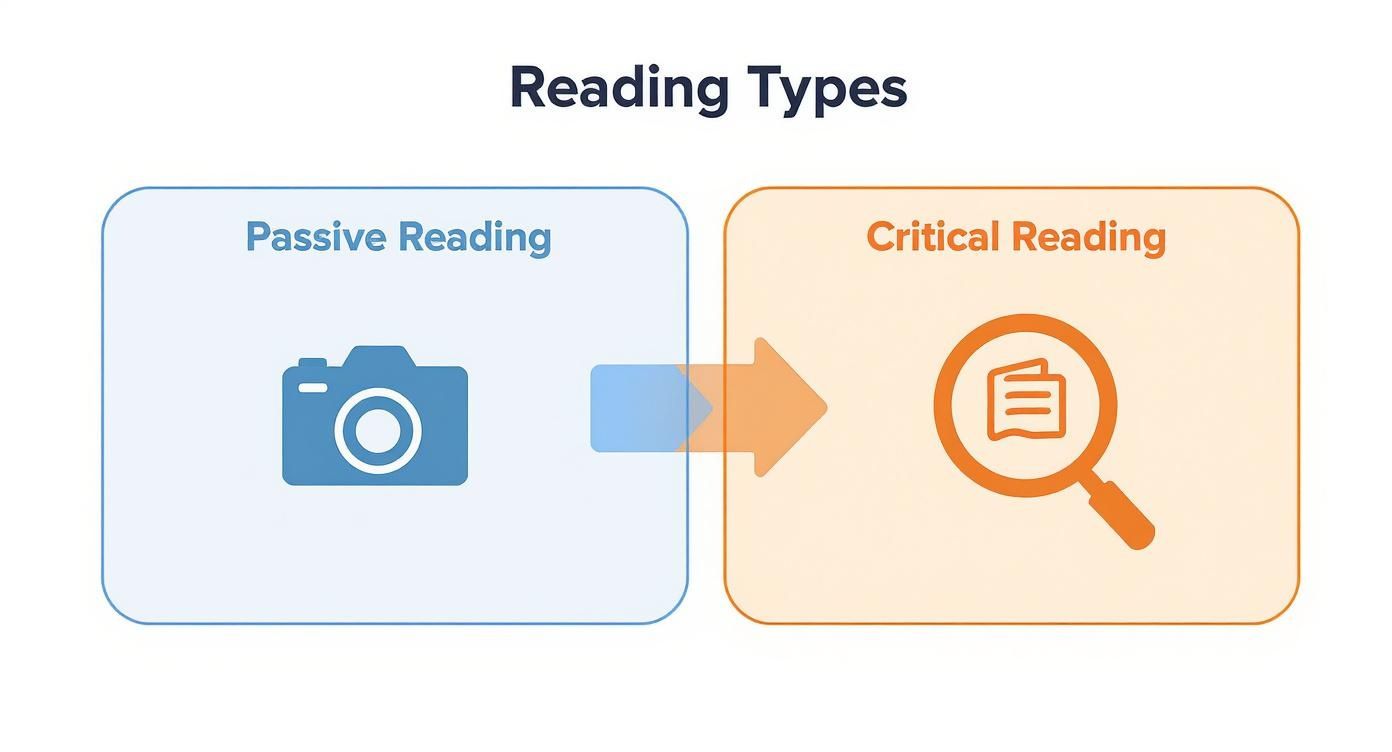
As you can see, critical reading requires moving beyond surface-level consumption to a deeper, more investigative approach.
Pillar 4: Synthesis
The final pillar, synthesis, is about creation. Think of a chef who takes incredible ingredients—fresh vegetables from one market, rare spices from another—and combines them to create a completely new and wonderful dish.
As a critical reader, you do the same thing with ideas. You connect what you're reading to your own knowledge and to other sources you've encountered. This allows you to build a richer, more nuanced understanding of the topic and, ultimately, to form new perspectives that are uniquely your own.
See Critical Reading in the Real World
Knowing the theory behind critical reading is great, but the real magic happens when you see it in action. Let’s put those four pillars to the test and apply them to the kinds of things you probably read every day. This is how you move from just reading words to truly understanding them.
Deconstructing a News Article
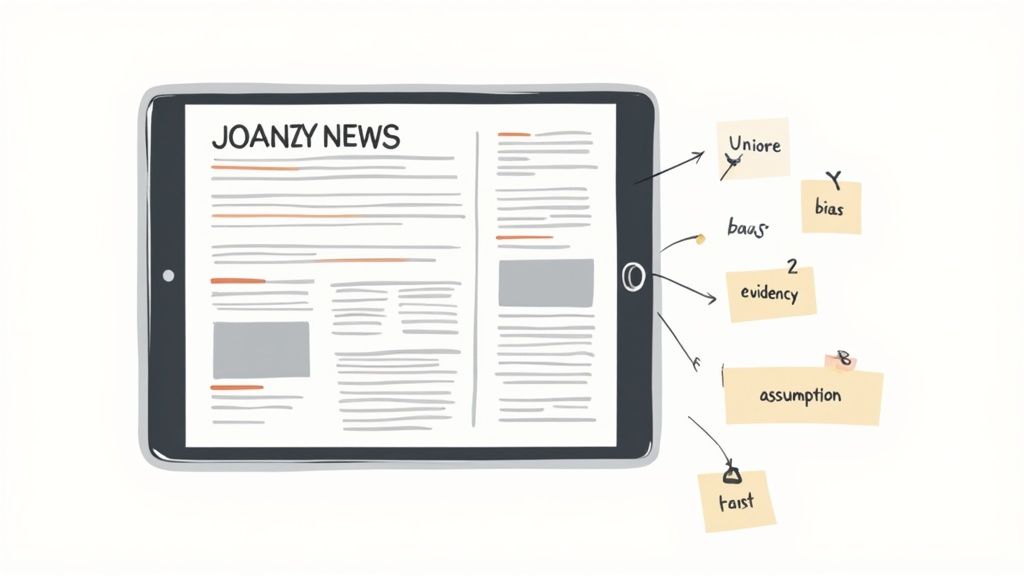
Picture this: you come across a news article with the headline, "New Recycling Program a Smashing Success." If you were just skimming, you'd probably nod and move on. But as a critical reader, you automatically start digging deeper.
Analysis: First, you pinpoint the main argument (the program works) and the proof it offers. The article quotes the mayor and the recycling company’s CEO, both singing its praises.
Inference: Now you start reading between the lines. Who are they not quoting? You notice there are no comments from sanitation workers, local environmental groups, or residents from different parts of the city. That silence is telling; it hints that the story might not be complete.
Evaluation: With that in mind, you weigh the evidence. The people quoted clearly have a stake in the program looking good. That doesn't mean they're being dishonest, but it's a clear source of potential bias. A critical reader asks: is this evidence really enough to call it a "smashing success"?
Synthesis: Finally, you pull it all together with what you already know. Maybe you remember other city projects that launched with big promises but fizzled out. Your conclusion? The program might have potential, but this article is a one-sided PR piece. You need more information to get the full story.
Analyzing a Marketing Blog Post
Next up, a blog post titled, "5 Reasons Our Software Will Triple Your Productivity." The goal here is obvious—to sell you something. Your job is to see through the persuasive language and find the substance.
A critical reader dissects persuasive content to understand how it works, not just what it's selling. This means looking at emotional appeals, strategic omissions, and the structure of the argument itself.
You could start by analyzing how the post is built, noticing the bold promises and glowing customer testimonials. From there, you infer the author's intent: they want to tap into your frustration with low productivity and position their product as the only solution.
During the evaluation phase, you challenge the claims head-on. Is "triple your productivity" backed by specific data, or is it just a catchy, empty phrase? Are the testimonials from real companies you can look up, or are they vague quotes? Finally, you synthesize by comparing these claims against competitor products and independent reviews. This helps you build a much more realistic picture of what the software can actually do. This kind of deep dive is a huge part of what document analysis is all about.
Examining an Academic Paper
Even formal academic research isn't immune to scrutiny. When you're faced with a scholarly paper about a new teaching method, you can't just take the abstract's word for it.
You start by analyzing the paper's skeleton: the methodology, results, and discussion sections. You identify the core research question. Using inference, you think about what the authors might not be saying. Perhaps the study's sample size was too small, or the experiment was too short to be conclusive.
Your evaluation here is the most important step. Was the methodology sound? Are there other ways to interpret the results? Do the authors fairly acknowledge research that contradicts their findings? The final step is to synthesize this paper with the broader conversation in the field. Does it support what's already known, or does it challenge it? This process is what separates someone who just reads studies from someone who truly understands them.
Practical Ways to Build Your Critical Reading Skills
Becoming a sharp critical reader isn’t something that happens overnight. Just like any other skill, it takes deliberate and consistent practice. The good news? You don't need a special class to get started. By weaving a few powerful habits into your routine, you can start building this expertise right now.
The real shift happens when you move from being a passive consumer of words to an active participant in a conversation. It's about learning to interact with the text, question its assumptions, and ultimately, understand it on a much deeper level. Think of these techniques as a workout plan for your analytical muscles.
Adopt a Structured Reading Method
One of the most effective ways to make sure you're reading critically is to follow a system. A classic, time-tested approach is the SQ3R method, which breaks down the reading process into five simple, powerful steps.
- Survey: Before diving into the first paragraph, get the lay of the land. Scan the entire text—look at headings, subheadings, images, and the introduction and conclusion. This gives you a bird's-eye view of where the author is going.
- Question: Turn those headings into questions. If you see a section titled "The Four Pillars of Critical Reading," ask yourself, "Okay, what are the four main pillars?" This primes your brain to look for answers.
- Read: Now, you read. But this time, you’re on a mission to answer the questions you just formed. Keep an eye out for main ideas and the evidence used to back them up.
- Recite: After finishing a section, pause for a moment. Can you explain the key points in your own words, without looking? This is a crucial step for checking if you truly understand and helps lock the information into your memory. Our guide on summarizing in reading has more great tips for this.
- Review: Once you've read the whole piece, circle back to your notes and questions. This final pass helps connect all the dots and solidifies your understanding of the author's complete argument.
This structured process prevents you from just letting your eyes glaze over the page. It forces you to engage, making it a foundational practice for anyone serious about improving their reading.
Make Annotation an Active Dialogue
Annotation is so much more than just highlighting. It’s about having a conversation with the author, right there in the margins of the page.
Effective annotation transforms the page into a dynamic workspace. It's not about making the book look busy; it's about making your thinking visible.
Think of it as leaving a breadcrumb trail of your thought process. As you read, get in the habit of jotting down notes to:
- Question claims that seem weak or unsupported.
- Define terms you're not familiar with.
- Connect an idea to something else you've read or experienced.
- Mark passages that are confusing, or ones that are particularly brilliant.
This simple habit forces you to slow down and process what you're reading instead of just skimming. Its importance is underscored in modern education. Standardized tests like the SAT and ACT now dedicate 40% of reading questions to critical analysis and evaluation. It's even more pronounced in programs like the International Baccalaureate (IB), where 70% of assessment criteria are built on these exact skills.
Using Critical Reading in a Digital World
https://www.youtube.com/embed/D9ivU_IKO6M
Let's be honest: reading on a screen is tough. Notifications are constantly popping up, a dozen other tabs are calling your name, and the sheer amount of information available can feel overwhelming. It's an environment that practically begs you to skim, not to think deeply.
This doesn't mean we have to give up on technology. The trick is to make it work for us, not against us. We can use modern tools to sharpen our critical reading skills, turning what might feel like a shortcut into a springboard for much deeper analysis.
A New Workflow for Digital Documents
The goal here isn't to let technology do the thinking for you. It's about using it to handle the initial heavy lifting so you can save your brainpower for what really matters: analysis, evaluation, and synthesis.
For dense PDFs, an AI-powered tool can be a game-changer. Think of it as creating a strategic workflow.
Here’s how you can approach it:
- Step 1: Get the Lay of the Land. Instead of just diving into a 50-page PDF blind, use a summarizer to get a quick overview. In seconds, you'll know the main arguments and key takeaways.
- Step 2: Form Your Questions. Now that you have the big picture, you can start formulating smart questions. You're no longer just asking, "What is this about?" You can jump straight to, "Is the evidence for this claim actually strong enough?" or "What assumptions is the author making here?"
- Step 3: Dive In with Purpose. With your questions in hand and a mental map of the document, you can now read the full text with intention. You know exactly which sections to focus on to find the answers you're looking for.
This completely flips the script on digital reading. You're no longer fighting off distractions; you're using technology to slice right through the noise and get to the heart of the matter, fully prepared to engage critically.
Leveraging AI for Deeper Analysis
An AI summarizer essentially acts as a research assistant, helping you quickly map out the structure of a complicated document. This screenshot shows how a tool like PDF Summarizer can pull out the key points, setting the stage for your own analysis.
This summary isn't the finish line—it's the starting block. It gives you a solid foundation so you can approach the full text ready to question, connect, and evaluate, rather than just trying to figure out what’s going on.
A summary isn't the end of your reading; it's the beginning of your critical engagement. It provides the map so you can explore the territory more effectively.
As AI continues to shape how we get our information, knowing how to vet sources for credibility is more important than ever. This is a challenge explored in "Building Trust in the Age of AI". By pairing your own analytical mind with smart tools, you become a much more efficient and effective thinker, ready to tackle any digital document with confidence.
How Critical Reading Gives You a Professional Edge
It's easy to think of critical reading as something you leave behind in college with your term papers and textbooks. But in the real world, it’s one of the most powerful—and often overlooked—tools for getting ahead in your career. It's what separates the doers from the thinkers, the followers from the innovators.
Think about it. In almost any job, you’re constantly bombarded with information: reports, emails, market data, project proposals. The person who just skims this content can follow instructions. But the person who reads it critically can shape the strategy.
Take a marketer looking at a competitor's new ad campaign. A surface-level read shows you what they did. A critical read helps you understand why. You start deconstructing the messaging, pinpointing the target audience, and questioning how effective their call-to-action really is. This is how you spot their weaknesses and build a smarter counter-move.
Don't just take my word for it. Employers are actively searching for this skill. A 2021 World Economic Forum report found that a staggering 85% of employers ranked critical reading and analytical thinking as top-tier skills. What’s more, the report showed that employees with these skills were 30% more likely to get promoted in their first five years. You can dig into the specifics in the full report on in-demand job skills.
From Theory to Tangible Results
So, what does this actually look like day-to-day? The advantage you gain from critical reading isn't just some abstract concept; it delivers real, measurable results that can make or break a project. It’s the process of turning a flood of information into sharp, actionable intelligence.
This shows up in a few key areas:
- Smarter Problem-Solving: A developer debugging a tricky piece of code doesn't just read the error message. They critically analyze the documentation, question the assumptions baked into the original code, and evaluate different fixes to find the root cause, not just a patch.
- Better Decision-Making: A manager reviewing a new business proposal doesn't take it at face value. They actively question the financial projections, challenge the market assumptions, and sniff out the potential risks that are hidden between the lines.
- Real Innovation: An engineer reading a technical paper might see a way to combine an idea from one field with a concept from another, creating something entirely new. They’re not just absorbing what the paper says; they’re using it as a launchpad.
In the end, critical reading is your filter for value and validity. In a professional context, that means you're the one who can spot the hidden opportunities, flag the risks no one else sees, and bring insights to the table that genuinely move the needle.
Ultimately, getting good at critical reading makes you indispensable. It gives you the power to not just do your job, but to define it, challenge old ways of thinking, and drive the kind of results that get you noticed.
Answering Your Questions About Critical Reading
As you start getting the hang of this, you’ll probably have a few questions pop up. It's totally normal. Let's clear up some of the most common ones so you can practice with more confidence.
Isn't Critical Reading Just Being Negative?
That's a common misconception, but no, it's not about tearing a text apart just for the sake of it. Think of it less like a critique and more like an objective evaluation.
The real goal isn’t to find fault. It's to understand the text on a much deeper level—recognizing its strengths, identifying its weaknesses, and forming a genuinely informed opinion. You're not just a critic; you're a discerning reader.
How Can I Possibly Read Critically When I'm Short on Time?
This is a big one. The secret is to be selective. You don't have to put every single thing you read under a microscope. That would be exhausting!
Learn to skim strategically first. A quick once-over can help you decide if a document is even worth a deeper, more analytical dive.
When you're dealing with PDFs or other digital docs, an AI summarizer is a game-changer. It helps you zero in on the most important sections, so you can focus your critical energy where it truly counts. It's about being effective, not just busy.
Can I Apply This to Videos or Podcasts?
Absolutely. The medium doesn't matter as much as the message. The core principles of critical thinking are universal.
Whether you're watching a documentary, listening to a podcast, or sitting through a business presentation, the same rules apply. You should still be analyzing the arguments, weighing the evidence, and considering the creator's purpose and potential biases. It's all about assessing the credibility and logic of the information, no matter how it's packaged.
Ready to make your digital reading more efficient and insightful? PDF Summarizer gives you the tools to quickly grasp key ideas from dense documents, so you can spend your time on deep analysis. Try PDF Summarizer for free and start reading smarter today.
Relevant articles
Learn how to take notes from textbooks using proven methods that boost retention. Go beyond highlighting with actionable strategies for effective learning.
Learn how to improve reading comprehension skills with practical, proven strategies for active reading, vocabulary, and retention.
Master the art of reading and summarizing complex texts. Learn proven techniques and AI-powered workflows to gain clarity and save time.
Reading comprehension strategies for students to boost understanding and retention with practical, classroom-tested tips you can start using today.
Transform your comprehension with our guide on summarizing in reading. Learn actionable techniques and practical tips to retain more from every text.