Reading comprehension strategies for students: 5 quick tips
Reading comprehension strategies for students to boost understanding and retention with practical, classroom-tested tips you can start using today.
Reading is fundamental, but true comprehension, the ability to not just decode words but to understand, analyze, and retain information, is a critical skill for academic and professional success. For students navigating everything from complex textbooks to dense research papers, mastering this skill is the key to unlocking deeper learning. This guide moves beyond generic advice to provide a comprehensive roundup of 10 evidence-based reading comprehension strategies for students.
We will explore each method in detail, offering step-by-step instructions, practical classroom examples, and ways to integrate modern tools to streamline your study process. The goal is to transform passive reading into an active, engaging, and effective process. Before diving into these specific techniques, it's beneficial to consider the broader development of fundamental reading skills that form the bedrock of advanced comprehension.
This article is designed for a wide audience. It offers actionable insights for:
- Students tackling readings and homework across all subjects.
- Academic researchers conducting literature reviews and analyzing source material.
- Professionals who need to quickly grasp the content of reports, proposals, or briefs.
Whether you're an educator searching for effective classroom techniques or a student aiming to study smarter, these strategies offer a clear path to improved understanding and better academic performance. We'll show you not only what to do but exactly how to implement these methods for maximum impact, turning difficult texts into manageable and meaningful learning opportunities.
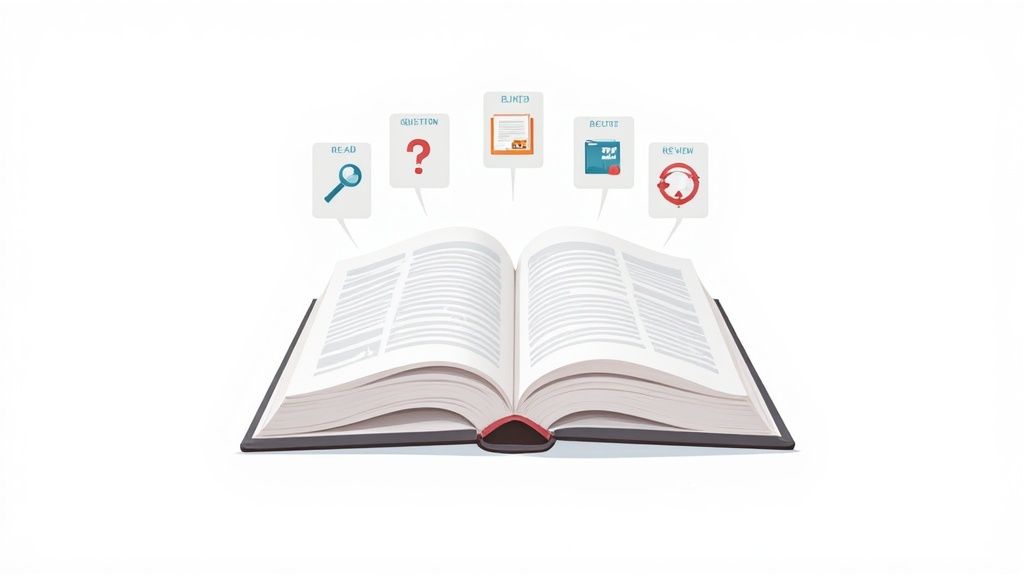
1. SQ3R Method (Survey, Question, Read, Recite, Review)
The SQ3R method is a classic, five-step reading comprehension strategy designed to transform passive reading into an active, critical process. Developed by educational psychologist Francis P. Robinson, it provides a systematic framework for students to deeply engage with and retain information from textbooks, research papers, and other dense materials. It’s one of the most enduring reading comprehension strategies for students because it forces a deliberate interaction with the text rather than a superficial scan.
How It Works: The Five Steps
This method is highly structured, guiding you through a logical progression from a broad overview to detailed recall. It's especially effective for college students preparing for exams or professionals analyzing detailed reports.
- Survey: Before you read, get a bird's-eye view. Skim headings, subheadings, introductions, summaries, and any end-of-chapter questions. This creates a mental map of the content.
- Question: Turn each heading into a question. For a section titled "The Process of Photosynthesis," your question might be, "What are the key stages of photosynthesis?" This primes your brain to actively search for answers.
- Read: Actively read the text one section at a time, specifically looking for answers to your questions. Highlight key concepts and take brief notes as you find relevant information.
- Recite: After reading a section, look away from the text and try to answer your question in your own words. This step is crucial for moving information from your short-term to your long-term memory.
- Review: Once you've finished the entire chapter or document, review your notes and the questions you created. This reinforces learning and helps you see the bigger picture.
Actionable Tips for Implementation
To maximize the SQ3R method, start by applying it to a single textbook chapter. For example, a high school student studying for a history test can survey the chapter on the American Revolution, turn headings like "Causes of the Conflict" into questions, and read to find specific answers. For the "Recite" step, they can summarize the main points to a study partner. Regular review sessions, spaced out over several days, will solidify their understanding for the exam. This structured approach builds a strong foundation for effective learning and information retention.
2. Skimming and Scanning
Skimming and scanning are foundational speed-reading techniques that enable students to process large volumes of text efficiently. While often grouped together, they serve distinct purposes: skimming is about quickly grasping the general gist or main ideas, while scanning involves searching for specific keywords or data points. These complementary skills are among the most practical reading comprehension strategies for students, allowing them to quickly assess a text's relevance and locate critical information without reading every single word. They empower learners to manage heavy reading loads and conduct research more effectively.
How It Works: Two Distinct Approaches
These techniques are not about shallow reading; they are about strategic information extraction. By using visual cues and understanding text structure, you can dramatically increase your reading speed and efficiency.
- Skimming: This is a pre-reading strategy used to get a general overview. You rapidly move your eyes over the text, focusing on titles, headings, introductions, first and last sentences of paragraphs, and any bolded text or summaries. The goal is to understand the main argument or topic, not the details. A student might skim a textbook chapter to decide if it’s relevant for their essay.
- Scanning: This is a targeted search for specific information. You already know what you're looking for, such as a name, date, or specific term. Your eyes sweep across the page in a set pattern (like an 'S' or 'Z' shape) until you find the keyword. This is what you do when looking for a specific definition in a glossary or a name in a phone book.
Actionable Tips for Implementation
To master these skills, practice is key. For example, a college student researching a paper can first skim several academic articles by reading their abstracts and conclusions to quickly identify the most relevant sources. Once they have selected a promising article, they can then scan it for specific keywords related to their research question, like "neuroplasticity in adolescents," to pinpoint the exact sections they need for detailed reading. Using a finger or cursor to guide the eyes can increase speed and focus during scanning. This two-pronged approach saves valuable time and makes the research process far more targeted and productive.
3. Annotation and Highlighting
Annotation and highlighting are foundational reading comprehension strategies that turn passive reading into an active dialogue with the text. This hands-on method involves marking up a document by underlining, highlighting key phrases, and writing notes, questions, or summaries in the margins. By physically or digitally interacting with the material, students create a personalized record of their thought process, making it easier to identify main ideas, track arguments, and review information later.

How It Works: Creating a Textual Conversation
This strategy is about making the text your own. Instead of just letting words wash over you, you actively engage, question, and interpret them. It’s highly effective for everything from literature analysis to deconstructing dense academic articles, as it forces you to slow down and process information more deeply. For complex materials like research papers, a systematic approach is key. You can find more targeted techniques on how to read scientific papers on pdfsummarizer.pro.
- Highlight with Purpose: Don't just color the page. Selectively highlight only the most crucial information, such as thesis statements, key evidence, or definitions. Aim to highlight no more than 10-15% of the text.
- Write Marginal Notes: Explain why you highlighted something. Summarize a paragraph in a few words, define a tricky term, or ask a question about a confusing concept.
- Use a System: Create a consistent key. For example, use a star for main ideas, a question mark for points of confusion, and an exclamation point for surprising facts. Circle unfamiliar vocabulary words to look up later.
- Connect Ideas: Draw lines and arrows to link related concepts across different parts of the text, helping you visualize the author's argument structure.
Actionable Tips for Implementation
To start, create a simple annotation key for your next reading assignment. A literature student could use yellow for character development, blue for symbolic imagery, and write marginal notes to track plot points. For a college student working with a PDF textbook, digital annotation tools allow for color-coding and adding comments without permanently marking a physical copy. The goal is to create a useful, personalized study guide. Reviewing your annotations before an exam is far more efficient than re-reading the entire text from scratch, solidifying it as one of the most effective reading comprehension strategies for students.
4. Predicting and Inferencing
Predicting and inferencing is a cognitive strategy that transforms reading from a passive activity into an active investigation. It involves using clues from the text combined with your own prior knowledge to make educated guesses about what might happen next (predicting) or to understand information that is implied but not directly stated (inferencing). This process is central to developing advanced reading comprehension strategies for students, as it encourages critical thinking and a deeper engagement with the author’s intent and underlying themes.
How It Works: The Two-Part Process
This strategy relies on being a literary detective, constantly looking for clues and piecing together a bigger picture. It's highly effective for analyzing fiction, interpreting scientific data, and understanding historical cause-and-effect relationships.
- Predicting: This is the act of forecasting what will happen in a text. Before and during reading, you can pause and ask, "Based on the title, the character's actions, or the events so far, what do I think will happen next?"
- Inferencing: This involves reading between the lines to draw conclusions. You might ask, "Why did the character say that?" or "What does this experimental result suggest?" The answer isn't explicitly in the text; you must combine textual evidence with your own logic and experience.
Actionable Tips for Implementation
To build these skills, make a habit of pausing as you read. A middle school student reading a novel can stop at the end of a chapter and jot down two or three predictions about the plot. For inferencing, a history student can analyze a primary source document and use a graphic organizer to list explicit details from the text on one side and the inferences they can draw from those details on the other. They can then verify or adjust their predictions and inferences as they continue reading, sharpening their analytical abilities. Discussing these thoughts with a peer can also help validate or refine their thinking, making it a powerful collaborative tool.
5. Summarization
Summarization is a powerful reading comprehension strategy that requires students to distill a text down to its most essential ideas. This process involves identifying the main points, filtering out non-essential details, and rephrasing the core concepts in a concise, coherent statement. More than just shortening a text, effective summarization forces a deeper level of engagement, ensuring the reader has truly understood the material enough to explain it in their own words. It's a fundamental skill for creating study aids, comprehending complex arguments, and retaining key information.
How It Works: The Core Process
This strategy moves a reader from passive consumption to active synthesis. By focusing on the "big picture," summarization helps solidify understanding and creates a mental framework for the information. It is invaluable for students creating study notes, researchers writing abstracts, or professionals needing to grasp the essence of a lengthy report quickly.
- Read First: Read the entire text or section first to get a complete understanding of the context and the author's main argument.
- Identify Main Ideas: Pinpoint the topic sentences or key arguments in each paragraph. Look for recurring themes or concepts that form the backbone of the text.
- Filter and Condense: Disregard trivial details, redundant examples, and secondary information. Focus only on the information that is absolutely necessary to understand the core message.
- Rephrase in Your Own Words: This is the most critical step. Articulating the main ideas using your own vocabulary confirms your comprehension and helps commit the information to memory.
- Check for Accuracy: Compare your summary to the original text to ensure you haven't misrepresented the author's points or missed a crucial piece of the argument.
Actionable Tips for Implementation
To put this strategy into practice, start small. A middle school student can practice by writing a one-sentence summary of each paragraph in their science textbook. A college student can use an AI tool to generate a preliminary summary of a dense academic paper, then refine it based on their own reading to ensure accuracy. For more guidance on honing this skill, you can learn more about effective summarization techniques and how to apply them to different types of texts. This proactive approach not only improves reading comprehension for students but also builds a valuable skill for academic and professional success.
6. Think-Aloud Strategy
The Think-Aloud Strategy is a powerful metacognitive tool where students verbalize their thoughts while reading a passage. By making their internal thinking process audible, readers gain awareness of their comprehension, pinpoint areas of confusion, and actively engage with the text. This approach is one of the most effective reading comprehension strategies for students because it externalizes the often-invisible mental work of skilled readers, making it a learnable skill for others.
How It Works: Making Thinking Visible
This strategy involves a running commentary of the reader's mind. It moves reading from a passive activity to an interactive dialogue with the text, helping students monitor their understanding in real-time. It's especially useful for teachers modeling comprehension and for students working through complex or unfamiliar material.
- Verbalize Questions: As you read, say your questions aloud. "What does this technical term mean?" or "Why did the character make that decision?" This keeps you actively searching for answers.
- Make Connections: Express links between the text and your prior knowledge. "This part reminds me of what we learned about ecosystems last week."
- Admit Confusion: It's crucial to acknowledge when you don't understand something. Saying "I'm lost here, let me reread that last paragraph" is an active step toward resolving confusion.
- Predict and Summarize: Pause periodically to predict what might happen next or to summarize what you've just read in your own words.
Actionable Tips for Implementation
To implement this, teachers can start by modeling a think-aloud with a challenging passage for the whole class. For example, a middle school science teacher can read a paragraph on cellular respiration and verbalize their process: "Okay, the text mentions ATP. I remember that's the energy currency of the cell. Now it's explaining glycolysis... I'm a bit confused on where that happens. I'll reread to see if it says it's in the cytoplasm."
Students can then practice this in pairs, taking turns reading a short text and thinking aloud. Using a PDF Summarizer to generate questions about a document beforehand can provide excellent prompts to guide a student's think-aloud session.
7. Graphic Organizers and Visual Mapping
Graphic organizers are visual tools that help students structure information, making complex relationships between concepts easier to understand and remember. By transforming linear text into a spatial, visual format, these tools cater especially to visual learners and enhance comprehension for all students. Using formats like concept maps, Venn diagrams, or timelines, students can actively process and organize what they read, moving beyond simple memorization to a deeper understanding of the material.

How It Works: Structuring Information Visually
This strategy encourages students to identify key ideas and map out how they connect. Instead of just reading a list of facts, students build a visual framework that shows hierarchy, comparison, or sequence. This process makes abstract concepts tangible and helps solidify learning by engaging different parts of the brain.
- Identify the Structure: Determine the text's underlying structure. Is it comparing and contrasting, showing a sequence of events, or describing a central concept with related details?
- Select an Organizer: Choose a graphic organizer that matches the text's structure. For instance, use a Venn diagram for comparisons, a timeline for historical events, or a concept map for defining a topic.
- Populate the Map: Extract key information from the text and place it into the appropriate sections of the organizer. This requires careful reading and discernment.
- Review and Refine: Look at the completed organizer to see the relationships and overall picture. Add details or make adjustments to clarify connections and reinforce understanding.
Actionable Tips for Implementation
To start, a middle school student could use a story map to deconstruct a short story, identifying the main characters, setting, conflict, and resolution. For a more complex task, a biology student could create a flowchart to illustrate the stages of mitosis, using color-coding to distinguish between phases. The visual clarity of these tools makes them powerful study aids. For those looking to structure larger projects, learning how to create a research paper outline on pdfsummarizer.pro can provide a similar organizational benefit. This method is one of the most versatile reading comprehension strategies for students, adaptable to any subject or grade level.
8. Context Clues and Vocabulary Development
Using context clues is a foundational strategy that empowers students to decipher the meaning of unfamiliar words directly from the text, reducing the need to constantly stop and consult a dictionary. This method involves analyzing the surrounding words, sentences, and punctuation to make an educated guess about a word’s definition. Mastering this skill not only enhances vocabulary but also improves reading fluency and comprehension, making it one of the most practical reading comprehension strategies for students to learn.
How It Works: The Five Types of Clues
This strategy is about becoming a "word detective," looking for signals embedded within the text. Students learn to recognize specific patterns that authors use to clarify meaning, making this skill invaluable for tackling complex academic or technical reading.
- Definition/Explanation: The word's meaning is directly explained in the sentence. For example, "The arboretum, a garden devoted to trees, was his favorite place."
- Synonym/Restatement: A word or phrase with a similar meaning is used nearby. For instance, "She was loquacious, or very talkative, during the meeting."
- Antonym/Contrast: The word is clarified by presenting an opposite meaning. For example, "Unlike his gregarious brother, he was quiet and reserved."
- Inference/Example: The word’s meaning is suggested by the overall context or specific examples. For example, "Celestial bodies, such as the sun, moon, and stars, have fascinated humans for centuries."
- Punctuation: Commas, parentheses, or dashes are used to set off a definition. For instance, "The charlatan (a person who falsely claims to have special knowledge) was exposed."
Actionable Tips for Implementation
To implement this strategy effectively, start by teaching students the specific types of context clues. A middle school teacher could provide a worksheet with sentences containing unfamiliar words and ask students to identify the clue type and infer the word’s meaning. For instance, given the sentence, "The project was arduous; it required weeks of difficult, non-stop work," students would identify the synonym/explanation clue. Encourage them to create a vocabulary journal where they log new words, their inferred meanings, and the context clues they used to figure them out. This active practice builds confidence and strengthens vocabulary retention.
9. Active Reading and Close Reading
Active reading and close reading are intensive strategies that move beyond understanding what a text says to analyzing how it says it. Close reading involves a careful, deliberate examination of a text, focusing on details like word choice, sentence structure, tone, and literary devices. Active reading builds on this by incorporating annotation, questioning, and continuous analysis as you read. This powerful combination is one of the most effective reading comprehension strategies for students tackling complex literary, historical, or philosophical works.
How It Works: The Deep Dive
This method encourages you to treat a text like a puzzle, examining each piece to understand the whole. It is particularly valuable for literary analysis, legal document review, or deciphering dense academic research. By slowing down, you uncover layers of meaning, authorial intent, and subtle arguments that a quick read would miss. It’s about engaging in a conversation with the text rather than passively receiving information.
- First Pass: Read the text once for a general understanding of its main ideas and overall structure.
- Detailed Analysis: Reread the text, this time with a pen or digital annotation tool. Highlight key phrases, question the author's word choices, and note patterns or contradictions.
- Question Everything: Ask text-dependent questions. For instance, "Why did the author use this specific metaphor?" or "What is the effect of the short, fragmented sentences in this paragraph?"
- Synthesize and Interpret: After annotating, step back and analyze your observations. Use your notes and the textual evidence you've gathered to form a comprehensive interpretation of the text's deeper meaning.
Actionable Tips for Implementation
To implement close reading, select a short passage, such as a single poem or a paragraph from a historical document. Read it multiple times, each time with a different focus: first for gist, then for literary devices, and finally for tone. Annotate your thoughts directly on the text, circling unfamiliar words and writing questions in the margins. For a college student analyzing a scientific study, this might involve dissecting the methodology section, questioning the experimental design, and evaluating the validity of the conclusions. Applying these active and close reading techniques is also crucial when you need strategies for reading scientific papers efficiently, as it helps you deconstruct complex arguments and data. This meticulous approach builds the critical analysis skills necessary for high-level academic and professional success.
10. Reciprocal Teaching and Peer Discussion
Reciprocal teaching is a dynamic, collaborative reading strategy that transforms students into teachers. In this model, students work together in small groups, taking turns leading a discussion about a segment of text. This method is one of the most effective reading comprehension strategies for students because it actively involves them in the learning process and builds multiple cognitive skills simultaneously, moving beyond passive reception to active construction of meaning.
How It Works: The Four Key Roles
The strategy revolves around four distinct comprehension-fostering roles that students cycle through. This structure ensures that the group conversation is both focused and comprehensive, covering different layers of understanding. It's particularly powerful in classroom settings for literature circles or when analyzing complex non-fiction texts.
- Questioning: The "Questioner" generates questions about the text to spark discussion. This includes literal questions (who, what, where) and inferential questions (why, how, what if) that prompt deeper thinking.
- Clarifying: The "Clarifier" identifies and addresses confusing parts of the text, such as difficult vocabulary, complex sentences, or unclear concepts. This student leads the group in finding solutions to these points of confusion.
- Summarizing: The "Summarizer" concisely restates the main ideas and key points from the section of text just read. This step ensures the group has a shared understanding of the core content.
- Predicting: The "Predictor" makes an educated guess about what will happen next in the text, using clues from what has already been read. This encourages students to think ahead and engage with the material proactively.
Actionable Tips for Implementation
To implement reciprocal teaching effectively, the teacher should first model each of the four roles explicitly. Start with a short, engaging text. Assign students to small groups of four, giving each a specific role (e.g., using role cards with prompts). After reading a paragraph or section, the designated student leader for that segment guides the group through the four steps. For example, in a science class reading about ecosystems, the Summarizer might identify the key interactions discussed, the Questioner might ask how a specific event could impact the food web, the Clarifier might look up a term like "symbiosis," and the Predictor might hypothesize about the next section on human impact. Rotating roles regularly ensures every student practices all four critical comprehension skills.
Reading Comprehension: 10-Strategy Comparison
| Technique | Implementation complexity | Resource requirements | Expected outcomes | Ideal use cases | Key advantages |
|---|---|---|---|---|---|
| SQ3R Method (Survey, Question, Read, Recite, Review) | Moderate — multi-step, requires practice | Low — time investment, notes/textbook | Strong retention and structured comprehension | Textbook chapters, exam preparation, academic study | Structured, question-driven reading with repeated review |
| Skimming and Scanning | Low — simple to learn and apply | Minimal — time and familiarity with text features | Rapid identification of relevance, quick information retrieval | Literature review, news intake, preliminary source assessment | Time-efficient, good for filtering large volumes quickly |
| Annotation and Highlighting | Low–Moderate — needs a consistent system | Low–Moderate — pens/highlighters or digital tools | Increased engagement, personalized study aids | Note-taking, close study of texts, exam revision | Active interaction with text, creates quick reference material |
| Predicting and Inferencing | Moderate — relies on prior knowledge and reasoning | Minimal — time to pause and reflect | Deeper comprehension, improved critical thinking | Fiction interpretation, data analysis, historical connections | Encourages anticipation and deeper meaning-making |
| Summarization | Moderate — requires condensing skills | Low — time and writing practice | Clear identification of main ideas, better memory retention | Study guides, abstracts, exam preparation, executive summaries | Forces selection of essentials and clarifies understanding |
| Think-Aloud Strategy | Moderate — needs modeling and practice | Low–Moderate — facilitator, time, optional recording | Greater metacognitive awareness, real-time error detection | Guided reading, tutoring, classroom modeling | Makes thinking visible; effective for teaching strategies |
| Graphic Organizers and Visual Mapping | Moderate — choose and design appropriate visuals | Moderate — paper or digital tools, time to create | Organized knowledge, clearer relationships between concepts | Complex topics, compare/contrast tasks, planning projects | Visualizes structure and relationships; aids visual learners |
| Context Clues and Vocabulary Development | Low–Moderate — requires explicit instruction in clue types | Minimal — text exposure, instruction time | Improved vocabulary, smoother reading fluency | Independent reading, vocabulary lessons, content-area texts | Teaches independent word learning without interrupting flow |
| Active Reading and Close Reading | High — intensive, multiple passes and analysis | Moderate–High — time, annotation tools, practice | Nuanced, evidence-based interpretation and critical analysis | Literary analysis, legal/scientific texts, philosophical works | Deep, text-focused understanding and analytical skill-building |
| Reciprocal Teaching and Peer Discussion | High — requires structure, role training, classroom management | Moderate — small groups, teacher facilitation, time | Improved comprehension, communication, and metacognition | Classroom literature circles, guided group study, book clubs | Collaborative, research-supported method that develops social and cognitive skills |
From Strategy to Skill: Building Your Comprehension Toolkit
Navigating the world of academic texts, professional reports, and complex documents can often feel like exploring a dense, uncharted forest. Without a map or a compass, it's easy to get lost. The ten powerful reading comprehension strategies for students detailed in this article are your essential tools for this journey. They are your map, your compass, and your survival kit, transforming you from a passive wanderer into an active, strategic explorer of information.
We've moved beyond simple advice, providing a comprehensive toolkit that empowers you to deconstruct any text you encounter. From the methodical structure of the SQ3R method to the dynamic collaboration of Reciprocal Teaching, each strategy serves a unique purpose. Think of them not as a rigid checklist, but as a versatile collection of instruments. You wouldn't use a hammer to turn a screw; similarly, you might use skimming for a preliminary review but turn to close reading for a deep analysis of a critical legal document.
Synthesizing Your Strategic Approach
The true power of these techniques is unlocked when they are combined and customized to fit your specific needs and the demands of the text. The journey from strategy to skill is paved with conscious, consistent practice.
- For Foundational Structure: Start with SQ3R to build a solid framework before you even begin reading. This creates a mental scaffolding that makes new information easier to place and retain.
- For Active Engagement: Weave in Annotation and Highlighting during your read-through. This isn't just about coloring pages; it's about creating a dialogue with the author, marking points of confusion, and flagging key evidence.
- For Deeper Understanding: Employ Graphic Organizers to visually untangle complex relationships between concepts. Use Summarization to distill vast amounts of information into a concise, manageable core.
- For Collaborative Learning: Engage in Peer Discussion or use the Think-Aloud strategy to articulate your thought process. Explaining a concept to someone else is one of the most effective ways to solidify your own understanding.
The ultimate goal is to achieve metacognitive awareness. This means you not only know how to use these strategies, but you also know which one to deploy and why. You begin to intuitively select the right tool for the job, whether you are a student tackling a dense textbook, a researcher conducting a literature review, or a professional analyzing a critical business proposal.
The Lasting Impact of Strategic Reading
Mastering these reading comprehension strategies for students is more than an academic exercise; it's a fundamental life skill that pays dividends far beyond the classroom. Proficient reading comprehension is the bedrock of critical thinking, effective communication, and continuous learning. It enables you to engage with diverse perspectives, evaluate the credibility of information, and construct well-reasoned arguments.
A reader lives a thousand lives before he dies . . . The man who never reads lives only one. - George R.R. Martin
This journey from passive consumption to active comprehension is transformative. It changes your relationship with information itself. Texts are no longer intimidating obstacles but opportunities for discovery. By building and refining your personal comprehension toolkit, you are not just preparing for an exam; you are equipping yourself for a lifetime of intellectual curiosity and growth.
Ready to supercharge your study sessions and put these strategies into action? Streamline your workflow with PDF Summarizer. Instantly generate summaries, formulate key questions, and extract critical passages from any document, allowing you to focus on the deep analysis that builds lasting knowledge. Visit PDF Summarizer to accelerate your learning today.
Relevant articles

Streamline your research and summary tasks with AI. Analyze documents, synthesize insights, and craft sharper reports, faster and with confidence.
Learn how to summarize book chapters effectively with practical methods, AI tools, and expert tips to create concise, memorable chapter summaries.
Learn how to summarise a document effectively. Our guide covers proven manual techniques and smart AI tools to help you master any text quickly.
What is close reading strategy? Learn a clear, step-by-step approach to analyze texts and uncover meaning (what is close reading strategy) for practical reference.
Learn how to take notes from textbooks using proven methods that boost retention. Go beyond highlighting with actionable strategies for effective learning.
Learn how to improve reading comprehension skills with practical, proven strategies for active reading, vocabulary, and retention.