What is close reading strategy? A Practical Guide to Analyzing Texts
What is close reading strategy? Learn a clear, step-by-step approach to analyze texts and uncover meaning (what is close reading strategy) for practical reference.
Close reading is the art of slowing down. It’s about meticulously analyzing a short, complex piece of writing—thinking less like someone scrolling through a news feed and more like a detective dusting a crime scene for fingerprints.
Instead of just asking what a text says, close reading digs deeper. It forces us to uncover how the author constructs their message through very specific word choices, sentence structures, narrative devices, and subtle patterns.
Understanding the Power of Deep Reading
At its heart, the close reading strategy shifts you from being a passive consumer of information to an active investigator of it. It’s a methodical way to approach a text where the goal isn't just basic comprehension, but a rich, analytical understanding.
You aren't just reading the words on the page; you're dissecting them to figure out the author's purpose, their craft, and the unspoken message hiding between the lines. This is a key difference from other methods, like critical reading, which is more focused on evaluating an author's argument. You can explore this distinction further in our guide on what is critical reading.
This careful, evidence-based approach is built on rereading. You’re meant to return to the text again and again, each time looking through a different lens.
- First Read: Get the lay of the land. What is this text generally about? You're just looking for the main idea.
- Second Read: Zoom in on the mechanics. How is the text put together? This is where you examine language, structure, and the author’s specific choices.
- Third Read: Put the puzzle together. What does it all mean? This pass is for synthesis—connecting all the little details to form a bigger, more nuanced interpretation.
To really see the difference, let’s compare close reading to the way most of us read on a daily basis.
Close Reading vs Casual Reading at a Glance
This table breaks down the fundamental differences between the deep, analytical approach of close reading and the surface-level engagement of skimming or casual reading.
| Aspect | Close Reading | Casual Reading (Skimming) |
|---|---|---|
| Primary Goal | Deep analysis and interpretation | Quick comprehension and information extraction |
| Pace | Slow, deliberate, and repetitive | Fast and linear |
| Focus | Author's craft, word choice, structure | Main ideas, keywords, and conclusions |
| Questions Asked | "How?" and "Why?" | "What?" and "Who?" |
| Reader's Role | Active investigator | Passive receiver |
Seeing them side-by-side makes it clear: one is about deconstruction, the other about quick consumption. Both have their place, but only close reading builds deep analytical muscle.
Why This Skill Matters Today
Close reading became a huge focus in modern education, especially after the Common Core State Standards were introduced in 2010. The emphasis on text-dependent analysis was seen as a powerful way to build stronger, more critical thinkers.
And it works. One study involving preservice teachers showed they made 25% gains in critical thinking after just eight weeks of practicing close reading.
Close reading is more than a school assignment; it’s a life skill. It trains your brain to look for evidence, question assumptions, and appreciate the power of language in any context.
Ultimately, mastering a close reading strategy is about learning to read with intention. It’s about slowing down enough to notice the small details that unlock big ideas—an invaluable skill for anyone who deals with complex information. This is why it's so tightly connected to practical strategies to improve your reading comprehension skills.
Whether you're a student, a researcher, or a professional, this method helps you pull precise meaning from dense documents and build a more robust, evidence-backed understanding of the world.
A Three-Pass Framework for Effective Close Reading
Jumping into a deep analysis of a text can feel overwhelming. Where do you even start? The trick is to stop thinking of it as one massive task and instead see it as a structured investigation broken into a few manageable stages. The best way I've found to do this is with a three-pass approach.
Think of it like a detective surveying a crime scene. You wouldn't immediately start looking for fingerprints. First, you'd get the lay of the land, then you'd zoom in on specific evidence, and finally, you'd piece it all together to form a theory. That’s precisely how this framework operates.
The First Pass: Get the Big Picture
Your first read-through is all about getting your bearings. Don't get hung up on tiny details or stop to look things up. Just read the passage from beginning to end to get a feel for the overall message and structure.
As you read, keep these high-level questions in the back of your mind:
- What's the main point? Can you boil down the core message into a single sentence?
- Who is this for? Is the author talking to experts, the general public, or a niche group?
- What are they trying to do? Is the goal to inform, persuade, entertain, or something else?
This first pass is your roadmap. It stops you from getting lost in the weeds before you even understand the landscape.
The Second Pass: Zoom In on the Details
Alright, now that you have the lay of the land, it’s time to pull out the magnifying glass. This is where the real work of close reading happens. In the second pass, you’ll read slowly and deliberately, annotating and questioning every choice the author makes.
This is where you focus on the how. How is the author creating their effect? Pay close attention to:
- Word Choice (Diction): Why this word and not another? What feelings or ideas does it bring to mind?
- Sentence Structure (Syntax): Are the sentences long and complex, or short and sharp? How does this rhythm affect the tone?
- Rhetorical Devices: Are you spotting any metaphors, repetition, or other literary tools at play?
- Patterns and Contrasts: Do you see any recurring ideas, images, or words? What about sharp contradictions?
This is the heart of any close reading strategy. You should be marking up the text, scribbling notes, and creating a visual record of your thoughts.
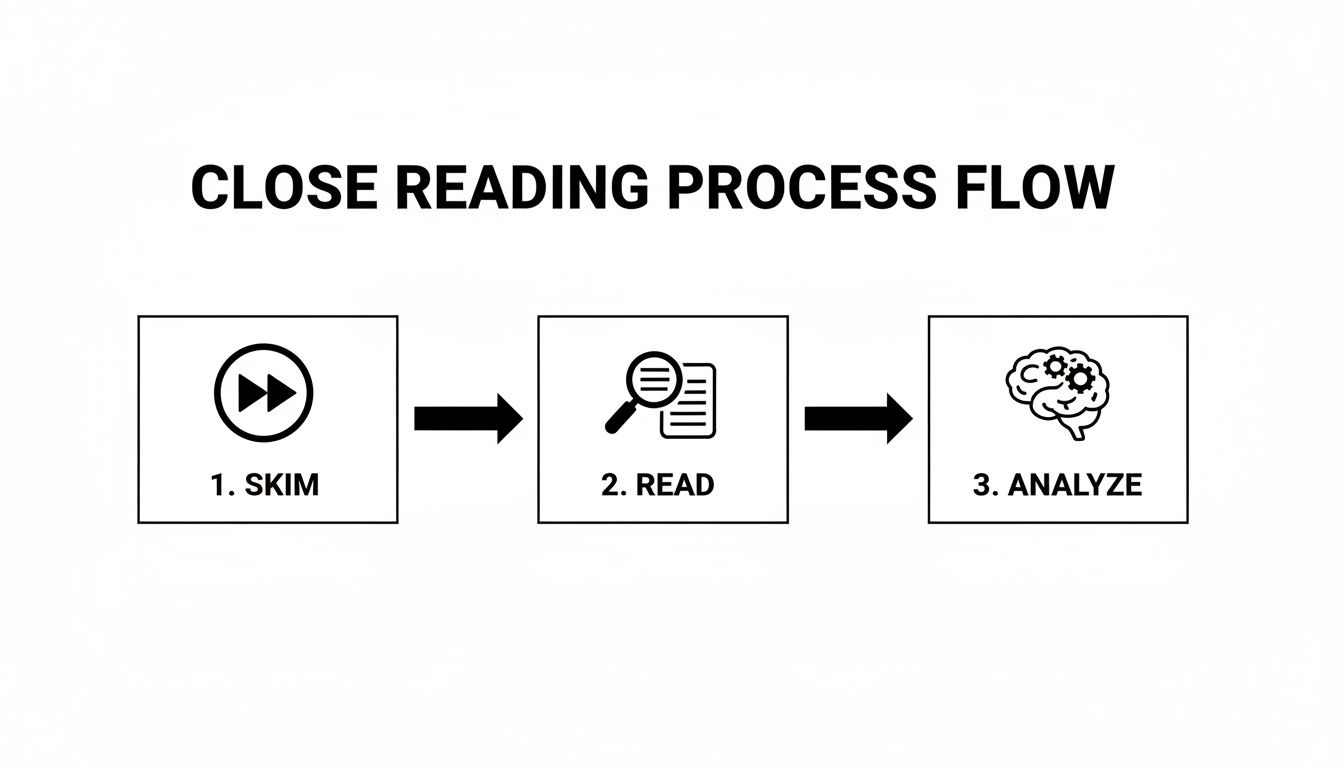
As this shows, the process moves logically from a broad overview to a detailed analysis, making sure you don't miss a thing.
The Third Pass: Connect the Dots and Interpret
For your final pass, you zoom back out. The goal now is to synthesize everything—your big-picture understanding from the first read and all the specific details you uncovered in the second. This is where you form your own interpretation, backed by the evidence you've gathered directly from the text.
You should now be able to tackle more complex questions:
- How do the author's specific choices (word choice, sentence structure) actually support their main argument?
- Is there a deeper meaning or subtext hiding beneath the surface?
- How does this piece fit into a larger conversation, a historical context, or your own knowledge?
This isn't just theory; this structured approach works. Studies show that close reading can improve comprehension of complex texts by 28-35%. The structure is what makes it so powerful: the first read often clears up about 70% of initial confusion, the second pass clarifies another 50% of what’s left by focusing on structure, and the final synthesis can lead to 40% higher retention of the material. You can dive deeper into these findings over at WestEd.org.
By moving from the general to the specific and back again, this three-pass framework turns reading from a passive activity into an active, strategic dialogue with the text. Your analysis becomes not just an opinion, but a conclusion built on a solid foundation of evidence.
Mastering the Art of Annotation and Analysis
Think of close reading not as a passive exercise, but as an active conversation with the text. The author makes points, and you, the reader, need a way to talk back—to ask questions, capture insights, and challenge ideas. That's where annotation comes in. It’s the simple act of writing on the text to create a visual map of your thought process.
Anyone can run a highlighter over a sentence, but that often just adds color to the page without adding much understanding. Real annotation is about systemizing your thoughts. It’s about creating a personal language of marks and notes that helps you track ideas, question assumptions, and link pieces of evidence together.
When you do it right, the text stops being a static document and becomes a dynamic workspace. Every scribble in the margin, every symbol, every underline is a breadcrumb that leads you toward a deeper, more sophisticated understanding.
Building Your Annotation Toolkit
There’s no single “right” way to annotate. The best method is whatever works for you and helps you think more clearly. The trick is to be consistent so your marks become a reliable shorthand.
I always suggest starting with a simple key or legend for your markings. This is a lifesaver when you come back to the text days or weeks later and can't remember what a particular squiggle meant. Here are a few foundational techniques to get you started:
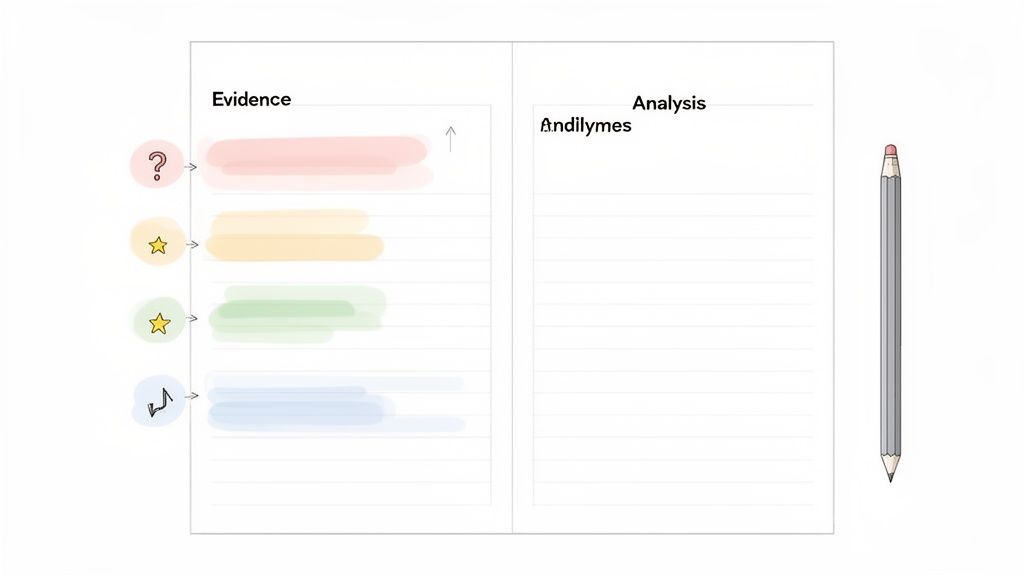
- Color-Coding: Assign specific colors to different textual elements. For instance, yellow could be for main ideas, blue for supporting evidence, and pink for passages that confuse you. To get more out of this, check out our guide on how to highlight a PDF strategically.
- Symbolism: Simple symbols can be incredibly efficient. A question mark (?) flags a point of confusion. An exclamation point (!) marks a surprising statement. A star (★) can single out a killer quote you want to use later.
- Marginalia: This is where the real conversation happens. Use the margins to paraphrase complex sentences in your own words, define tricky terms, ask questions, or connect an idea to something else you've read.
The goal of annotation isn't to decorate the page. It's to document your intellectual journey. A well-annotated text is a record of your critical engagement and analytical discovery.
By weaving these methods together, you create a rich, layered record of your reading experience. This isn't just a helpful habit; it's the engine that drives a successful close reading.
Popular Annotation Strategies
Once you're comfortable with the basics, you can try more structured methods that really push your analysis. These frameworks are designed to create a clear separation between what the text says and what you think it means.
A classic and highly effective approach is the Two-Column Note system. You can do this on a separate sheet of paper or in a digital document by creating two columns:
| Evidence (The "What") | Analysis (The "So What?") |
|---|---|
| Pull direct quotes or paraphrase facts from the text. | Write down your interpretations, questions, and connections here. |
This simple structure is powerful because it forces you to ground every single one of your claims in concrete textual evidence. It’s a great way to keep your analysis from becoming just unsupported opinion.
Another fantastic technique is the Four-Pen Method, which uses different colors to organize your thoughts as you read. The specific colors don't matter, but the system itself is what counts:
- Red Pen: Use this to circle or underline the big stuff—key ideas, powerful word choices, and the author's main arguments.
- Blue Pen: Grab this pen to write questions in the margins. Why this specific metaphor? What does this word imply in this context?
- Green Pen: Use green to make connections, either linking an idea to another part of the text or to your own outside knowledge.
- Black Pen: This is for summarizing. Briefly restate the point of a key paragraph or section in your own words.
A huge part of mastering this is learning to dissect an author's word choice, especially the subtle differences between denotative vs. connotative meanings. Strategies like these give you a clear framework for that kind of detailed work, turning a passive read into a structured, analytical investigation.
Applying Close Reading Skills Across Different Fields
The real power of close reading is its versatility. It's not just a technique for English class. Think of it as a universal key that can unlock the hidden meanings in a legal contract, a scientific study, or a historical letter. The core principles—weighing evidence, questioning the author's choices, and piecing together the deeper meaning—apply everywhere.
When you start using this strategy across different subjects, it fundamentally changes how you process information. Your mind gets trained to spot the nuances, the subtle biases, and the underlying structure of a text, no matter what it's about. You stop just skimming for facts and start digging for a much richer, more critical understanding.
Unpacking Literary Texts
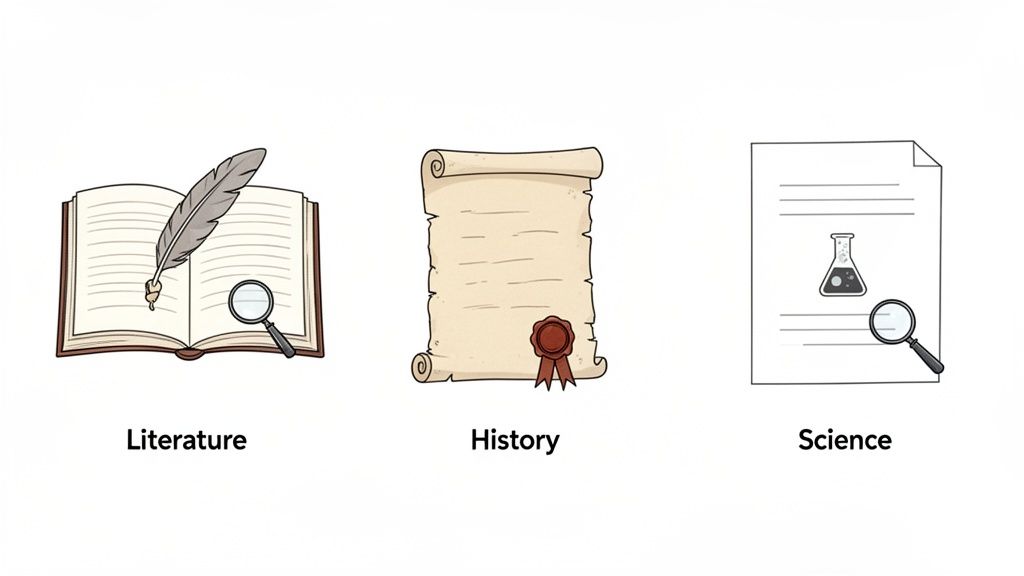
In literature, close reading is the classic tool for peeling back layers of meaning. Here, the focus is squarely on the artistry of the language. How do things like imagery, metaphor, and sentence structure come together to create a specific feeling or idea? You aren't just reading a story; you're taking apart the engine to see how it works.
Take this famous line from F. Scott Fitzgerald's The Great Gatsby:
"He had one of those rare smiles with a quality of eternal reassurance in it, that you may come across four or five times in life. It faced, or seemed to face, the whole external world for an instant and then concentrated on you with an irresistible prejudice in your favor."
A casual reader thinks, "What a nice smile." But a close reader starts asking questions. Why "eternal reassurance"? What's the deal with that phrase "irresistible prejudice"? This deeper look shows us how Fitzgerald masterfully builds Gatsby’s mystique. His charisma feels magnetic, but it also seems like a calculated performance. That smile isn't just friendly; it's a powerful tool of influence.
Examining Historical Documents
When you apply close reading to history, it feels a bit like textual forensics. The goal isn't to appreciate artistry but to uncover purpose, perspective, and bias. You're reading not just for what the document says, but for what it doesn't say—and why.
Let's look at a line from the Declaration of Independence:
"He has plundered our seas, ravaged our Coasts, burnt our towns, and destroyed the lives of our people."
A close read zeroes in on those powerful, emotionally-charged verbs: plundered, ravaged, burnt, destroyed. Thomas Jefferson wasn't just making a list. He carefully chose words to spark outrage and justify a revolution. The analysis reveals the document for what it is: a brilliant piece of persuasive writing, designed to unite the colonies and build a case for war. It’s both a legal argument and powerful propaganda.
A close reading strategy forces you to treat every text as a deliberate construction. It moves you from asking "What does this say?" to the more powerful question, "Why was it written this way?"
Dissecting Scientific Abstracts
In science and other technical fields, precision is everything. Close reading helps you extract key information with surgical accuracy, forcing you to focus on the methodology, the exact claims being made, and the study's limitations. It's about pulling apart an argument to its core components.
Consider this sentence from a fictional scientific abstract:
"Our study suggests a correlational, but not causal, link between daily caffeine intake and increased productivity in controlled settings."
The most important words here are the deliberate distinction between "correlational" and "causal." Someone skimming might jump to the conclusion that coffee makes you more productive. But a close reader spots the nuance. The researchers are making a much more careful claim: the two things happen together, but they haven't proven that one causes the other. That one little phrase defines the entire boundary of the research and prevents a huge misinterpretation.
To help guide your own analysis, you can tailor your questions based on what you're reading.
Guiding Questions for Different Text Types
The table below offers some starting points for different kinds of documents. The goal is to ask targeted questions that get to the heart of how that specific text is constructed.
| Text Type | Key Questions to Ask |
|---|---|
| Literary Text | What literary devices (metaphor, imagery) are used? How does the author's word choice create a specific tone or mood? |
| Historical Document | Who is the intended audience? What is the author's purpose or bias? What does the language reveal about the historical context? |
| Scientific Paper | What specific claim is being made? What is the scope of the methodology? Are there any qualifying words (e.g., "suggests," "may indicate")? |
By simply adjusting your focus, the same core skills of careful observation and critical analysis can help you unlock profound insights, no matter what document is in front of you.
Using Digital Tools to Enhance Your Close Reading
It might seem counterintuitive, but modern technology can be a huge help when you're doing a close reading, especially with a long or complicated document. Think of these tools not as a shortcut that does the thinking for you, but as a smart assistant. They handle the grunt work, freeing you up to focus on the deep, meaningful analysis that really matters.
AI-powered platforms can make the three-pass framework much more manageable, saving you a ton of time without losing any analytical rigor. For instance, a tool like PDF Summarizer can perform that initial scan for you, delivering a high-level overview of a text in just a few seconds. In effect, it automates the first pass, letting you dive right into the more involved work of annotating and questioning the text.
Aligning AI Tools with the Three-Pass Framework
The trick is to strategically match a tool’s features to each stage of your close reading process. You’re not letting the technology take over; you’re telling it exactly how to support your established method. This way, you stay in the driver's seat intellectually while getting a major boost in speed and efficiency.
Here’s a practical look at how an AI assistant can fit into each pass:
- First Pass (The Gist): Use an AI summarizer to get an instant, concise overview. It will pull out the main arguments and key themes, accomplishing the goal of the first pass in a tiny fraction of the time it would take you to read it cold.
- Second Pass (The Details): This is where an interactive chat feature shines. You can ask specific, text-dependent questions like, "What is the author's tone in this section?" or "What evidence supports this claim?" This lets you probe the text’s mechanics, much like you would during the annotation-heavy second pass.
- Third Pass (The Synthesis): When you’re ready to connect the dots, multi-file chat capabilities are invaluable. You can compare arguments across several documents at once, which is perfect for literature reviews or synthesizing research findings.
This is the kind of user interface you'll find in an AI tool designed for document analysis.
The side-by-side view is incredibly useful—you can chat with the document while keeping the original text in sight, and clickable citations jump you directly to the source of the information.
Bridging Traditional Skills with Modern Efficiency
This digital-first approach doesn’t abandon the core principles of close reading that became so central to education after the Common Core State Standards were adopted in 2010. Instead, it builds on them.
Academics working on literature reviews can use these tools to simulate a conversation between different research papers, cross-referencing ideas and even translating dense passages on the fly. For a professional who needs to analyze a 200-page proposal, an AI assistant can deliver the key takeaways three times faster, complete with clickable links to instantly verify the author's intent. You can explore the research on digital tool integration in education to see just how far this has come.
Technology doesn't replace the critical thinking of a close read; it amplifies it. By handling the initial summarization and information retrieval, AI frees up your cognitive resources for the more demanding tasks of interpretation and synthesis.
At the end of the day, incorporating a tool like a free PDF summarizer is about making your close reading strategy more sustainable and scalable. You can approach more complex documents with greater confidence, knowing you have a powerful assistant to help manage the information, check claims, and uncover those subtle details that lead to real insight. The human analyst is still in charge—the tech just provides a much smarter magnifying glass.
Common Close Reading Mistakes and How to Avoid Them
Getting the hang of close reading takes practice, and even seasoned readers can fall into a few common traps. It's best to think of these mistakes not as failures, but as learning opportunities that sharpen your analytical instincts. Knowing what these pitfalls look like is the first step to avoiding them.
One of the biggest hurdles is letting our gut feelings take over without backing them up. You might read a passage and think, "This just feels sad," but a true close reading pushes you to ask, "What in the text is making me feel that?" The goal is to tie every single one of your insights back to concrete evidence you can point to on the page.
Mistake 1: Letting Opinion Replace Evidence
This is probably the most common slip-up. It’s when your analysis leans more on your personal reaction than on what the author actually wrote. It's the difference between saying "I think this poem is about loneliness" and pointing out that "The poet’s repeated use of words like 'empty,' 'hollow,' and 'shadow' builds a pervasive sense of loneliness."
How to fix it: Constantly challenge yourself with one simple question: "Where's my proof?" For every single claim you make about the text, you should be able to highlight a specific word, phrase, or sentence that led you there. This simple habit keeps your analysis grounded in reality.
Mistake 2: Getting Lost in the Weeds
It's surprisingly easy to get so bogged down in dissecting a single word or symbol that you completely lose sight of the author's main point. Think of it like staring at a single brushstroke in a painting so intently that you never actually see the whole picture. The details matter, but only when they connect back to the bigger idea.
- The problem: Your analysis ends up feeling like a random list of observations rather than a coherent argument.
- The solution: Make a habit of pausing to ask, "So what? How does this little detail I found help explain the author's overall message?" This keeps your micro-analysis tied to a macro purpose.
Mistake 3: Summarizing Instead of Analyzing
Simply rephrasing what the author said is paraphrasing—it shows you understood the text, but it isn't analysis. Close reading isn't about what the author said; it's about digging into how they said it and the effect that has.
The easiest way to break this habit is to shift from asking "what" to asking "why." Instead of just noting, "The author says the experiment failed," push yourself further: "Why did the author choose the word 'catastrophic' to describe the failure? What does that specific, dramatic word do to the reader?" That one small change moves you from summary right into the heart of real analysis.
Common Questions About Close Reading, Answered
Even when you have a good roadmap, a few questions always come up on the journey. Let’s tackle some of the most common ones about close reading to make sure you feel confident putting it into practice.
How Long Should a Close Reading Session Really Take?
There’s no magic number here. The time you’ll need is all about the text's length and how complex it is. For a dense paragraph or a short poem, you could easily spend 20-30 minutes digging in.
But for a long article or a book chapter, trying to close read the whole thing in one go is a recipe for burnout. Instead, be strategic. Focus your energy on the parts that matter most, like the introduction, a paragraph packed with data, or the conclusion. The real goal is depth, not speed.
A great way to manage this is to time-box your analysis. For instance, give yourself a focused 45 minutes to really pull apart a research paper's abstract and findings.
Can I Use Close Reading on Any Type of Text?
Absolutely. While people often connect it with analyzing literature, the principles of close reading are valuable for any important document you come across. At its heart, it's about doing a careful, evidence-based analysis of language and structure.
You can close read a:
- Business proposal to find hidden assumptions or risks.
- Legal document to grasp the exact meaning behind every single clause.
- Marketing email to see precisely how it’s trying to persuade you.
What’s the Difference Between Close Reading and Just Reading Carefully?
This is a fantastic question because it gets to the core of the strategy. Reading carefully is all about comprehension—making sure you understand what the author is saying. Close reading pushes beyond that into analysis—it's about asking how the text is constructed to create its meaning.
Think of it this way: Careful reading makes sure you don't miss any information. Close reading helps you uncover the subtext, potential bias, and the specific rhetorical tricks the author is using. It’s a systematic process of rereading, marking up the text, and questioning every choice the author made.
Do I Really Have to Read a Text Three Times?
The "three-pass" method is a fantastic framework, especially when you're just starting out. It gives you a clear, structured path from getting the general idea to forming a deep, nuanced interpretation. But think of it as a helpful guide, not a strict rule you can never break.
Seasoned pros often blend these passes together or move through them more quickly. The key principle isn't the number three; it's engaging with the text multiple times, each with a different focus. You’re always aiming for the same outcome: move from the gist, to the details, and finally to a synthesized understanding of the whole piece.
Ready to make your own close reading process more efficient? PDF Summarizer uses AI to handle the first pass for you, generating instant summaries and allowing you to chat with your documents to ask text-dependent questions. Turn complex PDFs into clear insights without any sign-up needed at https://pdfsummarizer.pro.
Relevant articles
Learn how to summarize book chapters effectively with practical methods, AI tools, and expert tips to create concise, memorable chapter summaries.
Reading comprehension strategies for students to boost understanding and retention with practical, classroom-tested tips you can start using today.
Transform your comprehension with our guide on summarizing in reading. Learn actionable techniques and practical tips to retain more from every text.