Summarize Book Chapters: A Quick Guide (summarize book chapters)
Learn how to summarize book chapters effectively with practical methods, AI tools, and expert tips to create concise, memorable chapter summaries.
To get the most out of a book chapter, you need a system—a way to read actively and take smart notes. It’s about digging in to find the chapter’s main point, its core themes, and the evidence backing them up. The final step, and the most important one, is putting all of that into your own words. That's when you shift from just reading to actually learning.
Why Getting Good at Chapter Summaries Is a Game-Changer
Let's be honest, staring at a 40-page chapter is daunting. It's even worse when a deadline for a project or a quiz is breathing down your neck. The real test isn't just surviving the read-through; it's remembering the important stuff long after the book is closed. Learning how to properly summarize a chapter isn't just a study trick—it’s a fundamental skill for anyone who needs to learn quickly and think on their feet.
When you force yourself to boil down complex ideas, you're building a mental muscle that pays dividends in school and at work. It’s what separates someone who just recognizes information from someone who genuinely gets it. Summarizing makes you wrestle with the author's ideas, challenge their arguments, and rebuild everything in a way that clicks for you.
It's Not Just for Students
This skill is incredibly valuable once you're out of the classroom. Imagine a project manager who has to get their team up to speed on a dense, 100-page industry report. If they can deliver a sharp, accurate summary, the team can act on the right information. If not, everyone gets bogged down in details. The same goes for a lawyer who needs to turn massive case files into clear briefs for a partner. In jobs like these, summarizing isn't just a nice-to-have; it's a critical function.
The payoff for mastering this is huge:
- You'll actually understand more. Instead of just scanning words, you'll start interpreting concepts and making them your own.
- You'll remember things better. The simple act of rephrasing and structuring information helps lock it into your long-term memory. In fact, studies show students who summarize what they read can retain up to 50% more information than those who just reread it.
- You'll think more critically. Summarizing forces you to decide what's essential and what's just noise, which is the very core of analytical thinking.
At its heart, summarizing is an act of translation. You're taking the author's detailed world of ideas and creating a simple, clear map that you can use to find your way back anytime. You turn a one-time read into a piece of knowledge you truly own.
Proven Techniques for Manual Summarization
Before you let an AI do the heavy lifting, it's worth mastering the art of manual summarization. Honestly, it’s a foundational skill. Building this mental muscle helps you truly understand and analyze what you’re reading, not just skim it. The real goal isn't just to make a chapter shorter; it's to internalize its core message. That process starts before you even think about writing a summary.
Think of it like a reconnaissance mission. Instead of just jumping into the first paragraph, do a quick scan of the entire chapter. Look at the headings, subheadings, any words in bold, and especially the introduction and conclusion. This gives you a mental map of where the author is going, making it much easier to fit all the details together later.
Active Reading and Targeted Questioning
Once you've got the lay of the land, it's time to switch from passive to active reading. Passive reading is just letting your eyes drift across the page. Active reading is like having a conversation with the author.
As you go, keep asking yourself a few key questions:
- What’s the one big idea the author is trying to get across here?
- How are they backing it up? What evidence or examples are they using?
- Are they bringing up any counterarguments or other points of view?
This constant questioning forces you to dig in and engage with the material on a much deeper level. If you want to take it even further, look into the close reading strategy. It's a fantastic method for dissecting complex texts piece by piece. This kind of active engagement is really what powers a good summary.
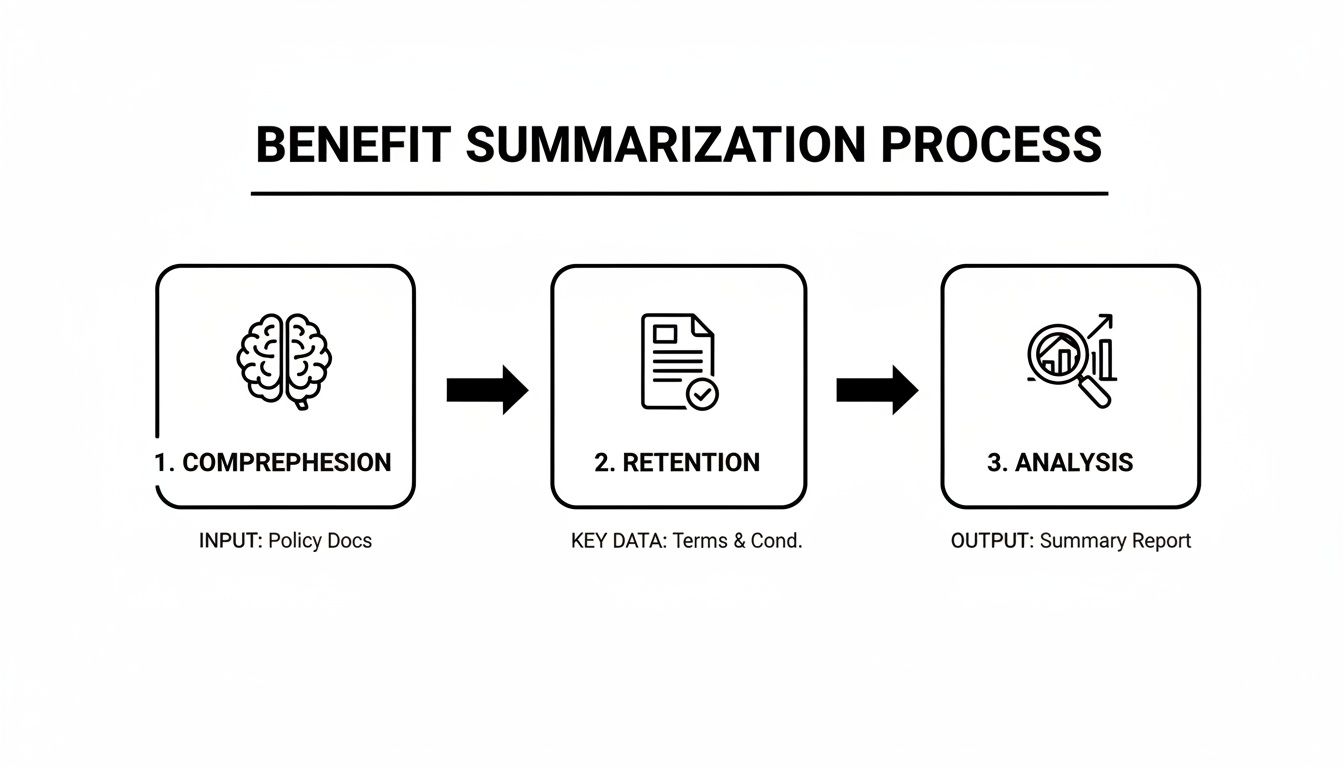
This simple flow shows that summarizing is more than just writing something down. It’s a full-on cognitive workout that improves your comprehension, locks in the information, and makes you a sharper thinker.
Choosing Your Note-Taking Method
As you start pulling out the key ideas, you need a way to capture them. Let's be real—not all note-taking methods are built the same. The best one for you will depend on the book you're reading and your own personal style. Finding a system that clicks is a game-changer for creating a summary you can actually use.
Choosing the right note-taking method can make all the difference. Here’s a quick breakdown to help you decide which approach might fit the chapter you're tackling.
Comparing Note-Taking Methods for Summarization
| Method | Best For | Key Advantage |
|---|---|---|
| Cornell Method | Structured academic texts and lectures where you need to recall specific facts. | The built-in summary section forces you to synthesize information immediately. |
| Outlining | Texts with a clear hierarchical structure, like textbooks or research papers. | Creates a logical, easy-to-scan framework of the chapter’s main points and sub-points. |
| Mind Mapping | Creative or conceptual chapters where ideas are interconnected in non-linear ways. | Visually represents connections between concepts, which can improve creative thinking. |
The best advice I can give is to try each one out. See what feels natural. The whole point is to create notes that are more than just a list of facts—they should be a launchpad for writing the summary in your own voice.
The real magic of manual summarization lies in the act of translation. You are filtering the author's extensive argument through your own understanding and reassembling it. This process ensures you don't just remember the information—you genuinely comprehend it.
These skills have a life well beyond summarizing single chapters. Once you get the hang of it, you can apply the same principles to bigger projects. For instance, if you ever need to write a book synopsis, you’ll use these exact techniques to capture the essence of an entire manuscript. The scale is different, but the core skill of identifying key themes and arguments is exactly the same.
How AI Tools Can Summarize Book Chapters Instantly
While there's no substitute for the deep understanding you get from summarizing manually, let's be realistic—sometimes you just don't have the time. Picture a student buried under three dense academic readings, all due tomorrow. This is exactly where AI tools designed to summarize book chapters become an indispensable part of a modern study routine.
The process is surprisingly straightforward. Instead of blocking out hours to read and outline, that student can just upload a PDF of the chapter into a tool like PDF Summarizer. In a matter of seconds, the AI scans the text and spits out a concise, organized summary, highlighting the main arguments, key evidence, and important terms.
This initial AI-generated draft is an incredibly powerful starting point. It gives you an immediate bird's-eye view, letting you grasp the chapter's core ideas before getting bogged down in the details. It's not about skipping the work; it's about amplifying your efforts with serious speed.
Going Beyond Basic Summaries with Interactive AI
The real magic of today's AI summarizers is in their interactive features. A static summary is helpful, but having a conversation with the document? That’s a total game-changer. It turns a flat piece of text into a dynamic learning space.
For example, our student might get the initial summary but still be fuzzy on a specific concept. Instead of re-reading the same dense paragraphs over and over, they can use a "Chat with Document" feature to ask pointed questions.
- "What is the author's main thesis in this section?"
- "Can you explain the methodology used in this study in simple terms?"
- "List the key evidence used to support the argument on page 12."
This kind of direct Q&A makes for a much more targeted and efficient way to learn. You get the exact information you need, right when you need it, without getting lost in the weeds.
Using an AI to summarize a chapter is like getting a pre-briefing from a research assistant. The AI does the initial heavy lifting of pulling out the key information, freeing up your mental energy to focus on the more important work of analysis and synthesis.
When you can actively interrogate the text for answers, learning becomes far more engaging. To get the most out of this, it's worth understanding the different kinds of AI assistance available by exploring the differences between AI notes vs. AI summaries.
Verifying Information with Precision
Of course, the big question with any AI-generated content is accuracy. How do you know the summary is a faithful take on the original text? The best tools have this figured out by linking the summary directly back to the source material, so there’s complete transparency.
One of the most useful features is a side-by-side view that includes clickable citations. This lets you see the AI's response right next to the original PDF, with footnotes or links embedded directly in the summary.
Here you can see how an AI tool answers a specific question and provides a direct citation.
When you click on a citation, the tool instantly jumps you to the exact sentence or paragraph in the original document where that information came from. This makes verification almost effortless. You can quickly confirm that the AI’s interpretation is accurate and has the right context. For anyone wrestling with dense academic or technical texts, being able to check sources on the fly is a lifesaver. If you're looking for more tips, check out our guide on how to use AI to summarize a PDF.
This feature perfectly bridges the gap between AI speed and human verification. It helps you move quickly without sacrificing the rigor that academic and professional work demands, ensuring your summaries are both fast and trustworthy.
Pulling It All Together: Synthesizing Ideas Across Multiple Chapters
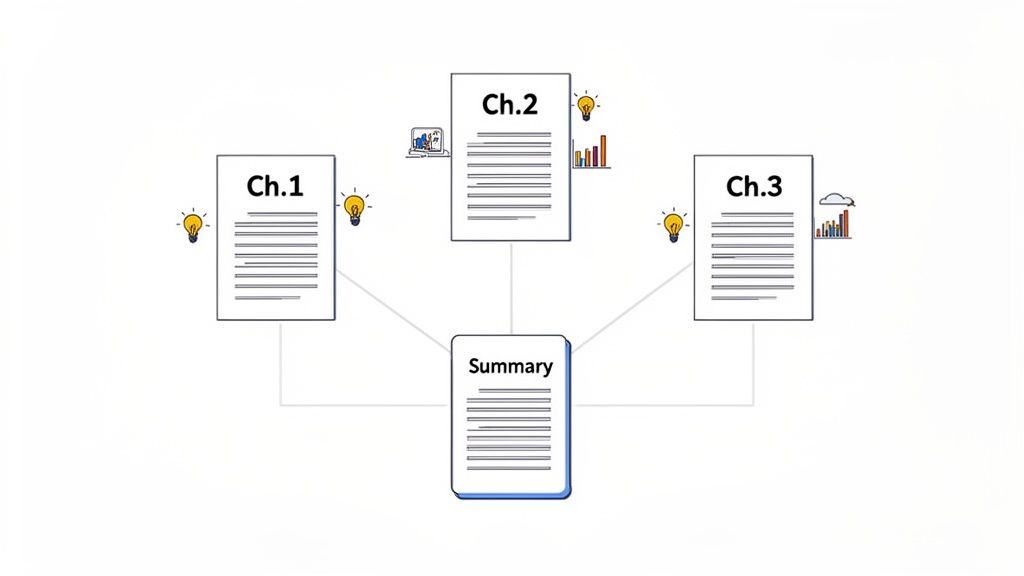
Summarizing one chapter is a good start, but the real magic happens when you start connecting the dots between several of them. This is where you graduate from simply recapping information to truly understanding the big picture.
The game changes from asking "What did this chapter say?" to "What's the larger conversation happening here?" This skill, often called synthesis, is essential for any serious work—whether you're conducting academic research, analyzing market trends, or just trying to get your head around a dense non-fiction book. Doing this by hand means constantly flipping between your notes, hunting for recurring themes, contradictions, or arguments that build on each other. It’s a lot to juggle.
How Multi-Document Analysis Changes the Game
This is precisely the kind of heavy lifting that modern AI tools were built for. Picture a grad student working on a literature review. Instead of tackling one research paper at a time, they can upload all five into a single chat session and interact with them as a single, unified body of knowledge.
This completely shifts your approach to reading. You're no longer stuck summarizing each chapter in isolation. Instead, you can ask questions that span the entire collection of documents, letting you spot patterns and conflicts that might have taken you hours to uncover manually. If you want to dive deeper into this concept, we have a guide on what synthesizing information really means.
Asking the Right Cross-Document Questions
The real power here is in the questions you can ask. By having all your sources in one place, you can prompt the AI to draw connections and deliver a much more holistic view.
For instance, a marketing analyst could upload three different competitor reports and ask:
- "What are the common market trends mentioned across all three of these reports?"
- "Compare the customer demographics described in Chapter 2 of Report A with Chapter 4 of Report C."
- "What are the key strategic differences between these three companies, based on these annual reviews?"
This isn't just about pulling out chunks of text. The AI can actually find and connect related ideas from different files, weaving them together into a single, cohesive answer.
A multi-file chat doesn't just combine documents; it creates a dialogue between them. You're no longer just reading sources—you're facilitating a conversation among them to uncover deeper insights.
The efficiency gains are substantial. In fact, some studies show that professionals can cut down the time they spend hunting for information by up to 40% with this approach, which frees them up to focus on the actual thinking and strategy.
Building Integrated Knowledge, Not Just Individual Summaries
Ultimately, the goal is to construct an understanding that’s more than just the sum of its parts. When you summarize book chapters one by one, you get a series of disconnected snapshots. When you synthesize them, you get the full story.
Think about a lawyer reviewing case law. They could upload several legal precedents and ask, "What's the common thread of legal reasoning in these cases regarding intellectual property?" The AI can trace that line for them, connecting arguments and outcomes across separate documents. A pile of research quickly becomes a clear, actionable legal strategy. This isn't just about speed; it's about adding a whole new level of depth to your analysis.
How to Evaluate and Refine Your Summaries
Drafting a summary is just the first part of the job. Whether you wrote it yourself or got a head start with an AI, that summary is only useful if it’s accurate and clear. The final step—which so many people skip—is a quick quality check to make sure it actually does what you need it to do.
If you don't take a moment to review, you could end up studying from a flawed interpretation of the text. A solid summary has to stand on its own, faithfully representing the original chapter without adding your own spin or twisting the author's message. This last look is what makes a rough draft into a tool you can rely on.
A Practical Checklist for Quality Control
Before you call it done, put your summary through a quick filter. This isn’t about writing a perfect literary analysis; it’s a simple, practical check to see if you’ve captured the right information.
Ask yourself these four questions:
- Did I get the main argument? Your summary absolutely must nail the central point or thesis. If it’s just a list of random details without the core idea, it's not a true summary.
- Is it objective? Be honest—did any of your own opinions sneak in? Your summary needs to reflect the author's viewpoint, not yours. Hunt down and remove any personal bias.
- Does it match the author's tone? Was the chapter persuasive, critical, or just laying out facts? A good summary should carry the same feel to keep the original context intact.
- Is it concise and easy to understand? A great summary is all about clarity. Ditch the jargon and any wordy phrases that muddy the waters.
The goal isn’t just to make the text shorter; it's to make it clearer. A truly effective summary acts as a lens, bringing the author's most important ideas into sharp focus without distortion.
Turning AI Summaries into Personal Knowledge
When you summarize book chapters with a tool like PDF Summarizer, you get an excellent first draft. But to really make that information stick, you need to add your own layer of insight. An AI is great at pulling out key facts, but it doesn't know how they connect to your specific course or project.
This is your chance to turn a generic summary into a personal study guide. Start by annotating the AI's output. Jot down your own thoughts. How does this chapter relate to what the professor said in last week's lecture? Does this argument challenge something you read in another book?
This active engagement does two powerful things. First, it forces you to think critically about the material, which is a proven way to improve memory and retention. Second, it helps you build a network of knowledge, connecting the dots between different chapter summaries until you have a cohesive understanding of the entire subject. The AI gives you the skeleton; it's your job to add the muscle.
Common Questions About Summarizing Book Chapters
Even with the best strategies in place, you’re bound to have questions when you start summarizing book chapters. It's just part of the process. Getting some solid answers upfront can save you a ton of frustration and help you get much better results. Let's dig into a few of the most common questions I hear.
How Long Should a Chapter Summary Be?
This is the classic "how long is a piece of string?" question, but there is a helpful guideline. I always tell people to aim for 10-15% of the original chapter’s length. So, if you're wrestling with a dense, 30-page academic chapter, you're probably looking at a 3 to 4-page summary.
But remember, that's just a starting point. The real answer depends on why you're summarizing. If you just need a quick rundown of the main arguments for a class discussion, a single page might do the trick. If you're studying for a major exam, you’ll need something more substantial to capture all the key evidence, examples, and subtle details.
What Is the Biggest Mistake to Avoid When Summarizing?
Hands down, the single biggest mistake is copying sentences word-for-word from the book. I see this all the time. It’s not just about the risk of plagiarism; it’s that you’re completely bypassing the learning process. When you just copy and paste, your brain isn't doing the hard work of actually understanding the material.
A true summary is an act of translation, not transcription. You have to write it entirely in your own words. This forces you to process the information, really internalize the concepts, and then explain them from a place of genuine understanding.
Can AI Summarizers Handle Technical or Academic Texts?
Yes, and they’ve gotten surprisingly good at it. Today’s AI models have been fed a massive diet of academic papers, technical manuals, and scholarly books. They're built to recognize complex jargon, follow the structure of formal arguments, and pull out the core thesis from some pretty dense writing.
The key to getting the most out of them is to use a tool that lets you interact with the summary. You want to be able to ask follow-up questions like, "Can you explain this specific theory in simpler terms?" That's how you can dig deeper and clarify any tricky points the first summary might have simplified.
Is It Better to Summarize Manually or Use an AI Tool?
Honestly, the best approach isn’t an either/or—it’s a blend of both. Think of it as a partnership where each method plays to its strengths.
- Manual Summarizing: This is unbeatable for deep learning and actually remembering what you read. The physical act of writing and re-organizing the information helps lock it into your memory.
- AI Summarizing: The speed and efficiency here are incredible. AI is perfect for getting a quick first draft or for tackling a huge volume of reading when you're short on time.
My favorite workflow is to let an AI tool like PDF Summarizer generate the first pass. Then, I go through it myself—editing, annotating, and adding my own thoughts. This way, I can connect the new ideas to what I already know, which makes the learning stick.
Ready to change the way you read and learn? PDF Summarizer lets you get instant summaries, ask questions about your documents, and check the facts with clickable citations. Give it a try for free and see how you can turn any dense text into clear, usable knowledge. Get started at https://pdfsummarizer.pro.
Relevant articles

Streamline your research and summary tasks with AI. Analyze documents, synthesize insights, and craft sharper reports, faster and with confidence.
Learn how to create executive summary that secures buy-in. Our guide offers actionable steps, real-world examples, and AI-powered workflows to get results.
Learn how to summarise a document effectively. Our guide covers proven manual techniques and smart AI tools to help you master any text quickly.
What is close reading strategy? Learn a clear, step-by-step approach to analyze texts and uncover meaning (what is close reading strategy) for practical reference.
Learn how to take notes from textbooks using proven methods that boost retention. Go beyond highlighting with actionable strategies for effective learning.
Learn how to improve reading comprehension skills with practical, proven strategies for active reading, vocabulary, and retention.