How to Create Executive Summary that Wins Over Decision-Makers
Learn how to create executive summary that secures buy-in. Our guide offers actionable steps, real-world examples, and AI-powered workflows to get results.
Before you can write a great executive summary, you have to get one thing straight: it’s not an introduction. It's a complete, miniature version of your entire report. It needs to stand on its own, giving a busy executive everything they need—the problem, the most critical findings, and your final recommendation—to make a decision in just a few minutes.
A well-written summary doesn't just inform; it persuades and pushes for action.
What an Executive Summary Really Does
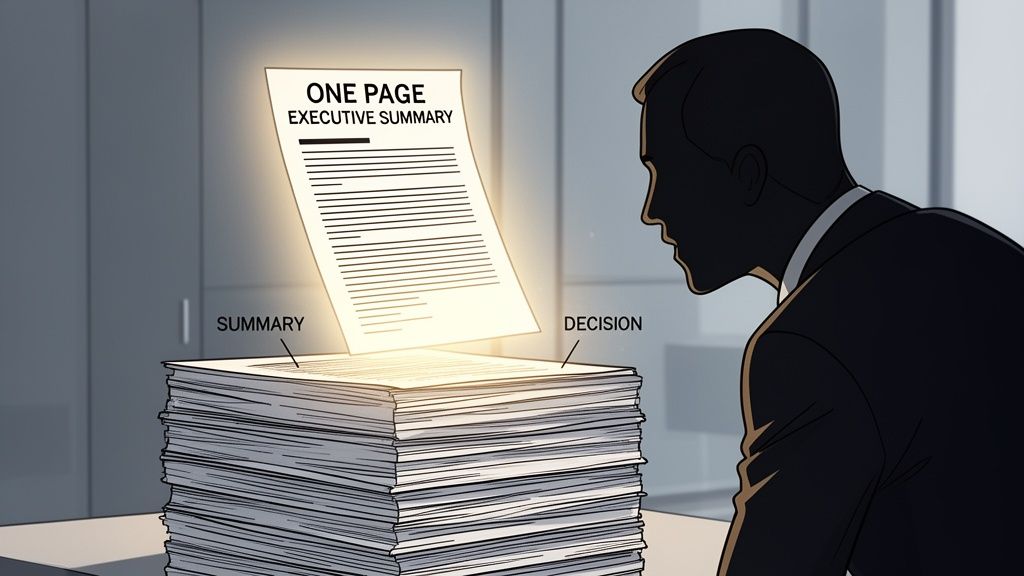
Think of the executive summary as the most valuable piece of real estate in your entire report. It's often the only part a key stakeholder will actually read. Its job isn't just to condense information but to act as a powerful tool to get something done.
Imagine handing a 100-page market analysis to your CEO five minutes before her next board meeting. A sharp, compelling summary can get your project the green light right there. A weak one guarantees the full report ends up at the bottom of a pile, unread. It’s a high-stakes document, and it has to deliver.
Ultimately, an executive summary has to accomplish three things:
- Inform Quickly: Get the reader up to speed on the core issue and key takeaways without forcing them to hunt through pages of data.
- Persuade Clearly: Build a strong case for a specific course of action, using the best evidence from the main document.
- Empower Decisions: Give executives the confidence to make an informed choice based only on what they read in the summary.
The Strategic Advantage of a Great Summary
The biggest mistake I see people make is treating the summary as an afterthought—something quickly slapped together at the end. That completely misses the point. When you craft an executive summary with intention, you're not just summarizing; you're framing the entire narrative and guiding how the reader will interpret your work.
The best executive summaries don't just shorten a document; they sharpen its focus. They answer the implicit question on every executive's mind: "Why does this matter to me, and what should I do about it?"
This is where its real power lies. It's your single best chance to grab attention and drive a result. For instance, a summary for a new product launch isn't just a list of features. It’s about hammering home the market gap, the projected revenue ($2.5M in the first year), and a direct recommendation for immediate budget approval.
To ensure your summary is always on point, it helps to have a mental checklist of its core parts. This table breaks down the essentials.
Key Components of an Effective Executive Summary
| Component | Purpose | Example Snippet |
|---|---|---|
| Opening Statement | Immediately state the core problem or opportunity. | "This report addresses the 15% decline in Q3 customer retention by proposing a new tiered loyalty program." |
| Key Findings & Analysis | Present the most critical data and insights from your research. | "Our analysis of competitor programs shows a direct correlation between loyalty rewards and a 20% increase in repeat purchases." |
| Proposed Solution | Clearly describe the recommended course of action. | "We recommend launching 'ProTier Rewards,' a three-level system designed to incentivize high-value customers." |
| Justification & ROI | Explain why this solution is the best option, with financial backing. | "Projected to boost retention by 10% in six months, this program offers an estimated ROI of 3:1 within the first year." |
| Call to Action | State exactly what you need from the reader to move forward. | "We are seeking a budget approval of $75,000 to initiate development and a Q1 launch." |
Having these components in mind ensures you cover all the bases and create a document that's not just informative, but truly persuasive.
Modern Tools Make the Process Smarter
Crafting this kind of tight, compelling narrative used to mean hours of painstaking work—manually highlighting, copying, and pasting key facts from dense reports. Honestly, it was a grind.
Today, the process is much more efficient. Tools like the PDF Summarizer give you a massive head start. Instead of sifting through dozens of pages or multiple files, you can use an AI-powered tool to pull out the essential insights in seconds.
This kind of technology is brilliant for cutting through the noise, spotting recurring themes, and extracting specific data points with their sources automatically linked. This frees you up to spend less time on tedious information gathering and more time on the strategic work: building a persuasive, data-backed argument that will resonate with your audience. The result is a more accurate and compelling summary, created in a fraction of the time.
Laying the Groundwork Before You Even Write
The best executive summaries are won or lost before you type a single word. It’s a common temptation to jump right in, but that’s like trying to navigate a new city without a map—you’ll get somewhere, but probably not where you intended.
Success starts with a bit of strategic groundwork. It’s about building a solid foundation based on two simple but powerful ideas: know who you’re talking to and know what you want from them. This isn't just busywork; it's what makes every sentence you write land with purpose and impact.
First, Get to Know Your Audience
Before you can convince anyone of anything, you have to understand them. An executive summary is never a one-size-fits-all document. The data and tone that click with a Chief Technology Officer will almost certainly miss the mark with a Chief Financial Officer.
To write something that truly connects, you need a clear picture of your reader. Take a moment to ask yourself a few critical questions:
- What's their role and expertise? Are they a technical expert who will dig into the data, or a high-level executive focused purely on the bottom line?
- What do they already know about this? Don’t waste their time with background information they already have. Get straight to the point with what's new and what matters.
- What are their biggest priorities and pain points? An investor is hunting for ROI. A project manager is worried about timelines and resources. Speak their language.
For instance, if you’re presenting to a board of non-technical directors, you’d skip the jargon and zero in on market share, competitive edge, and financial projections. But for an engineering lead? You’d want to highlight technical innovation, feasibility, and how it integrates with existing systems.
A huge mistake people make is writing for a generic "stakeholder." Try picturing a specific person instead. This simple mental trick forces you to sharpen your message, making it exponentially more powerful.
Then, Define Your Core Objective
With a clear audience in mind, your next job is to nail down exactly what you want to achieve. Without a specific goal, an executive summary is just a jumble of facts. With one, it becomes a tool of persuasion.
Your objective should be a single, clear sentence that acts as your North Star for the entire writing process. It keeps you focused and forces you to select only the information that serves a purpose. Thinking this through is also the first step in synthesizing information from your source documents, as you’ll immediately start spotting the data that supports your goal.
Look at the difference between a vague goal and a powerful one:
| Vague Goal | Sharp, Action-Oriented Objective |
|---|---|
| "To summarize the Q3 marketing report." | "To secure a $250,000 budget for the Q4 campaign by showcasing Q3's strong ROI." |
| "To provide a project update." | "To get the green light for Phase 2 by proving we're on schedule and 10% under budget." |
| "To share new research findings." | "To convince leadership to adopt the new CRM by demonstrating it will boost team productivity by 15%." |
This kind of clarity is everything. A strong objective turns your summary from a passive document into an active proposal.
Align Your Message with Your Goal
Once you know your audience and your objective, the last piece of the puzzle is aligning them. This is where you become a ruthless editor. You must select only the information that speaks directly to your reader's priorities and nudges them toward your desired outcome.
If you need funding, every fact and figure should build an undeniable business case. If you need a project approved, every point should scream feasibility and success. This tight alignment is what makes a summary not just informative, but genuinely persuasive. It sets you up to write a document that doesn't just get read—it gets results.
Extracting Key Insights with Modern Tools
Let's be honest, manually sifting through dense reports to find the golden nuggets of information is a slow, painstaking process. It’s a relic of a time before we had smarter ways to work. Today, the real challenge isn't just reading the information—it's synthesizing it quickly and accurately, especially when you're juggling multiple sources.
This is where a modern workflow makes all the difference. Imagine you're a consultant tasked with creating an executive summary that pulls together findings from three different 50-page market analysis reports. The old way meant days of reading, highlighting, and manually compiling notes. That kind of grind is not just slow; it's practically begging for human error and fatigue to creep in.
There’s a much better way.
A Modern Workflow in Action
Instead of reading every single page, you can use an AI-powered tool like PDF Summarizer to do the heavy lifting. The process is surprisingly straightforward: upload all three reports into a single conversational interface. From there, you can treat the documents like a subject matter expert you can interview directly.
This simple shift turns a multi-day reading marathon into a focused, hour-long analytical session. It allows you to ask targeted, cross-document questions that get right to the heart of what you need to know.
For instance, you could ask:
- "What are the primary market risks identified across all three of these reports?"
- "Compare the Q4 growth projections from Document A and Document C."
- "Summarize the key competitive advantages mentioned in Document B."
The AI synthesizes the information from all your sources and gives you a cohesive answer. This helps you rapidly create an executive summary that isn't just a rehash of one document, but a true synthesis of several.
The real power here is the inclusion of clickable citations. Every piece of information the AI generates is linked directly back to the specific passage in the source PDF. This allows for instant verification and ensures your summary is built on a foundation of solid, accurate evidence.
This whole process removes the grunt work, freeing you up to focus on the truly strategic task: crafting a compelling narrative for your summary. If you want to dive deeper into this, check out our guide on the benefits of using a PDF summary generator.
Why This Matters in Today’s Document-Heavy World
This shift towards smarter document analysis couldn't be more timely. The global PDF software market was valued at USD 2.15 billion in 2024 and is projected to skyrocket to USD 5.72 billion by 2033, growing at a robust compound annual growth rate of 11.47%. This explosive growth shows just how indispensable PDFs are, with over 98% of businesses relying on them for external communication. We're dealing with a staggering 2.5 trillion existing PDFs worldwide, and more than 290 billion new ones are created each year.
The sheer volume of information makes manual analysis impractical. AI-driven tools are no longer a luxury; they're a necessity for anyone who needs to build an executive summary from complex source materials. To truly pinpoint the most impactful information, it's worth exploring tools for advanced AI-powered data analysis.
The infographic below illustrates the foundational steps that should come before you even start extracting data. Getting this right ensures your efforts are always aligned with your summary's goals.
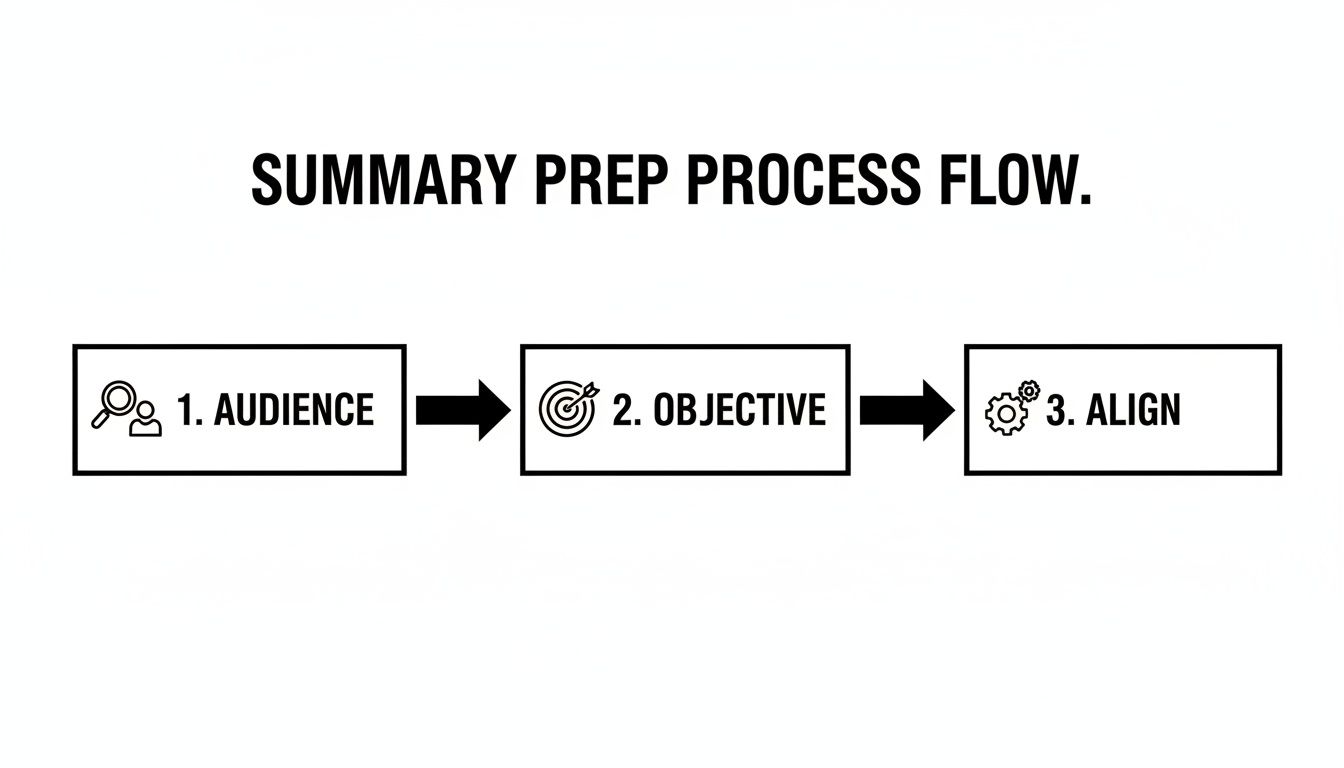
As you can see, a clear understanding of your audience and a defined objective are critical. These first two steps are what allow you to align your summary's content effectively from the start.
Structuring Your Summary for Maximum Impact
Once you’ve pulled out all the key insights from your documents, the real work begins: weaving them into a story that sticks. A truly great executive summary isn't just a jumble of facts. It's a carefully constructed narrative that walks your reader from a critical problem straight to a clear, compelling solution. The structure in writing is everything here.
Too often, summaries just list findings in the order they were discovered. That’s a mistake. A powerful summary builds momentum and is engineered to get a decision. It follows a deliberate flow that respects your reader's time by putting the most crucial information right up front.
Start with a Powerful Hook
You’ve got about ten seconds to grab your reader. Don’t waste them with predictable lines like, "This report discusses..." Instead, lead with your single most important finding, the biggest threat, or the most lucrative opportunity.
Let's say you're summarizing a market analysis. A flat opening would be: "This document analyzes the market for our new software." A much better hook? "Our analysis reveals a $5 million untapped market segment that our competitors have completely overlooked." Now that tells the reader exactly why they need to keep reading.
A strong opening like this sets the tone for the entire document. It creates immediate urgency and makes the reader lean in, eager to hear your plan.
Provide Essential Context and Core Findings
Right after the hook, give your reader just enough context to get their bearings. This isn’t the place for a detailed history lesson. A single sentence or two will do. For example: "Following a 15% decline in Q2 sales, we launched this research to find the root cause."
From there, you’ll present your most important findings, each backed by a specific, hard-hitting data point. This is where you have to be ruthless. Don't list everything you found; cherry-pick the top two or three insights that directly pave the way for the conclusion you're about to make.
- Focus on the "So What?": Never just state a fact. Explain its impact. Instead of, "We found that 70% of customers are under 30," try this: "Our research shows 70% of our target customers are under 30, a demographic that overwhelmingly prefers mobile-first purchasing."
- Use Numbers: Quantify everything you can. "A 40% increase in support tickets" has a much greater impact than "a rise in support tickets."
The goal here is to build a logical bridge. You're connecting the initial problem (the hook) to the eventual solution (your recommendation) with a foundation of irrefutable evidence.
Move to a Clear Conclusion and Decisive Recommendation
Your conclusion should feel like the inevitable result of the findings you just presented. It’s a direct, unambiguous statement that sums up the situation. For instance: "The data clearly indicates that our outdated desktop platform is the primary driver of customer churn among our most valuable demographic."
That one sentence perfectly sets the stage for the most important part of your summary: the recommendation. This is where you tell them exactly what to do next. Vague suggestions are the enemy. You need to be specific, decisive, and actionable.
Let’s look at the difference between a weak recommendation and one that gets results:
| Weak and Passive | Strong and Actionable |
|---|---|
| "Further research is needed to explore mobile options." | "We recommend allocating a $50,000 budget to develop a mobile app prototype in Q4." |
| "The company should consider updating its platform." | "We propose an immediate project to overhaul the user interface, with a target launch of Q1." |
| "There are opportunities for growth in the new market." | "We recommend launching a targeted pilot program in the Northeast region with a $20,000 marketing budget to validate demand." |
A strong recommendation provides a clear path forward, complete with the required resources, timelines, and budgets. It turns your summary from a simple report into a real business proposal. If you want to see how this is done across different industries, reviewing a variety of executive summary examples can be incredibly helpful.
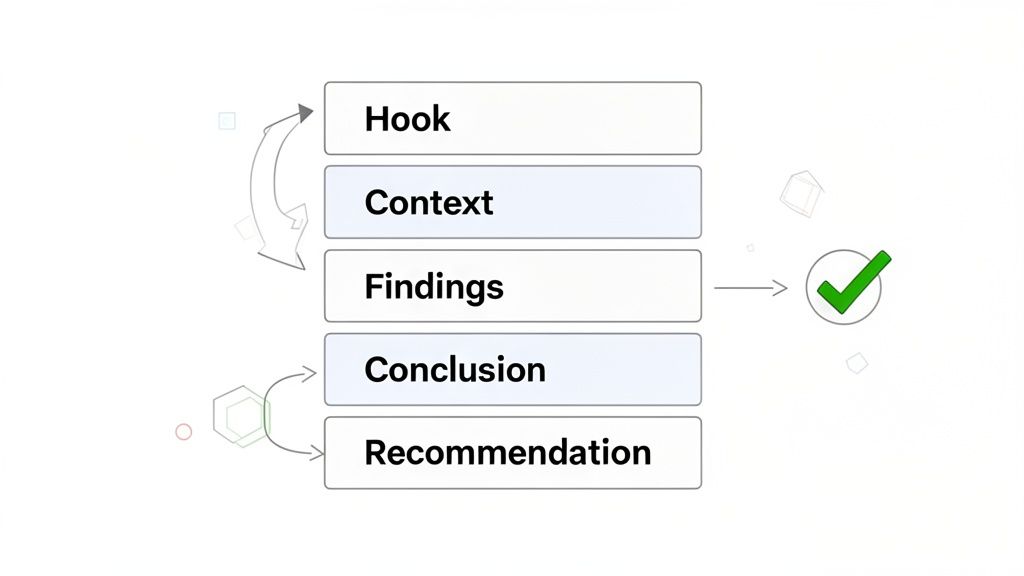
Ultimately, this structure—Hook, Context, Findings, Conclusion, Recommendation—creates a persuasive arc. It takes your reader on a journey from a compelling problem to an undeniable solution, making it incredibly easy for them to say "yes."
Polishing Your Draft from Good to Great
Getting that first draft down is a huge milestone, but the real magic happens in the editing. This is where a good summary becomes a great one—a document that not only informs but persuades. Think of it as the final 10% of the effort that delivers 90% of the impact. It's about moving from a simple collection of facts to a sharp, compelling narrative.
You have all the raw footage. Now it's time to edit it down to the most powerful scenes that tell a clear story and drive your reader toward a decision. This final pass makes all the difference.
Cut the Clutter and Sharpen Your Language
Your first editing pass should be ruthless. The mission is simple: hunt down and eliminate every word that doesn’t add value. This means cutting the jargon, corporate buzzwords, and any acronyms your audience might not immediately recognize.
Clarity is king. For instance, a phrase like, "We will leverage synergies to optimize our go-to-market strategy" is vague and weak. Instead, write, "We'll combine our marketing and sales teams to launch the product more effectively." The second version is direct, confident, and leaves no room for misinterpretation.
This is also your chance to inject a confident, authoritative tone.
- Scrap the weak phrases: Words like "we think," "it seems," or "it might be possible" kill your credibility. Get rid of them.
- Embrace the active voice: Instead of the passive "The report was completed by our team," write "Our team completed the report." It’s punchier and takes ownership.
Adopting an assertive tone isn't about being aggressive; it's about showing conviction. It tells the reader your recommendations are built on a solid foundation of research and analysis.
The Art of Extreme Condensing
Brevity is the soul of an executive summary. Your target is to get the summary down to about 5-10% of the original document's length. This isn't just an arbitrary number; it's a practical necessity born out of respect for an executive's packed schedule.
A great summary isn't short because it's less important. It's short because every single word has been handpicked for maximum impact. The goal is to deliver the highest possible signal-to-noise ratio.
To achieve this, you have to be relentless. Go through your draft line by line and ask, "Is there a simpler way to say this?" You’ll be surprised how often a ten-word sentence can be trimmed to six without losing a drop of meaning. This tightening process makes your writing more forceful and much easier to digest.
This is especially critical today. Professionals are drowning in documents—in fact, PDFs are the web’s second-most-served file type after JPEGs, and their creation has been climbing by 12% annually since 2020. Your concise summary is the tool that cuts right through that noise. You can learn more about the prevalence of PDFs and what it means for modern business.
Final Checks for Clarity and Impact
Once you’ve trimmed the fat, it’s time for a couple of tried-and-true final checks.
First, read the entire summary out loud. This is the fastest way to catch awkward phrasing, run-on sentences, and clunky transitions. If you stumble while saying it, your reader will stumble while reading it.
Second, give it to a colleague who knows nothing about the project. This is your ultimate clarity test. Can they grasp the problem, the key findings, and your final recommendation without any extra context? If the answer is yes, you've nailed it. Their feedback is pure gold for spotting any lingering jargon or assumptions you missed. This final step ensures your summary isn't just well-written, but genuinely effective.
Lingering Questions About Executive Summaries
Even after you've got the process down, a few practical questions always seem to pop up. These are the little details that can trip you up, but getting them right makes all the difference in how your summary lands with its intended audience. Let's clear up some of the most common ones.
Getting a handle on these concerns helps smooth out the process, letting you write with confidence and create a summary that actually does its job.
So, How Long Should an Executive Summary Actually Be?
The best rule of thumb I've found is the 5-10% rule. Aim for your summary to be about 5% to 10% of the total length of the original document. This keeps it a true snapshot, not a miniature novel.
- For a 20-page report, you're looking at a tight one or two pages.
- For a hefty 100-page business plan, the summary might stretch to a more detailed five to ten pages.
But remember, the real goal isn't just about hitting a magic number. It's about creating something a busy executive can read and fully grasp in about five to ten minutes. Always lean towards brevity. If you can say it in fewer words, do it.
The Big Question: Do I Write the Summary First or Last?
This one isn't up for debate: Always, always write the executive summary last. Think of it as a reflection of the final, polished document. Writing it any sooner is like trying to write the blurb for a book you haven't even finished yet.
You simply can’t capture the essential findings and recommendations until they are set in stone. Once the main document is completely done and approved, that’s your green light to start distilling it down to its core message.
An executive summary is a promise. It promises the reader what the full document delivers. Writing it at the end ensures that promise is based on a solid foundation of finalized facts and analysis.
What’s the Difference Between an Executive Summary and an Introduction?
It's easy to mix these two up, but they have fundamentally different jobs. An introduction is the foyer—it welcomes the reader, sets the scene, and outlines what's coming. It’s designed to lead you into the rest of the document.
An executive summary, on the other hand, is a scale model of the entire building. It’s a self-contained piece that gives you the problem, the analysis, the conclusion, and the recommendations all in one place. A person should be able to read only the executive summary and walk away knowing the whole story and its bottom line.
Can I Just Get AI to Write the Whole Thing for Me?
AI tools like PDF Summarizer are fantastic for doing the heavy lifting. They can pull out key stats, synthesize ideas from dozens of pages, and give you a surprisingly solid first draft in minutes instead of hours.
But don’t think of AI as a one-click replacement. It’s more like a brilliant research assistant. The final pass absolutely needs your human touch to:
- Nail the tone: AI can be a bit robotic. You need to adjust the language so it sounds right for your specific audience.
- Tell a compelling story: The data points need to be woven into a persuasive narrative, and that’s a human skill.
- Connect to the big picture: You know the strategic goals. You need to make sure the summary and its recommendations align perfectly with them.
Let AI be your analyst, gathering and organizing the raw material. Then you, the strategist, step in to add the crucial final layer of insight, context, and persuasion.
Ready to stop wading through documents and start extracting key insights in seconds? PDF Summarizer lets you chat with any PDF, synthesize information across multiple files, and get instant, source-linked answers. Ditch the manual reading and start building better summaries, faster. Try PDF Summarizer for free today.
Relevant articles
Learn how to write a powerful executive summary in reports. Our guide offers practical steps, real-world examples, and proven tips to win over stakeholders.
Learn how to write an executive summary on a report that highlights key findings, drives decisions, and delivers impact in minutes.
Learn how to summarize book chapters effectively with practical methods, AI tools, and expert tips to create concise, memorable chapter summaries.
Learn how to summarise a document effectively. Our guide covers proven manual techniques and smart AI tools to help you master any text quickly.