Mastering the Executive Summary in Reports A Guide for Leaders
Learn how to write a powerful executive summary in reports. Our guide offers practical steps, real-world examples, and proven tips to win over stakeholders.
Think of an executive summary as the movie trailer for your entire report. It's a short, powerful preview that hits all the critical plot points, major highlights, and the final conclusion—all before anyone commits to reading the full document. In many cases, it's the only page a busy leader will read, which easily makes it the most important one you'll write.
Why an Executive Summary Is Your Most Important Page
The main job of an executive summary is to boil down dozens, sometimes hundreds, of pages of complex information into a single, digestible overview. But it’s not just about shortening the content. It’s a strategic communication tool built specifically for a high-level audience.
That audience—think C-suite executives, investors, and department heads—is always short on time. They need to make smart decisions, and they need to do it quickly. They lean on the summary to get them there. A great summary doesn't just inform; it persuades and pushes for action.
The Strategic Value of a Strong Summary
The importance of this document is clear from how widely it's used. A survey from the International Association of Business Communicators found that 85% of organizations globally include executive summaries in their reports. This just goes to show how much leaders depend on these overviews to get a handle on key insights and make faster, more confident choices.
An effective summary gives your audience real power by:
- Saving Valuable Time: It gets the core message across in minutes, showing respect for the packed schedules of key stakeholders.
- Driving Faster Decisions: By putting the conclusion and recommendations right at the beginning, it lets leaders act without delay.
- Ensuring Message Clarity: It cuts through the jargon and technical details to shine a light on what really matters to the business.
Tailoring the Message to the Audience
Knowing who will read your executive summary is the key to getting it right. This isn't the place for dense data tables or niche terminology. Your focus has to be on the big picture. This is especially true for massive reports, like those explaining how to conduct market analysis, where a sharp summary is essential for getting the most critical findings across.
Different readers come to the summary with different needs. This table breaks down what matters most to each group.
Core Purpose of an Executive Summary
| Stakeholder | Primary Goal | Key Information Needed |
|---|---|---|
| C-Suite Executives | Make strategic decisions | The bottom-line impact, key recommendations, and resource needs. |
| Investors | Assess viability and ROI | The business opportunity, financial projections, and competitive advantage. |
| Department Heads | Understand cross-functional impact | How the findings affect their team's goals, operations, and budget. |
| Project Managers | Gain project approval | The problem statement, proposed solution, and expected outcomes. |
Ultimately, every reader is looking for clear, concise answers to a few fundamental questions:
- What is the core issue or opportunity?
- What are the most significant findings?
- What does this mean for our business?
- What should we do next?
Think of it this way: The full report provides the evidence, but the executive summary delivers the verdict. It’s your one chance to shape the narrative and guide your reader toward the conclusion you want them to reach.
By answering these questions directly and confidently, your summary becomes more than a simple overview. It transforms into a powerful tool for alignment, persuasion, and progress, making sure your hard work gets the attention it deserves from the people who matter most.
The Anatomy of a Powerful Executive Summary
So, what separates a decent summary from a document that actually gets things done? A truly powerful executive summary in reports isn't just a handful of highlights thrown together. It's a carefully built narrative resting on four essential pillars. Think of it as a blueprint for persuasion, engineered to tell the whole story in just a few paragraphs.
Each piece of this blueprint has a specific job. When you put them all together, they form a standalone document that delivers clarity, inspires confidence, and makes sure your most important messages land exactly as you intended.
Let's pull this structure apart, piece by piece.
1. The Core Problem or Purpose
The very first thing you write must answer the reader's most immediate question: "Why am I reading this?" This is your hook. You have to frame the entire report by stating the core problem it solves, the opportunity it uncovers, or the big question it answers.
This isn't the time for a long, meandering backstory. Get straight to the point. A well-stated purpose grabs attention right away and signals why the information that follows is so critical.
For instance, skip the vague intro and lead with something sharp:
This report digs into the 15% decline in our Q3 customer retention, identifying the key drivers behind the drop. Our goal here is to lay out a data-backed strategy to boost loyalty and cut churn by at least 10% within the next six months.
2. Critical Findings and Insights
Once you've set the stage with the "why," it's time to deliver the "what." This is where you lay out the most crucial data, discoveries, and insights from your full report. The trick is to be incredibly selective. You have to fight the temptation to cram in every single interesting tidbit you found.
Stick to the absolute golden nuggets—the insights that directly support your final conclusions and recommendations. Present them as clear, confident statements, often with a powerful number to back them up. This is all about pulling together the most important threads of information, a skill you can sharpen by understanding what it means to synthesize information into a coherent story.
Here’s what impactful findings look like in practice:
- Customer Exit Surveys: Our analysis revealed that a staggering 72% of churned customers pointed to a "poor onboarding experience" as their main reason for leaving.
- Competitor Analysis: Our main rival, InnovateCorp, recently rolled out a personalized onboarding program, which directly correlates with a 20% jump in their user engagement.
- Internal Data: Our current onboarding process has a 45% drop-off rate before users even finish, largely because it lacks any interactive elements.
3. The Bottom-Line Conclusion
After laying out the evidence, you need to connect the dots. What does all this data really mean for the business? Your conclusion translates the findings into a single, hard-hitting statement that spells out the significance.
This is the "so what?" moment of your summary. It’s your final interpretation, and it should leave no room for doubt. It needs to flow logically from the facts you just presented, making it obvious why something needs to be done.
A strong conclusion might read like this:
The data clearly shows that our outdated and impersonal onboarding is the direct cause of our recent spike in customer churn, putting us at a serious competitive disadvantage.
4. Actionable Recommendations
Finally, every great executive summary in reports must answer the ultimate question: "Okay, so what do we do now?" This is where you propose clear, decisive, and actionable next steps. Your recommendations need to be so specific that a manager could turn around and delegate them to their team immediately.
Vague suggestions like "we should improve onboarding" are completely useless here. You need to provide concrete actions that directly solve the problems you've identified.
Proposed Action Plan
- Develop a New Onboarding Module: Earmark $50,000 and a project team to build an interactive, personalized onboarding experience, with a launch target of Q1.
- Establish Success Metrics: Implement new tracking to monitor user progress through the new onboarding, with a goal of hitting a 90% completion rate.
- Launch a Win-Back Campaign: Create a targeted campaign for recently churned customers, offering them early access to the improved experience as an incentive.
When you follow this four-part structure, your executive summary becomes so much more than a simple overview. It turns into a persuasive tool that tells a complete story—from problem to solution—and gives leaders everything they need to make a smart decision, fast.
A Step-by-Step Guide to Writing Your Summary
Writing an effective executive summary in reports can feel like a high-stakes task, but it really doesn't have to be. The best way to tackle it is by breaking the process down into a simple, manageable workflow. Think of it less like writing a brand new document and more like assembling the most important pieces of a puzzle you've already solved.
This guide will walk you through creating a summary that’s clear, powerful, and gets straight to the point for busy decision-makers.
1. Read the Entire Report First
Before you can even think about summarizing a report, you have to know it inside and out. That's why the executive summary should always be the last thing you write. Go through the full report from beginning to end, not just to jog your memory, but to really get a feel for its narrative, the key arguments, and the weight of the evidence you’ve presented.
Only when you have that complete picture can you accurately pull out the true highlights. Rushing this first step is a classic mistake that leads to a summary that feels disconnected or misses the whole point.
2. Find the Golden Nuggets
Okay, now that you have the full context, it’s time to put on your detective hat. Reread the report with one specific mission: to identify the absolute most critical information. You're looking for the "golden nuggets"—those essential findings, pivotal data points, and bottom-line conclusions that form the very heart of your message.
This isn’t about just grabbing interesting tidbits. It’s about carefully selecting the handful of insights a stakeholder must know to make a smart decision. If your project pulls from a lot of different sources, it can be a huge help to first summarise each document to pinpoint its core ideas before you try to weave them all together.
3. Build Your Summary, Section by Section
With your key points identified, you can start drafting. The trick is not to write the whole thing in one go. Instead, build it piece by piece using the fundamental structure we talked about earlier.
This infographic breaks down that logical flow perfectly.
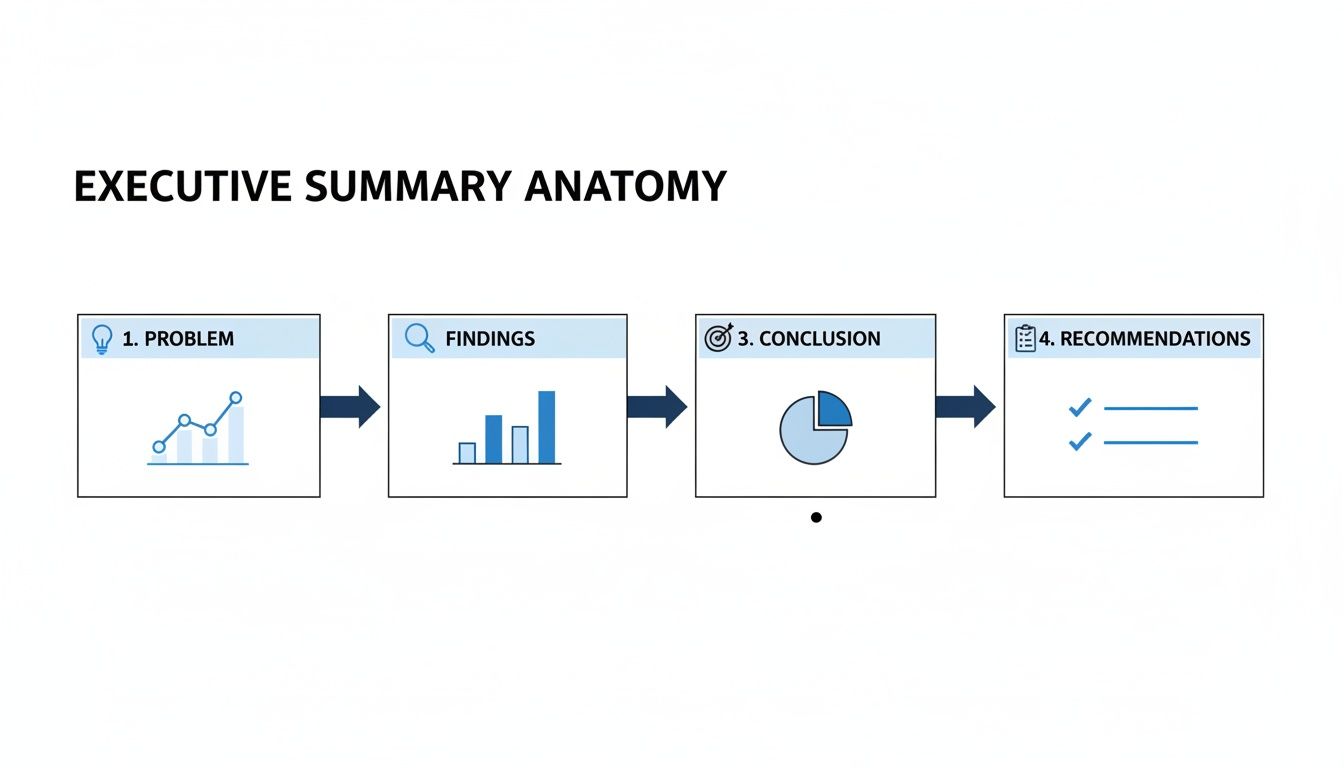
As you can see, each section naturally leads to the next, guiding your reader from understanding the problem to getting behind your proposed solution. Sticking to this structure makes your summary logical and persuasive.
Follow this simple blueprint:
- The Problem: Kick things off with a clear statement about the challenge or opportunity.
- Key Findings: Present the most important data and insights that back up your story.
- The Conclusion: Explain what all those findings actually mean for the business.
- Your Recommendations: Lay out specific, actionable steps to take next.
This structured approach has become the gold standard for high-level decision-making. Placed right at the beginning of the report, it lets readers decide if they need to dig deeper. It’s no surprise that summaries built around clear benchmarks have been shown to drive 30-50% faster decisions in major markets, simply because they help stakeholders grasp challenges and solutions so efficiently.
4. Edit, Then Edit Again
Your first draft is never your final one. Now it's time to polish every sentence until it’s sharp, clear, and direct. The goal here is to make every single word pull its weight.
As you edit, keep an eye out for these things:
- Cut the Jargon: Swap out any technical terms for plain English that anyone can understand.
- Use an Active Voice: Say "Our team analyzed the data" instead of "The data was analyzed." It sounds more confident and direct.
- Trim the Fat: Get rid of filler words ("in order to," "due to the fact that") and redundant phrases that don't add real value.
A great executive summary is defined not by what's included, but by what has been thoughtfully left out. Clarity and brevity are your most powerful tools for persuasion.
5. Run the Stakeholder Test
For the final step, read your summary through the eyes of your audience. Imagine you're that busy executive, an investor, or a department head who’s short on time. Ask yourself: "If I only had five minutes, would this summary give me everything I need to know to make a confident decision?"
If the answer is a solid "yes," then you’re good to go. If not, it’s time for one more round of edits until it passes that crucial test. This final check ensures your summary doesn't just present information—it actually communicates why it matters.
Executive Summary Examples for Different Scenarios
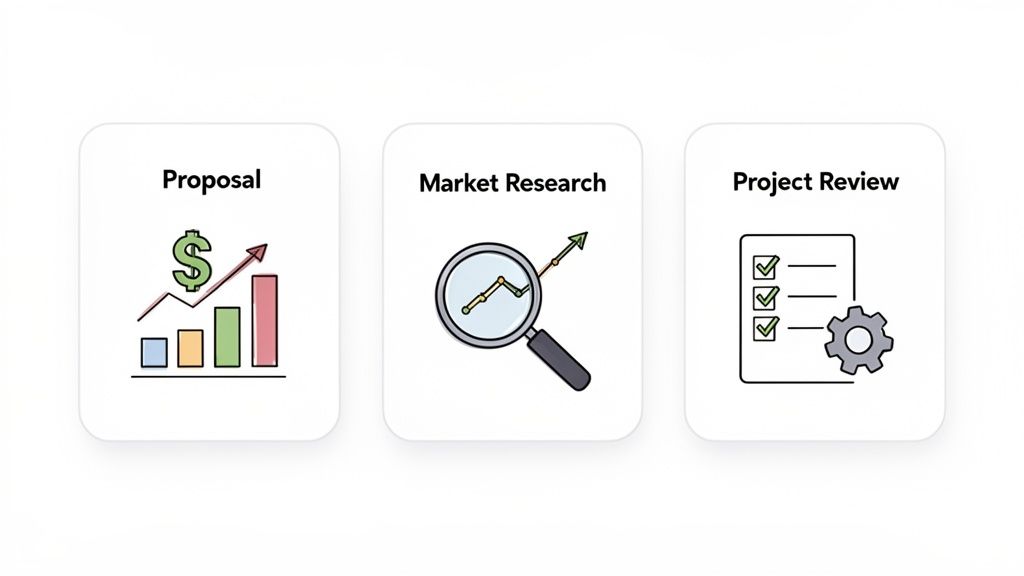
Knowing the theory is one thing, but seeing a powerful executive summary in reports in action is where it all clicks. The way you frame a summary depends entirely on its goal—are you trying to secure funding, inform a strategic pivot, or evaluate performance?
While the core components stay the same, the emphasis shifts based on who you're talking to and what you need them to do. To make this tangible, let's walk through three distinct examples. Each one is built for a specific business need, showing you how to adjust your tone, data, and recommendations for the biggest impact.
For a deeper look at different formats, our guide with more executive summary examples is a great resource.
Example 1: The Business Proposal
A proposal is all about persuasion. You need to convince a stakeholder—a boss, an investor, a client—to put their money, time, or resources behind your idea. This means the executive summary has to be sharp, benefit-driven, and laser-focused on a compelling return on investment (ROI). It's your sales pitch in a nutshell.
In fact, great executive summaries for proposals are often the only reason the full document gets read at all.
Executive Summary: Project "ConnectFlow" CRM Overhaul
Our current customer relationship management (CRM) system is actively hurting our sales performance. It has contributed to a 12% decrease in lead conversion rates over the last year, costing us an estimated $250,000 in missed revenue. This proposal details the implementation of "ConnectFlow," a modern, automated CRM designed to fix these core inefficiencies.
Our internal analysis shows the sales team is losing 8 hours per week to manual data entry—time that should be spent with clients. Worse, our lack of lead-scoring tools means high-value prospects are slipping through the cracks.
We've concluded our existing technology simply can't scale with us. Implementing ConnectFlow will automate data entry, introduce predictive lead scoring, and give us a unified view of every customer's journey.
We recommend a three-month phased rollout of ConnectFlow with a total budget of $120,000. We project this investment will increase lead conversion by 20% and boost sales productivity by 15% in the first year alone, delivering an ROI of over 300%. We are requesting approval to move forward with vendor selection.
Why it works: It grabs attention immediately by framing the problem in hard numbers ($250,000 in missed revenue). It then presents a clear solution and closes with a powerful, data-backed recommendation that’s almost impossible to ignore.
Example 2: The Market Research Report
Unlike a proposal, a market research report is meant to inform, not just persuade. Its executive summary has to distill complex data into clear, strategic insights that guide big decisions. The tone here is more objective and analytical, focusing on trends, opportunities, and competitive threats.
Executive Summary: The Rise of Eco-Conscious Millennial Consumers
This report breaks down the purchasing habits of millennial consumers within the sustainable goods market. We aimed to identify key trends and opportunities for our upcoming eco-friendly home product line. Our research, based on a survey of 2,500 millennials, shows a massive and growing demand for ethically sourced and environmentally friendly products.
A few critical findings stood out: 73% of millennials are willing to pay more for sustainable goods, and 68% actively research a brand's green credentials before buying. However, this space is getting crowded. Three major competitors already own a combined 45% market share by building their brands on supply chain transparency and minimalist aesthetics.
Our analysis concludes that while the market is competitive, a real opportunity exists for brands that can prove their environmental commitment and engage with their community authentically. For this audience, brand transparency trumps price.
We recommend a two-pronged strategy:
- Obtain Third-Party Certifications: Secure well-recognized stamps of approval like Fair Trade and B Corp to validate our claims.
- Launch a Digital Campaign: Focus our marketing on telling the story behind our ethical sourcing and production to build trust and set us apart.
Why it works: This summary uses hard data (73% of millennials) to establish a clear market trend. It smartly identifies both the opportunity and the threat, then provides specific, actionable recommendations that flow directly from the research.
Example 3: The Project Review Report
A project review summary is all about reflection. Its job is to evaluate how a completed project went, celebrating the wins, dissecting the failures, and pulling out key lessons for next time. The audience is usually internal, so the focus is squarely on performance, learning, and getting better.
Executive Summary: Q4 "Momentum" Marketing Campaign Review
This report details the performance of our Q4 "Momentum" marketing campaign, which was designed to increase new user sign-ups by 25%. The campaign ran from October 1 to December 31 with a budget of $75,000.
Overall, the campaign blew past its primary goal, delivering a 31% increase in user sign-ups. The influencer collaboration was a huge win, driving 40% of all conversions at a very low cost-per-acquisition. On the other hand, our paid search channel underperformed, yielding a negative ROI because of unexpectedly high keyword costs.
We conclude that the campaign was a major success, largely thanks to our organic social and influencer efforts. The paid search failure, however, shows we need to do more robust keyword research for future projects.
Based on this review, we recommend reallocating 20% of our Q1 paid search budget to expand the influencer program. We also suggest a comprehensive SEO audit to strengthen our organic reach.
Why it works: It leads with the most important result (a 31% increase), balances the good with an honest look at what went wrong, and finishes with a forward-looking recommendation that applies the lessons learned directly to the next quarter's strategy.
Executive Summary Do's and Don'ts
To keep these best practices in mind, here’s a quick-reference table. Think of it as a cheat sheet for making sure your summary hits all the right notes.
| Do | Don't |
|---|---|
| Start with the key takeaway or recommendation. | Bury the most important info in the middle. |
| Keep it short and concise—under 10% of the report. | Get lost in minor details or technical jargon. |
| Write it after the main report is finished. | Try to write it first as an outline. |
| Use strong, data-backed statements. | Rely on vague claims or unsupported opinions. |
| Focus on the "why" and "so what." | Simply repeat a list of topics from the report. |
| Tailor the language to your specific audience. | Use a one-size-fits-all, generic tone. |
Following these simple rules will help you avoid common mistakes and ensure your summary does its job: getting your reader's attention and delivering the core message effectively.
Common Mistakes That Weaken Your Summary
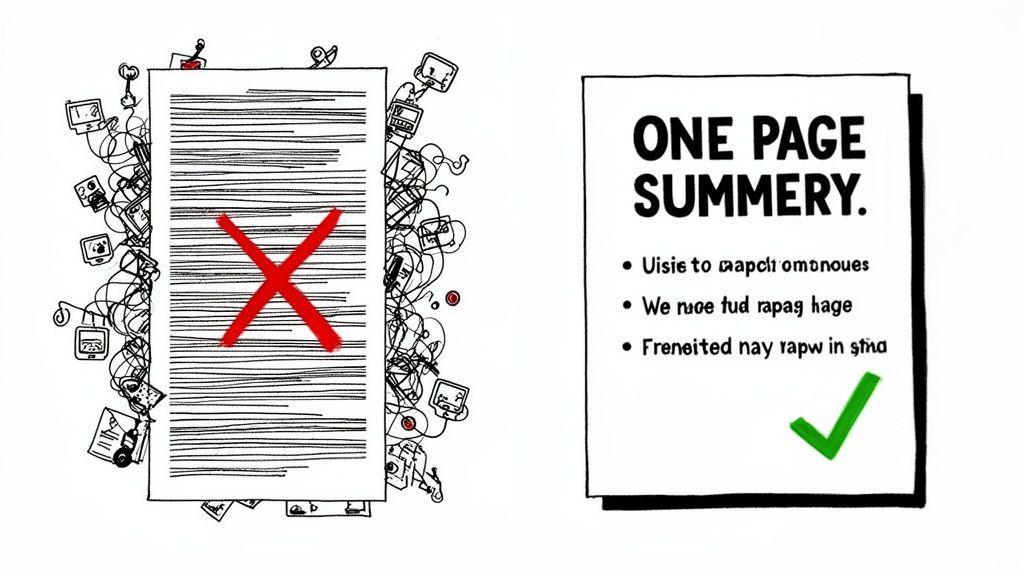
Writing a strong executive summary in reports is just as much about dodging common traps as it is about hitting the right notes. It's easy, even with the best intentions, to make a few simple mistakes that completely tank your message, confuse your audience, and damage your credibility. Think of this as your final quality-control pass.
When you learn to spot and avoid these pitfalls, your summary becomes sharp and persuasive. It transforms from a simple overview into a strategic tool that busy decision-makers will actually read and respect.
Introducing New Information
This is the cardinal sin of summary writing. An executive summary should only contain information that’s already in the main report. Its job is to boil down existing content, not to spring new facts, figures, or arguments on the reader at the last minute.
Dropping in a new statistic or finding that isn't backed up in the full document just creates confusion and erodes trust. It breaks the logical flow and sends your reader on a wild goose chase for a source that doesn’t exist.
An executive summary is a mirror reflecting the most important parts of the report, not a window to an entirely new landscape. Every single point must be traceable back to the main document.
Exceeding the Ideal Length
Let's be blunt: a long summary is a failed summary. The whole point is brevity. A good rule of thumb is to keep it between 5-10% of the total report length. When a summary drags on for several pages, it defeats its own purpose and becomes just another document people don't have time to read.
A bloated summary sends a clear signal: the author couldn’t figure out what was actually important. This buries your key messages in a wall of text, guaranteeing that busy executives will either skim it or skip it altogether.
Using Too Much Technical Jargon
Always remember who you're writing for. Your executive summary will land on the desks of people from finance, marketing, HR, and other departments who aren’t involved in the day-to-day technical details. Filling it with specialized jargon and acronyms is the fastest way to lose them.
Your job is to act as a translator, turning complex topics into clear, plain language that any leader can grasp instantly.
- Before: "The CRM integration experienced API latency, impacting our SLA compliance."
- After: "The new customer software was slow to respond, causing us to miss our customer service targets."
This simple switch makes sure everyone gets the message, not just the tech experts. A clear and direct executive summary in reports will always win out over one that's bogged down in confusing terms.
A Few Common Questions About Executive Summaries
Even with a solid plan, a few questions always pop up when you're putting the final touches on an executive summary. Let's tackle the most common ones so you can wrap up your report with confidence.
What’s the Sweet Spot for Length?
Think proportionally. The unofficial rule of thumb is to keep your executive summary between 5% and 10% of the total report length.
If you have a 20-page report, you’re aiming for a tight one-to-two-page summary. For a massive 100-page document, you have a bit more space, but your goal is still to be as brief as possible. This isn't just a suggestion; it's a constraint that forces you to be ruthless in your editing and focus only on what truly matters.
Do I Write the Summary First or Last?
This one’s easy: always write it last. You can't summarize a story that hasn't been written yet. Trying to write the summary first is like making a movie trailer before you've even shot the film—you have no idea what the most important scenes will be.
Once your full report is done and dusted, you can step back, see the entire picture, and pull out the genuine highlights. Only then can you craft a summary that accurately reflects the core findings and final recommendations.
Isn't This Just an Abstract?
Not at all, and it's a critical distinction to make. An abstract is descriptive. It tells the reader what the report is about—the topics covered, the methods used, and the overall scope. Think of it as a neutral table of contents, often used in academic and scientific papers.
An executive summary, on the other hand, is persuasive. It's a tool designed for decision-making. It doesn't just outline the content; it synthesizes the key insights to convince the reader and spur them to action. It’s a mini-version of the report that can stand on its own.
Can I Stick a Chart or Graph in There?
Yes, but tread carefully. A single, powerful visual can sometimes say more than a paragraph of text. For example, a simple bar chart showing a 75% jump in market share delivers an immediate, powerful punch.
If you do use one, make sure it’s dead simple and self-explanatory. The visual should scream the main takeaway without needing a lengthy explanation. If it adds clarity and impact, go for it. If it clutters the page or needs its own instruction manual, stick to words.
Ready to create clear, actionable summaries from your dense reports in seconds? PDF Summarizer uses AI to instantly extract key findings, verify sources with clickable citations, and even chat with multiple documents at once. Transform your research and analysis workflow by trying it for free at https://pdfsummarizer.pro.
Relevant articles
Learn how to create executive summary that secures buy-in. Our guide offers actionable steps, real-world examples, and AI-powered workflows to get results.
Learn how to write an executive summary on a report that highlights key findings, drives decisions, and delivers impact in minutes.