How to Summarise a Document Without Losing Key Insights
Learn how to summarise a document effectively. Our guide covers proven manual techniques and smart AI tools to help you master any text quickly.
To get a great summary, you have to do more than just shorten a document. You need to pinpoint its core arguments and supporting evidence, then distill them into your own words. It's a real skill—a mix of strategic skimming and a sharp understanding of what the original text is trying to achieve. The goal is to capture the essence without getting bogged down in the weeds.
Why Summarising Documents Is Your Modern Superpower
Let's be honest, we're all drowning in information. Whether you're a student facing a mountain of academic papers or a professional sifting through dense reports, the amount of text thrown at us daily is just too much. In this environment, the ability to summarise a document quickly and accurately has gone from a handy school skill to a must-have professional tool.
This isn't just about saving a few minutes, either. A good summary actually leads to deeper understanding and better memory. When you force yourself to condense complex ideas, you have to truly engage with the material, spot the connections, and grasp the core message. It’s the difference between just letting your eyes glaze over the words and actually learning.
The Growing Need for Efficient Summarisation
The pressure to get through information quickly is only increasing. Just think about the sheer volume of digital documents, especially PDFs. The global PDF software market was valued at a staggering USD 2.15 billion in 2024 and is projected to hit USD 5.72 billion by 2033. This isn't just a random statistic; it shows that professionals are juggling more documents than ever before. Trying to manually read and process a single 50-page report can easily eat up four hours—time that most of us simply don't have.
This is exactly where mastering summarisation—both by hand and with some help from AI—gives you a real edge. It allows you to:
- Make Faster Decisions: Pull the key findings from a business proposal or market analysis to decide on your next move without delay.
- Improve Academic Performance: Boil down complex research papers into focused notes for a literature review or exam cram session.
- Enhance Communication: Share the critical points from a long email chain or project update so your team is on the same page instantly.
- Boost Productivity: Slash your reading time without losing comprehension, freeing you up for more important, strategic work.
A great summary isn't just shorter—it's smarter. It's a precision tool designed to deliver exactly the information you need, right when you need it.
Ultimately, knowing how to summarise well lets you cut straight through the noise. By blending timeless reading strategies with smart modern tools, you can process information faster and gain a serious advantage in your field.
Summarisation Methods at a Glance
There are several ways to tackle a document, each with its own strengths. Here's a quick look at the most common methods to help you decide which one fits your needs.
| Method | Best For | Key Benefit |
|---|---|---|
| Manual Skimming & Note-Taking | Deep comprehension and retention for critical documents | Forces active engagement with the material |
| Abstractive Summarisation | Creating a completely new, unique summary in your own words | Ensures originality and avoids plagiarism |
| Extractive Summarisation | Quickly pulling key sentences and data points from a document | Speed and accuracy in identifying core information |
| AI-Powered Tools | Processing very long or multiple documents simultaneously | Massive time savings and handling of large volumes |
Choosing the right approach often depends on your goal. Are you studying for a final exam, or just trying to get the gist of a 100-page report before a meeting? Each scenario might call for a different technique.
Start With Your Goal, Not the Document
Before you even open the file or highlight a single sentence, the most important work happens. It’s tempting to just dive right in, but jumping into a document without a clear objective is like setting off on a road trip with no destination—you’ll get somewhere, but probably not where you needed to go.
The best summaries aren't just shorter versions of the original; they're custom-built tools designed for a specific job.
So, pause for a moment and ask yourself one critical question: “What do I need this summary to do for me?” Your answer will dictate everything that follows.
Figure Out What You're Trying to Achieve
Your purpose acts as a filter, helping you instantly separate the crucial stuff from the noise. Are you trying to quickly get the main argument for a research paper, or are you hunting for very specific data points to drop into a financial report? These are completely different missions.
Think about which of these common scenarios fits your situation:
- Getting the Gist: You've got a meeting in an hour and just need the high-level takeaway. In this case, you’ll focus on the introduction, conclusion, and maybe the section headings.
- Deep-Dive Study: You're prepping for an exam or need to truly internalize the material. Here, you'll be pulling out core arguments, supporting evidence, and the author's final conclusion.
- Data Hunting: You're on a scavenger hunt for specific numbers, names, or dates for a project. You can pretty much ignore the narrative and just scan for the exact details you need.
When you start with a clear goal, your summary becomes a precision tool, not just a condensed blob of text. It's the difference between a scalpel and a sledgehammer.
Ask a Few Questions Before You Read
Once your main objective is clear, a couple of pre-reading questions can sharpen your focus even more. Spending just two minutes on this upfront can easily save you an hour of backtracking later.
First, who is this summary actually for? Is it for your boss, who needs the bottom line? Is it for your teammates, who need to understand the technical details? Or is it just for your own reference? The audience changes everything—the tone, the language, and how deep you need to go. A summary for a fellow engineer will look nothing like one for the marketing department.
Finally, try to answer, “What problem is this document trying to solve?” or “What’s the single biggest point it’s making?” Identifying this core idea gives you a framework to hang all the other details on, making it much easier to decide what's truly essential. This isn't passive reading; it's active information strategy.
Getting Your Hands Dirty: Mastering Manual Summarisation
In an age of AI, you might wonder why you’d ever summarise something by hand. It's a fair question. While AI tools are fantastic for speed, there's a certain depth of understanding that only comes from doing the work yourself. Think of it like this: an AI gives you a guided tour, pointing out the landmarks. Manual summarisation is like drawing the map yourself—you learn the lay of the land in a way a tour could never teach you.
When you manually create a summary, you're forced to wrestle with the text. You have to engage with the arguments, follow the structure, and really get what the author is trying to say. This active process is priceless for students, researchers, or anyone who needs to truly internalize complex information, not just get the highlights.
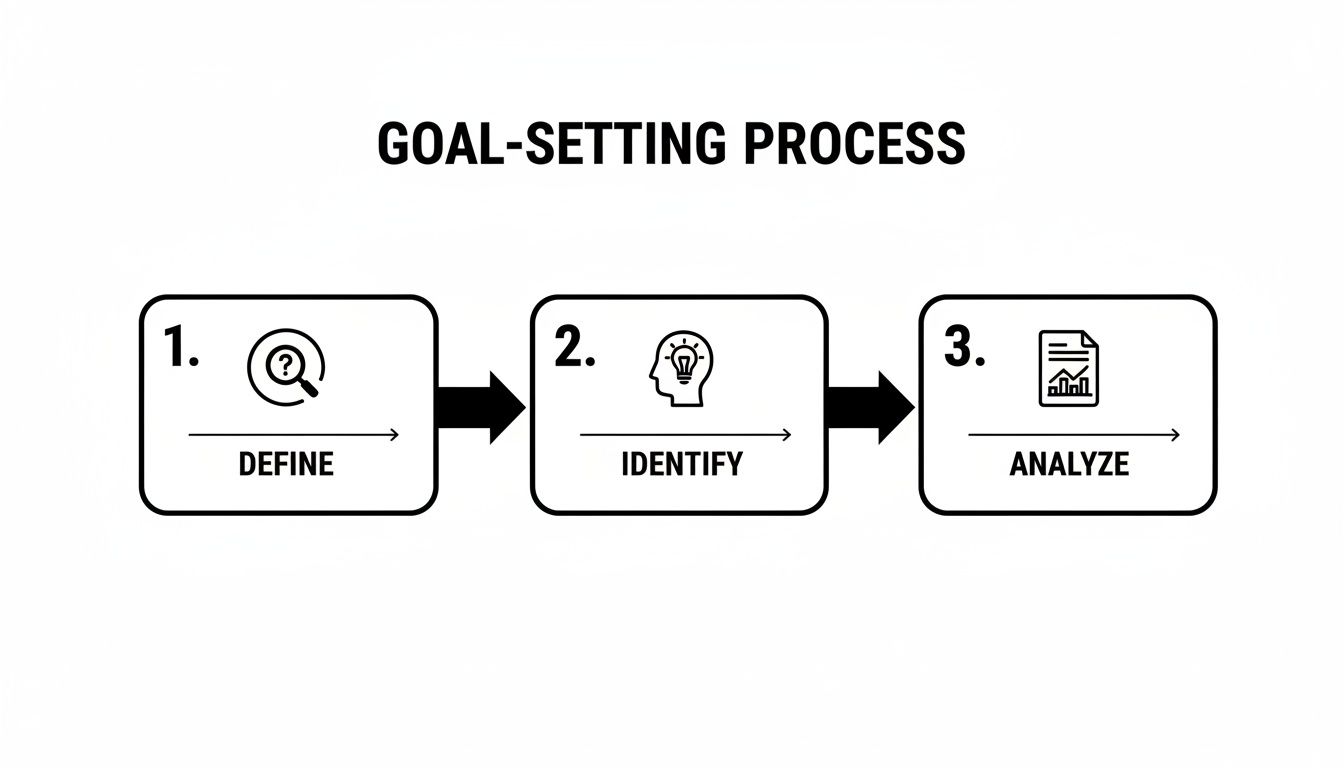
Before you even start reading, you need a clear purpose. This simple framework can keep your efforts focused and efficient.
First Pass: Skim Like a Pro
Your first encounter with any document shouldn't be a deep dive. It's more of a reconnaissance mission. The goal here isn't to understand every detail but to map the terrain and build a mental framework. This makes the real reading you do later much more effective.
So, where should you focus your attention during this initial flyover?
- The Intro and Conclusion: These are your goldmines. The author lays out their main argument in the introduction and wraps it all up in the conclusion. Read these first.
- Headings and Subheadings: These are the signposts. A quick scan of the table of contents or the headings scattered throughout the text reveals the entire structure of the argument.
- The First and Last Sentences: In most well-written pieces, the first sentence of a paragraph introduces the main idea, and the last one often summarises it. Zero in on these.
This isn’t just about saving time; it’s about priming your brain for what’s to come. For more on this, our guide on effective summarizing in reading provides some great additional strategies.
Here's a good benchmark: after a five-minute skim, you should be able to state the document's core argument and its basic structure in a sentence or two. If you can't, it’s worth another quick pass.
Second Pass: Annotate with a Purpose
Alright, you’ve got the big picture. Now it's time to zoom in. This is where active reading begins. Don't just let your eyes glide over the words; that's passive reading. Instead, have a conversation with the text. Your pen, highlighter, or digital annotation tool is how you talk back.
The key is to avoid the rookie mistake of highlighting everything. You need a system. Let's say you're tackling a dense academic paper on climate change. A purposeful annotation system might look like this:
- Main Hypothesis: Highlight this in yellow. It's the central claim the author is making.
- Key Evidence: Underline all supporting data, stats, or case studies in blue.
- Questions & Doubts: Scribble any questions or counterarguments in the margins. "Is this data outdated?" or "But what about X?"
- Connections: Draw arrows to link related concepts across different pages or sections, tracing how the argument builds.
Suddenly, the document isn't just a block of text; it's your workspace. You're actively filtering, questioning, and connecting the dots—the real work of building a solid summary.
Final Step: Extract and Synthesise
Your document is now full of your own highlights, notes, and scribbles. The final move is to pull all those scattered pieces together into something clean and coherent.
Start by pulling all your key points into a separate document or a fresh page in your notebook. As you do, group related ideas together. The most critical part of this step is to rephrase everything in your own words. This is your personal comprehension check. If you can't explain a concept simply, you probably haven't quite grasped it yet.
Once your points are translated and organized, craft an opening sentence that nails the main idea, then build out your summary from there. This deliberate process ensures the final product is a true reflection of your understanding, not just a collage of the author's sentences.
Strategies for Long and Complex Documents
Let’s be honest: staring down a dense, 100-page research paper or a sprawling technical manual is intimidating. The sheer volume of information can feel like a tidal wave, and the usual summarization tactics often fall short. When you need to summarise a document of this magnitude, you need to upgrade your game plan.
These marathon documents call for a divide-and-conquer approach. Forget trying to read it all in one sitting. The trick is to break the beast into smaller, more digestible pieces. This not only makes the task feel less daunting but also dramatically improves the clarity and structure of your final summary.
The Chunking Method
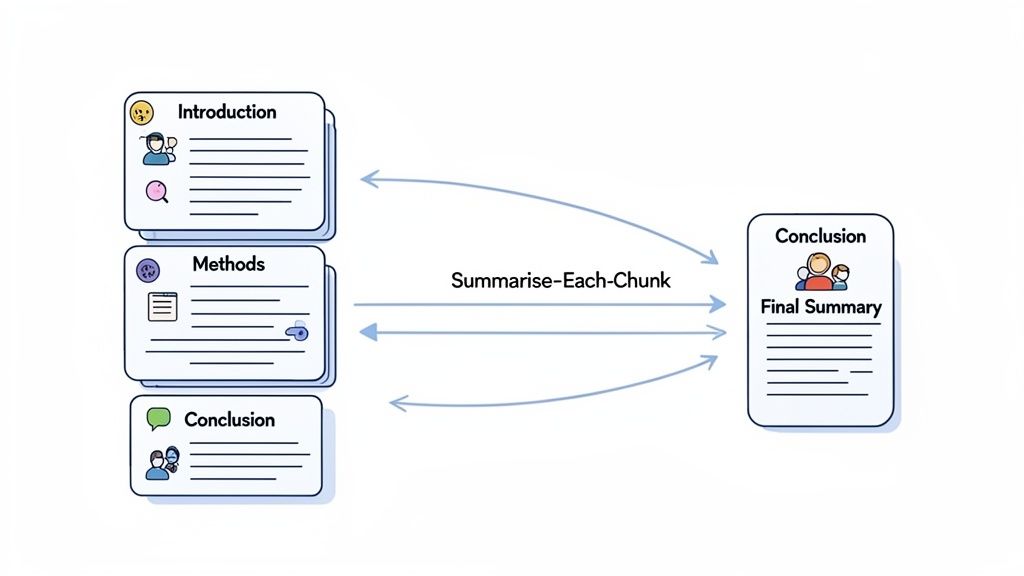
My go-to strategy for this is called chunking. Instead of seeing a monolithic wall of text, view the document as a collection of distinct sections, each with its own job to do. Luckily, for most academic papers or reports, the author has already done the hard work of creating these chunks for you.
The idea is to isolate these sections and treat each one as a mini-document. Your first pass involves creating a summary for each part before you even think about the whole thing.
Here’s how I’d break down a typical research article:
- Introduction/Literature Review: What's the core problem? What does the existing research say? Pinpoint the author's main hypothesis or research question.
- Methodology: Give a brief, no-frills description of how the study was done. What methods were used? What was the sample size? Keep it short and to the point.
- Results: This is where you pull out the key findings. Zero in on the most significant data, statistics, or outcomes they present.
- Discussion/Conclusion: This part is gold. What’s the author’s interpretation of the results? What are their final takeaways?
Once you have a mini-summary for each chunk, the last step is to stitch them together into a single, flowing narrative. You’ve essentially built a comprehensive overview piece by piece, ensuring no critical components were missed along the way.
Create a Reverse Outline
Another incredibly effective technique, especially for dense material, is to create a reverse outline. This method forces you to trace the author's argument backward, which is a brilliant way to test its logical flow and identify its main pillars. Think of it like being a detective, piecing together the crime from the final piece of evidence.
You start with the conclusion. What is the single biggest claim the author makes at the very end? Write that down. From there, work your way backward through the document, section by section, identifying the main point of each one. For every section, ask yourself, "How does this part support that final conclusion?"
By mapping the argument from its end to its beginning, you build a skeleton of the document's core logic. This outline becomes the perfect foundation for writing a summary that is both concise and faithful to the author's original intent.
I find this method particularly useful for complex legal documents or philosophical texts where the argument is layered and intricate. It helps you slice through the dense prose to see the structural bones of the piece. When you summarise a document this way, you're not just restating points; you're showing you understand how those points lock together to form a cohesive whole.
How to Use AI Tools to Summarise Your Documents (The Smart Way)
Let’s be honest. Manually summarizing a document is fantastic for deep learning, but when you're staring down a 100-page report with a deadline looming, it’s just not realistic. This is precisely where AI-powered tools like PDF Summarizer come into play—not as a replacement for your brain, but as a powerful assistant to do the heavy lifting.
Today's AI tools are far more than simple text-shorteners. They can pull the core arguments from a dense academic paper in seconds, find specific answers to your questions buried in the text, and even compare insights across a whole batch of documents at once.
Picture this: you have five research papers for a literature review. Instead of painstakingly reading each one from start to finish, you could simply ask the AI, "What are the common findings about machine learning ethics across these five documents?" That’s the kind of efficiency we're talking about.
Keep a Human in the Loop
The best way to work with these tools is with what's called a "human-in-the-loop" approach. The idea is simple: you don't just blindly trust what the AI spits out. You let the machine do the grunt work—the initial scanning, extracting, and synthesizing—and then you step in to apply your critical thinking.
Your job becomes much more strategic. You’re there to:
- Verify accuracy: Does this point truly reflect what the source says?
- Add nuance: What context or subtle meaning did the AI miss?
- Refine the output: How can I tweak this summary to perfectly align with my project's goal?
This hybrid approach gives you the best of both worlds: the raw speed and processing power of AI combined with the irreplaceable judgment and expertise of a human mind. It's about working smarter, not just faster.
The real power of AI isn't in replacing your skills, but in augmenting them. It handles the tedious parts, freeing you up to focus on analysis, strategy, and deeper insights.
Manual vs AI-Powered Summarisation
Choosing between summarizing by hand and using an AI tool depends entirely on your goal. Neither one is universally "better"—they just serve different purposes. I've put together this quick comparison to help you decide which approach fits your situation.
| Aspect | Manual Summarisation | AI-Powered Summarisation |
|---|---|---|
| Speed | Slow and time-consuming, especially for long documents. | Extremely fast, processing pages in seconds. |
| Comprehension | Promotes deep understanding and retention of the material. | Provides a high-level overview; depth can be superficial. |
| Bias | Prone to the summarizer's own interpretations and biases. | Can inherit biases from its training data, but is objective to the text. |
| Scalability | Not scalable. Summarizing multiple documents is a major effort. | Highly scalable. Can process hundreds of documents with ease. |
| Best For | In-depth study, critical analysis, and learning complex subjects. | Quickly grasping the gist, literature reviews, and processing large volumes of information. |
Ultimately, the most effective workflow often involves a combination of both. You can use an AI to get the initial lay of the land and then dive in manually on the sections that matter most.
Getting the Best Results from Your AI
To really get your money's worth from an AI summarizer, you need to be strategic. Just dropping a file in and hitting "summarize" barely scratches the surface. If you want to use technology for smarter reading, understanding how to craft an AI summary of an article is a great place to start.
One non-negotiable feature you should always look for is clickable citations. A good summarizer won't just give you a block of text; it will link every summarized point back to its exact location in the original document. This feature is a game-changer for fact-checking and builds trust in the output.
Your prompting skills are also key. Vague commands get vague results. Be specific.
Instead of "Summarize this," try prompts like:
- "Summarise the methodology section of this research paper."
- "What are the main counter-arguments presented in this legal brief?"
- "Extract all statistics related to market growth from this report and present them in a table."
The more precise your instructions, the more targeted and useful the AI's response will be. You can learn more about how to use AI to summarize a PDF with these kinds of advanced techniques. This way, you’re not just summarizing for brevity, but for focused, actionable intelligence.
Got Questions About Summarizing? We've Got Answers.
When it comes to boiling down a dense document, a few questions always seem to come up. Getting them sorted out can be the difference between a crisp, useful summary and a jumble of notes that wastes your time. Let's walk through some of the most common sticking points.
So, How Long Should a Summary Actually Be?
It's the classic question, and the honest answer is: it depends. But a great rule of thumb to start with is the 5-15% guideline. If you're looking at a 10-page report, you're probably aiming for a summary that’s about one page, maybe a page and a half.
But context is king here. If you just need the single most important finding to share in a team meeting, a few punchy sentences might be all you need. On the flip side, if you're building a literature review for a dissertation, your summary will need to be much more detailed and structured. The goal dictates the length.
What's the Real Difference Between a Summary and a Paraphrase?
This one trips a lot of people up, but the distinction is pretty simple once you see it. A paraphrase is when you take a specific sentence or a short chunk of text and rephrase it in your own words. The goal is usually to clarify a tricky point, and the length often ends up being similar to the original passage.
A summary, however, is a bird's-eye view. It’s about capturing the essential arguments and main ideas of the entire document. You're intentionally leaving out the granular details, specific examples, and supporting stories.
Here’s a helpful way to think about it:
- Paraphrasing is like explaining a single complex movie scene in simpler terms.
- Summarizing is telling someone the entire plot of the movie in 30 seconds.
You’ll often use paraphrasing for key points within your summary, but the main objective is always to condense, not just reword.
Can You Really Summarize Any Type of Document?
Absolutely, but you can't use the same game plan for everything. Your approach for summarizing a legal agreement should look completely different from how you’d tackle a scientific paper or a chapter from a novel.
- For legal or technical docs: You're a detective looking for facts. Hunt down the key definitions, obligations, and critical data points. Precision is non-negotiable.
- For academic research: Your focus is on the intellectual journey. What was the hypothesis? What methods were used? What were the results, and what did the author conclude?
- For stories or creative writing: Here, you're capturing the narrative arc. What are the major plot points, how do the characters change, and what are the underlying themes?
Before you start, always ask yourself: what does "essential information" actually mean for this specific type of document?
A common pitfall is treating all documents the same. To create a summary that’s genuinely useful, you have to tailor your technique to the material in front of you.
Is It Cheating to Use an AI Summarizer?
This is a big one, especially in school and at work. The answer isn't a simple yes or no—it’s all about how you use the tool. If you just copy and paste what the AI spits out and claim it as your own, then yes, that’s plagiarism. Plain and simple.
The smart approach is to treat AI as your research assistant. Let it generate a first draft, pull out the key statistics, or highlight potential themes you might have missed. Then, you step in. Your job is to verify the facts, refine the language, add your own analysis, and shape it into something that reflects your understanding. This "human-in-the-loop" method isn't cheating; it's just a more efficient way to work.
Ready to transform how you handle dense documents? PDF Summarizer gives you the power of AI to get instant answers, create clear summaries, and even chat with multiple files at once. Stop drowning in text and start extracting actionable insights in seconds. Try PDF Summarizer for free today!
Relevant articles

Streamline your research and summary tasks with AI. Analyze documents, synthesize insights, and craft sharper reports, faster and with confidence.
Learn how to create executive summary that secures buy-in. Our guide offers actionable steps, real-world examples, and AI-powered workflows to get results.
Learn how to summarize book chapters effectively with practical methods, AI tools, and expert tips to create concise, memorable chapter summaries.
Learn how to take notes from textbooks using proven methods that boost retention. Go beyond highlighting with actionable strategies for effective learning.
Learn how to improve reading comprehension skills with practical, proven strategies for active reading, vocabulary, and retention.
Save hours of reading with a free PDF summarizer. Learn how these AI tools work, discover key features, and see how to integrate one into your workflow today.