10 Powerful Executive Summary Examples to Master in 2026
Discover 10 powerful executive summary examples for business, research, and legal use. Learn to write concise, impactful summaries with our expert tips.

An executive summary is often the most critical page of any document you create. It is your single, best opportunity to capture a stakeholder's attention, secure vital funding, or get your project the green light it deserves. Yet, writing a compelling summary is a significant challenge. It requires a delicate balance: delivering essential details without overwhelming the reader, and being persuasive while maintaining objectivity. A great executive summary doesn't just shorten a document; it sharpens its core message into a powerful, standalone argument.
This guide moves beyond generic templates to provide a deep, strategic analysis of what makes these documents effective. We have curated a collection of powerful executive summary examples spanning diverse industries and critical use cases. You won't just see a finished product; you'll learn the replicable strategies behind its success.
Through these detailed breakdowns, you will learn to:
- Identify the Core Components that make an executive summary persuasive and clear.
- Adapt Your Tone and Content for different audiences, from investors and academics to legal teams and project managers.
- Apply Specific Tactics to highlight key findings, quantify impact, and articulate a clear call to action.
Each example includes a copyable sample, actionable takeaways, and a list of crucial "dos and don'ts" to guide your writing process. From a tech startup’s business plan to a complex academic research paper, these examples will equip you with the practical skills needed to craft an executive summary that not only gets read but also drives decisive action. We will also explore how modern tools can streamline this process, turning hours of document analysis into minutes of focused insight.
1. Technology Sector Executive Summary
A technology sector executive summary is a highly focused document designed to capture the attention of investors, partners, and technical stakeholders. Unlike a general business summary, this version prioritizes product innovation, market disruption, and technical differentiation. It’s the strategic spearhead of a tech company's business plan, condensing complex technical concepts into a compelling narrative that highlights a clear path to market leadership and scalability.
This summary type is crucial for startups and established tech firms seeking funding or strategic partnerships. Popularized by entities like Y Combinator and other tech incubators, it serves as the first-and often only-impression for venture capitalists who need to quickly assess a venture's potential.
Why It's a Top-Tier Example
This type of executive summary excels because it directly addresses the core concerns of a tech-savvy audience: viability, scalability, and defensibility. It moves beyond a simple business idea to prove that the underlying technology is not just functional but superior. For instance, an executive summary for a new AI-powered PDF analysis tool wouldn't just state its purpose; it would quantify its processing speed against competitors, detail its unique machine learning model, and highlight any patent-pending algorithms.
Actionable Tips for Your Tech Summary
- Lead with the Problem-Solution Framework: Immediately state the critical market problem you're solving. Follow up with your unique technological solution, creating a strong narrative hook.
- Quantify Everything: Don't just claim your product is "faster" or "more efficient." Use hard numbers. Provide performance benchmarks, comparative data, and key metrics (e.g., "reduces data processing time by 45% compared to the leading competitor").
- Highlight Your "Moat": Clearly define your competitive advantage. This could be proprietary technology, a unique dataset, key patents, or an exclusive partnership. Explain why it’s difficult for others to replicate.
- Show, Don't Just Tell: Use visuals. A simple diagram explaining your system architecture or a chart showing performance data can communicate complex information more effectively than a dense paragraph.
2. Academic Research Executive Summary
An academic research executive summary is a concise, highly structured document that distills a research project's core components for a scholarly audience. Unlike business-focused summaries, this format prioritizes methodological rigor, evidence-based findings, and contribution to existing knowledge. It functions as the gateway to complex research, presenting the study's purpose, methods, key results, and significance in a standardized format.
This summary type is fundamental in academia and research, essential for grant proposals, journal articles, and dissertations. It was popularized by institutions like the National Institutes of Health (NIH) and major university presses, which require a succinct yet comprehensive overview to quickly evaluate a study's merit and relevance. This format allows review boards and fellow researchers to grasp the essence of the work without reading the entire document.
Why It's a Top-Tier Example
This type of executive summary excels because of its unwavering commitment to clarity, precision, and transparency. It presents a logical and defensible argument, guiding the reader from the initial research question to the final conclusion in a clear, linear path. For example, a summary for a new clinical trial wouldn’t just state the outcome; it would specify the study design (e.g., double-blind, randomized controlled trial), define the sample size, report the statistical significance of the findings (p-value), and discuss the implications for medical practice.
Actionable Tips for Your Academic Summary
- Lead with Clear Research Questions: Start by explicitly stating the research question or hypothesis your study addresses. This immediately frames the context and purpose of your work.
- Quantify Your Methodology: Be specific about your methods. Mention sample sizes, statistical tests used, and confidence levels to establish the credibility and validity of your research.
- Connect Findings to Broader Discourse: Don't present your results in a vacuum. Briefly explain how your findings confirm, challenge, or expand upon existing theories and studies in your field.
- Highlight Limitations and Future Research: Acknowledge the limitations of your study to demonstrate scholarly integrity. Conclude by suggesting specific directions for future research, showcasing your deep understanding of the topic. If you need help structuring your paper, you can learn more about how to summarize a research paper for additional guidance.
3. Legal and Compliance Executive Summary
A legal and compliance executive summary is a meticulously crafted document designed for precision, clarity, and risk mitigation. Unlike other summaries focused on growth or innovation, this format prioritizes liability exposure, regulatory adherence, and contractual obligations. It translates dense legal jargon and complex compliance frameworks into an accessible overview for legal teams, executives, and compliance officers who need to make informed, risk-averse decisions.
This summary type is indispensable in highly regulated industries. It was popularized by corporate legal departments, major law firms, and regulatory bodies like the SEC to streamline the review of lengthy documents such as merger agreements, GDPR compliance reports, and complex contracts. Its core function is to flag critical issues, not just to inform.
Why It's a Top-Tier Example
This type of executive summary is exceptional because it navigates the high-stakes world of legal and regulatory risk with surgical precision. It excels by isolating the most critical information-potential liabilities, key dates, and non-compliance penalties-from hundreds of pages of dense text. For example, a summary of a new supplier contract wouldn't just outline the service terms; it would explicitly highlight indemnification clauses, termination penalties, and data privacy obligations under GDPR, often assigning a risk level to each point.
Actionable Tips for Your Legal Summary
- Prioritize Risk and Liability: Start with the most significant legal exposures. Use clear headings like "Key Risks," "Compliance Gaps," or "Critical Obligations" to draw immediate attention to potential problems.
- Be Unambiguously Precise: Avoid subjective language. Instead of saying a clause is "problematic," state, "Clause 7.2 conflicts with SEC Rule 10b-5, creating potential securities fraud liability." Quote or reference specific clauses and regulations directly.
- Flag Critical Dates and Deadlines: Clearly list all important dates, such as contract renewal deadlines, regulatory filing due dates, and compliance audit schedules. Use a table or a bulleted list for maximum visibility.
- Include a Clear Recommendation: Conclude with a direct course of action. This could be "Recommend legal review of Section 4," "Advise immediate remediation of compliance gaps," or "Approve contract as written." This transforms the summary from a report into a decision-making tool.
4. Business Proposal and Investment Executive Summary
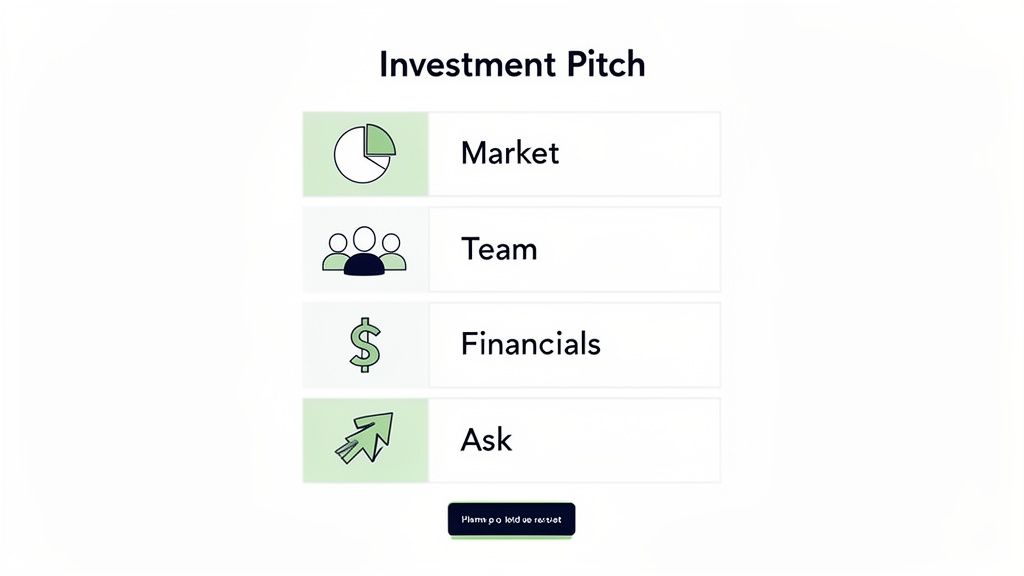
A business proposal and investment executive summary is a high-stakes, persuasive document crafted to secure funding or stakeholder buy-in. It strategically blends a visionary business idea with concrete data, focusing on market opportunity, financial projections, and the strength of the founding team. This summary is the gateway to a full business plan, designed to convince investors, from VCs to corporate boards, that the venture is not just viable but also highly profitable.
This summary type is the standard for startup funding rounds and corporate investment proposals, popularized by accelerators like Y Combinator and Techstars. It's an essential tool that must quickly articulate a compelling case for capital, answering an investor's core question: "Why should I invest my money in this venture?"
Why It's a Top-Tier Example
This format is effective because it’s engineered to speak the language of investors: ROI, risk mitigation, and market dominance. It moves beyond a simple product description to build a comprehensive investment thesis. For instance, a summary for a new fintech app wouldn't just describe its features; it would quantify the total addressable market (e.g., "$10B TAM"), showcase early traction with user growth metrics, and present a clear financial model projecting revenue over five years. It presents the business as a well-researched, scalable machine for generating returns.
Actionable Tips for Your Investment Summary
- Lead with the Market Pain Point: Start by defining the urgent, expensive problem your target market faces. Hook the reader emotionally and logically before introducing your solution.
- Use Specific, Defensible Numbers: Avoid vague claims. Instead of "a huge market," state "a $50M serviceable market opportunity." Support projections with data. For more on refining long reports into concise summaries, check out this guide on how to summarize a PDF.
- Showcase Customer Validation: Prove market demand with evidence. Include key customer testimonials, impressive beta test results, or signed letters of intent from potential clients.
- End with a Clear Ask: Conclude with the specific amount of funding you are seeking, how you will use the capital, and what key milestones it will help you achieve over a defined timeline.
5. Healthcare and Medical Research Executive Summary
A healthcare and medical research executive summary is a highly structured document designed for rigorous scientific and regulatory scrutiny. Unlike a standard business summary, this format prioritizes clinical efficacy, patient safety, and regulatory compliance. It is the gateway to a much larger body of data, such as a clinical trial report or a new drug application, condensing complex medical findings into a clear narrative for experts like FDA reviewers, institutional review boards (IRBs), and peer reviewers.
This summary type is indispensable for pharmaceutical companies, medical device manufacturers, and academic researchers seeking regulatory approval or publication. Popularized by regulatory bodies like the FDA and NIH, as well as esteemed medical journals like The Lancet and NEJM, these summaries must meet exacting standards of transparency and accuracy, as they directly impact patient care and public health policy.
Why It's a Top-Tier Example
This type of executive summary excels because it demands unwavering precision and transparency. It’s not about persuasion in the marketing sense; it’s about presenting objective evidence to a highly critical audience. For example, a summary for an FDA new drug submission wouldn't just claim the drug is "effective." It would meticulously present the primary endpoints, statistical significance (p-values), effect sizes (like odds ratios), and a complete profile of adverse events, allowing regulators to perform a thorough risk-benefit analysis.
Actionable Tips for Your Healthcare Summary
- Prioritize Clarity and Compliance: Adhere strictly to regulatory guidelines (e.g., FDA or ICH). The structure is often non-negotiable, requiring specific sections for methodology, results, and safety data.
- Quantify Clinical Outcomes: Use precise metrics. Instead of saying a treatment "improves symptoms," state that it "reduced the primary symptom score by an average of 15.2 points (95% CI, 12.1-18.3; p < 0.001) compared to placebo."
- Be Transparent About Limitations: Honestly document all study limitations, potential biases, and adverse event profiles. Omissions or attempts to downplay negative findings can lead to rejection and erode credibility.
- Distinguish Statistical vs. Clinical Significance: A result can be statistically significant (p < 0.05) but clinically meaningless. Always explain the practical impact of the findings on patient health.
6. Financial and Investor Relations Executive Summary
A financial and investor relations executive summary is a high-stakes document that translates complex financial data and strategic initiatives into a clear, compelling narrative for investors, analysts, and stakeholders. This summary prioritizes financial performance, key performance indicators (KPIs), and forward-looking guidance. It serves as the official overview of a company's health, condensing dense reports like 10-Qs and 10-Ks into a digestible format that shapes market perception and investor confidence.
This summary type is a cornerstone of corporate communications for publicly traded companies, mandated by regulatory bodies like the SEC and demanded by institutional investors. It must artfully balance regulatory transparency with a strong strategic message, justifying past performance while building conviction in the company’s future direction.
Why It's a Top-Tier Example
This executive summary is exceptional because it operates under immense scrutiny where every word and number can impact market capitalization. It excels at storytelling with data, contextualizing financial results within the broader market landscape and the company's strategic roadmap. For example, a summary for a quarterly earnings report won't just list revenue figures; it will explain the drivers behind a revenue beat or miss, detail margin improvements from operational efficiencies, and address shareholder concerns head-on. This proactive communication is crucial for building and maintaining trust.
Actionable Tips for Your Financial Summary
- Lead with Headline Metrics: Start with the most critical numbers: revenue, net income, earnings per share (EPS), and year-over-year growth. This immediately answers the primary questions on every investor's mind.
- Visualize Performance Trends: Use charts and graphs for key metrics like revenue growth, profit margins, and cash flow. Visuals make complex trends and historical performance much easier to understand at a glance. For deeper insights, you can learn more about how to read financial reports.
- Explain the "Why" Behind the Numbers: Don't just present data; interpret it. Clearly explain variances and drivers. If revenue declined, was it due to market headwinds or a strategic divestiture? If margins improved, was it from pricing power or cost-cutting?
- Provide Clear Forward-Looking Guidance: Offer a forecast for future performance with specific, defensible assumptions and ranges. This demonstrates leadership's command of the business and sets clear expectations for the market.
7. Consulting and Professional Services Executive Summary
A consulting executive summary is a high-impact document delivered to a client at the conclusion of an engagement. It translates extensive analysis, data, and observations into a concise, strategic narrative. This summary prioritizes actionable recommendations, quantifiable business impact, and a clear implementation roadmap over the granular details of the consulting process itself. It’s designed to justify the engagement's value and secure client buy-in for the proposed changes.
This summary type is a cornerstone of the professional services industry, perfected by firms like McKinsey & Company, Deloitte, and other top-tier consultancies. It serves as the final, persuasive argument that convinces senior leadership to move forward with a recommended strategy, making it one of the most powerful executive summary examples for driving organizational change.
Why It's a Top-Tier Example
This executive summary excels because it is relentlessly focused on the client's perspective and future success. It answers the crucial "so what?" question immediately, bridging the gap between complex analysis and executive decision-making. Instead of just presenting findings, it synthesizes them into a compelling business case. For example, a summary for a digital transformation project wouldn't just list technological gaps; it would frame the solution as a path to "increase market share by 5% within 18 months by leveraging AI-driven customer segmentation."
Actionable Tips for Your Consulting Summary
- Lead with Business Impact: Start with the most critical takeaway or the biggest potential gain for the client. State the bottom-line result first (e.g., "Our recommendations will generate a 15% reduction in operational costs") before explaining how.
- Prioritize Recommendations: Use an impact/effort framework to categorize your suggestions. Highlight the "quick wins" that offer high impact for low effort to build immediate momentum and trust.
- Assign Clear Ownership: Don’t leave recommendations open to interpretation. Specify which department or role is responsible for leading each initiative to create accountability from day one.
- Provide a Phased Roadmap: Break down the implementation plan into clear phases (e.g., 30-day, 90-day, and 6-month goals). This makes a large-scale project feel manageable and provides clear milestones for tracking progress.
8. Product Development and Project Management Executive Summary
A product development and project management executive summary is an essential internal communication tool that bridges the gap between on-the-ground project teams and high-level stakeholders. This document concisely reports on a project's status, key outcomes, and lessons learned. It prioritizes performance against targets, resource allocation, and strategic next steps to ensure all parties are aligned and informed.
This summary type is crucial for maintaining momentum and accountability within organizations. Popularized by Project Management Offices (PMOs) and agile development teams, it distills complex project data like timelines, budgets, and scope changes into a clear, digestible format. It's the go-to document for phase-gate reviews, project completions, and milestone updates.
Why It's a Top-Tier Example
This type of executive summary excels because it fosters transparency and drives strategic decision-making. It moves beyond a simple status update to provide a holistic view of a project's journey, including both successes and challenges. For example, an executive summary for a completed IT system implementation wouldn't just state that the project is done; it would compare the actual timeline and budget against the plan, quantify the system's performance metrics (e.g., "99.9% uptime achieved"), and detail lessons learned during the migration for future projects.
Actionable Tips for Your Project Summary
- State the Status Upfront: Immediately clarify if the project is on-track, at-risk, completed, or delayed. This allows readers to instantly grasp the most critical piece of information.
- Compare Planned vs. Actual: Use a clear format (like a small table or bullet points) to show the planned versus actual results for the timeline, budget, and scope. This quantifies performance and provides immediate context.
- Quantify Key Deliverables: Be specific and use numbers. Instead of saying "new features were launched," state "47 new user-facing features were delivered, resulting in a 15% increase in engagement."
- Document Lessons Learned: Dedicate a specific section to what went right and what went wrong. This transforms the summary from a simple report into a valuable tool for institutional knowledge and continuous improvement.
10. Project Management Executive Summary
A project management executive summary is the high-level snapshot of a project's entire lifecycle, purpose-built for stakeholders who need to understand progress, risks, and outcomes without diving into granular details. It distills complex project plans, timelines, and budgets into a concise, decision-making tool. This summary focuses on key milestones, resource allocation, risk assessment, and return on investment (ROI), serving as the primary communication bridge between the project team and executive leadership.
This summary is essential for internal reporting, securing ongoing funding, and maintaining stakeholder alignment. It’s the document that gets reviewed in board meetings and steering committees, providing a quick-glance health check of a project's viability and progress. Its core function is to answer critical questions: "Are we on track? Are we on budget? What are the roadblocks? And what will we get when this is done?"

Why It's a Top-Tier Example
This type of executive summary excels because it is fundamentally action-oriented. Its value is measured by its ability to facilitate clear decisions. A well-crafted project summary doesn't just report status; it guides stakeholders toward necessary actions, whether that’s approving a budget increase, reallocating resources, or giving the green light for the next phase.
For instance, a summary for a software development project wouldn't just state "Phase 2 is 50% complete." It would specify, "Phase 2 coding is 50% complete, but a critical roadblock in API integration has caused a 5-day delay. We recommend reallocating one developer from Phase 3 for two weeks to mitigate this, keeping the project on its final deadline." This proactive approach makes it one of the most effective executive summary examples for internal business operations.
Actionable Tips for Your Project Summary
- Use a "Red, Amber, Green" (RAG) Status: Immediately signal the project's health with a simple color code for key areas like budget, schedule, and scope. This provides an instant, high-level overview.
- Focus on Milestones, Not Tasks: Stakeholders care about major achievements, not daily activities. Frame your progress around key deliverables and phase completions.
- Quantify Risks and Impacts: Don't just list risks. Explain their potential impact in concrete terms (e.g., "A delay in vendor delivery could increase costs by $15,000 and push the launch date back by one week").
- End with a Clear "Ask": Conclude with a specific recommendation or request. Whether you need a decision, more resources, or formal approval to proceed, make it explicit so stakeholders know exactly what is required of them.
10 Executive Summary Examples: Side-by-Side Comparison
| Executive Summary Type | Implementation complexity | Resource requirements | Expected outcomes | Ideal use cases | Key advantages |
|---|---|---|---|---|---|
| Technology Sector Executive Summary | High — detailed technical specs and benchmarks | Engineering/product inputs, architecture diagrams, performance data | Demonstrates technical feasibility and scalability; attracts tech investors | Tech startups, AI/ML products, VC pitches | Highlights technical differentiation and scalability |
| Academic Research Executive Summary | Medium — rigorous methods, structured reporting | Research data, statistical analysis, citations | Evidence-based conclusions supporting publication or funding | Grant applications, journal articles, literature reviews | Builds academic credibility; transparent methodology |
| Legal and Compliance Executive Summary | High — precise legal language and citations required | Legal counsel, regulatory texts, contract clauses | Identifies liabilities, compliance gaps, and mitigation steps | Contract reviews, regulatory filings, M&A due diligence | Pinpoints legal risks and supports auditability |
| Business Proposal and Investment Executive Summary | Medium — persuasive narrative plus financial modeling | Market research, financial projections, team credentials | Secures funding or approval; clear funding ask and ROI | Investor pitches, funding rounds, corporate investment proposals | Communicates business viability and investment case |
| Healthcare and Medical Research Executive Summary | High — strict clinical and regulatory standards | Clinical trial data, safety reports, regulatory documentation | Assesses safety and efficacy; supports regulatory submissions | Clinical trials, FDA/EMA submissions, medical journals | Ensures patient-safety focus and regulatory compliance |
| Financial and Investor Relations Executive Summary | Medium — complex financial disclosures and analysis | Financial statements, KPIs, reconciliations, charts | Transparent financial performance and forward guidance | Quarterly/annual reports, investor decks, analyst briefings | Maintains investor confidence and informs valuation |
| Consulting and Professional Services Executive Summary | Medium — strategic analysis and implementation planning | Client data, market research, consultant expertise | Actionable recommendations and implementation roadmap | Post-engagement reports, strategic advisory, audits | Demonstrates ROI and provides prioritized implementation steps |
| Product Development and Project Management Executive Summary | Low–Medium — status reporting and milestone tracking | Project plans, test reports, team updates, metrics | Clarifies project status, lessons learned, and next steps | Product launches, phase-gate reviews, IT implementations | Ensures stakeholder alignment and documents project outcomes |
Next Steps: Write Your Summary with Confidence
Throughout this article, we've dissected a diverse collection of executive summary examples, moving far beyond generic templates to reveal the strategic architecture that underpins each successful document. From the data-driven precision of a financial report summary to the persuasive narrative of a startup business plan, a clear pattern emerges: the most effective executive summaries are not afterthoughts. They are meticulously crafted, audience-centric instruments designed to achieve a specific outcome.
We’ve seen how a single page can secure funding, authorize a project, or validate years of research. The key lies in understanding that an executive summary is a standalone argument. It must be self-sufficient, providing all the critical information a stakeholder needs to make an informed decision without having to read the full document.
Synthesizing the Core Principles
As you prepare to write your own summary, let’s distill the most critical lessons from the examples we've analyzed. Mastering these principles will elevate your summaries from simple recaps to powerful tools of influence and communication.
- Clarity Over Complexity: The goal is to be understood instantly. Avoid jargon, acronyms, and overly technical language unless your audience is exclusively composed of subject matter experts. As demonstrated in the consulting and project management examples, a clear, direct statement of the problem and proposed solution is always more effective than a paragraph dense with industry buzzwords.
- Quantify Everything Possible: Numbers are a universal language. Whether it’s market size, ROI projections, key research findings, or project milestones, data adds weight and credibility to your claims. The financial and business proposal summaries were particularly strong because they anchored their narratives in concrete metrics, making their arguments both compelling and verifiable.
- Lead with the "Why": Capture your reader's attention immediately by stating the core problem or opportunity. The nonprofit and healthcare examples excelled at this, opening with a compelling purpose that created an immediate emotional and logical connection with the reader. Your first sentence should answer the implicit question: "Why should I care about this?"
- Structure is Strategy: The flow of your summary matters. A logical progression from problem to solution, to justification, and finally to a call-to-action creates a coherent and persuasive narrative. Each section should build upon the last, guiding the reader seamlessly toward your intended conclusion.
Your Action Plan for a Winning Summary
With these principles in mind, you are equipped to tackle your next executive summary with a strategic framework, not just a blank page. The powerful executive summary examples we have explored provide a blueprint for what success looks like across various professional contexts.
Your next step is to apply these insights. Begin by clearly defining your objective and your audience. Who are you writing for, and what do you need them to do? Once you have that answer, gather your essential data points: the key findings, the critical recommendations, the financial implications, and the proposed next steps. Use the "dos and don'ts" and rewrite templates provided with each example as a checklist to refine your draft. Edit ruthlessly. If a sentence doesn't serve a critical purpose, remove it. If a point can be made more concisely, shorten it.
Remember, an executive summary is your one shot to make a lasting impression on a busy decision-maker. It is the most valuable real estate in any report or proposal. By applying the strategic analysis and actionable takeaways from this guide, you can craft a document that not only informs but also persuades, inspires action, and drives results. You now have the tools and the knowledge to transform this often-dreaded task into an opportunity to showcase the value of your work with clarity and confidence.
Ready to accelerate your research and writing process? Instead of manually hunting for key data across multiple documents, let PDF Summarizer do the heavy lifting. Upload your source reports, competitor analyses, and research papers to instantly extract the critical information you need to build a powerful, evidence-backed executive summary.
Recent articles

Learn how to merge pdf foxit reader PDFs quickly with step-by-step tips, free options, and 2026 updates.

Learn how to open pdf in google docs across devices, fix formatting, and edit PDFs with ease.

Discover the 12 best document collaboration tools for any team. Compare features, pricing, and use cases to find the perfect platform for your workflow.

Learn how to add citations in Google Docs using the built-in tool, add-ons like Zotero, and an advanced PDF workflow. Master APA, MLA, and Chicago styles.

Discover the best citation management software for your research. Compare Zotero, EndNote, Mendeley, and more to find the perfect tool for your workflow.

Explore critical thinking skills for students with practical strategies to analyze information, argue persuasively, and boost academic success.