How Text Summarization AI Actually Works A Complete Guide
Discover how text summarization AI turns dense documents into clear, actionable insights. Our guide explains the models, methods, and real-world applications.
At its core, AI text summarization is a technology that automatically shrinks a long document into a shorter, easy-to-digest version that still holds all the key information. Think of it as a smart assistant that reads for you, pulling out the main ideas so you don't have to wade through every single word.
It’s built to save you time and mental energy by delivering the core message of an article, report, or any lengthy text, fast.
How AI Can Rescue You from Information Overload
Let's be honest, we're all drowning in information. Students have mountains of research papers, professionals are buried in dense reports, and researchers struggle to keep up with the latest studies. The volume is just too much for any one person to handle. This is exactly the problem AI summarization was designed to solve.
It's more than just a tool; it’s a cognitive partner. It handles the initial heavy lifting of reading and comprehension, freeing you up to focus on what really matters: critical thinking and analysis. Instead of spending hours reading, you can get the gist in minutes.
The Two Main Flavors of AI Summarization
When you get down to it, AI summarization works in one of two ways. Figuring out the difference helps you pick the right tool for the job.
Extractive Summarization: This approach is like taking a highlighter to a document. The AI scans the text, pinpoints the most important sentences based on things like keywords and where they appear, and then lifts them directly from the source to create the summary. It's fast, straightforward, and guarantees the summary is factually identical to the original text.
Abstractive Summarization: This is the more sophisticated method. Here, the AI acts more like an expert colleague who reads a document and then explains it to you. It actually comprehends the material and then generates a brand-new summary in its own words. The result is often a much more fluid and natural-sounding summary that can capture subtle meanings that a simple copy-and-paste job would miss.
To help clarify the differences, here’s a quick breakdown:
Extractive vs Abstractive Summarization at a Glance
| Feature | Extractive Summarization | Abstractive Summarization |
|---|---|---|
| Core Method | Selects and copies key sentences directly. | Understands context and generates new sentences. |
| Output Style | Factual, sometimes a bit choppy. | Fluent, coherent, and human-like. |
| Factual Accuracy | Very high, as it's a direct copy. | High, but with a small risk of misinterpretation. |
| Speed | Generally faster and less computationally intensive. | Slower and requires more powerful models. |
| Best For | Legal documents, technical reports, news fact-checking. | General articles, literature, creating natural overviews. |
Ultimately, both approaches have their place, and the most advanced tools can switch between them depending on your needs.
Choosing the Right Approach
So, which one should you use? It really depends on your goal.
Extractive summaries are perfect when you need the cold, hard facts from a technical manual or a legal contract where every word counts. Abstractive summaries are fantastic when you want a smooth, readable overview of a news story or a book chapter, where the overall flow is more important.
An AI's ability to produce either type of summary is a powerful asset. It allows users to shift from simple fact-finding to nuanced understanding, depending on the complexity of the source material and their end goal.
AI tools excel at tasks like Summarising, which is the foundational skill for more advanced features. This is precisely what powers a good PDF Summarizer, turning overwhelming documents into clear, concise overviews that can save you hours of work.
How AI Learns to Read and Summarize Text
The technology behind text summarization AI isn't some black box magic; it's the result of clever engineering and a fascinating evolution in how machines understand language. The core goal has always been simple: teach a machine to read a long document and then boil it down to its essential ideas. It all started with foundational models that paved the way for the powerful tools we use today.
The process is pretty straightforward when you break it down.
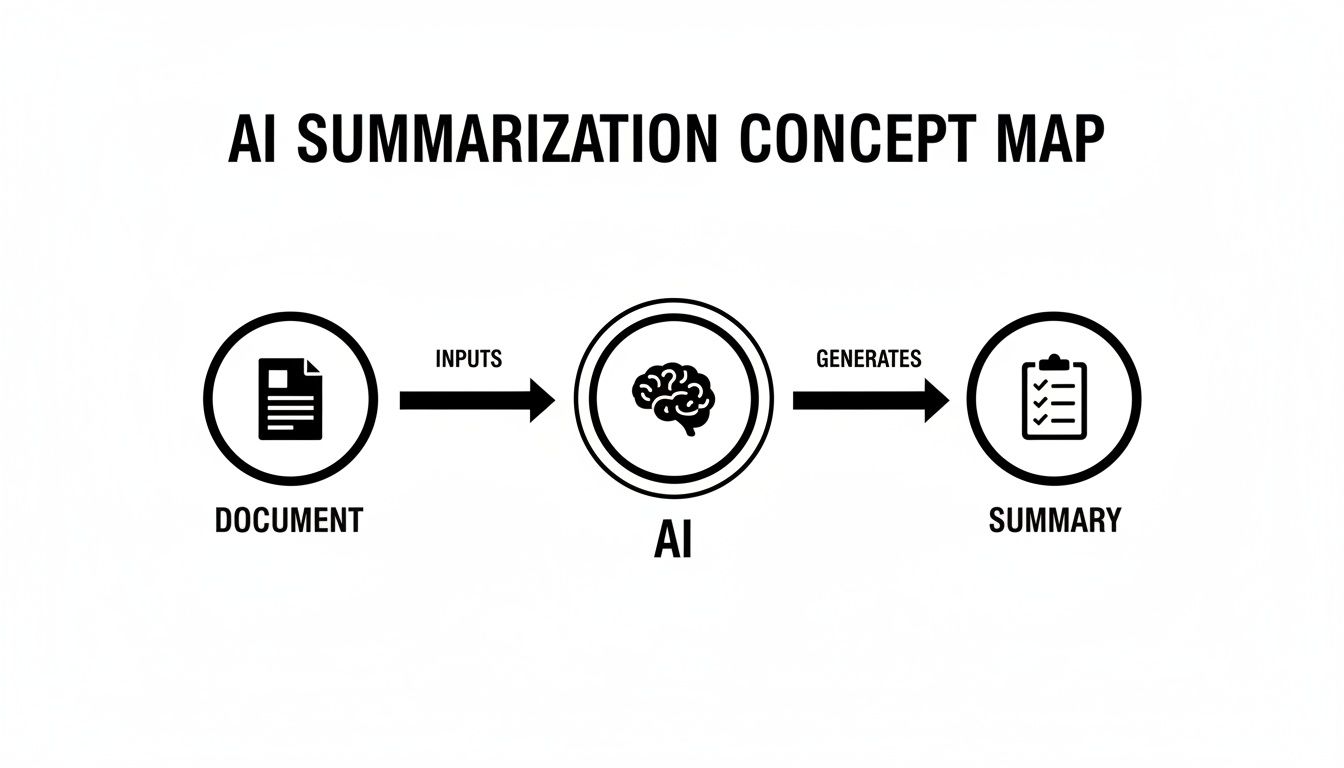
This map shows the journey from a dense document, through the AI's analytical "brain," to a clear, actionable summary.
The Original Blueprint: Sequence-to-Sequence Models
The first real crack at AI summarization came from sequence-to-sequence (seq2seq) models. A good way to think about a seq2seq model is as a translator. But instead of translating from Spanish to English, it translates from "long document language" to "short summary language."
It works in two key steps:
- The Encoder: This part reads the entire source document, word by word, and squashes all that meaning into a compact numerical code. Imagine it trying to cram every plot point and character arc of a novel into a single, dense paragraph.
- The Decoder: The decoder then takes this compressed code and starts building the summary, word by word, until it has a complete, concise version of the original.
These models were a great start, but they had a bottleneck. The encoder had to pack the meaning of the entire text into one fixed-size chunk of data. It was like trying to memorize an entire lecture in one shot. For longer documents, important details would inevitably get lost.
A Breakthrough in Understanding Context: The Transformer
The next big leap forward was the Transformer architecture. Its game-changing innovation? The attention mechanism.
Instead of forcing the AI to remember the whole document at once, the attention mechanism lets it look back at the original text while it writes the summary. This is much closer to how a person does it. You don't just rely on memory; you glance back at the most important sections of the source material. The attention mechanism allows the AI to do the same, constantly weighing which words are most important in relation to all the others.
The Transformer architecture finally gave AI the ability to understand context. It could now tell that the word "bank" means something different in "river bank" than it does in "savings bank"—a crucial skill for writing accurate summaries.
This ability to grasp context is the bedrock for many advanced NLP applications. For a closer look, you can learn more about how context is used in our guide to question answering AI.
The Age of Educated Giants: Pre-Trained Models
The most powerful developments we see today come from massive, pre-trained models. Think of models like BART, T5, and PEGASUS as hyper-educated specialists who have already read a huge chunk of the internet—books, articles, websites, you name it.
They come "pre-trained" with an incredibly deep understanding of language, grammar, and general knowledge. So, when you ask them to summarize a document, they aren't starting from zero. They apply this vast knowledge base to your specific text, which lets them create amazingly nuanced, human-like abstractive summaries. This is the engine driving the AI text generator market, which was valued at USD 392.0 million in 2022 and is projected to hit USD 1,402.3 million by 2030.
These modern powerhouses combine the seq2seq structure with the Transformer’s attention mechanism, giving them the best of both worlds. They have the framework to process text and the contextual awareness to do it brilliantly. This is precisely the technology that powers advanced tools like PDF Summarizer, turning complexity into clarity.
How We Know If an AI Summary Is Actually Good
An AI can spit out a summary in seconds, but what's the point if it’s wrong or completely misses the main idea? So, how do we—the developers and users of text summarization AI—actually know if the summary is any good? It all boils down to a serious evaluation process that uses smart metrics to measure the AI's work against a human benchmark.
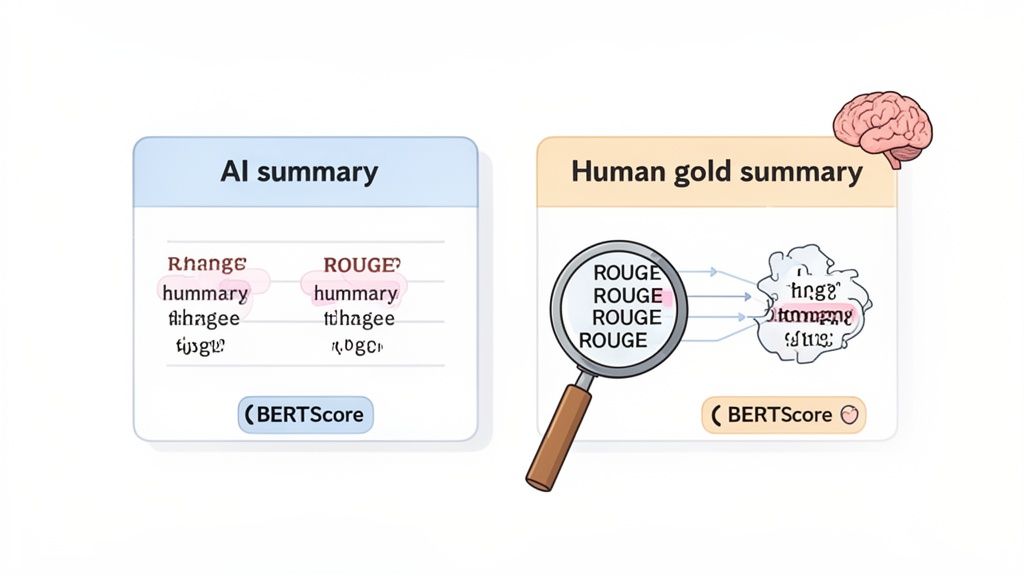
Think of it like grading a student’s book report. You don't just check for spelling errors. You're looking to see if they actually understood the plot, the characters, and the deeper themes. Evaluating an AI summary works the same way; we need to check both its factual accuracy and its grasp of the source material. This is what separates a neat party trick from a truly useful tool.
Measuring Overlap with ROUGE
A classic starting point is a metric called ROUGE (Recall-Oriented Understudy for Gisting Evaluation). The idea is pretty simple: you take the AI-generated summary and compare it to a "gold standard" summary written by a human.
Let's say a human expert writes, "The study found significant growth in renewable energy." The AI might produce, "Significant growth was observed in the renewable energy sector." ROUGE gets to work by counting the matching words and phrases between the two versions.
It comes in a few flavors:
- ROUGE-1: Checks the overlap of single words (unigrams).
- ROUGE-2: Looks at matching two-word phrases (bigrams).
- ROUGE-L: Finds the longest common sequence of words, giving a higher score to sentences that share a similar structure.
ROUGE is fantastic for checking factual alignment, especially with extractive summaries that just pull sentences. But it has a major blind spot. It can't really tell if the AI understood the meaning behind the words. For that, we need to bring in the heavy hitters.
Going Deeper with Semantic Meaning
A great summary might use completely different words but capture the original idea perfectly. This is the real challenge. How do you give an AI credit for understanding meaning, not just playing a game of keyword match-up? That’s where semantic metrics come in.
A powerful one is called BERTScore. Instead of just counting matching words, BERTScore uses sophisticated models to check if the words in the AI summary are semantically similar to the words in the human one. It's smart enough to know that "significant growth" and "major expansion" mean basically the same thing, even though the words are different.
This shift from keyword matching to semantic understanding is a major leap. It allows us to measure if an AI summary is not just factually correct, but also contextually intelligent and coherent, which is essential for abstractive summarization.
The Foundation of Quality Training Data
At the end of the day, no fancy metric can save a model that was trained on junk data. A text summarization AI is only as good as the information it learns from. High-quality training datasets are the absolute bedrock of any reliable summarizer.
These datasets are massive collections of documents, each paired with a summary written by a person. The AI learns by constantly trying to create its own summaries that match the human examples, refining its approach over millions of attempts. When you want to see which AI is best, it's crucial to know how to compare AI models using both these metrics and the data they were built on.
This whole rigorous cycle of training and evaluation is what lets a tool like PDF Summarizer deliver results you can actually trust. By combining robust metrics like ROUGE and BERTScore with top-tier data, we can build AI that doesn't just shorten text, but genuinely clarifies it.
Putting Text Summarization AI into Practice
It's one thing to understand the tech behind a text summarization AI, but it’s another to see it in action. That’s where the value really clicks. Across countless professions, this technology is shifting from a nice-to-have gadget to an essential tool for getting things done. It’s actively changing how we work, cutting down research time, and helping people make smarter decisions by tackling the age-old problem of too much information.
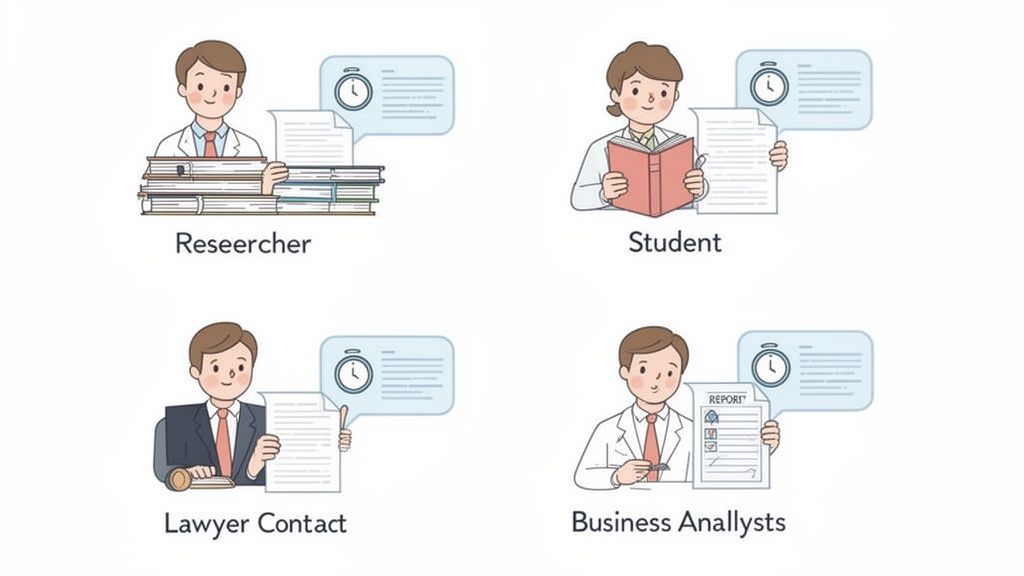
From the halls of academia to the corporate boardroom, the practical uses are immediate and profound.
A Game-Changer for Academic Research
For researchers and students, the literature review is a necessary evil. It can be a real grind, taking weeks or even months to manually plow through dozens—sometimes hundreds—of dense academic papers to pull out key findings, methods, and conclusions.
A text summarization AI flips this script entirely. Instead of reading every single word, a researcher can just upload a pile of papers and get back concise summaries of each one in minutes. This lets them quickly sort the wheat from the chaff, tossing irrelevant studies and zeroing in on the ones that matter. A task that once ate up a whole month can now be knocked out in an afternoon, freeing up precious time for actual analysis and writing.
Students get a similar boost. They can turn dense textbook chapters or assigned readings into much more manageable study guides. It’s not just about saving time; it actually helps with comprehension by shining a spotlight on the critical concepts they need to know for an exam.
Speeding Up Legal and Business Analysis
In the legal and business worlds, time is literally money, and wading through long documents is a massive time-sink. Lawyers are constantly buried in contracts, case files, and regulatory docs that can run for hundreds of pages.
With an AI summarizer, a legal team can boil a massive contract down to its key clauses, obligations, and potential red flags in no time. This puts the due diligence process on the fast track and helps lawyers spot the exact areas that need a closer human look, reducing the risk of missing something critical.
It's the same story for business analysts. They can feed complex market reports, financial statements, or competitive analyses into the AI and get back an executive-level briefing almost instantly. This allows them to spot trends and give leaders actionable insights without the usual delay.
The core benefit in these professional settings is velocity. AI summarization doesn't replace expert analysis; it dramatically speeds up the preliminary work, allowing human experts to apply their judgment and expertise to a pre-filtered, high-value set of information.
Advanced Features for Deeper Insights
Today's AI summarizers are moving way beyond just shortening a single document. New capabilities are popping up that make these tools feel more like research assistants than simple text shorteners.
Multi-File Chat: Picture this: you have ten related research papers. Instead of summarizing them one by one, you can load them all into a single chat and start asking questions across the entire set. You could ask, "Which of these studies used a similar methodology?" or "Synthesize the main conclusions from all sources regarding climate impact." This is a game-changer for synthesizing information. To see more on this, check out our guide on automatic document processing.
Cross-Language Q&A: The best ideas aren't always published in your native language. The latest tools can now take in documents in one language and let you ask questions and get answers in another. A researcher can analyze a study published in German, a business analyst can review a report from Japan, and a student can tap into sources from around the world—all without any language barriers.
These features show just how fast the generative AI field is moving. The market, which includes text summarization, is expected to explode from USD 55.51 billion in 2026 to USD 1.206 trillion by 2035. With 92% of Fortune 500 firms already using generative AI, tools that turn long PDFs into clear takeaways are becoming the new standard. You can find more insights about the booming AI market on Neural Arb.
Choosing the Right AI Summarizer for Your Needs
Knowing the difference between extractive and abstractive summaries is great, but what really matters is how that technology translates into a tool you can actually use. The market is flooded with options, but the best ones make all that complex AI feel invisible. You shouldn't need a PhD in machine learning just to get the main points from a dense report.
A great summarizer acts as a bridge. It connects the raw power of models like BART or T5 to your immediate need for clarity and understanding. The whole process should be as simple as uploading a document and getting a reliable summary back in seconds. This is the core idea behind tools like PDF Summarizer—turning advanced tech into a no-fuss solution for information overload.
Key Features That Build Trust and Efficiency
When you're evaluating a summarizer, look past the basic "make it shorter" function. A few critical features are what separate a decent tool from an indispensable research assistant. These aren't just about saving time; they're about building your confidence in what the AI tells you, ensuring accuracy and helping you dig deeper.
For anyone working with complex information, three features are non-negotiable:
- Clickable Citations and Side-by-Side View: Trust is everything with AI. A tool that shows the summary next to the original document—with citations that link directly to the source text—is a game-changer. It lets you instantly fact-check any claim or statistic, killing the guesswork and preventing those infamous AI "hallucinations."
- Multi-File Chat: Real-world work rarely sticks to a single document. Imagine uploading ten research papers for a literature review and being able to ask questions across the entire set. That's a huge advantage. You can synthesize findings, compare methodologies, and spot themes without drowning in browser tabs.
- Multilingual Support: Good information isn't confined to one language. A top-tier summarizer should effortlessly break down those barriers. You should be able to upload a document in Spanish and ask questions about it in English, opening up a global library of knowledge for your work.
A truly effective text summarization AI does more than just shrink text. It creates a dynamic workspace where you can interact with your documents, verify information on the fly, and synthesize knowledge across multiple sources and languages.
From Complex Research to Clear Insights: A Practical Example
Let's walk through a common scenario. Say you’re a student who needs to understand the key findings from a dense, 50-page scientific paper on climate change. It's packed with technical jargon, and you need the highlights fast.
Here’s how a tool like PDF Summarizer makes that happen:
- Instant Upload and Summary: First, you just drag and drop the PDF into the tool. Within moments, you get a clean, abstractive summary that covers the paper's purpose, methods, findings, and conclusion. Right away, you know if this paper is even relevant to your research.
- Deeper Inquiry with Chat: Instead of reading all 50 pages, you start a conversation with the document. You can ask specific questions like, "What was the sample size for this study?" or "List the main limitations mentioned by the authors." The AI pulls the exact answers right from the text.
- Verification with Clickable Citations: The AI gives you a critical data point: "The study found a 3.2°C increase in average temperature." Next to that fact is a citation number. You click it, and the tool instantly scrolls to the precise sentence on the original page where that data appears. Your confidence in the answer is now 100%.
This interactive workflow turns passive reading into an active investigation. You can explore how to get the most out of these features in our guide to using an AI PDF summarizer.
Making Advanced AI Accessible to Everyone
Ultimately, the goal of a modern AI summarizer is to make information more accessible for everyone. You shouldn't have to install clunky software or mess around with an API. The entire experience should live in your browser, ready to go on any device, so you can move from your laptop to your tablet without missing a beat.
By focusing on a clean, intuitive interface that hides all the complexity, these tools empower anyone to cut through the noise. Whether you're a student prepping for an exam, a lawyer reviewing a contract, or a researcher digging for insights, the right text summarization AI becomes your personal cognitive assistant, ready to turn dense documents into clear, actionable knowledge.
Common Questions About Text Summarization AI
It's smart to be a little skeptical of any new technology, and text summarization AI is no exception. How much can you really trust it? What are its blind spots? Getting straight answers to these questions is the key to using these tools well.
Let’s dig into some of the most common things people wonder about.
Can AI Truly Understand the Context of a Document?
This question gets right to the heart of the matter. Modern AI models, especially those built on the Transformer architecture, are incredibly good at piecing together context. They don't "understand" things like a human does, of course, but their attention mechanisms are designed to map out the complex relationships between words and ideas across an entire document.
This is what gives them an almost uncanny ability to pinpoint central themes and key arguments. For an abstractive summarizer, this skill is what allows it to write brand new sentences that actually capture the soul of the original text.
Still, they aren't flawless. Nuance, sarcasm, and deep-seated irony can sometimes go right over their heads. This is exactly why features like clickable citations are so critical—they act as a bridge of trust, letting you instantly check the AI's interpretation against the source material yourself.
Is Using an AI-Generated Summary Considered Plagiarism?
This is a big one, but the answer is pretty straightforward when you think about it. Using a text summarization AI to get your head around a topic or speed up your research is just a smart way to work. It’s no different from using a search engine to find information or a calculator to crunch numbers.
Plagiarism is when you pass off someone else’s work or ideas as your own without credit. So, if you pull a specific insight, a piece of data, or a unique argument from an AI-generated summary into your own work, you must cite the original document.
The summary is a tool to help you understand the source, not a replacement for it. You’re still responsible for citing the original author's work properly.
Think of the summary as your personal set of cliff notes. You use them to get the gist, but you always go back to the original source for direct quotes and your official citations.
What Are the Biggest Challenges for Summarization AI?
Even with all the impressive progress, AI summarizers still have some real hurdles to overcome. Knowing what they are helps you use these tools a lot more effectively.
- Hallucination: This is a major one for abstractive models. It’s when the AI confidently states something that sounds plausible but is factually wrong and not in the original text. Better training and verification features are constantly working to stamp this out.
- Bias: AI models are trained on a massive diet of text from the internet. If that data has biases—and it almost always does—the AI can accidentally repeat or even amplify them in its summaries.
- Handling Extremely Long Documents: While they’re getting better, asking an AI to maintain perfect context across a 500-page book is still a tall order. It might start to "forget" details from the early chapters by the time it gets to the end.
- Creative and Figurative Language: Summarizing a lab report is one thing, but summarizing a poem is something else entirely. AI still has a hard time capturing the metaphor, emotional weight, and artistic nuance in highly creative writing.
Researchers are working hard on these very problems, focusing on improving factuality, reducing bias, and giving AI a much longer contextual memory.
How Can I Get the Best Results from an AI Summarizer?
Getting great results from a text summarization AI is all about how you prompt it. Think of yourself as a manager delegating a task—the more specific you are, the better the outcome.
Instead of just telling it to "summarize this," guide its focus with a targeted question.
For example, try asking:
- "What are the main conclusions about the impact of climate change on coastal erosion?"
- "Summarize the methodology section in three clear bullet points."
- "What were the key limitations of this study as mentioned by the authors?"
If you're analyzing several files at once, make sure they’re all related to the same core topic so you don't confuse the AI. And always use features like clickable citations to double-check any critical numbers or facts. Clear instructions lead to clear, valuable answers.
Ready to see how a smart summarizer can change the way you work? PDF Summarizer makes it easy to chat with your documents, get instant answers with verifiable sources, and pull together information from multiple files at once. Stop drowning in text and start discovering insights.
Relevant articles
Discover how question answering AI transforms documents into conversations. Learn how NLP and machine learning deliver instant, sourced answers from your files.
Discover the best pdf article summarizer to boost your productivity. Our 2026 review covers top AI tools for students, researchers, and professionals.
Discover the top 12 tools for any PDF summarizer AI free workflow. Get instant, accurate summaries from dense documents, reports, and research papers today.

Save hours of reading with a free PDF summarizer. Learn how these AI tools work, discover key features, and see how to integrate one into your workflow today.
Discover how a PDF summary generator can transform your workflow. This guide breaks down how AI works, features to look for, and tips for perfect summaries.
Learn to create a flawless AI summary of article with this guide. Discover the best tools, prompts, and verification methods to get accurate results.