How to Summarize a Book Without Losing Its Essence
Learn how to summarize a book with our expert guide. Master practical pre-reading, note-taking, and drafting techniques for any nonfiction or fiction work.
To get the most out of any book, you need a system. It starts with understanding its basic structure before you even read the first chapter, shifts to actively taking notes on the big ideas, and ends with boiling all of that down into a clear, concise overview. This approach turns even the most complex book into its essential arguments and themes, making it far easier to understand and remember.
Why Mastering Book Summaries Is a Superpower
In a world overflowing with information, being able to distill a book's core message is a genuine superpower. It's not just an academic exercise. Whether you're a student drowning in a reading list, a professional trying to absorb business insights quickly, or just someone who wants to remember more of what you read, knowing how to summarize well is a game-changer.
The demand for this skill is huge. The global book market is currently valued at $156.43 billion and is expected to climb to $198.16 billion by 2032. That growth isn't just about selling more books; it's about making knowledge more accessible. Just look at the rise of summary apps like Blinkist and getAbstract, which break down dense works into 15-minute reads. It's clear people are hungry for concentrated knowledge. You can dig deeper into these publishing market trends and their impact.
The Three Pillars of an Effective Summary
A truly effective summary doesn't just happen. It's built on a deliberate, three-phase process that ensures you capture the author's intent without getting lost in the details. Instead of just diving in, you'll learn to build a mental framework before you even start reading. This initial prep work makes the whole process smoother and your final summary much more insightful.
This guide breaks down the entire process into clear, manageable stages. Here's a quick look at what we'll cover:
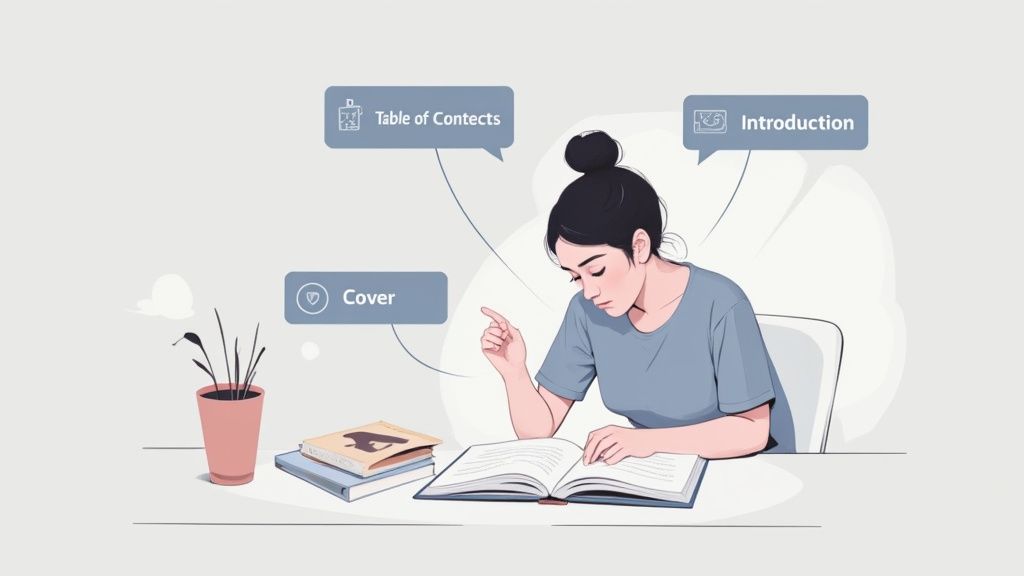
- Pre-Reading Strategies: We'll start by laying the groundwork. You’ll learn how to scout a book’s cover, table of contents, and introduction to get a feel for its purpose and structure.
- Active Engagement: Next, we'll get into the weeds of active reading and note-taking. This is where you learn to have a conversation with the text, pulling out key ideas, recurring themes, and crucial supporting evidence.
- Synthesis and Drafting: Finally, we’ll bring it all together. This last step is about turning your raw notes into a polished summary that captures the book's core message in your own words.
A great summary is more than a simple retelling; it is a reconstruction of the book's architectural foundation, revealing the core ideas that hold the entire structure together.
Mastering these pillars will give you the confidence to tackle any book.
To get a clearer picture, think of the process as having three core stages. Each one builds on the last, taking you from a high-level overview to a detailed, useful summary.
Three Pillars of an Effective Summary
| Phase | Objective | Key Action |
|---|---|---|
| Phase 1: Foundation | Understand the book's structure and purpose before you read. | Analyze the cover, table of contents, and author's bio. |
| Phase 2: Engagement | Actively capture key ideas and themes while reading. | Use a structured note-taking system like Cornell Notes. |
| Phase 3: Synthesis | Distill your notes into a concise and coherent summary. | Identify the main thesis and supporting points, then draft. |
By following this simple framework, you create a repeatable process that works for fiction, non-fiction, and everything in between.
Active Reading and Smart Note-Taking Strategies
If you want to summarize a book, just letting your eyes glaze over the pages isn’t going to work. You have to get in there and engage with the material—think of it as a conversation with the author. This means you're questioning what you read, making connections, and jotting down ideas as they hit you.
This kind of active engagement is what separates passive reading from real comprehension. Instead of just letting the information flow past you, you’ll be building a mental framework that makes pulling together a summary much, much easier down the line.
Go Beyond Highlighting with Purposeful Annotation
We've all been guilty of it—highlighting huge blocks of text until half the page is neon yellow. It feels productive, but it's not. The trick is to be surgical, marking only the stuff that truly matters.
A great way to do this is to create your own personal "legend" for annotating. It doesn’t have to be anything fancy. You could use different colors for main ideas versus supporting details, or just use simple symbols in the margins.
Here’s a system I’ve found helpful:
- Underline the author's core thesis statement. You'll usually find this hiding in plain sight in the introduction or conclusion.
- Put an asterisk (*) next to compelling examples or statistics that jump out at you.
- Use a question mark (?) for anything that’s unclear or that you want to dig into later.
- An exclamation point (!) works great for sentences that are especially profound or insightful.
Having a simple, consistent system turns random marks into a structured dialogue with the book. When you come back to review, your notes will actually mean something.
Use a Structured Note-Taking System
Just scribbling notes randomly on a page is a recipe for a headache later. A structured approach, like the classic Cornell Note-Taking method, can bring some much-needed order to the chaos.
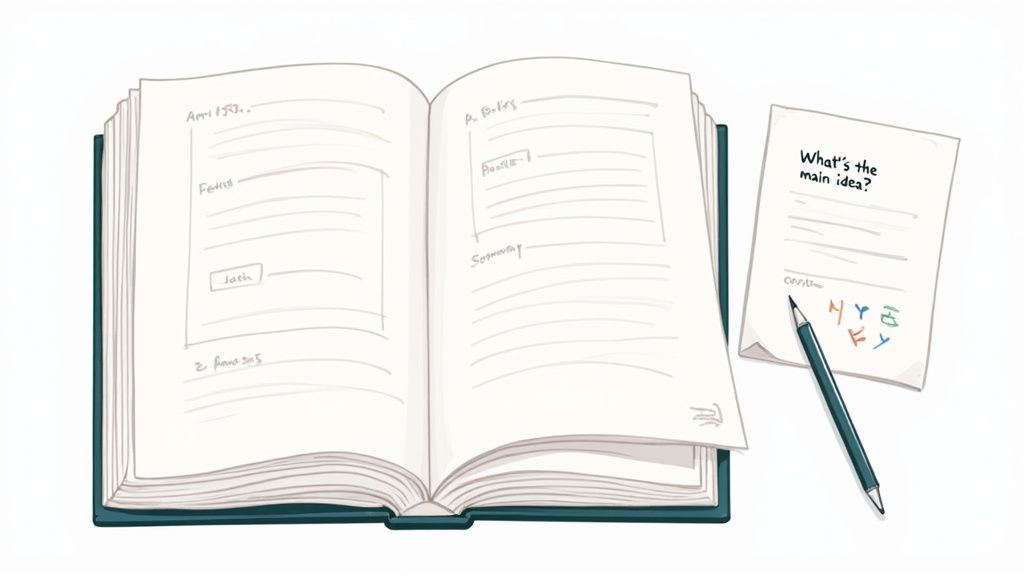
It's simple. You just divide your page into three distinct areas: a large column for your main notes, a narrower column for cues, and a small section at the bottom for a summary.
- Main Notes: This is where you'll do most of your writing. Capture the author's key arguments, important data, and any detailed points you want to remember.
- Cues: In the skinny column on the side, pull out keywords or write short questions that relate to your notes. These are perfect for quickly quizzing yourself later.
- Summary: Once you're done with a chapter or section, force yourself to write a one or two-sentence summary of that page's content at the bottom.
This method is brilliant because it makes you process the information, not just copy it down. By separating big ideas from your little memory-jogging cues, you're already doing the heavy lifting needed to summarize a book.
If you're more of a digital person, knowledge management tools can be a game-changer. For example, tools with features like Obsibrain's quick capture and note-taking features are designed to help you organize your thoughts on the fly. Ultimately, all these techniques are about one thing: deepening your understanding. For more tips on that front, check out our guide on https://pdfsummarizer.pro/blog/how-to-improve-reading-comprehension-skills.
From Notes to Narrative: Crafting Your First Draft
You’ve done the hard work of reading and taking detailed notes. Now for the fun part: turning that raw material into a coherent summary. This isn't about just listing facts; it's about weaving together the author's key ideas into a story that captures the book's essence.
First, take a step back and look at your notes from a bird's-eye view. What concepts or phrases keep popping up? You're searching for the single, overarching message the author is trying to get across. This becomes your thesis statement—the core idea that everything else in your summary will support.
Finding the Book's Backbone
Once you've got a grip on the central thesis, it's time to identify the pillars holding it up. These are the main arguments and themes that form the book's structure. Go back to your chapter notes or your Cornell summaries and pull out the most important points and the evidence the author uses to back them up.
Think of it as building a skeleton. Your thesis is the spine, and each major argument is a rib. A simple but effective outline can make all the difference here:
- Introduction: Kick things off with the book's title, author, and your newly minted thesis statement.
- Body Paragraphs: Dedicate a paragraph to each major supporting argument. Explain the point and show how it connects to the main idea.
- Conclusion: Wrap it up by restating the thesis in a fresh way and briefly touching on the main points you just covered.
This framework creates a logical path for your reader, guiding them from the big idea through the evidence that proves it. It's crucial to put these ideas into your own words. This isn't just about dodging plagiarism—it’s the ultimate test of whether you've truly understood the material. If you need a refresher on getting your notes into shape, our guide on turning a PDF into organized notes is a great resource.
Getting the First Draft Down
Alright, it's time to start writing. Don't worry about making it perfect right now. Just focus on getting the ideas from your outline onto the page. Write freely and let the thoughts flow. Your main goal is to create a logical progression of ideas, always staying true to the author's original perspective without adding your own two cents.
Your first draft is really just a conversation with yourself. You're testing your own understanding, checking to see if the connections you made in your notes actually hold up when written out.
The skill you're building is more valuable than ever. The global books market is projected to hit $142.72 billion, and a big part of that growth comes from summaries and digests. In fact, summary platforms see an 80% user preference for 10-20 minute reads, which in turn leads to a 35% increase in people buying the full book. For professionals, this is huge—60% of them use summaries every week to stay sharp and advance their careers. You can dive deeper into these book sales statistics and trends to see just how big the impact is.
Once you’ve finished that first draft, walk away. Seriously. Give yourself a few hours, or even a whole day. When you come back to it with fresh eyes, you'll be in the perfect position to edit, refine, and polish your work into a summary that’s not just accurate, but genuinely insightful.
Choosing the Right Summary Format for Your Goal
Knowing how to summarize a book is one thing, but picking the right format for your audience and purpose is a completely different skill. A summary isn't a one-size-fits-all document. The version you’d draft for your boss will look nothing like the one you’d text a friend.
Think of it like dressing for an occasion—you wouldn't show up to a casual barbecue in a tuxedo. In the same way, dropping a dense, academic abstract into a fast-paced business meeting would just fall flat. The real trick is matching the summary's depth, tone, and structure to the specific situation you're in.
Decoding Different Summary Types
Let's break down the most common formats, since each one serves a very distinct purpose.
An executive summary is your go-to in the corporate world. It’s designed to cut right through the fluff and spotlight actionable insights and crucial findings. This helps busy decision-makers get the gist immediately without getting bogged down in details.
On the other end of the spectrum, you have the academic abstract. This format is far more rigid and structured, meant for research papers and scholarly articles. It’s typically capped at 250 words and gives a high-density overview of the book's core thesis, methodology, results, and conclusion. It's pure information, with zero room for casual language.
Then, of course, there’s the ultra-casual TL;DR (Too Long; Didn't Read). This is perfect for online forums, quick emails, or group chats. It boils an entire book down to its absolute core message in just a sentence or two—the fastest way to share a big idea without any formality. If you get really good at this, you might even find you have the foundation to create and sell an engaging ebook by expanding on your more detailed summaries.
This decision tree gives you a great visual for how your goal—whether you're tackling fiction or non-fiction—should guide your summary's focus.
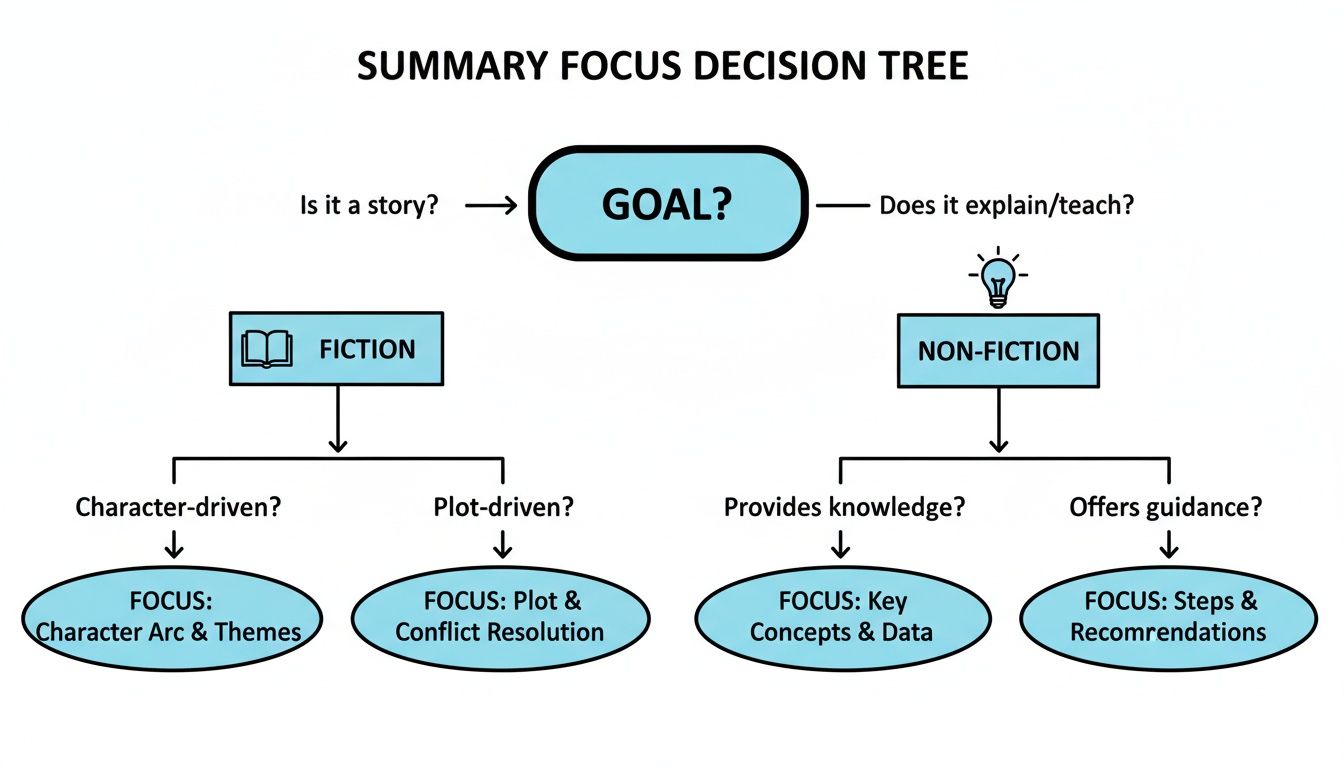
As you can see, summarizing a novel is often about tracing the plot and character arcs, whereas a non-fiction summary is all about the author's arguments and supporting evidence.
Which Book Summary Format Should You Use
A comparative look at different summary types to help you choose the right one for your specific audience and purpose.
| Summary Type | Best For | Typical Length | Key Focus |
|---|---|---|---|
| Abstract | Academic papers, research articles, scholarly work | 150-250 words | Thesis, methodology, results, and conclusion |
| Executive Summary | Business reports, proposals, corporate settings | 1-2 pages | Key findings, actionable insights, and recommendations |
| TL;DR | Online forums, social media, informal emails | 1-3 sentences | The absolute core message or main takeaway |
| Outline Summary | Personal study notes, book club prep, content planning | Varies (bullet points) | Hierarchical structure, main points, and sub-points |
Choosing the right format ultimately comes down to knowing your reader and what they need from you.
Matching Format to Function
Before you even start writing, you need to answer a few quick questions:
- Who is this for?
- What do they absolutely need to know?
- And honestly, how much time do they have?
The most effective summary is one that anticipates the reader's needs and delivers the necessary information in the most efficient and appropriate format possible.
When you take a moment to consider your audience, you ensure your summary doesn't just accurately reflect the book but also hits its mark. Whether you're trying to persuade, inform, or just share a great read, picking the right format is what turns a simple report into a genuinely powerful communication tool.
Using AI Tools as Your Summarization Assistant
Think of artificial intelligence as a powerful assistant for summarizing books, not as a replacement for your own brainpower. AI tools can spit out a first draft in seconds, highlighting what the algorithm thinks are the most important sentences and themes. Honestly, this is a fantastic way to get started and beat that initial "blank page" feeling. It gives you an immediate, high-level look at the book's structure.
But don't just copy and paste what the AI gives you. The real work starts when you treat that AI-generated draft as a benchmark. Pull out your own handwritten notes and compare them. Did the machine pick up on the same core arguments you did? More importantly, what subtle points or crucial supporting details did it completely miss? This back-and-forth is where your understanding really deepens, helping you build a much stronger final summary.
Verifying and Enhancing with AI
I've found one of the best uses for an AI summarizer is as a sophisticated fact-checker. Once you have a draft of your own summary, feed the original book (or even just your detailed notes) into the tool. Then, you can start asking it very specific questions to tighten up your work.
For instance, you could prompt it with things like:
- "What were the three main arguments presented in Chapter 5?"
- "Find all sentences that show the author's primary tone."
- "Pull out the statistical data mentioned in the conclusion."
This approach turns the AI into a collaborator. It helps you catch errors, fill in gaps, and ensure your final summary is both accurate and comprehensive. Our guide to using a PDF summary generator walks through more of these advanced, interactive techniques.
The real power of AI in summarization isn't that it writes for you; it's that it helps you think better. It's a tool for verification and discovery, not just a shortcut.
Understanding AI's Limitations
You have to be realistic about where these tools fail. AI is notoriously bad at picking up on nuance, tone, and the subtext that’s so critical to understanding an author's true message. It might perfectly list the plot points of a novel but completely whiff on the satire or emotional weight behind them. This is where your human insight is absolutely essential.
The book publishing industry in the United States is a $46.5 billion market, and digital content is changing everything. While print sales have seen a slight dip, ebooks have climbed 2.4% and digital audiobooks have jumped 5.3%. Summary tools are becoming more common, and some data even suggests content with summaries sees 25% higher completion rates.
This trend shows just how much people value good summaries. But it also highlights the risk of letting AI do all the work. You always need to be the final editor, adding the human layer of context and critical analysis that a machine simply can't replicate.
Common Questions About Summarizing Books
Even with the best process laid out, a few practical questions always pop up. Let's dig into some of the most common ones I hear, because getting these details right can make all the difference between a decent summary and a great one.
How Long Should a Book Summary Be?
This is easily the most frequent question, and the honest answer is: it depends. There's no one-size-fits-all word count.
A good starting point is to aim for about 5-10% of the original book's length. So, for a 300-page book, that might translate to a 15 to 30-page summary if you're creating a detailed study guide. But if your boss needs a quick brief on that same book, a single-page executive summary is probably what they're looking for.
The real driver is your goal and your audience. Think about it this way:
- For an academic abstract? You’ll be held to a strict 150-250 word limit.
- For an executive summary? One or two pages focusing on actionable insights is standard.
- For a TL;DR to a friend? A couple of punchy sentences will get the job done.
Always start by asking who the summary is for and what they need from it.
Can You Summarize a Book Without Reading It?
You can, but I wouldn't recommend it. It's a risky shortcut. Using online reviews, other people's summaries, or even an AI tool can give you a superficial overview. This might be fine if all you need is a vague, low-stakes idea of what the book is about.
But for a summary that has any real substance, you have to engage with the text yourself. Reading the whole book is the only way to truly grasp the author's voice, tone, and the subtle connections between their ideas. If you're summarizing for any kind of academic or professional reason, skipping the reading part isn't just a bad idea—it compromises the integrity of your work.
A summary written without reading the book is like a map drawn by someone who's only heard stories about the place. It might point you in the right general direction, but you definitely wouldn't trust it to find your way.
What Are the Biggest Mistakes to Avoid?
I see a few common tripwires that can really weaken a summary. Knowing what they are is the best way to avoid them. The biggest mistake by far is just retelling the plot or listing facts one by one. Your job is to distill the core message, not just report what happened.
Keep an eye out for these other critical errors:
- Injecting Your Own Opinion: A summary needs to be an objective reflection of the author's work. Save your personal critique for a book review.
- Copying and Pasting: Always use your own words. Lifting sentences directly from the text isn't just plagiarism; it shows you haven't really processed the information.
- Missing the Main Point: If you misinterpret the author's central thesis, the entire summary will be off-base, no matter how well you write it.
- Forgetting to Conclude: A strong summary needs a final sentence that ties everything together and reinforces the book's main takeaway.
Steering clear of these pitfalls will help you create a summary that’s accurate, ethical, and genuinely useful to your reader.
Ready to make your summarization process even faster and more accurate? PDF Summarizer uses AI to help you chat with any document, get instant answers with cited sources, and create clear, concise summaries in seconds. Whether you're a student, researcher, or professional, it's the perfect tool to turn dense reports into actionable insights. Try it for free today at https://pdfsummarizer.pro.
Relevant articles

Discover the best way to study textbooks with our top 10 methods. Learn active reading, SQ3R, and AI-powered tips for maximum retention and efficiency.