How to Finish Homework Fast Without Sacrificing Your Grades
Learn how to finish homework fast with proven strategies for planning, focus, and using tools to cut study time and boost your results. Stop drowning in work.

Getting homework done fast isn't about rushing; it's about being strategic. The whole game boils down to a simple, repeatable process: plan your attack, get into a state of deep focus, and then use the right tools to do the heavy lifting. This is how you reclaim your evenings without sacrificing your grades.
Your Game Plan for Finishing Homework Faster
We’ve all been there—staring at a massive to-do list and feeling totally paralyzed. The instinct is to just dive in and work for hours, but that's a recipe for burnout. The real secret is to stop working harder and start working smarter. With a solid game plan, you can turn those marathon study sessions into a series of quick, effective sprints.
This framework is built on three core pillars you can put into practice literally tonight.
First, you need a plan. This means taking a few minutes to map out every assignment, deciding what to tackle first, and why. It completely eliminates that "I don't even know where to begin" feeling.
Next, it's all about creating an environment for intense focus. You have to be intentional about shutting out the world—both the physical clutter on your desk and the digital noise from your phone—so you can give your full attention to the task at hand.
Finally, we'll look at how technology can be your secret weapon. The right tools can automate the boring, repetitive parts of your work, like summarizing a dense chapter or checking your grammar. This frees up your brainpower for the important stuff, like actually understanding the material.
This whole approach is pretty straightforward when you look at it visually.
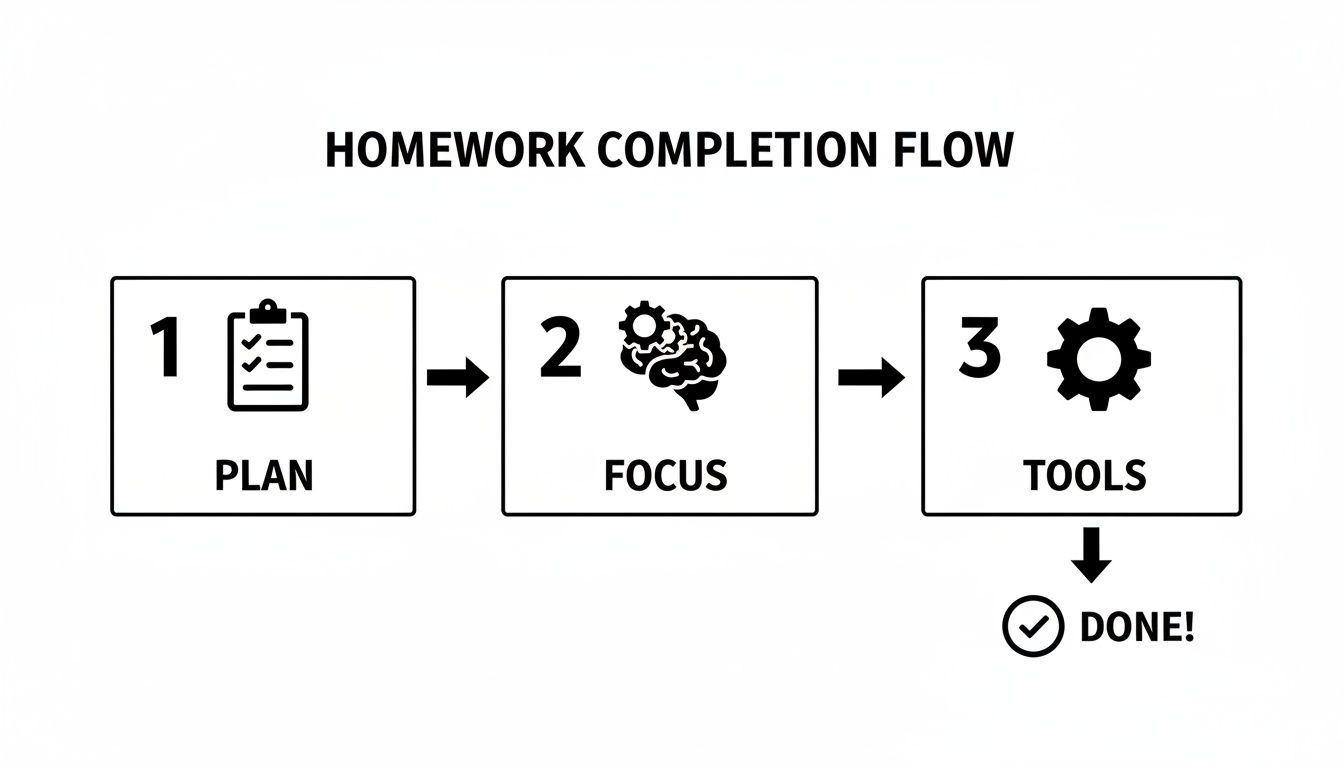
As you can see, a systematic approach is the fastest path from "To-Do" to "Done." You plan your work, focus on the execution, and use tools to make it easier.
The Three Pillars Of Efficient Homework
Let's break this down into actionable stages. Thinking about your homework process this way keeps you from getting stuck in the weeds.
Strategic Planning: Before you even crack open a book, take five minutes. List everything you have to do, then rank it by deadline and difficulty. That little bit of upfront clarity creates all the momentum you need.
Deep Focus Sessions: Don't try to work for hours on end. Instead, work in focused bursts—maybe 45 minutes of heads-down work followed by a 10-minute break. You're training your brain to lock in, which is way more powerful than hours of half-hearted effort.
Leveraging Smart Tools: Pinpoint the biggest time-sinks in your assignments. If you're buried in reading, this is where you can learn how to take notes from textbooks more effectively and use tech to pull out key information for you.
To give you a bird's-eye view, here's how the entire framework comes together.
The Fast Homework Framework At a Glance
| Phase | Objective | Key Action |
|---|---|---|
| Plan | Create clarity and momentum | List all tasks, then prioritize by deadline and effort. |
| Focus | Maximize concentration and output | Work in timed, distraction-free blocks (like Pomodoros). |
| Tools | Automate repetitive work | Use software for summarizing, grammar checks, and citations. |
This table neatly summarizes the process. It's not complicated, but it is a system.
The goal isn't just speed; it's efficiency. A single, well-planned hour of focused work is easily worth three hours of distracted, disorganized effort. When you master this system, you're not just finishing homework faster—you're building planning and execution skills that will pay off for the rest of your life.
Master Your Time Instead of Letting It Master You
Time is your single greatest asset for getting homework done, but most students just let it slip away without a fight. The secret to finishing faster isn't about magically finding more hours in the day—it's about taking command of the hours you already have. Let's skip the vague advice and get straight into practical tactics that put you back in control.
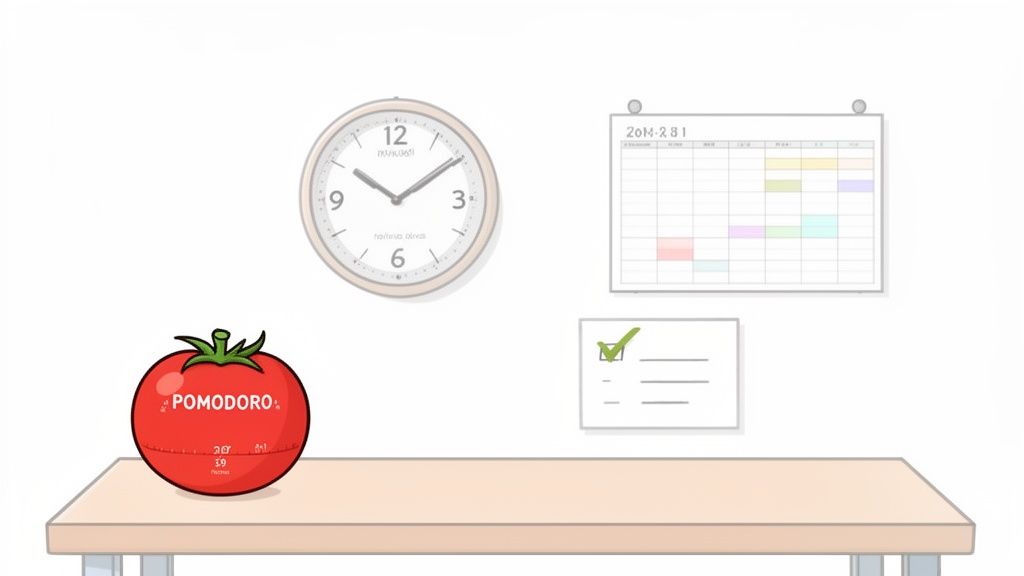
This is a mental shift. You're no longer just "doing homework"; you're executing a planned mission. When you assign specific jobs to specific blocks of time, you kill the mental drag of figuring out what to do next. You just do it.
The Power of Pomodoros
One of the best ways I’ve found to stay locked in is the Pomodoro Technique. It's brilliant in its simplicity: work in a focused 25-minute sprint, then take a mandatory 5-minute break. No exceptions.
This works because it forces you into a short burst of deep work, which makes a huge project feel way less intimidating. Just knowing a break is right around the corner helps you resist the urge to scroll through social media. After four of these "Pomodoros," you reward yourself with a longer break, maybe 15-30 minutes.
Schedule Your Success with Time-Blocking
While Pomodoros manage your focus within a study session, time-blocking organizes your entire day. Instead of staring at a long, overwhelming to-do list, you schedule your homework directly into your calendar as if it were a non-negotiable appointment.
For instance, your calendar might look something like this:
- 4:00 PM - 4:45 PM: Knock out Algebra Chapter 5 problems.
- 4:45 PM - 5:00 PM: Break. Get up, walk around, grab a snack.
- 5:00 PM - 5:30 PM: Read and highlight History Chapter 9.
This strategy stops one task from bleeding into the next—a classic problem where a "quick" assignment ends up hijacking your entire evening. It puts a container around the work and fiercely protects your free time.
By scheduling your work, you are making a commitment to yourself. You are telling your brain, "This specific time is for this specific task, and nothing else." This simple act dramatically reduces procrastination and decision fatigue.
To really get this right, you have to think beyond the clock. This brings up the crucial debate of Energy Management vs Time Management. Time is fixed, but your energy isn't. The real pro move is to pair your high-energy periods with your toughest tasks.
Set Micro-Goals for Momentum
Finally, for each time block you create, set a tiny, realistic goal. Don't just block out an hour to "Study for Biology." That's too vague. Instead, make the goal something concrete like "Complete the first 10 review questions" or "Create flashcards for the key vocabulary list."
Achieving these small wins creates a powerful sense of momentum. Each completed micro-goal builds your confidence and makes it that much easier to start the next one. This is how you transform a mountain of homework into a series of small, manageable hills, guaranteeing you finish faster every single time.
3. Conquer Your Reading List with Smarter Strategies
Let’s be honest: heavy reading assignments are usually the biggest time-suck. When you’re staring down a dense, 50-page chapter or a complex academic journal, it can feel like you’re about to run a marathon you didn't train for. But what if you could change the race? The secret isn't just about reading faster; it's about reading smarter—getting exactly what you need from the text, and fast.
You have to shift from just letting your eyes glaze over the words (passive reading) to actually wrestling with the material (active reading). A classic, time-tested framework for this is SQ3R: Survey, Question, Read, Recite, and Review.
Before you even dive into the first paragraph, you survey the chapter by scanning headings, captions, and summaries. Then, you turn those headings into questions. This simple trick primes your brain, turning you into a detective hunting for clues and answers as you read. This keeps you engaged, boosts what you remember, and helps you get through the material much quicker.
Give Yourself an Edge with Technology
Old-school reading methods are solid, but why not give yourself an incredible advantage with modern tools? Technology can do the initial heavy lifting, freeing up your mental energy for the important stuff like analysis and critical thinking, instead of just slogging through the text. This is where you can seriously speed things up.
Tools like a PDF Summarizer are built for the exact kind of documents that slow students down. Instead of dedicating an hour to a research paper, you can upload it and get the core arguments, key findings, and main conclusions laid out for you in seconds.
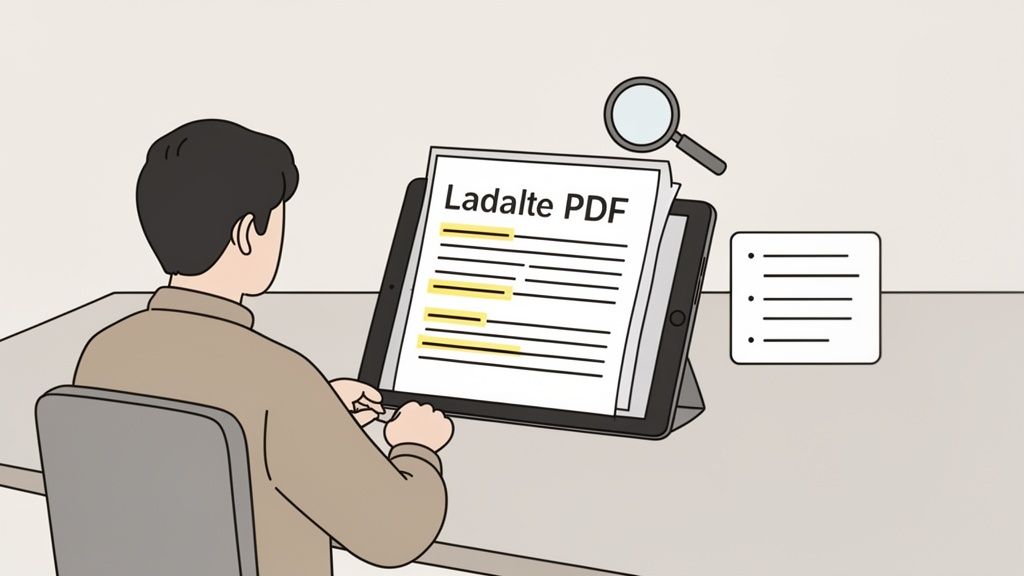
It’s that simple. What was once a daunting task becomes a quick, manageable one.
Go Beyond Summaries with Interactive Research
The real game-changer with these tools is how interactive they are. Once you’ve got the summary, you can literally "chat" with your document. Think about it: you could ask your textbook a direct question, like, "What were the three main causes of the Peloponnesian War?" or "Explain this scientific concept in simpler terms." The AI digs into the text and pulls out the exact answer for you.
This isn't about skipping the reading. It's about making your reading laser-focused.
Even better, the best tools provide clickable citations. When the AI gives you an answer, it shows you precisely where in the original document it found the information. This is a brilliant feature that bridges the gap between AI-powered speed and academic integrity, letting you verify every source instantly.
This approach transforms reading from a passive, time-consuming chore into an active, efficient hunt for knowledge. You're no longer just absorbing text; you're interrogating it to find exactly what you need for your assignment.
This focused, efficient approach is backed by research on study habits. A 2014 analysis of PISA scores found that students who spent just one hour a day on math homework scored 33 points higher than those who did none. Bumping that up to one or two hours daily resulted in a massive 61-point leap. The takeaway? Consistent, targeted effort beats last-minute cramming every time.
By combining active reading strategies with smart technology, you can process your assignments in shorter, more effective bursts. This frees up so much time while making sure you actually understand the material. For more on this, check out our guide on how to read faster and retain information.
Building the Ultimate Distraction-Free Study Zone
Where you choose to do your homework can make or break your productivity. A messy desk in a loud room is a recipe for disaster; it constantly sends little stress signals to your brain that make it nearly impossible to focus. Building a dedicated study zone isn't about having a perfect, Instagram-worthy office—it’s a strategic move that tells your brain, "Okay, it's time to get to work."
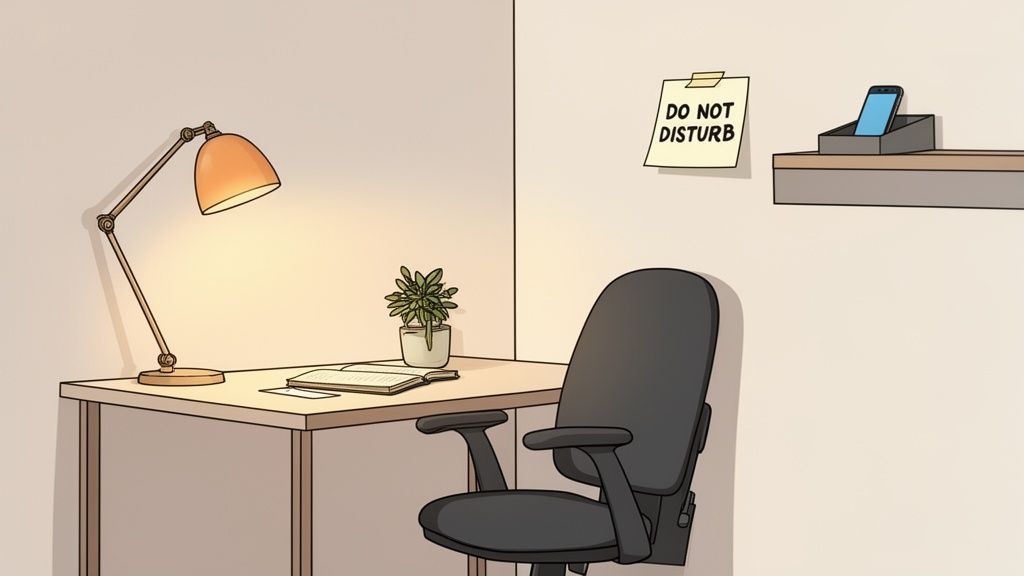
You don't need a whole room. Even a small corner of your bedroom can become a high-focus sanctuary. The secret sauce is consistency. When you only use that space for studying, your brain starts to build a powerful connection. The simple act of sitting down at that desk becomes a ritual that automatically switches you into work mode. Make sure you have a comfortable chair, decent lighting, and an organized surface—these are the basics that prevent physical discomfort from distracting you.
Fortifying Your Physical Space
First things first: declutter. Clear your desk of anything that isn't absolutely essential for the homework you're doing right now. This isn't just about being tidy; it reduces the visual noise that pulls at your attention and gives you fewer things to fidget with.
Next up, set some boundaries. If you've got family or roommates, a quick, polite conversation can work wonders.
A simple, "Hey, I'm going to be studying from 6 to 8 PM in my room, so could you try to keep it down?" sets clear expectations. This proactive step helps prevent those jarring interruptions that completely shatter your concentration and steal precious minutes.
Your study zone is more than just a place; it's a psychological trigger. When your brain associates a specific location exclusively with focused work, the act of sitting down there becomes a powerful ritual that jump-starts your productivity.
Think of it like setting up a cockpit. Keep everything you need—pens, notebooks, your calculator—within arm’s reach. Every time you have to get up to find a highlighter, you're giving your brain an excuse to break its focus. It might seem small, but those little breaks make it much harder to get back into the zone.
Conquering Digital Distractions
Your physical setup is only half the battle. The digital world is literally engineered to hijack your attention. The most powerful strategy here is often the simplest: put your phone in another room. It’s not just about the notifications; research has shown that the mere presence of your phone on your desk can tank your cognitive capacity. Out of sight, out of mind really works.
On your computer, be ruthless. Close every tab that isn't directly related to your assignment. Social media, email, and YouTube are productivity black holes. If you don't trust your self-control (and who does?), use a website and app blocker like Freedom or Cold Turkey. These tools let you create blocklists and schedule focus sessions, taking willpower out of the equation.
Here are a few digital habits to build right away:
- Silence all notifications on your laptop and phone before you even start.
- Create a separate browser profile for schoolwork. Keep it clean and free of distracting bookmarks and extensions.
- Play instrumental music or white noise if complete silence feels more distracting than helpful.
By carving out a true study sanctuary, you remove the constant decision-making and friction that drains your mental energy. This makes it so much easier to slip into a state of flow, where every minute is spent making real, tangible progress.
Using AI Tools Responsibly and Effectively
Artificial intelligence has moved from sci-fi to a real-deal academic assistant sitting on your laptop. When you use it the right way, it can be one of the best shortcuts to getting your homework done faster. The trick is to treat it like a partner in thinking, not a machine that does the thinking for you.
There's a very fine line between using AI to be more productive and just plain cheating. The goal should be to automate the tedious parts of your work—like finding sources or getting a rough outline down—so you have more brainpower left for actual critical thinking and analysis.
For instance, try feeding the prompt for your history essay into an AI tool like ChatGPT. Ask it to generate five different thesis statements. Don't just copy one. Instead, look at them as springboards to craft your own unique argument. This simple trick helps you beat the dreaded "blank page syndrome" and gets your mind working right away.
Smart Ways to Use AI for Homework
Think of AI as a specialist you can call on for different jobs. Instead of vaguely asking it to "do my homework," give it specific, targeted tasks that will actually speed up your process.
Here are a few ethical and genuinely effective ways to do it:
- Brainstorming and Outlining: If you're stuck, ask an AI to brainstorm some angles for your paper or create a logical outline. This gives you a solid skeleton that you can then flesh out with your own research and ideas.
- Breaking Down Complex Ideas: Struggling to wrap your head around a tough math problem or a scientific theory? Ask an AI to explain it in simpler terms or come up with a helpful analogy.
- Summarizing Dense Texts: This is where AI tools really shine. You can learn more about how an AI can summarize a PDF to pull the key arguments from a dense research paper, saving you hours of reading.
Think of AI as a Socratic partner. Ask it questions, challenge its answers, and use the back-and-forth to deepen your own understanding. It’s a tool to help you learn, not just to turn in an assignment.
The data backs this up. While AI is helping students work faster, its effect on real learning can be a mixed bag. A recent survey showed that while 28% of US high schoolers use tools like ChatGPT to finish work 40% faster, only 25% felt they actually understood the material better. This really drives home the need to use these tools for support, not as a crutch. You can find more insights about teens using ChatGPT for homework on nchstats.com.
The Do's and Don'ts of AI in Academics
To keep your work honest and effective, you need some clear ground rules. It's all about enhancing your own abilities, not outsourcing your brain. And to really boost your efficiency, exploring what a dedicated homework helper AI can do might streamline your study sessions even further.
Here’s a quick guide to staying on the right track:
| The Right Way to Use AI | The Wrong Way to Use AI |
|---|---|
| DO ask for feedback on your writing. | DON'T ask it to write the whole essay for you. |
| DO use it to generate practice problems. | DON'T copy and paste its solution as your own. |
| DO ask it to summarize sources for you. | DON'T cite a summary without reading the source first. |
| DO use it to check your grammar and style. | DON'T let it change the core meaning of your work. |
At the end of the day, the responsibility is yours. Always double-check facts, figures, and sources an AI gives you—they can sometimes be wrong or outdated. By using these powerful tools thoughtfully, you can seriously cut down your homework time while still mastering the material and keeping your academic integrity intact.
Frequently Asked Questions About Finishing Homework Fast
Even with a solid game plan, you're bound to hit a few snags. That's just how homework goes. Let's walk through some of the most common questions I hear from students so you can get unstuck and back on track.
Think of this as your quick-reference guide for those moments when things just aren't clicking.
How Can I Finish Homework Fast with ADHD?
If you have ADHD, the standard advice to just "sit down and focus" is pretty useless. You have to work with your brain's wiring, not against it. Forget about long, marathon study sessions—they're your kryptonite.
The trick is to break everything down into tiny, bite-sized pieces. The Pomodoro Technique is a great starting point, but you might need to adjust the timing. Try a super-focused 15-minute work block, followed by a 5-minute break where you have to get up and move around.
Visual aids are also your best friend. A physical timer ticking on your desk, a super-detailed checklist for every single assignment, and color-coded notes can make a world of difference. It's all about creating an external structure that takes the guesswork out of what to do next.
Is It Better to Do Hardest Homework First or Last?
This is a classic debate, but my experience lines up with what most productivity pros say: get the hardest thing done first. It’s often called the "eat the frog" method, and it works because your brain is sharpest and has the most fuel at the start of a session.
Tackling your toughest assignment right away gives you a massive psychological win. Once that beast is slain, everything else feels so much more manageable. You build this incredible momentum that makes the rest of your to-do list feel like a breeze.
If you save that brutal math problem set for when you're already drained, you're just setting yourself up for a long, frustrating night. Get it over with.
What Is the Best Way to Get Help When I Am Stuck?
Staring at the same problem for an hour is the ultimate time-killer. Seriously, don't do it. As soon as you realize you're properly stuck, your strategy needs to change. My rule? If you've made zero progress in 10-15 minutes, it's time to get help.
First, try to figure out exactly what's tripping you up. Is it a specific vocabulary word? A formula you can't remember? A core concept that's still fuzzy? Go back to your textbook or class notes and review just that part. If you’re still lost, ask an AI tool to explain it to you in a different way.
And if that doesn't work? Send a quick text to a classmate or circle the problem and plan to ask your teacher tomorrow. The goal is to move on quickly so one roadblock doesn't blow up your entire evening.
Ready to conquer your reading assignments in a fraction of the time? PDF Summarizer lets you upload any document and get instant summaries, ask direct questions, and find key information with clickable citations. Stop wasting hours on dense texts and start studying smarter.
Try PDF Summarizer for free and see how much time you can save
Relevant articles
Want to know how to complete homework faster? Explore proven strategies and smart tools to save time and keep your grades strong.