Discover how to complete homework faster: Simple tips
Want to know how to complete homework faster? Explore proven strategies and smart tools to save time and keep your grades strong.
If you want to stop spending your entire evening on homework, you need a solid game plan. The secret isn't about working harder; it's about being strategic. It all starts with figuring out exactly where your time is going, then deciding what’s most important, and finally, mapping out how you’ll tackle each assignment before you even open a book.
Build Your Blueprint for Faster Homework
Let's face it, the homework grind can feel relentless. But breaking the cycle is less about brute force and more about building a system that actually works for you. Forget the generic advice you’ve heard a million times. We’re talking about creating an actionable blueprint that turns that intimidating mountain of assignments into a simple, manageable checklist.
This whole process kicks off with a quick "homework audit" to see what’s actually eating up your time. Once you know your personal time sinks, you can build a workflow that avoids them. A huge part of this is learning how to automate repetitive tasks and save time, which can completely change how you approach your work.
Create Your Homework Action Plan
The goal here is to stop reacting to looming deadlines and start proactively managing your workload. This means taking a good, hard look at everything on your plate and making smart decisions about what to do first.
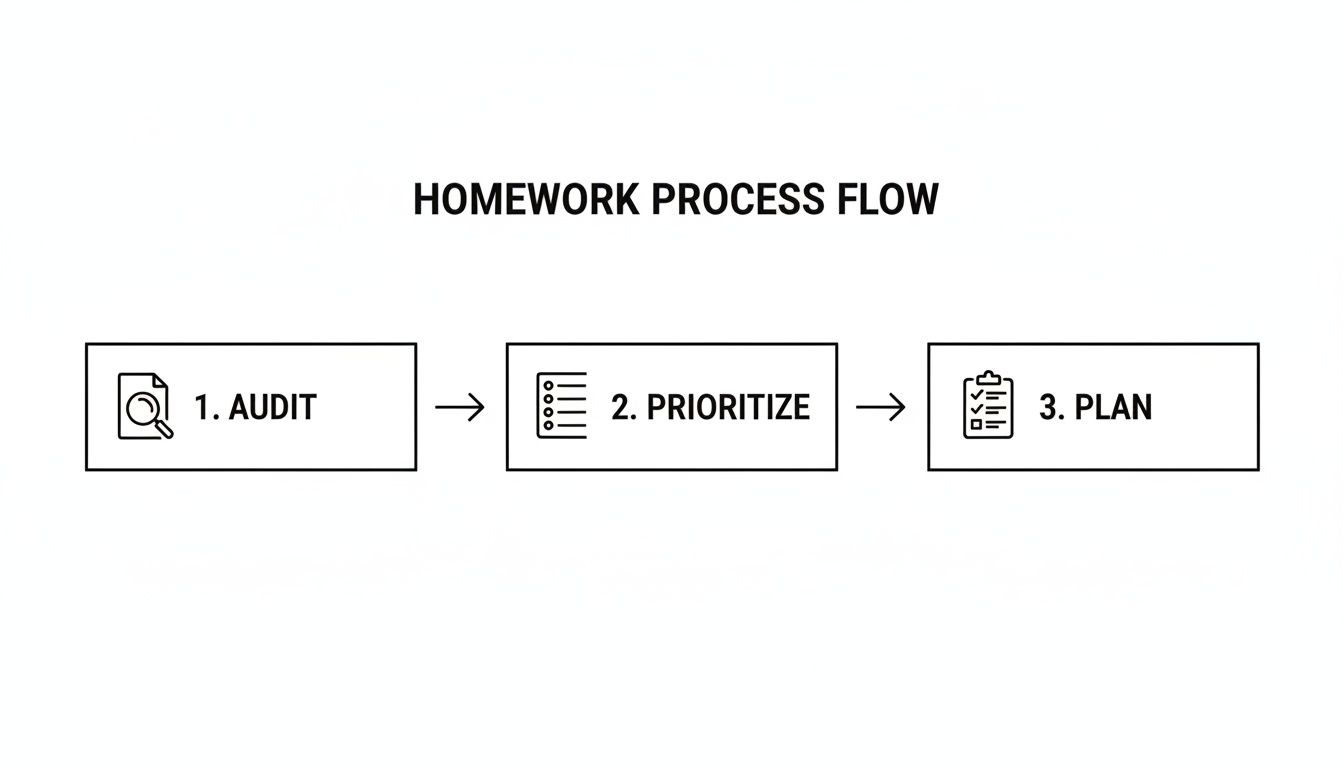
We can break this down into three simple phases: auditing your tasks, prioritizing them with intent, and planning your work sessions.
- Audit Your Assignments: First, just list out everything you have to do. Get it all out of your head and onto paper or a screen. This gives you the full picture, so no nasty surprises pop up an hour before something is due.
- Prioritize with Purpose: Don't just work on whatever is due next. Think about what tasks need the most brainpower. Tackle those high-energy assignments when you're at your sharpest. This "eat the frog" method keeps you from saving the hardest stuff for last when you’re already drained.
- Plan Your Attack: Big projects feel overwhelming. A 10-page essay sounds impossible, but "find 3 sources," "write an outline," and "draft the introduction" are all totally doable. Break everything down into small, concrete steps.
This simple flowchart shows how auditing, prioritizing, and planning turns chaos into a clear path forward.
Here's a quick look at how these strategies come together to form your new, efficient homework routine.
Your Homework Fast-Track Framework
This table gives you a quick overview of the key strategies discussed to help you complete your homework more efficiently.
| Strategy | Key Action | Expected Outcome |
|---|---|---|
| Audit | List all current and upcoming assignments in one place. | Full visibility of your workload, preventing last-minute surprises. |
| Prioritize | Rank tasks by a mix of deadline, effort, and energy level. | You work on the most critical tasks when you're most productive. |
| Plan | Break down large assignments into small, manageable sub-tasks. | Overwhelm is replaced with a clear, step-by-step action plan. |
Adopting this framework consistently is the key to finishing your work faster and actually having some free time. For more tips on speeding things up, you can learn how to process information faster in our guide.
Master Your Focus with Proven Techniques
So you've got a solid plan. That's half the battle, but now comes the hard part: actually protecting your time from all the things trying to steal it. Let’s be real—the biggest hurdle to getting homework done fast usually isn't how hard the work is. It’s the constant fight for your attention.
To win this fight, you need a system. Instead of just hoping you'll be in the mood to focus, you can build a structure that practically forces it to happen. Two of the most effective, battle-tested methods are Time-Blocking and the Pomodoro Technique. They also happen to work incredibly well together.
Schedule Your Success with Time-Blocking
Time-Blocking is exactly what it sounds like: you schedule specific blocks of time for specific tasks in your calendar. Think of it as making an unbreakable appointment with your assignments.
Instead of a vague goal like, "I'll work on my history essay tonight," you get specific. You block out 7:00 PM to 8:30 PM and dedicate it only to that essay. This simple move kills the procrastination that comes from having to decide what to do next. You're not choosing if you should work—you're just following the schedule you already made for yourself. It’s a game-changer.
Supercharge Your Blocks with Pomodoro Sprints
Okay, so you’ve blocked out the time. How do you stay locked in? That’s where the Pomodoro Technique comes in. It breaks down your work sessions into short, intense sprints, which makes even the most daunting tasks feel totally doable.
Here’s how the cycle works:
- Work for 25 minutes: Set a timer and give one single task your absolute, undivided attention. That means phone away, social media tabs closed. Just you and the work.
- Take a 5-minute break: When the timer dings, you stop. Step away from your desk.
- Repeat: After you’ve done four of these "Pomodoros," give yourself a longer break of 15-30 minutes.
The real magic here is how it reframes the work. A huge 90-minute block for that history essay suddenly becomes three manageable 25-minute sprints. It lowers the mental hurdle to just getting started and helps keep your energy high.
Let’s say you need to knock out a math problem set and read a biology chapter. Your time-blocked evening could look like this:
- 7:00-7:25 PM: Math problems (Pomodoro 1)
- 7:25-7:30 PM: Quick break (stretch, get some water)
- 7:30-7:55 PM: Math problems (Pomodoro 2)
- 7:55-8:00 PM: Quick break
- 8:00-8:25 PM: Biology reading (Pomodoro 3)
- 8:25-8:40 PM: Longer break (walk around, grab a snack)
A quick tip for those 5-minute breaks: stay off your phone. The goal is to let your brain recharge, not get pulled into a new distraction. This structured approach is also fantastic when you're gearing up for tests. For more on that, take a look at our guide on how to study for exams effectively.
By pairing Time-Blocking with Pomodoro sprints, you're not just working harder; you're working smarter and creating a powerful system to truly master your focus.
Use AI to Accelerate Your Reading and Note-Taking
Let's be honest, staring at a dense textbook chapter or a long research article can feel like hitting a brick wall. Plowing through pages of academic writing is one of the biggest time-drains when it comes to homework, and you often walk away without a solid grasp of the main points. It's time to work smarter, not just harder.
Artificial intelligence isn't some far-off concept anymore; it's a practical tool that can help you conquer your reading list in a fraction of the time. The numbers don't lie. By early 2025, it's estimated that 28% of U.S. high schoolers and 21% of middle schoolers will be using AI tools for their schoolwork. The impact is huge—students report cutting their assignment time by around 40%, with 72% saying they simply "finish faster."
Transform Dense PDFs into Quick Summaries
The first move toward working faster is getting a bird's-eye view of your material. Instead of slogging through a 30-page chapter just to figure out what it's even about, let a tool like PDF Summarizer handle the heavy lifting.
Just upload your document—it could be a scanned textbook chapter, a research paper, or even your class notes—and let the AI work its magic.
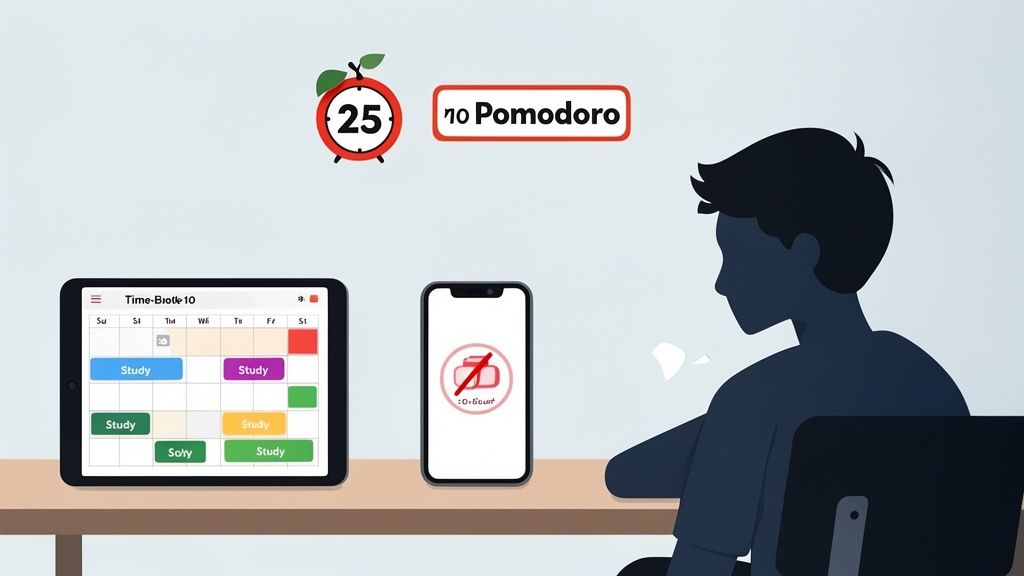
In just a few seconds, you'll get a clean summary highlighting the core concepts, main arguments, and important conclusions. Think of this summary as your roadmap. It shows you exactly which parts of the document need your full attention and which you can afford to skim.
Turn Passive Reading into an Active Conversation
A summary is a great launchpad, but the real power comes from interacting directly with the document. This is where you switch from being a passive reader to an active investigator—a crucial skill if you want to know how to complete homework faster while actually learning the material.
Don't just read. Start asking specific, targeted questions. This simple shift turns a one-way information dump into a dynamic Q&A session. For example, understanding how to use AI homework help effectively can dramatically cut down the time you spend on those really tough assignments, guiding you straight to the answers you need.
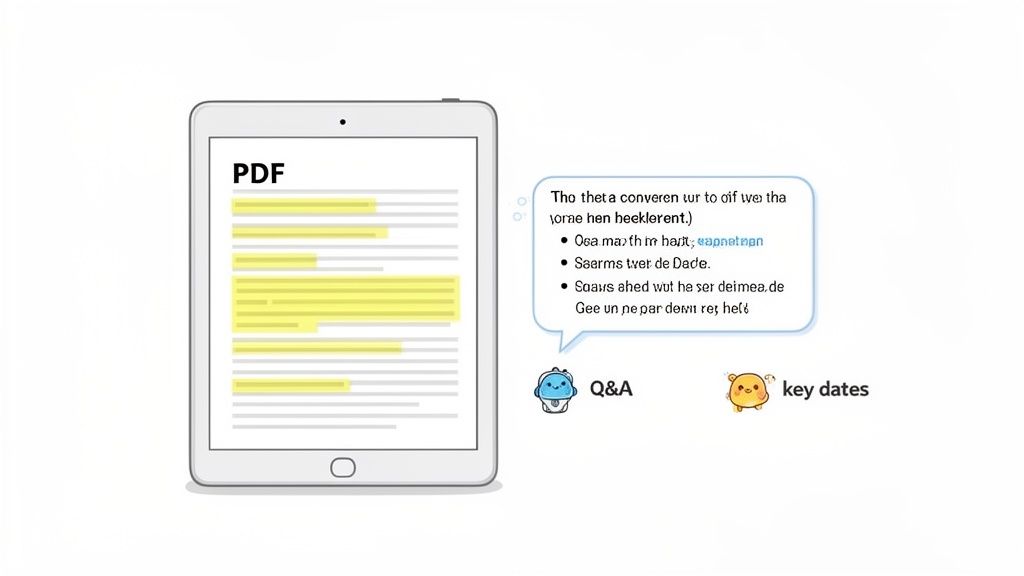
Here are some real-world examples of questions you can ask your PDF:
- "What are the three main arguments against this theory?"
- "List all the key dates and events mentioned in this chapter."
- "Explain the concept of quantum entanglement in simple terms."
- "Summarize the methodology section of this research paper."
This isn't just a time-saver; it’s a powerful comprehension booster. You’re actively training your brain to hunt for specific information, which is a far more effective way to learn than just passively highlighting text you think might be important later.
Instantly Extract the Information You Need
Once you have the main ideas down, you can use AI to zero in on the exact details your assignment requires. This is a game-changer when you need to pull specific data, find direct quotes, or verify a fact without having to re-read entire sections.
Imagine you're writing an essay that needs evidence from three different research papers. Instead of juggling multiple PDFs and dozens of tabs, you can use a multi-file chat feature to ask questions across all your sources at once. You can learn more about how to use AI to summarize a PDF and other advanced tricks in our detailed guide.
This method lets you:
- Find Supporting Quotes: Just ask the tool to "Find quotes that support the author's main claim."
- Gather Data Points: Command it to "List all statistics related to market growth in Section 3."
- Clarify Terminology: Instantly get definitions for complex terms as you come across them.
By treating AI as your intelligent reading assistant, you get to skip the most tedious parts of homework—that slow, manual search for information—and jump straight to the parts that matter: thinking, analyzing, and writing.
Solve Problems and Answer Questions More Efficiently
Alright, you've got your notes and summaries. Now for the main event: actually doing the work. This is where all that smart prep starts to pay off, changing how you approach everything from complex problem sets to in-depth essay questions. The idea isn't to find a magic shortcut, but to build a solid workflow that lets you get assignments done quickly and confidently.
Let's be real—the pressure to just finish homework can be overwhelming. A 2023 study of 7,500 high school students found that only 40% of lower-performing students actually complete their assignments. Meanwhile, 55% of high achievers said they were stressed and giving up family time to stay on top. The system is either leaving students behind or burning them out. You can read more about this homework paradox on Bonfire Leadership Solutions. Efficient strategies are no longer a "nice-to-have"; they're a necessity.
Use Your AI Notes as a Dynamic Resource
Think of your AI-generated summary as more than just text—it's an interactive command center for your assignment. The really good tools, like PDF Summarizer, don't just give you notes; they embed clickable citations right into them. This one feature is a game-changer.
Let's say you're writing a history paper and need a perfect quote to back up an argument. Instead of digging through the original PDF, you just click the citation next to the summary point. Boom. You're instantly teleported to that exact passage in the source material, ready to copy it.
This workflow lets you:
- Verify Facts Instantly: Double-check a date, name, or statistic without breaking your train of thought.
- Grab Direct Quotes: Pull supporting evidence for your essays in seconds.
- Deepen Understanding: If a summary point feels a bit thin, jump back to the original context for a fuller picture.
This transforms your notes from a static document into a dynamic dashboard for your homework. You can zip between the big-picture overview and the nitty-gritty details, all without losing momentum.
Tackle Complex Problems with Momentum
We've all been there. Staring at a tough math or science problem, hoping the answer will just appear. It's a classic recipe for frustration and wasted time. A much better way to work is to build momentum.
Scan the entire problem set first and knock out the easy ones—the questions you know how to solve right away. This does two powerful things: First, it banks you some quick wins, which feels great and boosts your confidence. Second, it warms up your brain, often helping you spot patterns or remember methods you'll need for the trickier problems.
Synthesize Information for Better Essays
Trying to write an essay using multiple sources can feel like herding cats. You're juggling different arguments, stats, and opinions scattered across several files. For anyone trying to figure out how to complete homework faster, this is where a multi-file chat feature becomes your secret weapon.
Instead of having five tabs open and trying to stitch everything together in your head, you can upload all your source materials into a single conversation. Then, you can ask the AI to do the heavy lifting of synthesis before you even start writing.
For example, try prompting it with things like:
- "Compare the main arguments from Document A and Document B on the topic of climate change."
- "Create an outline for an essay on the industrial revolution, using key points from all three of my sources."
- "Are there any conflicting data points between these two reports?"
This gives you a solid, comprehensive outline from the get-go. You can see how the sources connect, map out your main points, and gather all your evidence before you write a single paragraph. It’s a structured way to organize your thoughts that dramatically speeds up the entire writing process.
Review Your Work Without Wasting Time
The finish line is in sight, but hitting "submit" without one last look is a classic rookie mistake. A quick, focused review is your last line of defense against those silly errors that can drag down your grade. This isn’t about re-doing everything; it’s a strategic scan to polish your work without tacking another hour onto your night.
This final step is probably the single easiest way to boost your grade. Think of it as a 10-minute investment that protects all the hard work you've already put in. The goal is to make it a fast, automatic habit.
Create a Quick Review Checklist
To keep your review from turning into a time-suck, you need a system. Don't just vaguely re-read what you wrote. Instead, perform a targeted sweep for the most common—and costly—mistakes. This forces you to look for specific issues, which is way faster and more effective.
Your personal checklist should cover these key areas:
- Assignment Prompts: Did you actually answer every single part of the question? It's shockingly easy to miss a sub-point in a multi-part prompt.
- Common Errors: Be honest with yourself. Are you notorious for spelling mistakes, grammar goofs, or simple calculation errors? Hunt for those specifically.
- Formatting Requirements: Do a quick scan for the required font, spacing, or citation style. These are easy points you don't want to give away on a technicality.
A final review isn't just about catching typos. It’s about confirming that the work you’re submitting is a complete and accurate response to what was asked. This simple check can be the difference between a good grade and a great one.
Leverage AI for a Final Quality Check
Here's a clever way to use your AI tool one last time for a quick comprehension check. Go back to one of the key source documents you used for the assignment—like that dense PDF reading. Ask your AI tool to summarize a specific concept or argument from it.
Now, compare that crisp AI summary to what you wrote in your homework. Does your explanation line up with the core ideas? This is an incredibly fast way to spot any misunderstandings or gaps in your logic before your instructor does. By adding this final, tech-assisted step, you learn how to complete homework faster while also making sure your answers are accurate and on point.
Making Homework Tools Work for You, Not Against You
Let's be real: using technology to get homework done faster is a huge leg up. But it’s also a double-edged sword. The whole point is to work smarter and faster, not to completely outsource your brain. There's a world of difference between using an AI tool as an intelligent sidekick and treating it like a vending machine for answers.
The temptation to just copy and paste an AI-generated answer is strong, especially when you're on a tight deadline. But the long-term cost is steep. Study after study shows that students who just grab answers without actually wrestling with the material don't retain anything. That might get you a good grade on the homework, but it’ll crush you on the exams.
The Smart Assistant vs. The Answer Machine
Think of it like this: an answer machine gives you a fish. A smart assistant teaches you how to fish. One solves your problem for tonight; the other builds a skill that will serve you for years. Relying on AI for a quick answer is like using a calculator to pass a basic math class—you'll get through the daily assignments, but you'll be completely lost when you have to solve a real problem on your own.
A recent multi-year study hit this nail on the head. It found that students who used their devices merely to look up answers saw their long-term exam scores plummet. Why? Because even with perfect homework scores, their knowledge retention was near zero. You can dig into the specifics of these findings and see exactly how technology impacts learning outcomes. True learning, the kind that sticks, takes effort.
How to Use AI for Active Learning
The secret is to weave tools like PDF Summarizer into your study routine in a way that actually boosts active learning. This means you stay in the driver's seat. You’re using the technology to guide your thinking, not to replace it.
Here’s how you actually do that:
- Turn it into a Q&A session. Don't just ask for a summary. Grill the document. Ask specific, probing questions. This forces you to think critically about what you need to know and actively hunt for the information, which cements it in your memory.
- Check the source. Use the side-by-side view to compare what the AI says with the original text. Those clickable citations are your best friend—they let you jump right to the source to check the context and make sure you're getting the full picture.
- Do the final synthesis yourself. Have the tool pull key points from a few different readings, but then it's your turn. Your job is to connect those dots, build your own argument, and write the essay or solve the problem. The AI gathers the raw materials; you provide the critical thought.
When you treat technology as a partner, you get the best of both worlds. You save a ton of time on the grunt work of finding information, but you still do the heavy mental lifting that builds real, lasting knowledge.
Building Study Habits That Actually Last
At the end of the day, the smartest way to learn how to complete homework faster is by building habits that will help you long after you’ve turned in this one assignment. Using AI tools responsibly is a modern-day skill, and it's one that will pay off big time in college and whatever career you pursue.
It really comes down to a conscious choice every time you study. Are you looking for a shortcut that leaves a gap in your knowledge, or are you using a powerful tool to become a more efficient, more effective learner? The choice you make doesn't just affect your grade tomorrow; it shapes your success for years to come.
Ready to transform your study sessions? Try PDF Summarizer to get instant summaries, ask questions, and interact with your documents like never before. Get started for free at https://pdfsummarizer.pro.
Relevant articles

Learn how to finish homework fast with proven strategies for planning, focus, and using tools to cut study time and boost your results. Stop drowning in work.