What Is Information Overload and How Do You Reclaim Your Focus
Feeling overwhelmed? This guide explains what is information overload, its causes, and gives you practical strategies to regain clarity and boost productivity.

Let's get straight to it: Information overload is that all-too-familiar feeling of being completely swamped. It happens when the amount of information coming at you is simply more than your brain can handle.
Picture your mind as a computer with way too many programs running at once. Eventually, the system starts to lag, freezes up, and crashes. That's information overload in a nutshell.
What is Information Overload in Our Always-On World?
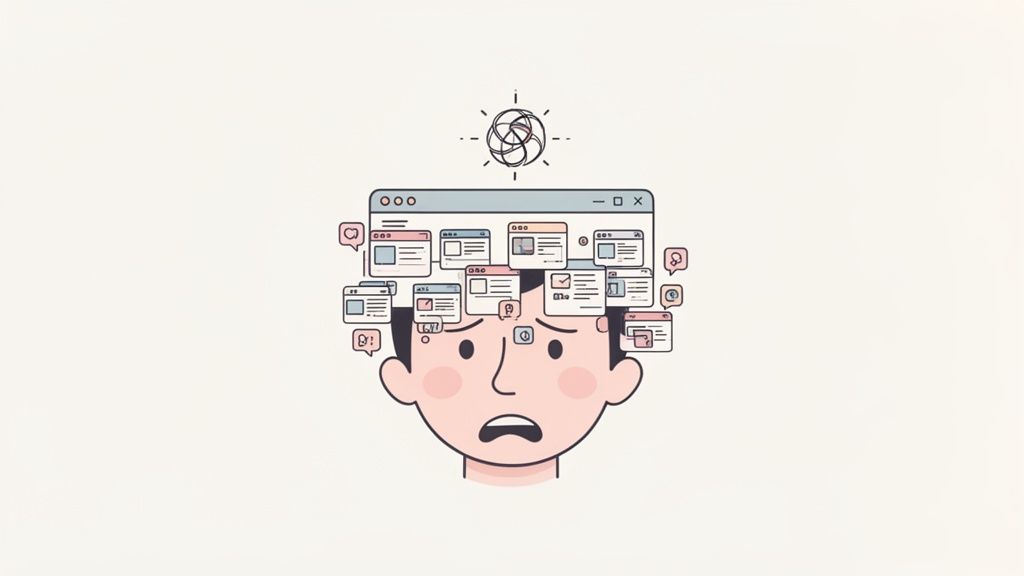
At its heart, information overload is the tipping point where having more data stops being helpful and starts being a problem. It’s that moment when you're so buried in facts, figures, and opinions that you can't make a clear decision or even think straight. This isn't just a minor annoyance; it’s a major challenge of modern life.
We're constantly bombarded. Emails flood our inboxes, news alerts buzz on our phones, and social media feeds scroll endlessly. This constant stream of pings and updates shatters our focus, making it nearly impossible to sink into deep, meaningful work.
Just How Big is the Problem?
The numbers are mind-boggling. In 2023, the world was generating a staggering 328.77 million terabytes of data every single day. That figure is only going up.
This digital flood has real-world consequences. A stunning 76% of professionals say this constant influx of information is a direct source of their daily stress and anxiety. For a deeper dive into these workplace dynamics, you can explore the insights on theemployeeapp.com.
Feeling overwhelmed isn't just about being busy; it’s a cognitive traffic jam with serious side effects.
When you're drowning in data, you often hit a state of "analysis paralysis." You have so many options and so much information that making any choice at all feels impossible.
This leads to a cycle of indecision and frustration. You lose the ability to separate the crucial signals from the background noise, which tanks productivity, stifles creativity, and paves the way for burnout.
Key Symptoms of Information Overload
Recognizing the signs is the first step toward managing the problem. This table breaks down some of the common red flags you might be experiencing.
| Symptom Category | Common Signs |
|---|---|
| Cognitive Strain | Difficulty concentrating, poor memory, mental fog, constant indecisiveness. |
| Emotional Impact | Increased stress and anxiety, feeling overwhelmed, irritability, a sense of helplessness. |
| Productivity Loss | Procrastination, missing deadlines, inability to prioritize tasks, making more mistakes. |
| Behavioral Changes | Avoiding information-heavy tasks, "tuning out" during meetings, constant multitasking. |
If these signs feel familiar, it's a clear signal that the sheer volume of information is taking a toll on your well-being and performance.
What's Really Causing Your Digital Burnout?
Ever feel like your brain is a browser with way too many tabs open? That feeling of being constantly overwhelmed isn't just in your head. It’s the direct result of some powerful forces at play in our digital lives. It's not just the sheer volume of data, but the very design of the platforms and habits that chop our attention into a million tiny pieces.
Imagine trying to have a deep, meaningful conversation while a dozen different people are constantly tapping you on the shoulder, asking for "just a second" of your time. That's what our digital world does to our focus, and it’s utterly exhausting.
The Never-Ending "Ping" and the Obligation to Reply
Workplace tools like Slack and Microsoft Teams were supposed to make collaboration seamless. Instead, they've created a culture of constant interruption. Every single notification is a little poke, a small but insistent demand that pulls your brain out of deep, meaningful work.
Think about this: a study of Fortune 500 companies found the average employee flips between different apps and windows nearly 1,200 times a day.
That constant "context-switching" is a real energy vampire. It adds up to nearly four hours every week spent just getting your bearings again after being pulled away. There's this unspoken pressure to be "always on," which creates a background hum of anxiety. You start to worry you'll miss something important if you dare to unplug for even an hour.
This isn't just a hit to your productivity; it’s a massive drain on your mental reserves. The very tools designed to connect us are often the ones leaving us feeling the most depleted.
The true cost of information overload isn't just the minutes lost to distraction. It's the creative energy and critical thinking we sacrifice every time we're forced to restart our focus.
Take a project manager, for example. They might be tracking progress reports in their email, fielding urgent questions on Teams, and getting notifications about new files in Asana. Each channel is a separate stream of information they have to mentally juggle, shattering their focus and making it incredibly difficult to see the big picture.
The Algorithms Built to Keep You Glued to the Screen
Once you clock out, a different kind of attention trap takes over. Social media platforms are engineered for one primary purpose: to keep you on their app for as long as possible. Their algorithms aren't there to give you the most important information and send you on your way. They're designed to learn your every click and habit to feed you a personalized, emotionally-charged stream of content that you can't look away from.
This creates a vicious cycle. You end up doomscrolling through endless feeds, consuming tons of "content" without actually feeling fulfilled or informed. It just leaves you feeling mentally cluttered and tired.
This algorithm-driven firehose of information is a key ingredient in digital burnout. To see where it might be showing up in your own life, see if any of these sound familiar:
- The Student Researcher: A college student has 30 browser tabs open, trying to synthesize information from academic papers, news articles, and YouTube videos for a term paper. The sheer volume leads to "analysis paralysis," and they can't even start writing.
- The Remote Worker: An employee sees notifications from their team popping up long after the workday has ended. They feel guilty if they don't respond, completely erasing the line between their work life and personal time.
- The News Junkie: Someone trying to keep up with current events is hit with a tidal wave of conflicting headlines, expert opinions, and angry social media threads, making it impossible to form a clear, rational viewpoint.
How Information Overload Hijacks Your Brain and Productivity
It’s easy to think of information overload as just feeling a bit stressed or busy, but the reality is far more serious. It actually rewires how your brain works, actively sabotaging your ability to get things done. When your mind is hit with a constant firehose of data, its processing power gets maxed out. This creates a cognitive bottleneck, and the fallout directly impacts your focus and efficiency.
One of the first things to go is your ability to make good choices. This is called decision fatigue. Think of your willpower and decision-making capacity like a battery. Every single choice you make, big or small, drains a little bit of that power. After sifting through hundreds of emails, Slack pings, and news alerts all day, that battery is completely dead. Suddenly, figuring out what to eat for dinner feels like an impossible task. Your brain is just out of juice.
This infographic really nails the culprits behind this modern-day mental exhaustion.
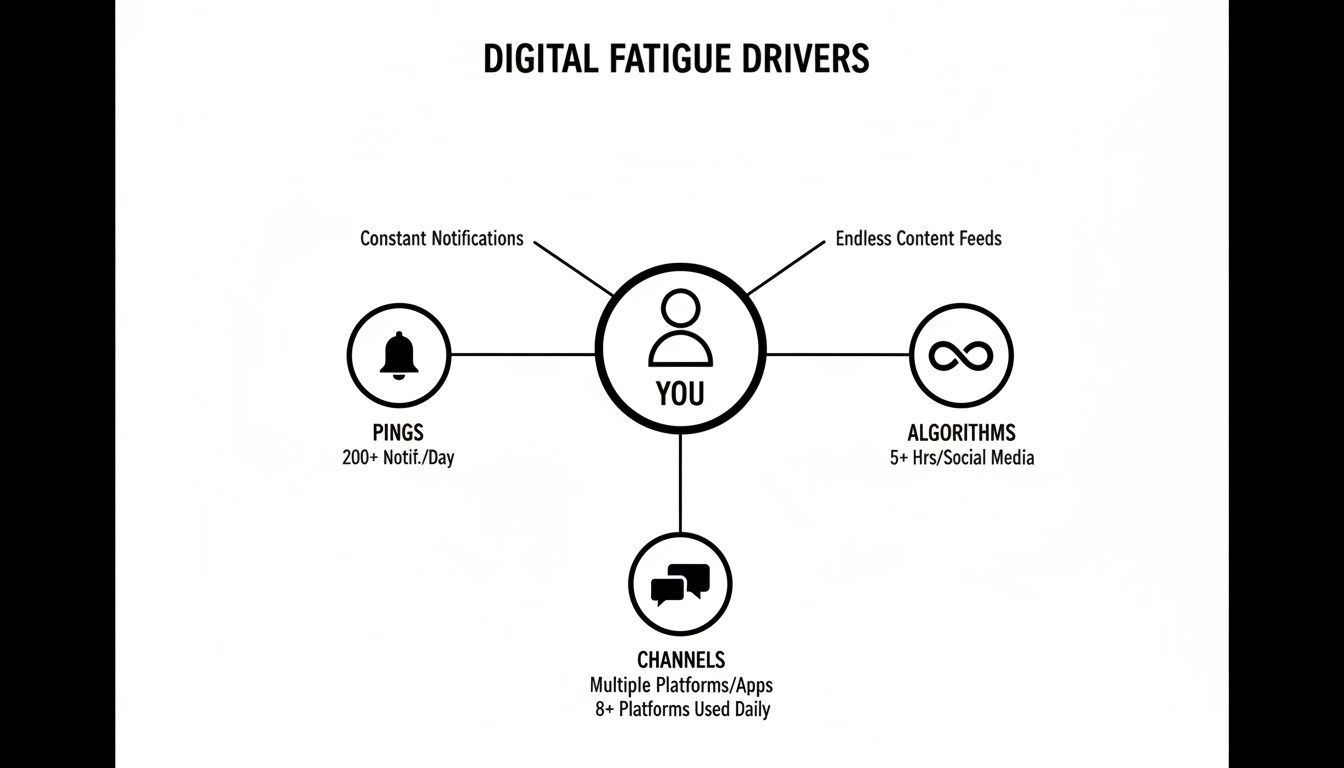
It’s a perfect storm of constant notifications, algorithms designed to grab your attention, and juggling a dozen different platforms—all competing for your limited mental bandwidth.
The Paralysis of Too Much Information
When you’re staring at a mountain of information, another mental trap snaps shut: analysis paralysis. This is that awful feeling of being completely frozen because you have so many data points you can’t possibly process them all. Imagine a project manager trying to make a call after reading ten conflicting reports. It’s nearly impossible to find a clear path forward.
Instead of feeling empowered by all that data, you just feel confused and start to doubt yourself. You endlessly second-guess every option, terrified you’re missing some tiny, critical detail buried in the noise. This indecisiveness doesn't just halt projects in their tracks; it chips away at your confidence and kills creativity. When every path looks equally fraught with risk, the easiest thing to do is nothing at all.
The greatest cost of information overload is not the time it consumes, but the deep work it prevents. True innovation and critical thinking require sustained, uninterrupted focus—the very thing a constant barrage of information destroys.
And then there are the interruptions. This is arguably the most destructive piece of the puzzle. Researchers and professionals trying to do deep, focused work are getting derailed every 3-11 minutes. Each time a notification breaks your concentration, it takes an average of 23 minutes to get back into that state of deep focus. The cumulative effect is staggering, tanking job satisfaction and stalling innovation. It's a massive productivity drain, costing the U.S. economy up to $1 trillion every year, as detailed in studies on digital communication overload.
The Path from Overload to Burnout
This relentless cycle of distraction, fatigue, and paralysis is a superhighway to burnout. Your brain simply isn't built to be on high alert 24/7. Over time, that constant cognitive strain leads directly to the mental and emotional exhaustion that the World Health Organization (WHO) now officially recognizes as a serious condition.
As your attention gets spread thinner and thinner, mistakes creep in. Your creativity dries up because your brain never gets the quiet downtime it needs to make new connections. In the end, our collective failure to manage the flood of information comes with a heavy price, paid by both our personal well-being and our organization’s bottom line.
Actionable Strategies to Combat Information Overload
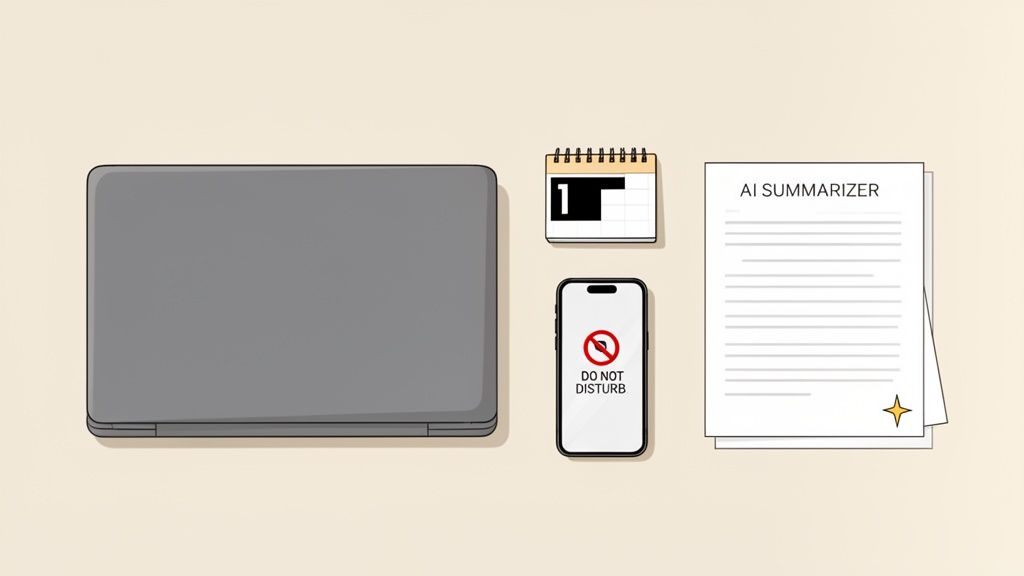
Knowing you’re drowning in information is one thing, but actually doing something about it is another entirely. To fight back, you need a practical toolkit—a set of strategies to filter the noise and protect your mental energy. It's not about finding one magic trick; it's about building a multi-layered defense to take back your focus.
The real goal is to shift from a reactive state—constantly jumping at every ping and alert—to a proactive one where you’re in the driver’s seat, deciding what gets your attention and when.
This takes a conscious shift in both your habits and your mindset.
Adopt Mindful Information Consumption
First things first: become a conscious consumer of information, not just a passive recipient. Before you even think about starting research or scrolling through a feed, stop and ask yourself, "What am I actually trying to achieve here?" That one simple question sets a clear purpose and keeps you from tumbling down endless rabbit holes.
It all comes down to intention. When you approach information with a specific goal, you create a natural filter for all the junk.
Here are a few ways to put this into practice:
- Set a Goal Before You Search: Know what success looks like before you open a single browser tab. Are you hunting for a specific stat or just getting a general overview? Define it.
- Use a "Read-Later" App: Stumble upon an interesting article that has nothing to do with your current task? Don't get sidetracked. Save it to an app like Pocket or Instapaper and come back to it later.
- Timebox Your Research: Set a timer. Give yourself a specific block of time for gathering information. When the alarm goes off, you stop. Then, you can start making sense of what you've found by synthesizing information.
Master Your Digital Environment
Let's be honest, your digital workspace is probably the biggest source of overload. Taming it isn't optional. This means curating notifications, organizing your workflow, and drawing some hard lines in the sand. Consider this: over 90% of the world's data was created in just the last two years. That firehose of information creates a constant flood of alerts and duplicate messages that shatter our focus.
It isn't just the sheer volume; it's the "burden" of irrelevant pings that demand an immediate response, which directly ties overload to stress and poor performance.
The point of digital minimalism isn't to get rid of technology. It's to use it intentionally to support your goals, not to let it fracture your attention into a million pieces.
Good organization is the bedrock of productivity. Figuring out how to stay organized at work can dramatically lighten your cognitive load and help you reclaim your focus. A great place to start? Turn off every single non-essential notification on your phone and computer. That one move alone can be a total game-changer.
Embrace Technology That Filters, Not Floods
While technology is often the culprit, the right tools can also be a powerful part of the solution. The trick is to pick tools that reduce your mental workload instead of adding to it. This is where AI-powered summarizers really shine.
Tools like PDF Summarizer are incredibly useful for anyone who has to wade through dense reports, academic papers, or long legal documents. Instead of losing hours reading every word, you can pull out the core insights and key takeaways in a matter of minutes.
- Process More in Less Time: An AI can take a 50-page report and distill it into a concise summary, handing you back valuable time and mental energy.
- Cross-Reference Documents: Chat with multiple files at once to quickly spot connections and synthesize insights from different sources.
- Verify with Precision: Get answers instantly with clickable citations that take you straight to the source text, so you can easily check the facts.
When you use technology to do the initial heavy lifting of summarizing and filtering, you free yourself up to focus on what humans do best: analysis and critical thinking. It’s a strategic way to manage the information deluge and start making smarter, faster decisions.
Building Sustainable Habits for a Focused Future
Winning the fight against information overload isn't a one-time thing. It’s about building a solid, sustainable system that actively protects your attention day in and day out. The real key is weaving new strategies into your daily routine, shifting from being constantly reactive to proactively in control. That’s how you build lasting focus.
This means you have to consciously create new patterns. Start by drawing clear, firm lines between your work life and personal time to protect your mental downtime. You have to start treating your attention like your most valuable resource—because it absolutely is.
Creating Your Personal Information Filter
The first step is learning to triage information based on your long-term goals, not just whatever feels most urgent in the moment. Let's be honest, not every notification or email is created equal. When you consciously decide what truly matters, you can begin to filter out the constant noise that hijacks your focus and drains your energy.
This cultural pressure to be constantly connected has a serious downside. Digital communication overload is a huge contributor to employee stress and burnout. In fact, a staggering 60% of employees report high stress levels due to digital fatigue, and a concerning 58% of remote workers feel pressured to be "always-on." You can see more on these workplace dynamics in this detailed report on Brosix.com.
To build a sustainable defense, start putting these practical habits into play:
- Schedule Digital Detox Periods: Actually block out time in your calendar—even if it's just an hour—to completely unplug from all screens. This gives your brain a much-needed break to rest and process information without a flood of new input.
- Implement a "One In, One Out" Rule: Before you jump into a new article, podcast, or video, stop and ask yourself if it truly aligns with your current priorities. If it doesn't, make a conscious decision to set it aside.
- Establish Clear Communication Boundaries: Be upfront with colleagues about your focused work times. Set your status to "Do Not Disturb" and make it known that you'll get back to non-urgent messages during specific windows.
The goal here is simple: build a system where you are the gatekeeper of your own attention. You decide what comes in and when, instead of letting the endless stream of digital noise run your day.
Making Focus a Daily Practice
Consistency is everything. These habits will feel like a conscious effort at first, but with time, they'll become second nature. Think of it like a powerful shield that deflects the chaos of information overload. It’s a form of mental fitness; every small act of setting a boundary or scheduling a detox is like another rep that strengthens your focus muscle.
For anyone who manages large volumes of information as part of their job, having effective strategies is non-negotiable. You can learn a lot more about structuring your workflow by checking out our guide on the best practices in knowledge management.
By pairing disciplined habits with smart organizational methods, you create a robust framework that not only supports deep, meaningful work but also protects your mental well-being for the long haul. This proactive approach ensures you're the one in control of your digital world, not the other way around.
Taking Back Control of Your Attention
So, we've walked through what information overload is, where it comes from, and how badly it can derail your productivity. The good news? This isn't a problem you just have to live with. With a proactive approach and the right strategies, you can absolutely filter out the noise and get your focus back.
The final message here is one of empowerment. You can transform your relationship with information from one of constant chaos to one of clarity and purpose.
Taking back control really comes down to implementing smart habits. A great starting point is to learn how to successfully ditch the digital distractions. When you set clear boundaries and become intentional about what you consume, you're protecting your most valuable resource: your attention.
Smart tools can also give you a serious edge. For example, instead of getting bogged down in a 50-page report, you can summarise a document to pull out the key insights in minutes. It's all about working smarter, not harder.
Got Questions? We've Got Answers
Once you start digging into the causes and solutions for information overload, a few common questions always seem to surface. Let's clear up some of the finer points so you can better manage the digital noise in your life.
Is Information Overload the Same as Burnout?
That's a great question, and while the two are deeply connected, they aren't the same thing. It's best to think of information overload as a major stressor that often leads to burnout.
Information overload is the constant barrage of data you're trying to process. Burnout, however, is the end state of that prolonged stress—that feeling of complete emotional, physical, and mental exhaustion. If you can get a handle on the former, you're taking one of the biggest steps to prevent the latter.
How Can Technology Help Without Making It Worse?
This is the classic double-edged sword, isn't it? Technology, with its endless notifications and distracting apps, is a huge part of the problem. But the right kind of technology can also be a powerful part of the solution.
The trick is to use tools built for focus and filtering, not just more communication. Think AI summarizers that distill long documents, dedicated task managers that organize your priorities, or apps that intelligently filter your notifications. These tools don't just add more noise; they're designed to help you cut through it, reducing your cognitive load instead of piling more on.
This isn't just a personal battle. Companies feel the pain when productivity dives because employees are completely overwhelmed and disengaged. Picture a researcher trying to piece together information scattered across Slack, Teams, and a dozen email threads. The right tools can slice through that chaos to highlight the key takeaways in seconds. You can learn more about the organizational impact of information overload and its cost.
What Is the Best First Step to Reduce Information Overload?
If you're looking for the single most impactful thing you can do right now, start with a notification audit. It's simple but incredibly effective.
For just one day, pay close attention to every single alert that pops up on your phone, computer, and smartwatch. Keep a running list. At the end of the day, look at that list and be absolutely ruthless. Turn off everything that isn't essential for your immediate work or personal life. This one small change can dramatically cut down on interruptions and give you back the mental space you need to focus.
Ready to cut through the noise of dense documents? PDF Summarizer lets you upload files, chat with your research, and get instant answers with clickable sources.
Try PDF Summarizer for free and understand your documents in seconds
Relevant articles
Feeling buried in data? Learn how to process information faster using strategic reading, smart note-taking, and AI tools designed to end information overload.