The Top 12 Legal Document Review Software Tools for 2026
Discover the 12 best legal document review software tools for 2026. Compare features, pricing, and use cases to find the right fit for your firm.
In today's data-intensive legal landscape, manual document review is no longer a viable option. The sheer volume of electronically stored information (ESI) in litigation, internal investigations, and compliance audits demands a smarter, faster, and more accurate approach. This is where legal document review software becomes indispensable. These platforms leverage artificial intelligence, advanced analytics, and powerful search capabilities to transform a traditionally time-consuming and expensive process into a strategic advantage for legal professionals.
This guide cuts through the marketing noise to provide a detailed comparison of the top tools available today. We will analyze their core functionalities, from AI-assisted review and predictive coding to security protocols and pricing models. Our goal is to offer practical insights to help you select the software that best aligns with your firm's specific needs, whether you're a solo practitioner, part of a large enterprise legal team, or an academic researcher. Moreover, as AI reshapes legal processes, understanding a practical AI GDPR compliance guide is essential for any legal tech solution processing sensitive data.
Each entry in our list includes a focused analysis of key features, ideal use-cases, and pricing considerations to simplify your decision-making. We provide direct links and screenshots for every platform, enabling you to see them in action and explore them further. This resource is designed to help you confidently navigate your options and find the right solution to streamline your document review workflow, reduce costs, and improve case outcomes.
1. PDF Summarizer
Best for Rapid AI-Powered Initial Assessment & Research
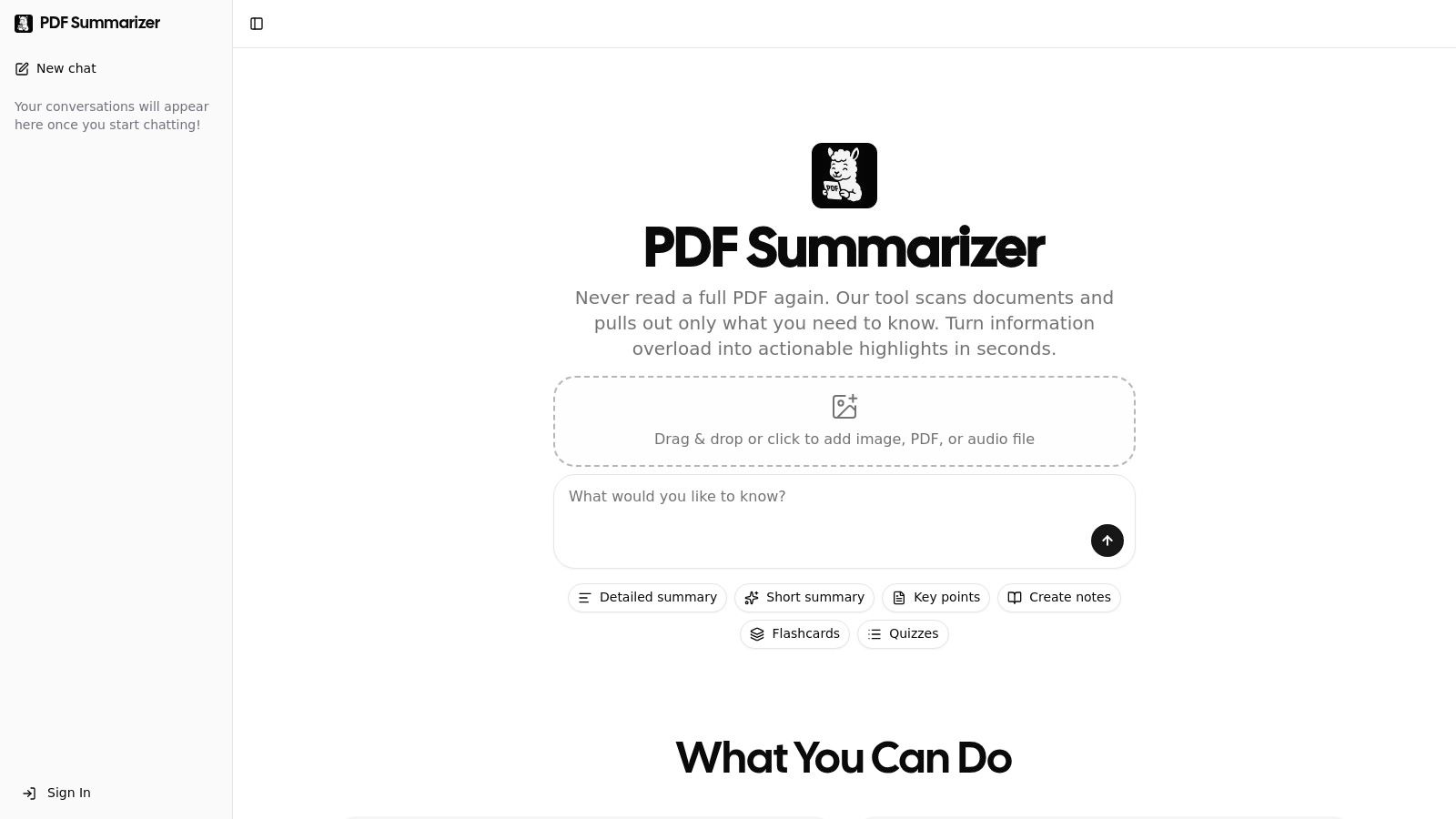
PDF Summarizer distinguishes itself as an indispensable tool for the critical, front-end stages of legal document analysis. While not a comprehensive eDiscovery platform for managing full-scale litigation, its strength lies in its powerful, AI-driven engine designed for rapid intelligence gathering and comprehension. It provides legal professionals with an immediate, deep understanding of dense materials like contracts, depositions, expert reports, and judicial opinions, making it a cornerstone of modern legal document review software for preliminary work.
The platform's standout capability is its interactive chat function. Users can upload single or multiple documents and engage in a sophisticated Q&A, asking complex questions across the entire dataset. Crucially, the AI provides answers complete with clickable, verifiable citations that link directly to the source text in the original document. This feature is a game-changer for tasks requiring both speed and accuracy, such as preparing for a deposition, verifying facts in an opposing counsel's brief, or conducting a swift comparative analysis of multiple contracts.
Core Features & Analysis
- AI-Powered Q&A with Citations: Go beyond simple keyword search. Ask natural language questions like, "Summarize the indemnification clause and identify any limitations on liability," and receive a synthesized answer with direct links to the relevant passages. This bridges the gap between AI summary and human verification.
- Multi-File Chat: This is a key differentiator. Upload a set of related documents, such as all prior rulings in a case or multiple expert witness reports, and query them simultaneously. This is exceptionally useful for identifying inconsistencies or patterns across a small but critical document set.
- Multilingual Support: The tool can ingest documents in various languages and provide summaries or answer questions in English (or another supported language), effectively breaking down language barriers in international cases or when dealing with foreign-language evidence.
- Security & Compliance: With SOC 2 Type II certification and end-to-end encryption, PDF Summarizer offers enterprise-grade security suitable for handling sensitive client information, though it is not intended for managing documents under a formal legal hold (ESI).
Ideal Use Cases
PDF Summarizer excels in scenarios that precede full-scale eDiscovery. It's an ideal solution for solo practitioners or small firms needing to quickly evaluate the merits of a potential case by rapidly reviewing initial client documents. It's also invaluable for in-house counsel conducting internal investigations or for paralegals tasked with summarizing extensive case law for a research memo. Its ease of use makes it a powerful asset for any legal professional looking to accelerate their initial research and review phases without the steep learning curve and cost of traditional platforms.
Our Take: PDF Summarizer is a powerful force multiplier for the initial stages of legal work. Its ability to deliver fast, verifiable insights from complex documents makes it an essential tool for any modern legal professional's toolkit, dramatically reducing the time spent on preliminary analysis and research.
Pricing: Offers a free trial with no signup required. Subscription plans are available for continued and expanded use.
Website: https://pdfsummarizer.pro
2. RelativityOne (Relativity)
RelativityOne is an enterprise-grade, cloud-based eDiscovery platform designed for high-stakes litigation, investigations, and compliance projects. This comprehensive solution manages the entire Electronic Discovery Reference Model (EDRM) from data collection and processing through review and production. It stands out as a market leader for large law firms and corporations handling massive data volumes and complex modern data types, including Slack, Teams, and AI-generated content.
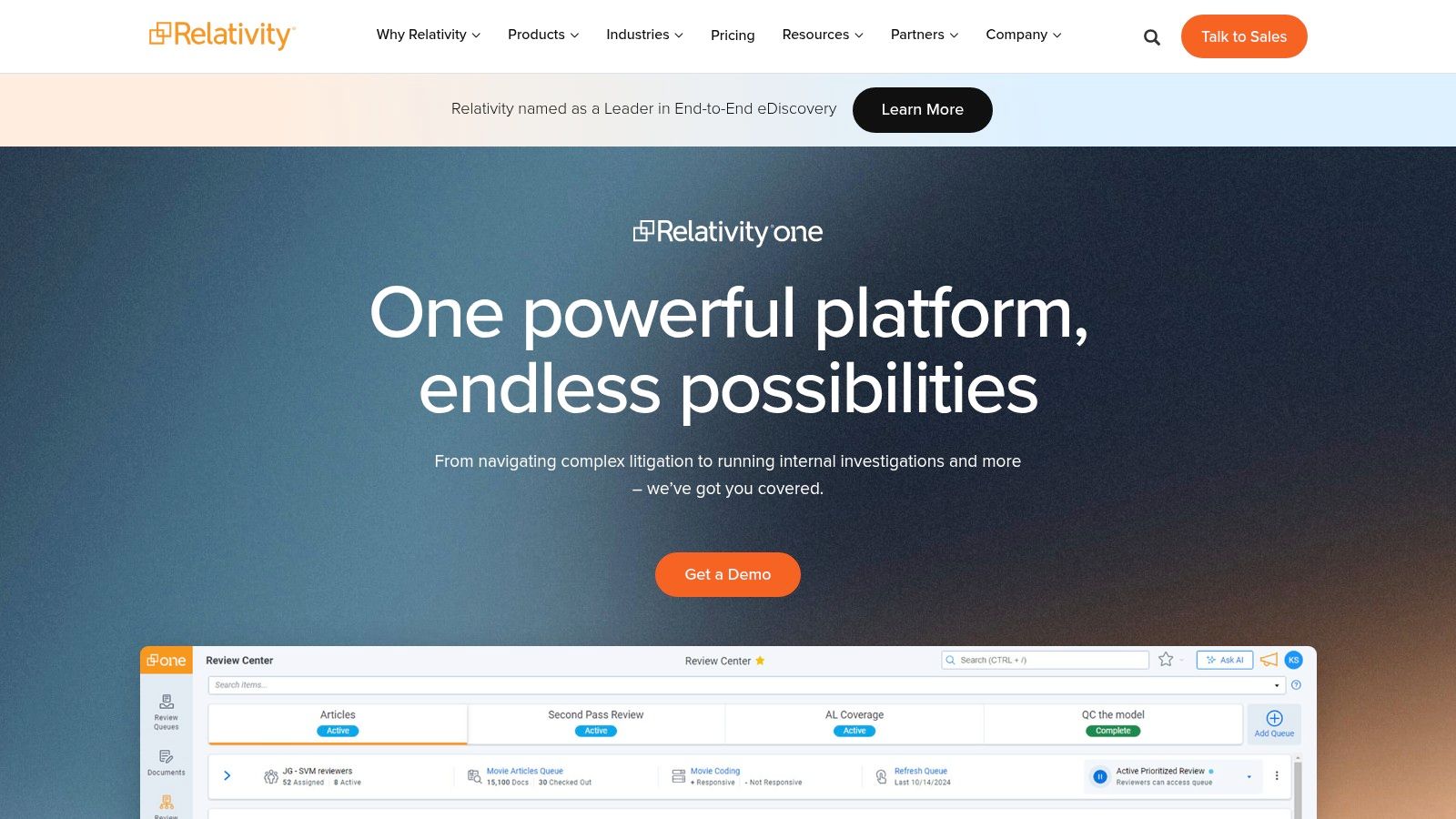
The platform’s generative AI tool, aiR for Review, accelerates first-pass review by summarizing documents, explaining key concepts with in-document citations, and suggesting relevant issues. For managers, the Review Center offers a structured environment to create and assign reviewer queues, track progress with real-time reporting, and conduct quality control, making it a robust piece of legal document review software.
Key Features & Use Cases
- End-to-End eDiscovery: Manages the full lifecycle, from data collection to final production.
- Generative AI Review: Uses aiR for Review to quickly assess document relevance and provide summaries with citations.
- Structured Review Management: The Review Center allows for customizable batching, coding, and real-time analytics on reviewer performance.
- Ideal For: Large-scale litigation, internal investigations, and complex due diligence efforts where a detailed review is critical. For a structured approach, you can create a legal due diligence checklist to guide your review process within the platform.
Platform Analysis
RelativityOne’s core strength is its scalability and extensibility via the App Hub, which offers hundreds of third-party integrations. However, its power comes with complexity; it requires significant training and enablement for teams to use it effectively. Pricing is quote-based and depends heavily on data volume and the specific modules required, positioning it as a premium solution for organizations with significant eDiscovery needs.
Website: https://www.relativity.com/ediscovery-software/relativityone/
3. Everlaw
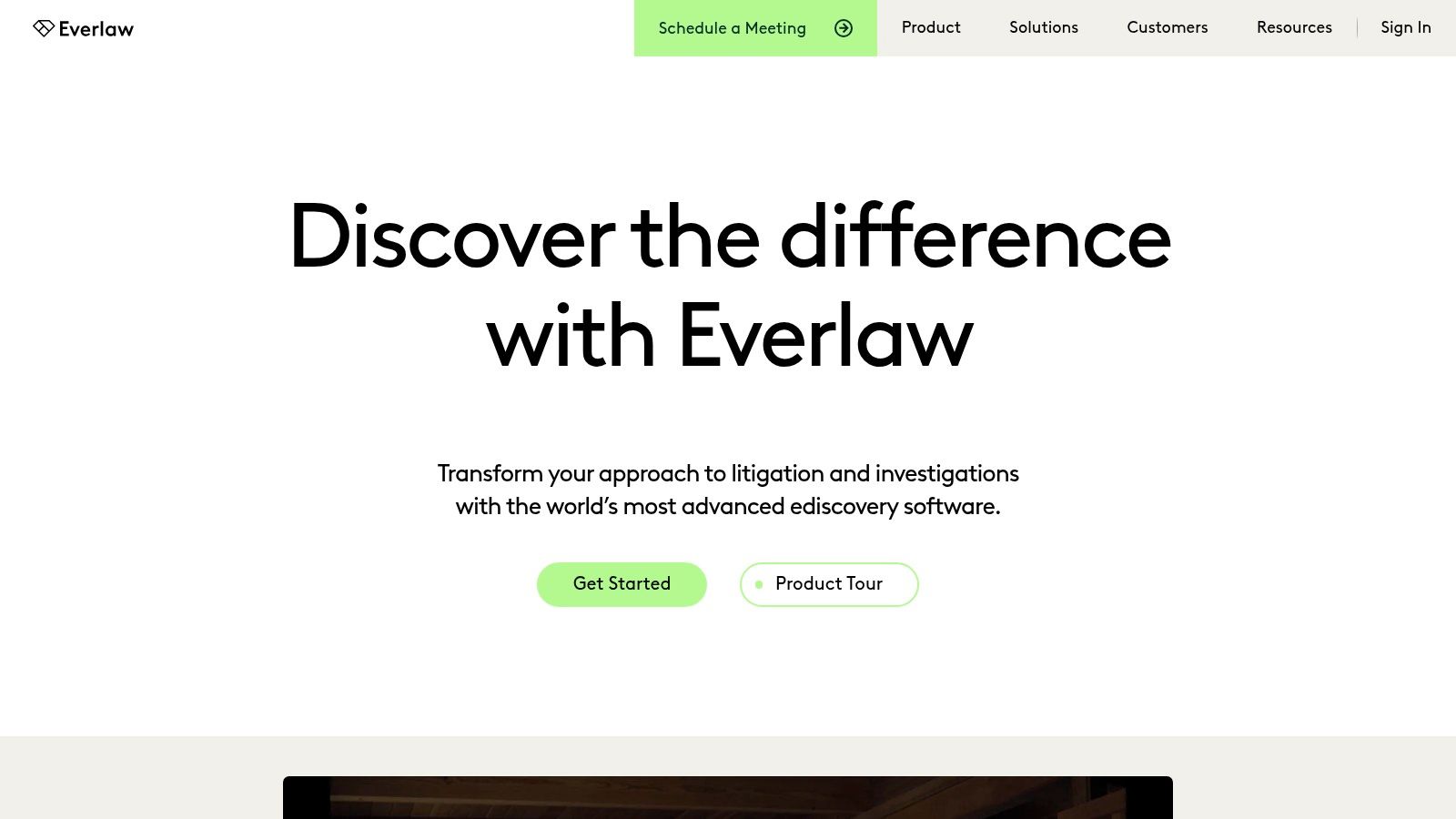
Everlaw is a cloud-native eDiscovery platform that combines cutting-edge technology with an intuitive, user-centric design. It supports the entire litigation and investigation lifecycle, from data ingestion to case preparation. Everlaw is recognized for its collaborative features and rapid innovation, making it a popular choice for law firms, government agencies, and corporate legal teams who prioritize ease of use without sacrificing powerful analytical capabilities.
The platform integrates generative AI for single-document summaries, translations, and coding suggestions directly within the review window, streamlining individual tasks. A standout feature is Storybuilder, which allows legal teams to collaboratively build case narratives, organize key documents, and prepare for depositions within the platform. This makes it more than just a piece of legal document review software; it's a comprehensive case management tool.
Key Features & Use Cases
- Integrated Case Preparation: Storybuilder enables teams to craft timelines, outlines, and deposition kits directly from reviewed documents.
- Predictive Coding: Leverages machine learning to prioritize relevant documents, accelerating review speed and improving accuracy.
- Advanced Data Visualization: Offers communication graphing and data clustering to quickly identify key players and conversation patterns.
- Ideal For: Mid-sized to large cases, collaborative case strategy development, and teams looking for an all-in-one eDiscovery and litigation platform. For teams aiming to enhance efficiency further, exploring legal document automation software can complement Everlaw's capabilities.
Platform Analysis
Everlaw's main advantage is its transparent, all-in pricing model that includes unlimited users and core AI features for a predictable per-gigabyte fee. This simplifies budgeting and encourages collaboration. While the frequent product updates are a major plus, the usage-based cost for batch AI actions can introduce some variability. The platform is powerful yet user-friendly, requiring less intensive training than some enterprise competitors, but pricing is only available via a direct quote.
Website: https://www.everlaw.com/
4. DISCO Ediscovery (CS Disco)
DISCO Ediscovery is a cloud-native review platform built by lawyers for lawyers, emphasizing speed, security, and an intuitive user experience. It streamlines the entire discovery process from data ingestion to production, aiming to eliminate the technical friction common in legacy systems. The platform is known for its high-speed data processing and a clean, modern interface that requires minimal training, making it accessible for teams that need to get up and running quickly.
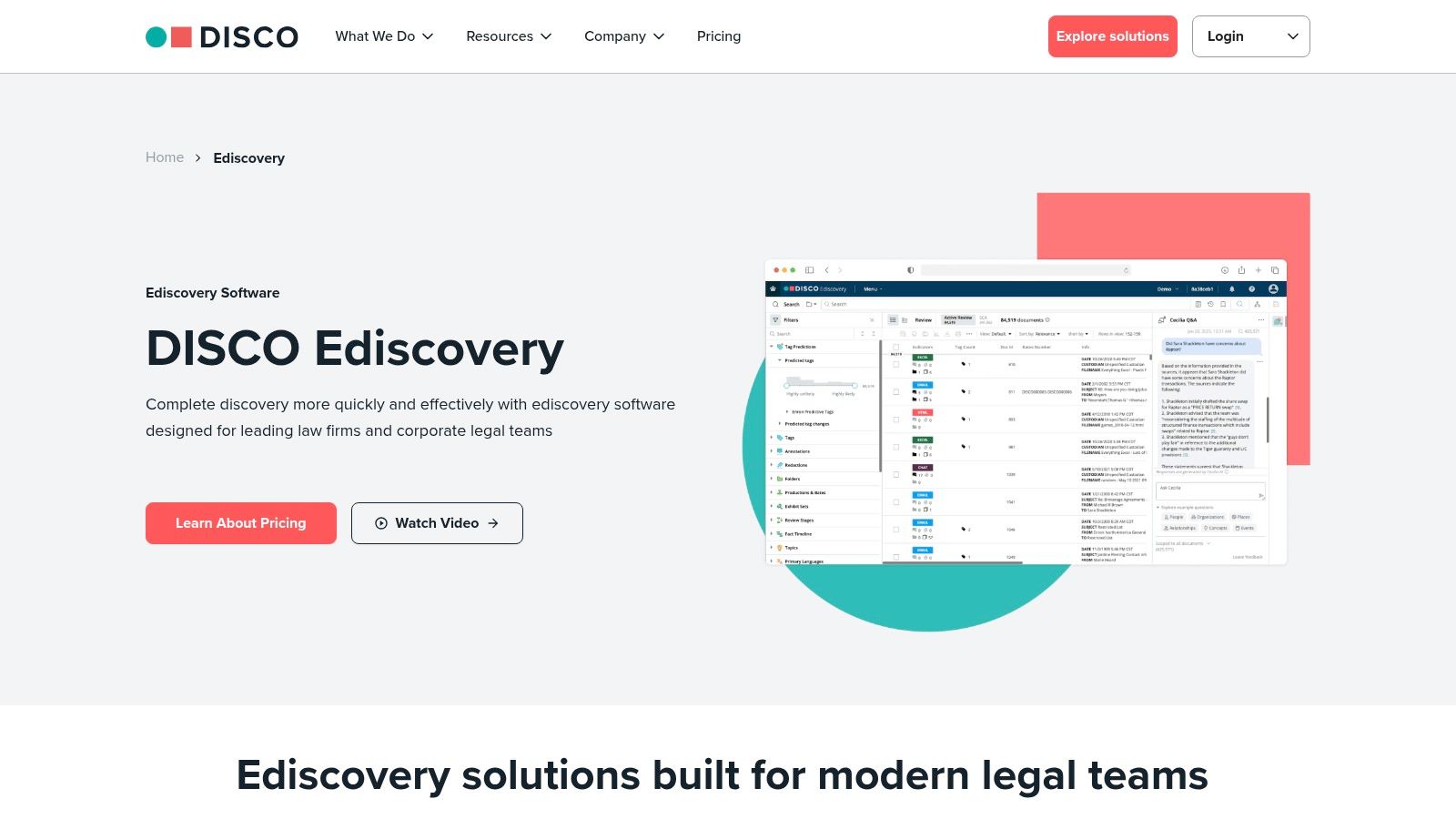
The platform’s integrated AI offers predictive tagging that learns from reviewer decisions to prioritize relevant documents and automates coding workflows. Its Early Case Assessment (ECA) tools allow legal teams to quickly analyze data sets, identify key trends, and transition seamlessly into a full review. This focus on performance and usability makes it a leading choice for firms and corporations seeking powerful yet user-friendly legal document review software.
Key Features & Use Cases
- AI-Powered Prioritization: Uses predictive tagging and topic clustering to surface the most relevant documents first.
- High-Speed Ingestion: Features a fast uploader and real-time monitoring to process large data volumes in hours, not days.
- Integrated ECA: Provides powerful analytics to assess case merits early and smoothly transition data into the review phase. For more on how this works, see these guides on automatic document processing.
- Ideal For: Law firms and corporate legal teams prioritizing rapid turnaround times, ease of use, and a secure, cloud-native environment.
Platform Analysis
DISCO’s primary strength is its performance-driven architecture, enabling incredibly fast productions and a responsive user experience. Its well-documented security posture, including SOC 2 and ISO 27001 certifications, provides assurance for handling sensitive data. However, its enterprise-focused model means pricing is not publicly available and requires a quote, which may be a barrier for smaller firms or one-off matters. The platform is best suited for organizations that value speed and usability over the deep customizability of more complex systems.
Website: https://csdisco.com/offerings/ediscovery
5. Logikcull (by Reveal)
Logikcull offers a cloud-based, self-service eDiscovery platform designed for simplicity and transparent pricing. It empowers in-house legal teams, government agencies, and smaller law firms to handle routine litigation, internal investigations, and public records requests without extensive IT support. The platform’s drag-and-drop functionality and intuitive interface lower the barrier to entry, making powerful document review accessible to non-technical users.
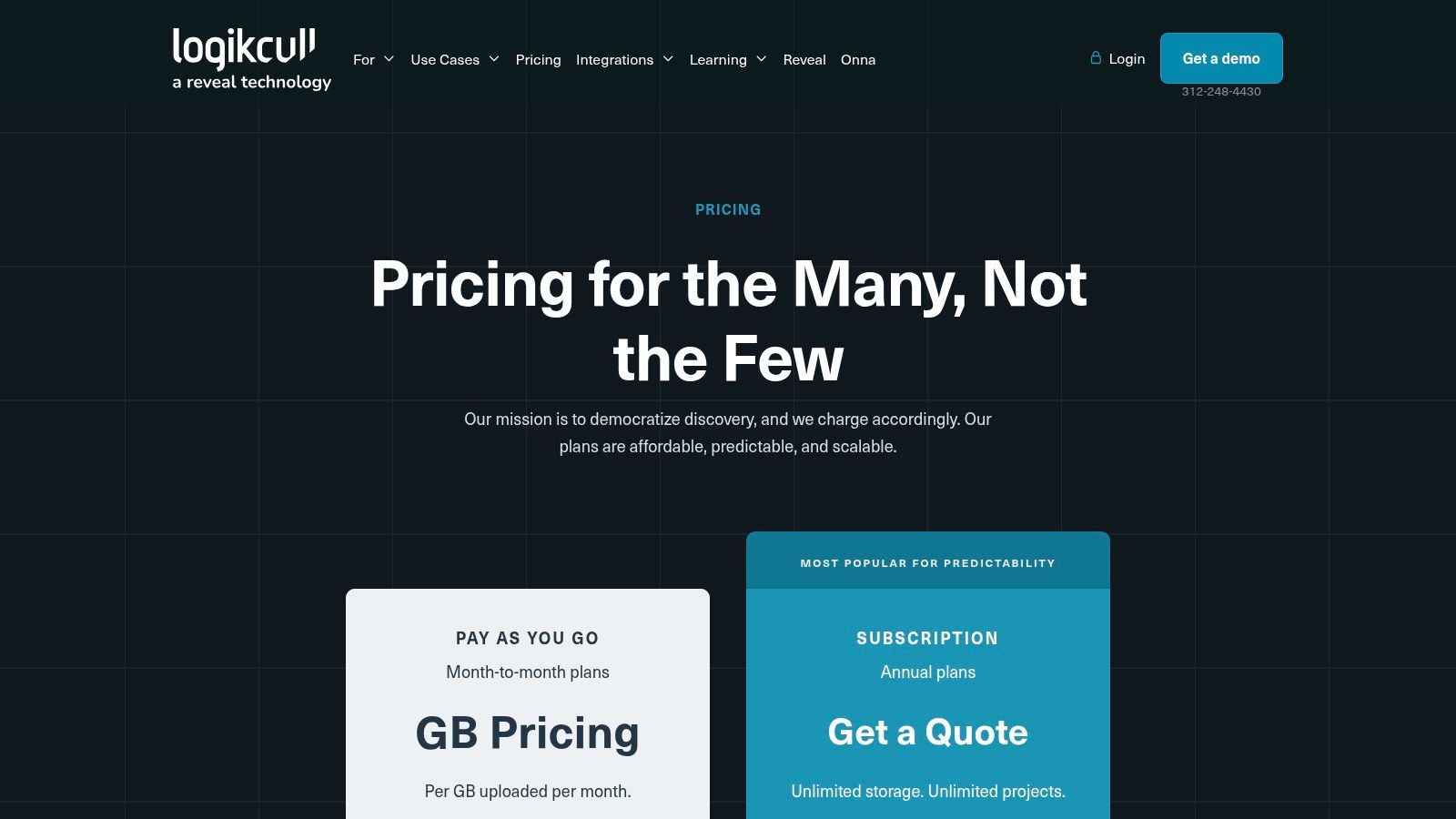
Its strength lies in its predictable cost structure, offering both pay-as-you-go and subscription models that include unlimited users and projects. This approach eliminates the hidden fees common in legacy systems. Built-in features like near-duplicate detection, audio/video transcription, and chat filtering for modern data sources like Slack streamline the initial culling and review stages, making it an efficient piece of legal document review software for straightforward matters.
Key Features & Use Cases
- Transparent Pricing: Offers clear per-gigabyte and subscription options, with calculators to estimate costs upfront.
- Self-Service Model: Designed for users to upload data and begin reviewing in minutes with minimal training.
- Modern Data Support: Includes native processing for chat applications and transcription for A/V files.
- Ideal For: In-house teams managing frequent but smaller-scale litigation, government entities handling FOIA requests, and firms seeking cost control.
Platform Analysis
Logikcull excels in user experience and cost predictability, making it a go-to for organizations that need a powerful but uncomplicated solution. Its in-app support and extensive educational resources empower teams to manage projects independently. While the per-GB costs can become substantial for very large, data-heavy cases, its model is highly effective for the small-to-mid-sized matters it targets. For highly complex enterprise workflows, users might need the broader capabilities of the parent Reveal platform.
Website: https://www.logikcull.com/pricing
6. Reveal (Enterprise Platform)
Reveal is an AI-powered, end-to-end eDiscovery platform engineered for complex investigations and high-volume litigation. It distinguishes itself by integrating powerful data visualization, machine learning, and generative AI tools directly into the review workflow. By combining its core processing capabilities with technology from its acquisitions of Brainspace and Logikcull, Reveal offers a unified solution that visualizes data relationships and automates relevance scoring to dramatically reduce manual review time.
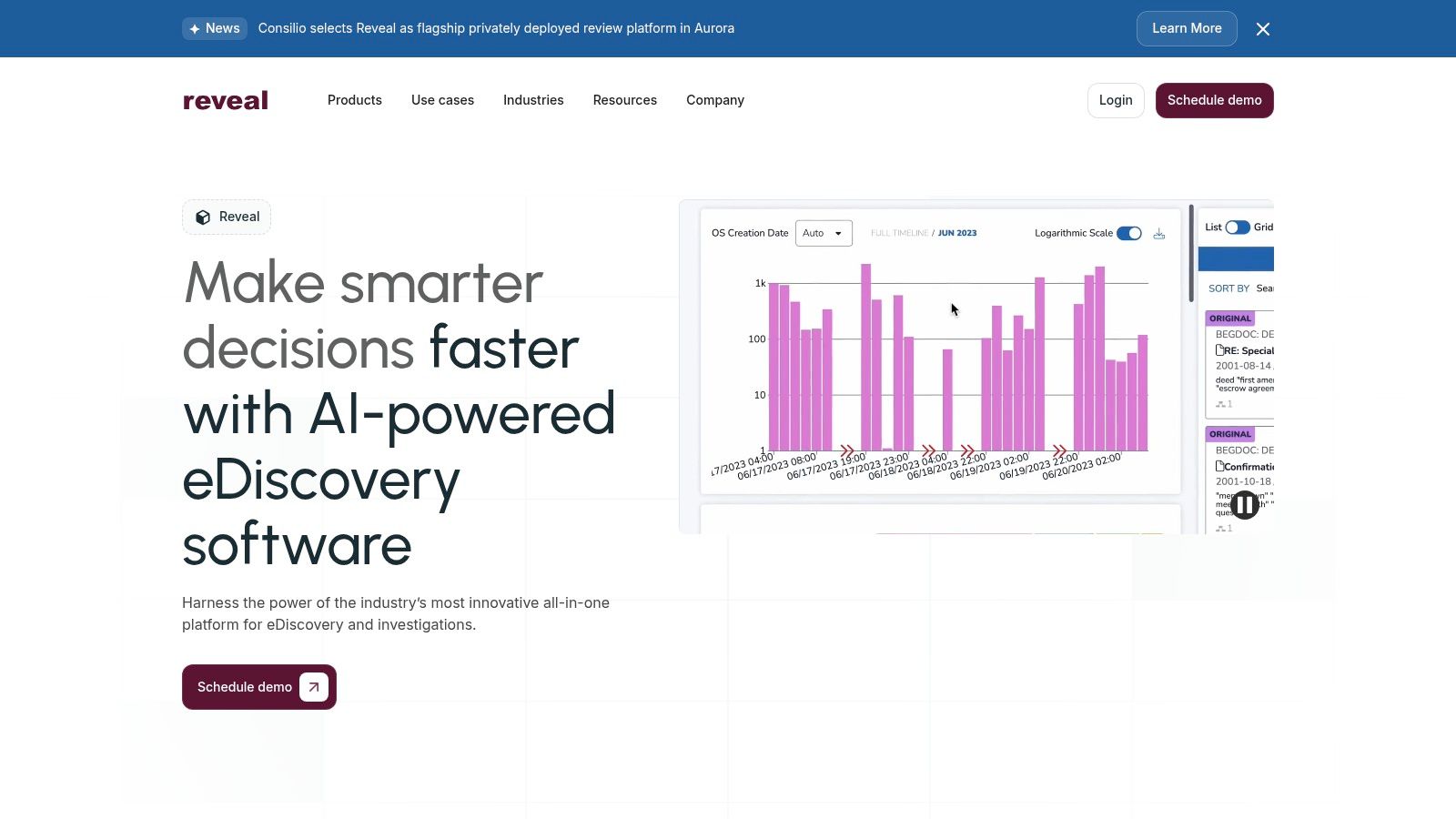
The platform’s strength lies in its multi-layered AI approach. Interactive analytics, such as cluster wheels and heatmaps, provide early case insights, while its continuously active machine learning (CMML) provides predictive scores on document relevance. The addition of a generative AI-powered “Ask” feature allows reviewers to pose natural language questions to the dataset, making it a highly advanced piece of legal document review software for uncovering critical evidence quickly.
Key Features & Use Cases
- Integrated AI and Analytics: Combines interactive data visualization (Brainspace) with supervised machine learning and generative AI for deep analysis.
- AI Model Library: Offers pre-built AI models for common review tasks like identifying privilege, PII, and toxic content.
- End-to-End Workflow: Manages the entire eDiscovery lifecycle, from legal holds and data processing to review and final production.
- Ideal For: Complex internal investigations, multilingual document review, and large-scale litigation where visual data analysis and predictive coding are essential.
Platform Analysis
Reveal’s key advantage is its powerful, multi-faceted AI engine that gives legal teams multiple ways to analyze and prioritize documents. Its flexible deployment options (SaaS, on-premise, hybrid) cater to diverse organizational needs. However, as an enterprise-focused platform, its pricing is available only by quote and may represent a significant investment best suited for law firms and corporations handling substantial data volumes. The complexity of its advanced analytical tools requires user training to maximize their effectiveness.
Website: https://www.revealdata.com/product/reveal
7. Casepoint
Casepoint is a unified, cloud-based data discovery platform designed to manage the entire eDiscovery lifecycle, from legal hold and data collection to review and production. It distinguishes itself with strong public-sector security credentials, including FedRAMP High and DoD IL authorizations, making it a trusted solution for government agencies and highly regulated industries. The platform is engineered for predictability in both performance and cost, offering an enterprise-grade solution for complex litigation and investigations.
A core component is CaseAssist, the platform's embedded AI engine, which provides active learning, analytics, and data visualization at no extra cost. This allows legal teams to quickly identify critical documents, uncover patterns, and streamline review workflows. By integrating advanced AI into its end-to-end framework, Casepoint delivers a powerful piece of legal document review software that aims to reduce both the time and expense associated with data discovery.
Key Features & Use Cases
- End-to-End Discovery: Manages the full process, including legal hold, data collection, processing, review, and production.
- Embedded AI (CaseAssist): Utilizes active learning and advanced analytics to prioritize documents and speed up review without additional licensing fees.
- Government-Grade Security: Holds FedRAMP High authorization, making it suitable for sensitive public-sector and government-related matters.
- Ideal For: Government agencies, highly regulated corporations, and law firms handling large-scale litigation or Freedom of Information Act (FOIA) requests.
Platform Analysis
Casepoint’s main advantage is its combination of an all-in-one platform with top-tier security and predictable, transparent pricing for enterprise clients. Customer case studies frequently document significant cost and time savings. However, its enterprise focus means it may be overly complex or expensive for very small cases or solo practitioners. Pricing is quote-based and requires a direct sales consultation, which is typical for solutions at this scale but less accessible for those seeking immediate, off-the-shelf pricing.
Website: https://www.casepoint.com/
8. Nuix Neo Discover (Nuix Discover)
Nuix Neo Discover is an AI-powered eDiscovery platform engineered for speed and scale, handling everything from data processing to review and production. Built on Nuix's renowned processing engine, it excels at ingesting and analyzing massive, diverse datasets quickly, making it a top choice for regulatory bodies, law enforcement, and corporations in highly regulated industries. It provides the flexibility of cloud, on-premise, or hybrid deployment to meet specific security and data sovereignty requirements.
The platform leverages powerful AI to accelerate understanding, using features like concept clustering and continuous active learning (predictive coding) to surface relevant information with minimal manual effort. With its multi-tenant capabilities, Nuix Discover allows law firms and service providers to manage multiple client matters securely within a single instance, solidifying its position as versatile legal document review software.
Key Features & Use Cases
- Powerful Data Processing: Natively processes over 1,000 file types and complex data sources at high speed.
- AI-Driven Analytics: Employs concept clustering, predictive coding, and advanced search to quickly identify key themes and documents.
- Flexible Deployment: Offers a choice between SaaS, on-premise, or hybrid hosting to meet specific compliance and security needs.
- Ideal For: Cross-border investigations, regulatory compliance matters, and eDiscovery service providers managing multiple tenants.
Platform Analysis
Nuix Discover's main advantage is its best-in-class processing engine combined with deployment flexibility, making it a trusted solution for complex, data-intensive cases. Its established presence with regulators and government agencies adds to its credibility. However, the platform's pricing is quote-based and tailored for enterprise-level needs, and its extensive feature set may introduce a steeper learning curve compared to more simplified tools designed for smaller, ad-hoc reviews.
Website: https://www.nuix.com/technology/nuix-discover
9. OpenText Core Insight (Axcelerate lineage)
OpenText Core Insight is an enterprise-focused, cloud eDiscovery platform built from the lineage of the powerful Axcelerate engine. It’s engineered for large corporations and law firms that need to standardize their review processes across multiple matters. The platform excels at managing vast, multilingual document sets by leveraging advanced technology-assisted review (TAR) to dramatically reduce review time and costs.
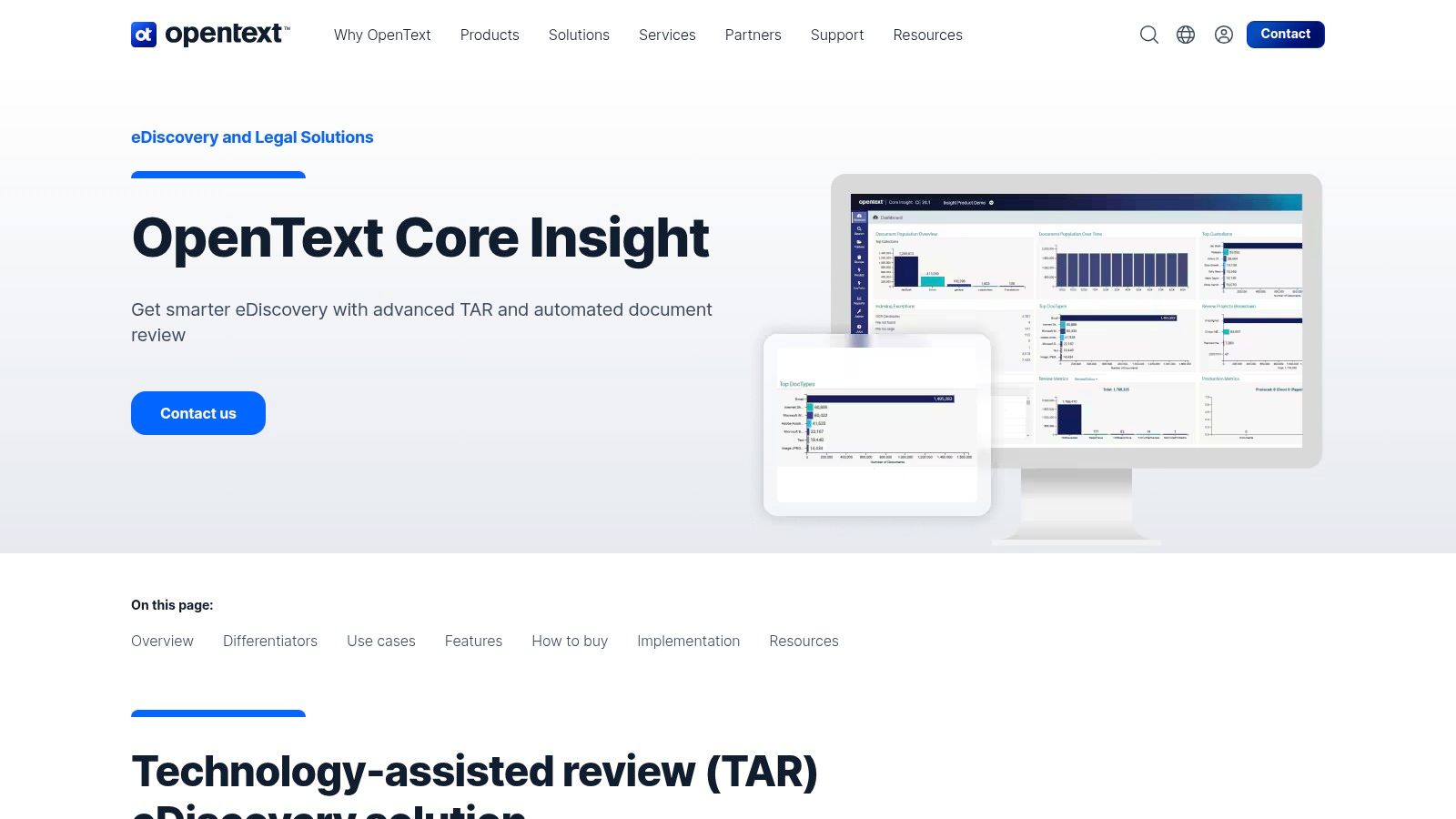
The platform’s strength lies in its use of continuous active learning (CAL), which intelligently prioritizes the most relevant documents for human review, learning from coding decisions in real-time. This dynamic approach makes it a highly efficient piece of legal document review software for culling non-responsive data. Combined with automated redaction and visual analytics, it provides a comprehensive toolkit for complex investigations.
Key Features & Use Cases
- Continuous Active Learning (CAL): Employs advanced TAR to continuously rank and surface relevant documents, streamlining review workflows.
- Automated Redaction: Automatically identifies and redacts sensitive data like PII and provides detailed reporting dashboards for quality control.
- Multilingual Support: Natively supports over 280 languages, making it ideal for cross-border litigation and international investigations.
- Ideal For: Corporations standardizing eDiscovery across their legal departments and firms managing high-volume, multi-matter projects with diverse language requirements.
Platform Analysis
OpenText Core Insight's primary advantage is its integration within the broader OpenText eDiscovery portfolio, creating a unified and repeatable workflow from collection to production. Its CAL technology is a significant differentiator for cost-effectively managing massive datasets. However, its enterprise-grade capabilities mean it can be overly complex and costly for smaller teams or single-matter cases. Pricing is available by quote, reflecting its positioning as a solution for organizations with substantial and ongoing eDiscovery needs.
Website: https://www.opentext.com/products/core-insight
10. Microsoft Purview eDiscovery (Premium)
Microsoft Purview eDiscovery (Premium) is an integrated solution for organizations heavily invested in the Microsoft 365 ecosystem. It provides an end-to-end workflow to manage legal holds, collections, and reviews directly within the Microsoft Purview compliance portal. This native approach minimizes data movement and associated risks by keeping content within the Microsoft 365 security and compliance boundary, making it ideal for in-house legal teams managing investigations related to Exchange Online, SharePoint, OneDrive, and Teams data.
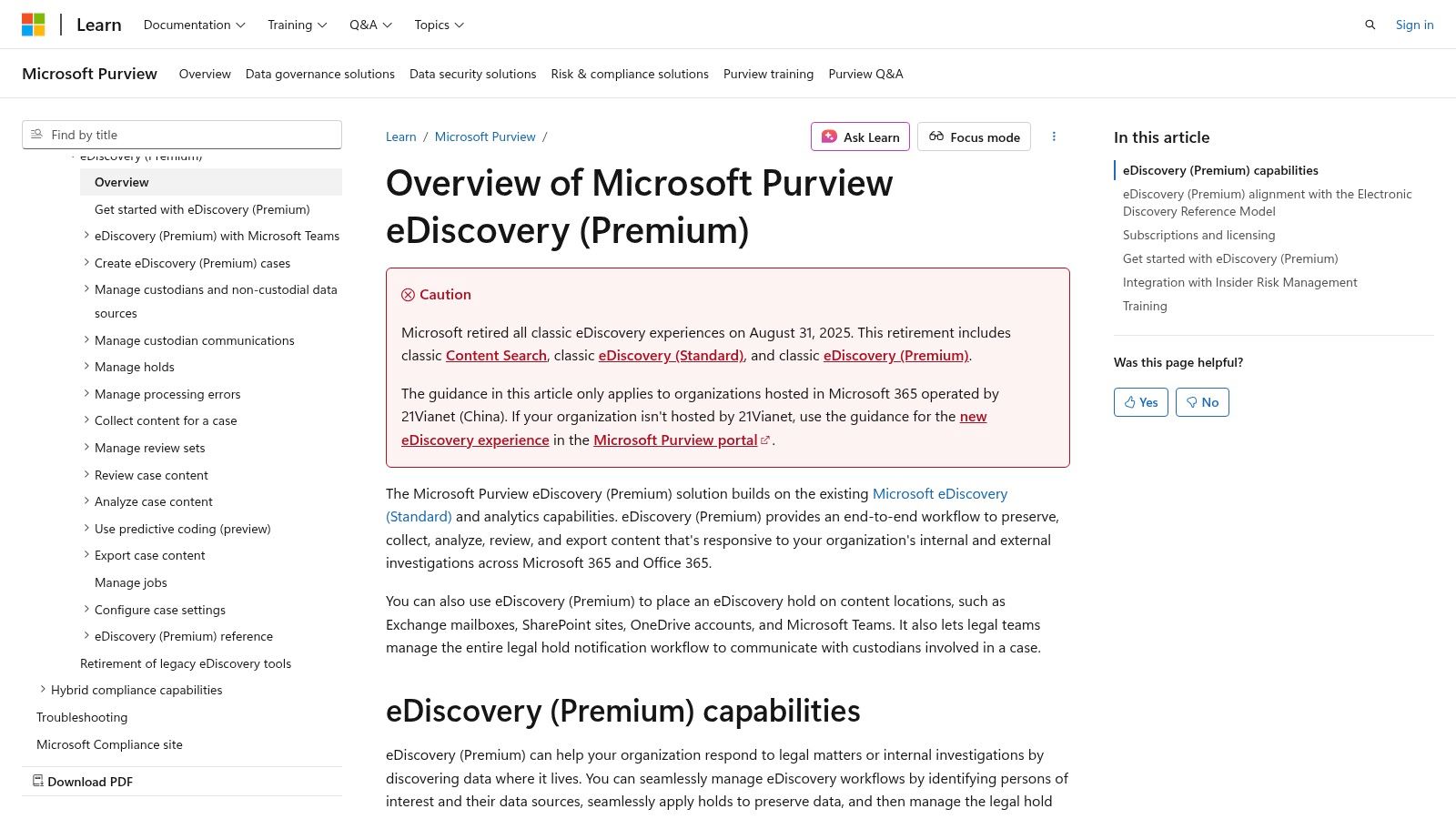
The platform supports the entire EDRM, from custodian identification and legal hold notifications to data processing, analytics, and review set management. Features like optical character recognition (OCR), conversation threading, and near-duplicate detection enhance the review process. As a comprehensive legal document review software, it streamlines case management for data that already resides within the Microsoft cloud.
Key Features & Use Cases
- Native M365 Integration: Manages the eDiscovery lifecycle for Microsoft 365 data without needing to export it to a third-party tool.
- Custodian Management: Provides a full workflow for identifying custodians, issuing legal hold notices, and tracking acknowledgments.
- Advanced Analytics: Leverages predictive coding and analytics to cull non-relevant documents and prioritize review efforts.
- Ideal For: Corporations with Microsoft 365 E5 licensing looking to handle internal investigations and litigation involving internal data sources efficiently.
Platform Analysis
Purview's main advantage is its seamless integration with Microsoft 365, which simplifies data preservation and collection while reducing costs associated with data transfer. However, its capabilities are most effective for Microsoft-native data; incorporating external data sources can be less straightforward. Access to Premium features is tied to specific licensing tiers (like E5) or requires an add-on, making cost-benefit analysis essential. Pricing for processing and storage is transparent, but overall cost depends heavily on your organization's Microsoft licensing agreement.
Website: https://learn.microsoft.com/purview/ediscovery-overview
11. Epiq Discovery
Epiq Discovery is an AI-enhanced eDiscovery and investigations platform that simplifies complex data challenges for legal teams. It integrates processing, analytics, and review into a single, intuitive interface, streamlining the entire discovery lifecycle. The platform is designed to be accessible and efficient, incorporating advanced AI to accelerate document review and uncover key insights without requiring deep technical expertise.
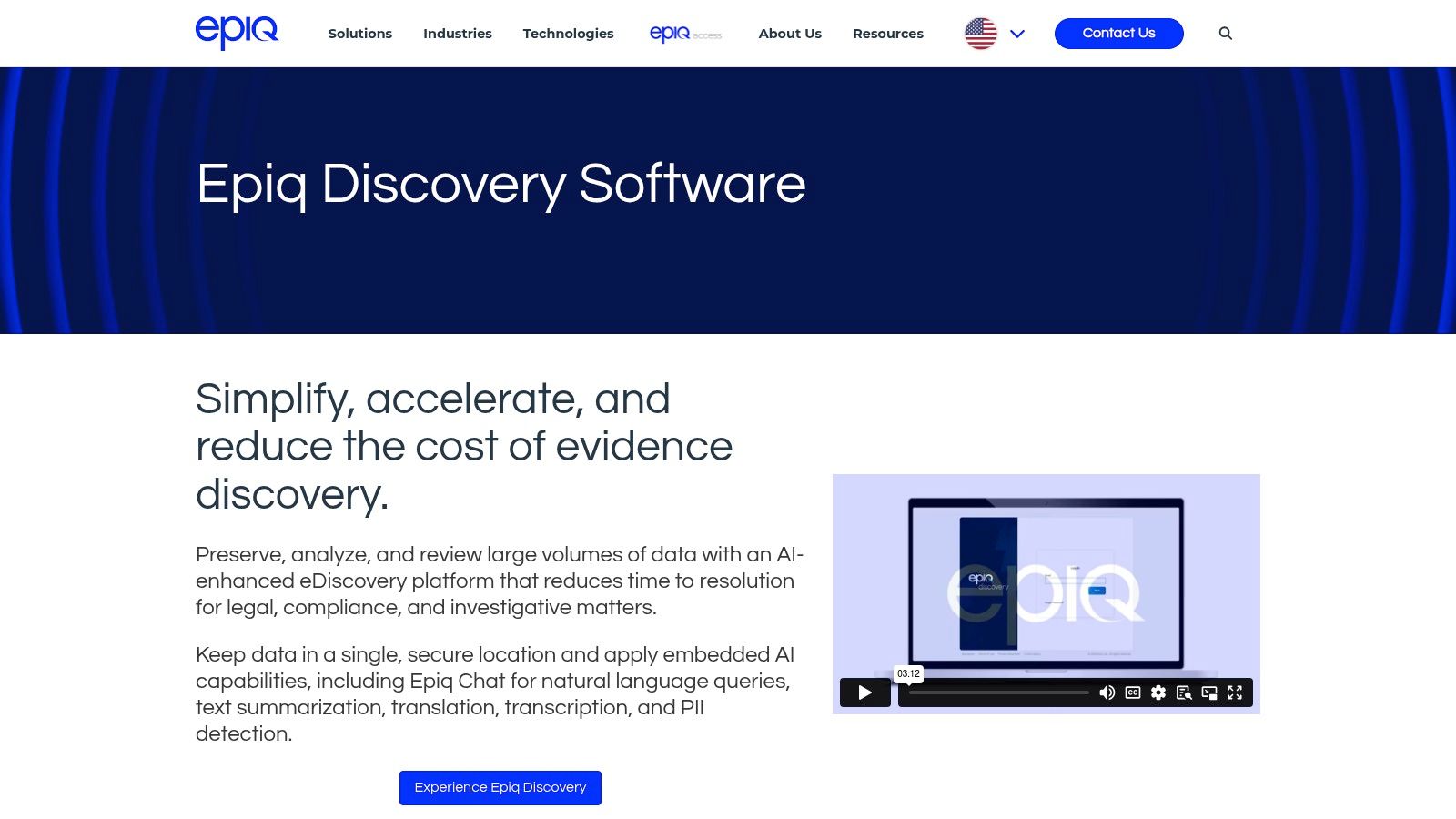
A key differentiator is its Epiq AI Discovery Assistant, a conversational AI tool that allows users to ask natural language questions about their data set and receive answers with grounded citations. This feature, combined with built-in PII detection, transcription, and translation, makes Epiq Discovery powerful legal document review software for modern investigations. The platform also offers an optional integration with Relativity for teams that need to combine its user-friendly front end with an established review ecosystem.
Key Features & Use Cases
- Conversational AI Q&A: The Epiq AI Discovery Assistant provides direct, cited answers to user queries, speeding up fact-finding.
- Integrated Platform: Combines data processing, analytics, and review in one place to reduce data transfer risks and complexity.
- Automated Sensitive Data Detection: Identifies and flags Personally Identifiable Information (PII), transcription needs, and foreign languages automatically.
- Ideal For: Corporate legal teams and law firms seeking a user-friendly, all-in-one eDiscovery solution with flexible deployment and pricing models.
Platform Analysis
Epiq Discovery’s strength lies in its usability and flexible procurement options, including availability on the AWS Marketplace. This allows for various pricing models, from flat-rate and subscription to per-GB transactional, catering to different budget needs. Its strong security posture, evidenced by SOC 2 Type II compliance, provides confidence for handling sensitive data. However, the lack of public list pricing means organizations must engage with sales or the marketplace to get a specific quote, and feature sets can differ depending on the procurement path chosen.
Website: https://www.epiqglobal.com/en-us/technologies/legal-solutions/epiq-discovery
12. G2 — eDiscovery Software Category
G2 is a leading peer-to-peer review site that offers a comprehensive category dedicated to eDiscovery and legal document review software. Instead of being a single platform, it functions as a research hub where legal professionals can compare dozens of tools based on verified user reviews, satisfaction scores, and detailed feature grids. It provides an independent, market-wide view that helps validate vendor claims and identify emerging leaders or niche solutions.
The platform is invaluable for the initial stages of software selection, allowing users to filter vendors by market segment, company size, and specific features. G2's Grid reports and Momentum Grids offer at-a-glance insights into market presence and user satisfaction, making it an essential resource for teams evaluating legal document review software options and looking for real-world feedback before committing to a demo or purchase.
Key Features & Use Cases
- Verified User Reviews: Access detailed feedback from real users, including summarized pros and cons for quick evaluation.
- Filterable Comparison Grids: Compare software side-by-side based on features, user satisfaction, and market presence.
- Quarterly Reports & Rankings: View current "Best Of" lists and momentum indicators to see which tools are trending.
- Ideal For: Law firms and corporate legal teams in the procurement phase, comparing vendors, and seeking unbiased user sentiment to build a shortlist.
Platform Analysis
G2’s primary strength is its aggregation of independent user sentiment, offering a crucial counterbalance to polished marketing materials from software vendors. It is an excellent starting point for discovering alternatives and understanding the practical strengths and weaknesses of different tools. However, review volume can be inconsistent across vendors, and the platform's summaries may not always capture the nuances of enterprise-level pricing or feature bundles. It is best used as a directional tool to be supplemented with direct vendor engagement.
Website: https://www.g2.com/categories/ediscovery
Top 12 Legal Document Review Tools — Feature Comparison
| Solution | Core features | UX & Security | Value / Unique selling point | Target audience | Pricing & limits |
|---|---|---|---|---|---|
| PDF Summarizer | AI chat with PDFs; instant summaries; multi-file chats; side-by-side view; clickable citations; on-the-fly translation | Fast browser-based experience; SOC2 Type II; encrypted in transit & at rest; no sign-up trial | Purpose-built for dense PDFs — fast, verifiable insights with source-jump citations; multilingual | Students, researchers, professionals, legal & compliance teams | Free trial (first messages); subscription thereafter; per-file limits: 50 MB / up to 500 pages |
| RelativityOne | End-to-end eDiscovery; generative AI review (aiR); reviewer queues & reporting; translation & A/V transcription | Enterprise-scale platform; mature ecosystem; strong governance & reporting | Scales to large matters; extensible App Hub & modern data support | Large law firms, corporations, service providers | Quote-based pricing by data volume & modules; training required |
| Everlaw | Advanced analytics; predictive coding / active learning; Storybuilder; cloud connectors & A/V transcription | Usability-focused UI; frequent updates; unlimited users in hosted model | Predictable hosted model + strong usability and continuous feature delivery | Mid-to-large litigation teams, in-house counsel | Per-GB hosted pricing; quote required; batch AI usage-based costs |
| DISCO Ediscovery | AI tag predictions & clustering; ECA → review; high-speed ingestion & exports | Emphasis on rapid productions and intuitive review; documented security controls | Very fast ingestion/exports; lawyer-built UX for rapid review workflows | Law firms and teams needing fast, production-oriented review | Demo/quote; enterprise positioning |
| Logikcull (by Reveal) | Pay-as-you-go & subscriptions; near-duplicate detection; AI-assist; Slack/A/V filtering | Self-serve, in-app onboarding & support; transparent UX | Simple, transparent pricing and self-serve workflow for routine matters | Small-to-mid legal teams, FOIA/records requests, in-house teams | Transparent per-GB or subscription pricing; costs scale with data |
| Reveal (Enterprise Platform) | Processing for 900+ file types; interactive analytics; AI model library; end-to-end workflow | Analyst-recognized; flexible deployments (SaaS/on‑prem/hybrid) | AI model library + Brainspace analytics for complex, multilingual reviews | Enterprises handling high-volume, multilingual matters | Quote/demo; enterprise pricing |
| Casepoint | CaseAssist active learning; legal hold & connectors; analytics; government-grade security | FedRAMP High & DoD IL certifications; secure for regulated workloads | Strong security pedigree for public sector; embedded active learning | Government agencies, regulated enterprises | Quote required; enterprise-focused pricing |
| Nuix Neo Discover | AI-driven analysis (clustering, CAL); predictive coding; bulk redaction; 1,000+ file types | Flexible hosting (SaaS/on‑prem/hybrid); strong processing performance | Powerful processing and deployment flexibility for regulated & cross-border matters | Regulated industries, law enforcement, large enterprises | Quote/enterprise sales |
| OpenText Core Insight | Continuous active learning (CAL) TAR; automated redaction; multilingual (280+); visual analytics | Enterprise portfolio integration for repeatable workflows | TAR-driven cost reduction at scale and deep multilingual support | Large enterprises standardizing multi-matter review | Contact sales; enterprise packaging |
| Microsoft Purview eDiscovery (Premium) | In-place holds, collections, predictive coding, threading, deep indexing within M365 | Operates inside M365 security boundary; role-based access & licensing controls | Native M365 eDiscovery reduces data movement; integrated governance | Organizations using Microsoft 365 natively | Requires E5 or Premium add-on; PAYG storage/processing (example cited ~$20/GB/mo) |
| Epiq Discovery | Conversational AI with grounded citations; analytics; translation, transcription, PII detection; Relativity option | Multiple procurement paths (AWS Marketplace or sales); SOC2 Type II / AWS security frameworks | Conversational Q&A + flexible procurement and pricing models | Firms seeking flexible pricing and deployment via marketplace | Multiple pricing models (flat-rate, per-GB, subscription); sales/marketplace pricing |
| G2 — eDiscovery Software Category | Vendor grids, filterable comparisons, verified user reviews, demo/trial links | Independent user sentiment & category-level filters; coverage varies by vendor | Quick way to validate claims and discover alternatives via user feedback | Buyers comparing eDiscovery vendors, procurement teams | Free access to reviews; quality of reviews varies |
Final Thoughts: Investing in Efficiency and Insight
The digital universe is expanding at an exponential rate, and with it, the volume of data that legal professionals must navigate. Gone are the days of manual, linear review of paper documents. Today, the strategic advantage in litigation, investigations, and compliance hinges on the ability to rapidly process, analyze, and extract critical insights from massive datasets. The legal document review software landscape we've explored is a testament to this technological shift, offering a spectrum of solutions tailored to diverse needs.
From comprehensive, end-to-end eDiscovery platforms like RelativityOne and Reveal to more accessible, user-friendly solutions like Logikcull, the core value proposition remains consistent: augmenting human expertise with powerful technology. These tools are no longer just about speeding up review; they are about uncovering the narrative hidden within the data. AI-powered features like technology-assisted review (TAR), conceptual clustering, and sentiment analysis are now table stakes, enabling legal teams to pinpoint crucial evidence and build stronger cases with unprecedented speed and accuracy.
Making the Right Choice for Your Practice
Choosing the right software is a critical strategic decision, not just an IT purchase. The ideal platform for a large corporation managing complex, multi-jurisdictional litigation (like Casepoint or Nuix Neo Discover) will differ vastly from the needs of a solo practitioner or a student who requires a fast, intelligent tool for initial case assessment.
Consider these key factors when making your selection:
- Scale and Complexity: Evaluate the typical size and complexity of your matters. Do you need a robust platform built for terabytes of data, or a more agile tool for smaller, focused reviews?
- User Experience (UX): A powerful tool is useless if your team finds it too complex to operate. Prioritize platforms with intuitive interfaces that reduce the training burden and empower users to leverage advanced features effectively.
- AI and Analytics: Don't just look for "AI" as a buzzword. Dig into the specifics. Does the software offer predictive coding, conceptual search, or AI-driven redaction? Does it provide the specific analytical capabilities that will give your team an edge?
- Integration and Workflow: How will the new software fit into your existing technology stack? Seamless integration with tools for case management, legal research, and data processing is crucial for maintaining an efficient workflow. For a broader understanding of the tools driving efficiency and insight across the legal landscape, you might find it useful to explore other essential legal platforms. You can find a curated list of 12 Essential Platforms for Lawyers that complement these review-focused systems.
- Total Cost of Ownership: Look beyond the initial license fee. Consider costs associated with data hosting, user training, support, and potential processing fees to understand the true long-term investment.
The Future is Insight-Driven
Ultimately, the best legal document review software is the one that best aligns with your specific goals, budget, and workflow. Whether you're a student dissecting academic papers, a researcher conducting a literature review, or a legal team facing a mountain of discovery, the right tool transforms a daunting task into a manageable, strategic process. Tools like PDF Summarizer highlight the trend toward instant, AI-driven insight, allowing for rapid summarization and multi-file analysis before a deep-dive review even begins.
Investing in this technology is an investment in your firm's or your practice's future. It empowers you to move beyond simply managing documents and toward actively extracting intelligence from them. This shift not only enhances efficiency but also elevates the quality of legal work, enabling you to deliver better outcomes for your clients and stay competitive in an increasingly data-driven world.
Ready to experience the power of instant, AI-driven document analysis? PDF Summarizer offers a fast and intuitive way to summarize complex legal documents, chat with multiple files at once, and get clickable citations without any signup required. Start your free trial today and see how quickly you can get to the core of any document at PDF Summarizer.
Recent articles

Learn how to merge pdf foxit reader PDFs quickly with step-by-step tips, free options, and 2026 updates.

Learn how to open pdf in google docs across devices, fix formatting, and edit PDFs with ease.

Discover the 12 best document collaboration tools for any team. Compare features, pricing, and use cases to find the perfect platform for your workflow.

Learn how to add citations in Google Docs using the built-in tool, add-ons like Zotero, and an advanced PDF workflow. Master APA, MLA, and Chicago styles.

Discover the best citation management software for your research. Compare Zotero, EndNote, Mendeley, and more to find the perfect tool for your workflow.

Explore critical thinking skills for students with practical strategies to analyze information, argue persuasively, and boost academic success.